Heinrich Meier, Nietzsche’s Legacy: Ecce Homo and The Antichrist, Two Books on Nature and Politics – University of Chicago Press, trans. Justin Gottschalk, March 2024

Heinrich Meier, Nietzsche’s Legacy: Ecce Homo and The Antichrist, Two Books on Nature and Politics – University of Chicago Press, trans. Justin Gottschalk, March 2024

[update 15 October 2024: the book is reviewed by Joshua Fox at NDPR]

A reappraisal of Ecce Homo and The Antichrist within Nietzsche’s oeuvre.

Nietzsche’s Legacy takes on the most challenging and misunderstood works in Nietzsche’s oeuvre to illuminate his view of what a philosopher is and what constitutes a philosophic life. Interpreting Ecce Homo and The Antichrist as twin books meant to replace the abandoned Will to Power project, Heinrich Meier recovers them from the stigma of Nietzsche’s late mental collapse, showing that these works are, above all, a lucid self-assessment. The carefully written pair contains both the highest affirmation—the Yes of the “revaluation of all values”—and the most resolute negation—the No to Christianity. How the Yes and the No go together, how the relation between nature and politics is to be determined, how Nietzsche’s intention is governing the political-philosophical double-face: this is the subject of Nietzsche’s Legacy, which opens up a new understanding of Nietzsche’s philosophy as a whole.
Posted in Uncategorized | Leave a comment

Laleh Khalili, The Corporeal Life of Seafaring – Discourse 013, November 2023

Laleh Khalili, The Corporeal Life of Seafaring – Discourse 013, November 2023

The body of the seafarer is a fulcrum upon which global systems of power, longstanding maritime traditions, and gendered and racialised pressures all rest. In this vital new essay, scholar Laleh Khalili draws on her ongoing research and experiences of travelling on cargo ships to explore the embodied life of these labourers. She investigates an experience riddled with adversities – loneliness, loss, and violence, stolen wages and exploitative shipowners – as well as ephemeral moments of joy and solidarity. In the unique arena of the ship, Khalili traces the many forms of corporeality involved in work at sea and the ways the body is engaged by the institutions that engulf seafarers’ lives and work.

Illustrated throughout with the author’s own photographs, this book takes in both scholarly and literary accounts to describe with care and imagination the material and physical realities of contemporary commerce at sea. Drawing on the insights of feminists and scholars of racial capitalism, it centres the lives of those so often forgotten or dismissed in enterprises of capital accumulation and the raced and gendered hierarchies that shape them.

Posted in Uncategorized | Leave a comment

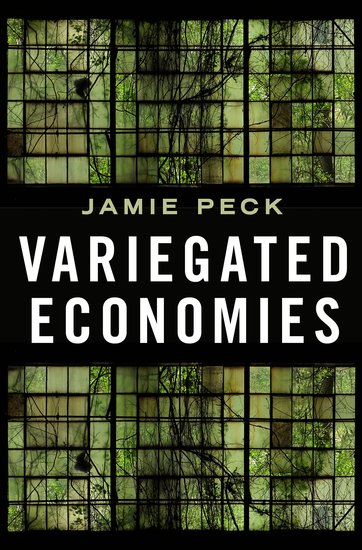
Jamie Peck, Variegated Economies – Oxford University Press, July 2023

Jamie Peck, Variegated Economies – Oxford University Press, July 2023

The culmination of more than two decades of work on the spatiality of economic forms, worlds, and lives, Variegated Economies tackles the question of how to approach, conceptualize, and analyze economies as geographically differentiated phenomena. Staged from the field of economic geography, the book seeks to build bridges to complementary developments in critical political economy and heterodox economic studies by way of a substantive theoretical and methodological program. Jamie Peck advances a series of arguments concerning the inherent-and highly consequential-spatiality of economic forms, worlds, and lives, engaging a range of issues from the diversity of capitalism(s) to the dynamics of late-stage neoliberalization, and from the problematic uneven geographical development to the challenges-cum-opportunities of conjunctural methodologies.

Posted in Uncategorized | Leave a comment

Andrew Feenberg, The Ruthless Critique of Everything Existing: Nature and Revolution in Marcuse’s Philosophy of Praxis – Verso, February 2023

Andrew Feenberg, The Ruthless Critique of Everything Existing: Nature and Revolution in Marcuse’s Philosophy of Praxis – Verso, February 2023

For several years after 1968, Herbert Marcuse was one of the most famous philosophers in the world. He became the face of Frankfurt School Critical Theory for a generation in turmoil. His fame rested on two remarkable books, Eros and Civilization and One-Dimensional Man. These two books represent the utopian hopes and dystopian fears of the time. 

In the 1960s and 70s, young people seeking a theoretical basis for their revolution found it in his work. Marcuse not only supported their struggles against imperialism and race and gender discrimination, he foresaw the far-reaching implications of the destruction of the natural environment. Marcuse’s Marxism was influenced by Husserl and Heidegger, Hegel and Freud. These eclectic sources grounded an original critique of advanced capitalism focused on the social construction of subjectivity and technology. Marcuse contrasted the “one-dimensionality” of conformist experience with the “new sensibility” of the New Left. The movement challenged a society that “delivered the goods” but devastated the planet with its destructive science and technology. A socialist revolution would fail if it did not transform these instruments into means of liberation, both of nature and human beings. This aspiration is alive today in the radical struggle over climate change. Marcuse offers theoretical resources for understanding that struggle.

Thanks to Johannes Schmitthenner for pointing to this book with a similar title to Robert Tally’s book shared in the previous post.

Posted in Uncategorized | Leave a comment

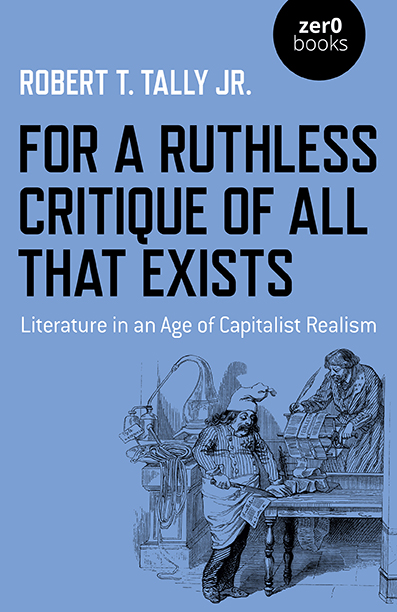
Robert T. Tally Jr., For a Ruthless Critique of All That Exists: Literature in an Age of Capitalist Realism – Zer0 books, June 2022 and New Books podcast

Robert T. Tally Jr., For a Ruthless Critique of All That Exists: Literature in an Age of Capitalist Realism – Zer0 books, June 2022

For a Ruthless Critique of All that Exists takes as its point of departure two profound and interrelated phenomena. The first is the pervasive sense of what Mark Fisher had called “capitalist realism”, in which (to cite the famous expression variously attributed to Fredric Jameson and Slavoj Žižek) it is easier to imagine the end of the world than then end of capitalism. 

As Jameson in particular has noted, “perhaps this is due to some weakness in our imaginations,” and the attenuation of the imaginative function in cultural criticism has far-reaching implications for the organization and reformation of institutions more generally. This manifests itself as a waning of speculative or theoretical energy, which in turn leads to a general capitulation to the tyranny of “what is,” the actually existing state of affairs, and the preemptive disavowal of alternative possibilities. 

Connected to this is the second phenomenon: the prevalent tendency in literary and cultural criticism over the past 30 or more years to eschew critical theory and even critique itself, while championing approaches to cultural study that emphasize surface reading, thin description, ordinary language philosophy, object-oriented ontology, and post-critique. Together these forms of anticritical and antitheoretical criticism have constituted a tendency that has in its various incarnations come to dominate the humanities and other areas of higher education in recent years. The latter has served to reinforce the former, and the result has been to align literary and cultural criticism with the broad-based forces of neoliberalism whose influence has so deleteriously transformed not only higher education but the whole of society at large. 

Robert T. Tally Jr. argues that, in order to counter these trends and empower the imagination, the time is ripe for “a ruthless critique of all that exists,” to borrow a phrase from the young Marx. This book is intended as a provocation, at once a polemic and a call to action for cultural critics.

There is a New Books discussion with Morteza Hajizadeh here.

Posted in Uncategorized | 2 Comments

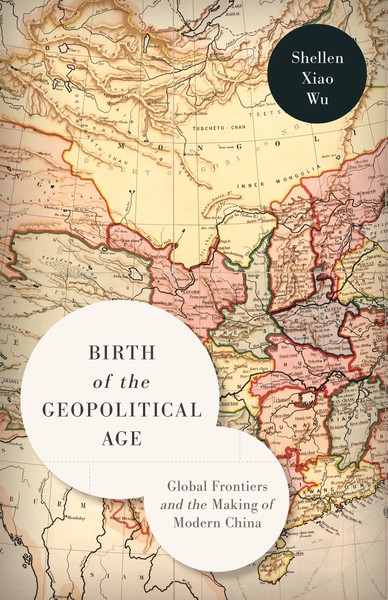
Shellen Xiao Wu, Birth of the Geopolitical Age: Global Frontiers and the Making of Modern China – Stanford University Press, September 2023

Shellen Xiao Wu, Birth of the Geopolitical Age: Global Frontiers and the Making of Modern China – Stanford University Press, September 2023

From the 1850s until the mid-twentieth century, a period marked by global conflicts and anxiety about dwindling resources and closing opportunities after decades of expansion, the frontier became a mirror for historically and geographically specific hopes and fears. From Asia to Europe and the Americas, countries around the world engaged with new interpretations of empire and the deployment of science and technology to aid frontier development in extreme environments. Through a century of political turmoil and war, China nevertheless is the only nation to successfully navigate the twentieth century with its imperial territorial expanse largely intact. In Birth of the Geopolitical Age, Shellen Xiao Wu demonstrates how global examples of frontier settlements refracted through China’s unique history and informed the making of the modern Chinese state. Wu weaves a narrative that moves through time and space, the lives of individuals, and empires’ rise and fall and rebirth, to show how the subsequent reshaping of Chinese geopolitical ambitions in the twentieth century, and the global transformation of frontiers into colonial laboratories, continues to reorder global power dynamics in East Asia and the wider world to this day.

Posted in Uncategorized | Leave a comment

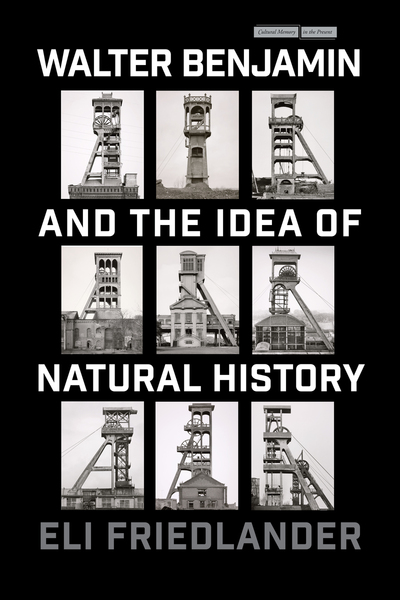
Eli Friedlander, Walter Benjamin and the Idea of Natural History – Stanford University Press, January 2024

Eli Friedlander, Walter Benjamin and the Idea of Natural History – Stanford University Press, January 2024

In this incisive new work, Eli Friedlander demonstrates that Walter Benjamin’s entire corpus, from early to late, comprises a rigorous and sustained philosophical questioning of how human beings belong to nature.

Across seemingly heterogeneous writings, Friedlander argues, Benjamin consistently explores what the natural in the human comes to, that is, how nature is transformed, actualized, redeemed, and overcome in human existence. The book progresses gradually from Benjamin’s philosophically fundamental writings on language and nature to his Goethean empiricism, from the presentation of ideas to the primal history of the Paris arcades. Friedlander’s careful analysis brings out how the idea of natural history inflects Benjamin’s conception of the work of art and its critique, his diagnosis of the mythical violence of the legal order, his account of the body and of action, of material culture and technology, as well as his unique vision of historical materialism.

Featuring revelatory new readings of Benjamin’s major works that differ, sometimes dramatically, from prevailing interpretations, this book reveals the internal coherence and philosophical force of Benjamin’s thought.

Posted in Uncategorized | Leave a comment

Simon Dalby, Pyromania: Fire and Geopolitics in a Climate-Disrupted World – Agenda, November 2023

Simon Dalby, Pyromania: Fire and Geopolitics in a Climate-Disrupted World – Agenda, November 2023

We are the only species that uses fire. It has determined how we have made our home on this planet and it has propelled us to the role of the dominant species in the biosphere. But at the heart of contemporary climate change is the process of combustion. Simon Dalby explores what a life without burning things might look like, and how we might get there.

Fires make the carbon dioxide in the atmosphere that is heating the planet, melting the ice sheets, changing weather patterns and making wildfires worse. Our civilization is burning things, especially fossil fuels, at prodigious rates. So much so that we are now heading towards a future “Hothouse Earth” with a climate that is very different from what humans have known so far.

By focusing on fire and our partial control over one key physical force in the earth system, that of combustion, Simon Dalby is able to ask important and interesting questions about us as humans, including different ways of thinking about how we live, and how we might do so differently in the future. Simply put, there is now far too much “firepower” loose in the world and we need to think much harder about how to live together in ways that don’t require burning stuff to do so.

Posted in Uncategorized | Leave a comment

Kenneth W. Harl, Empires of the Steppes: The Nomadic Tribes who Shaped Civilisation – Bloomsbury, March 2023

Kenneth W. Harl, Empires of the Steppes: The Nomadic Tribes who Shaped Civilisation – Bloomsbury, March 2023

The barbarian nomads of the Eurasian steppes played a decisive role in world history, but their achievements have gone largely unnoticed. These tribes produced some of the world’s greatest conquerors: Attila the Hun, Genghis Khan and Tamerlane, among others. And their deeds still resonate today.

Indeed, these nomads built long-lasting empires, facilitated the first global trade of the Silk Road and disseminated religions, technology, knowledge and goods of every description that enriched and changed the lives of so many across Europe, China and the Middle East. From a single region emerged a great many peoples – the Huns, the Mongols, the Magyars, the Turks, the Xiongnu, the Scythians, the Goths – all of whom went on to profoundly and irrevocably shape the modern world.

In this enthralling new history, Professor Kenneth W. Harl draws on a lifetime of scholarship to vividly recreate the lives of these peoples from their beginnings to the early modern age. Their brutal struggle to survive on the steppes bred a resilient, pragmatic people ever-ready to learn from their neighbours. In warfare, they dominated the battlefield for over fifteen hundred years. Under charismatic rulers, they could topple empires and win their own.

There is a review in The Guardian here.

Posted in Uncategorized | Leave a comment

David Myer Temin, Remapping Sovereignty: Decolonization and Self-Determination in North American Indigenous Political Thought – University of Chicago Press, August 2023

David Myer Temin, Remapping Sovereignty: Decolonization and Self-Determination in North American Indigenous Political Thought – University of Chicago Press, August 2023

An examination of anticolonial thought and practice across key Indigenous thinkers.

Accounts of decolonization routinely neglect Indigenous societies, yet Native communities have made unique contributions to anticolonial thought and activism. Remapping Sovereignty examines how twentieth-century Indigenous activists in North America debated questions of decolonization and self-determination, developing distinctive conceptual approaches that both resonate with and reformulate key strands in other civil rights and global decolonization movements. In contrast to decolonization projects that envisioned liberation through state sovereignty, Indigenous theorists emphasized the self-determination of peoples against sovereign state supremacy and articulated a visionary politics of decolonization as earthmaking. Temin traces the interplay between anticolonial thought and practice across key thinkers, interweaving history and textual analysis. He shows how these insights broaden the political and intellectual horizons open to us today.

Posted in Uncategorized | Leave a comment