Judith Revel, Orazio Irrera, Inédit de Michel Foucault : le discours philosophique (2023)

Inédit de Michel Foucault : le discours philosophique – discussion on Radio France with Orazio Irrera and Judith Revel

Clare O'Farrell's avatarFoucault News

Inédit de Michel Foucault : le discours philosophique, Radio France, podcast Samedi 13 mai 2023

Dans un texte inédit, le penseur français fait l’histoire du discours philosophique et l’aborde avec un regard critique.

Avec
Judith Revel Philosophe, traductrice, professeure des universités au département de philosophie de l’université Paris Nanterre, spécialiste de Michel Foucault et directrice du laboratoire Sophiapol

Orazio Irrera éditeur, maître de conférence à Paris 8

Comment la philosophie peut-elle nous aider à appréhender l’actualité ?
Dans un texte inédit rédigé en 1966, Michel Foucault se demande quel est le rôle de la philosophie. Il questionne le développement de la pensée philosophique, s’attarde sur Descartes, Kant et Nietzsche. Pas encore penseur du pouvoir, il esquisse déjà un regard critique et poursuit son travail de penseur de la pensée.
View original post

Posted in Uncategorized | Leave a comment

Gabriel Rockhill, “The Myth of 1968 Thought and the French Intelligentsia: Historical Commodity Fetishism and Ideological Rollback”, Monthly Review, June 2023 (open access)

Gabriel Rockhill, “The Myth of 1968 Thought and the French Intelligentsia: Historical Commodity Fetishism and Ideological Rollback“, Monthly Review, June 2023 (open access)

Like any major social and political movement, the events referred to as those of May 1968 have multiple different aspects and internal contradictions. They cannot be easily summed up in terms of a single significance, and they were themselves the site of class struggles, with various groups vying for power, pushing and pulling in different directions. This is as true of the past as it is of the present, in the sense that the battle over historical meaning continues long after the event itself has passed.

A dialectical approach to ’68 begins with the recognition of the infinite complexity of the events, while also concretely abstracting from them in order to establish a heuristic framework that makes sense of some of their fundamental traits. This frame can be situated at a greater or lesser level of abstraction, allowing for a multiscalar analysis, meaning one that can either cast the event at its most macro level, or hone in on microdevelopments. For such an analysis to function, of course, it requires a coherent relationship between the different scales, so that they can be nested within one another.

Posted in Uncategorized | Leave a comment

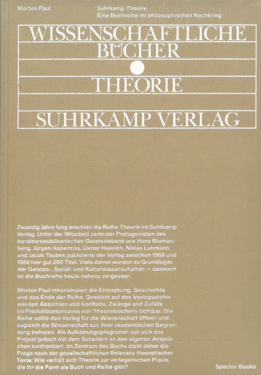
Morten Paul, Suhrkamp Theorie: Eine Buchreihe im philosophischen Nachkrieg – Spector, February 2023

Morten Paul, Suhrkamp Theorie: Eine Buchreihe im philosophischen Nachkrieg – Spector, February 2023

Suhrkamp’s “Theory” series appeared over a period of 20 years, from 1966 to 1986. The publishing house included over 200 titles in the series, including basic texts on the humanities and cultural studies: Kuhn’s ‘The Structure of Scientific Revolutions’, Habermas’s ‘Knowledge and Human Interests’, Althusser’s ‘For Marx’, Mauss’s ‘The Gift’, Bourdieu’s ‘Zur Soziologie der symbolischen Formen’, Searle’s ‘Speech Acts’, Foucault’s ‘The Archaeology of Knowledge’, Knorr-Cetina’s ‘The Manufacture of Knowledge’. With the help of archival records, interviews, and readings, Morten Paul reconstructs the creation of the series against the backdrop of questions relating to the social relevance of theoretical texts. How does theory behave in relation to practice, which supplies it with form as a text, book, or series? How does this form determine the social impact of theory? And why was this series ultimately doomed to failure, given the success of edition suhrkamp and suhrkamp taschenbuch wissenschaft? The book is part of the series Applied Publishing Studies.

Morten Paul, (b. in 1987), wrote his thesis on the “Theory” series in the Suhrkamp Research Group at the German Literature Archive Marbach, obtaining his doctorate at the University of Konstanz.

Posted in Uncategorized | 5 Comments

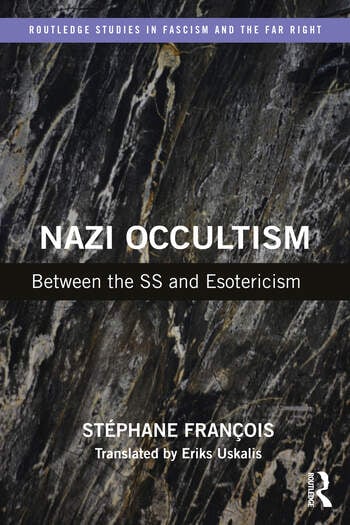
Stéphane François, Nazi Occultism: Between the SS and Esotericism, Routledge, March 2023

Stéphane François, Nazi Occultism: Between the SS and Esotericism, trans Eriks Uskalis, Routledge, March 2023

Nazi Occultism provides a serious scholarly study of a topic that is often marred by sensationalism and misinformation.

The Morning of the Magicians by Pauwels and Bergier (1960) gave rise to the idea that a secret society with wide powers, the “Thule society”, was the hidden and ignored centre of Nazism. The influence of this very real small group is, however, only a fantasy, a myth. The author, a historian specializing in neo-Nazism, looks back on this speculative construction, its origins, its ideological tinkering and the practices which have succeeded in forming a sort of radical and sulphurous counterculture which has created a fascination with esotericism and Nazism and the SS. To better understand it, he also paints a portrait of some of the authors who contributed to this extremist subculture, such as the Italian esotericist Julius Evola, the Argentine anthropologist Jacques-Marie de Mahieu, Chilean neo-Nazi Miguel Serrano, and the writer Jean-Paul Bourre.

This book will appeal to scholars, researchers and activists as well as general readers with an interest in the history of Nazism and the occult.

Posted in Uncategorized | Leave a comment

Biopolitics of the More-Than-Human, Joseph Pugliese online book talk, 23 June 2023

Biopolitics of the More-Than-Human, Joseph Pugliese online book talk, 23 June 2023

registration free but required via Eventbrite

The Emergent Nonfiction Lab at the University of Warwick welcomes Jospeh Pugliese for this talk and discussion on his book Biopolitics of the More-Than-Human: Forensic Ecologies of Violence.

“In Biopolitics of the More-Than-Human Joseph Pugliese examines the concept of the biopolitical through a nonanthropocentric lens, arguing that more-than-human entities—from soil and orchards to animals and water—are actors and agents in their own right with legitimate claims to justice. Examining occupied Palestine, Guantánamo, and sites of US drone strikes in Afghanistan, Pakistan, Somalia, and Yemen, Pugliese challenges notions of human exceptionalism by arguing that more-than-human victims of war and colonialism are entangled with and subject to the same violent biopolitical regimes as humans. He also draws on Indigenous epistemologies that invest more-than-human entities with judicial standing to argue for an ethico-legal framework that will enable the realization of ecological justice. Bringing the more-than-human world into the purview of justice, Pugliese makes visible the ecological effects of human war that would otherwise remain outside the domains of biopolitics and law” (Duke University Press).

“A mesmerizing exploration of the more-than-human dimensions of later modern war that is never less than deeply human. Linguistically inventive, analytically sobering—you keep wondering why it has taken us so long to see like this—Joseph Pugliese’s vision of forensic ecology initiates an arrestingly novel critique of military violence. At once profoundly political and deeply ethical, this is a magnificently vital achievement” (Derek Gregory, Peter Wall Distinguished Professor and Professor of Geography, University of British Columbia).

Posted in Uncategorized | Leave a comment

Keith Tribe, Constructing Economic Science: The Invention of a Discipline 1850-1950 – Oxford University Press, April 2022; and New Books discussion

Keith Tribe, Constructing Economic Science: The Invention of a Discipline 1850-1950 – Oxford University Press, April 2022

An accessible account of the role of the modern university in the creation of economics 

During the late nineteenth century concerns about international commercial rivalry were often expressed in terms of national provision for training and education, and the role of universities in such provision. It was in this context that the modern university discipline of economics emerged. The first undergraduate economics program was inaugurated in Cambridge in 1903; but this was merely a starting point. 

Constructing Economic Science charts the path through commercial education to the discipline of economics and the creation of an economics curriculum that could then be replicated around the world. Rather than describing this transition epistemologically, as a process of theoretical creation, Keith Tribe shows how the new “science” of economics was primarily an institutional creation of the modern university. He demonstrates how finance, student numbers, curricula, teaching, new media, the demands of employment, and more broadly, the international perception that industrializing economies required a technically-skilled workforce, all played their part in shaping economics as we know it today. This study explains the conditions originally shaping the science of economics, providing in turn a foundation for an understanding of the way in which this new language transformed public policy.

There is a New Books discussion with Morteza Hajizadeh here.

Posted in Uncategorized | Leave a comment

A Cornelius Castoriadis Forum – Journal of the History of Ideas blog

A Cornelius Castoriadis Forum – Journal of the History of Ideas blog

For the Greek-French philosopher Cornelius Castoriadis (1922-1997), the creative power of imagination was best described in volcanic terms. Much more than a mental faculty that would store and recombine available images, he argued that the “radical imagination” preceded all distinctions between “real” and “fictitious:” to imagine something meant not only to repeat existing forms but “bursting, emerging, creating, […] explosion, split, rupture – the rupture of what is as such.” Against philosophers’ prejudices which have often reduced the imagination to the model of a (more or less true or false) representation of reality, Castoriadis set out to defend it as an ontological well-spring: a volcano of creative form-making, both for the individual psyche and society as a whole…

Posted in Uncategorized | Leave a comment

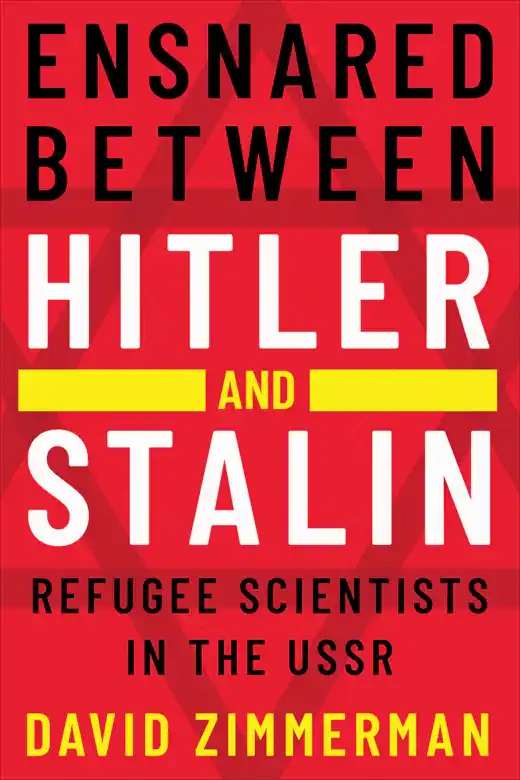
David Zimmerman, Ensnared between Hitler and Stalin: Refugee Scientists in the USSR – University of Toronto Press, January 2023

David Zimmerman, Ensnared between Hitler and Stalin: Refugee Scientists in the USSR – University of Toronto Press, January 2023

In the 1930s, hundreds of scientists and scholars fled Hitler’s Germany. Many found safety, but some made the disastrous decision to seek refuge in Stalin’s Soviet Union. The vast majority of these refugee scholars were arrested, murdered, or forced to flee the Soviet Union during the Great Terror. Many of the survivors then found themselves embroiled in the Holocaust. Ensnared between Hitler and Stalin explores the forced migration of these displaced academics from Nazi Germany to the Soviet Union.

The book follows the lives of thirty-six scholars through some of the most tumultuous events of the twentieth century. It reveals that not only did they endure the chaos that engulfed central Europe in the decades before Hitler came to power, but they were also caught up in two of the greatest mass murders in history. David Zimmerman examines how those fleeing Hitler in their quests for safe harbour faced hardship and grave danger, including arrest, torture, and execution by the Soviet state. Drawing on German, Russian, and English sources, Ensnared between Hitler and Stalin illustrates the complex paths taken by refugee scholars in flight.

Posted in Uncategorized | Leave a comment

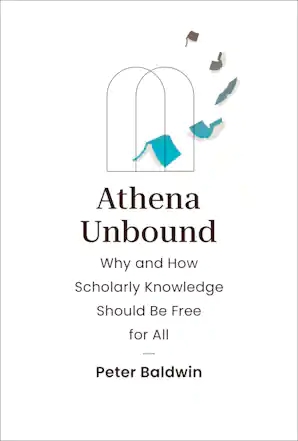
Peter Baldwin, Athena Unbound: Why and How Scholarly Knowledge Should Be Free for All – MIT Press, 2023 (and New Books Discussion)

Peter Baldwin, Athena Unbound: Why and How Scholarly Knowledge Should Be Free for All – MIT Press, 2023

The book is available to buy in print and open access

A clear-eyed examination of the open access movement: past history, current conflicts, and future possibilities.

Open access (OA) could one day put the sum of human knowledge at our fingertips. But the goal of allowing everyone to read everything faces fierce resistance. In Athena Unbound, Peter Baldwin offers an up-to-date look at the ideals and history behind OA, and unpacks the controversies that arise when the dream of limitless information slams into entrenched interests in favor of the status quo. In addition to providing a clear analysis of the debates, Baldwin focuses on thorny issues such as copyright and ways to pay for “free” knowledge. He also provides a roadmap that would make OA economically viable and, as a result, advance one of humanity’s age-old ambitions.

Baldwin addresses the arguments in terms of disseminating scientific research, the history of intellectual property and copyright, and the development of the university and research establishment. As he notes, the hard sciences have already created a funding model that increasingly provides open access, but at the cost of crowding out the humanities. Baldwin proposes a new system that would shift costs from consumers to producers and free scholarly knowledge from the paywalls and institutional barriers that keep it from much of the world.

Rich in detail and free of jargon, Athena Unbound is an essential primer on the state of the global open access movement.

There is a New Books Discussion here. Thanks to dmf for the link.

Posted in Uncategorized | Leave a comment

Leibniz’s Discourse on Metaphysics: A New Translation and Commentary, ed. Christopher Johns – Edinburgh University Press, April 2023

Leibniz’s Discourse on Metaphysics: A New Translation and Commentary, ed. Christopher Johns – Edinburgh University Press, April 2023

The first English translation based on the Akademie Edition, its ‘variant apparatus’ and Leibniz’s handwritten manuscript – making this the closest English edition to Leibniz’s original

  • Includes explanatory translator’s notes and an extensive commentary on each of the Discourse’s 37 sections 
  • Provides historical and biographical context for the work and the author himself
  • Designed for teachers and students of Early Modern philosophy
  • Includes a bibliography of primary texts and recommended secondary reading

This new translation is based on the Akademie Edition and its variant apparatus, which tracks all the changes Leibniz made to his text. Christopher Johns translates these changes (placing them in footnotes) and shows how they relate to the main text, adding interesting – and sometimes essential – detail to your understanding of the main text. Johns also compares the Akademie to Leibniz’s handwritten manuscript, correcting some errors. Additionally, a chronicle of Leibniz’s activities during the years 1685 and 1686 is included, as are several letters previously unpublished in English that shed light on the intellectual context of the time. The result is a truly scholarly, complete and reliable translation and commentary.

Posted in Uncategorized | Leave a comment