Hanne Jacobs (ed). The Husserlian Mind – Routledge, 2021, paperback May 2023

Hanne Jacobs (ed). The Husserlian Mind – Routledge, 2021, paperback May 2023

Edmund Husserl (1859-1938) is widely regarded as the principal founder of phenomenology, one of the most important movements in twentieth-century philosophy. His work inspired subsequent figures such as Martin Heidegger, his most renowned pupil, as well as Jean-Paul Sartre and Maurice Merleau-Ponty, all of whom engaged with and developed his insights in significant ways. His work on fundamental problems such as intentionality, consciousness, and subjectivity continues to animate philosophical research and argument. 

The Husserlian Mind is an outstanding reference source to the full range of Husserl’s philosophy. Forty chapters by a team of international contributors are divided into seven clear parts covering the following areas:

  • major works
  • phenomenological method
  • phenomenology of consciousness
  • epistemology
  • ethics and social and political philosophy
  • philosophy of science
  • metaphysics.

Contained in these sections are chapters on many of the key aspects of Husserl’s thought, including intentionality, transcendental philosophy, reduction, perception, time, self and subjectivity, personhood, logic, psychology, ontology, and idealism. 

Offering an unparalleled guide to the enormous range of his thought, The Husserlian Mind is essential reading for students and scholars of Husserl, phenomenology, and the history of twentieth-century philosophy. It will also be of interest to those in related fields in the humanities, social sciences, and psychology and the cognitive sciences.

Posted in Edmund Husserl | Leave a comment

Saussure’s notes on German legends – cross-references between the different editions of these manuscripts

I’ve previously discussed reading Ferdinand de Saussure’s work, mainly around the variant texts of his posthumously published Course on General Linguistics, and some of his early work on Indo-European languages.

Saussure’s notes on German legends are one of the other major posthumous publishing projects of his work. He had the project of seeing how the structures of legends could be related to the structure of language, but it was unfinished and he published nothing.

There are various collections of the manuscripts in Geneva. They overlap, and are not organised in a reader-friendly way. It took a lot of work to make sense of them, and this page provides some analysis, with cross-references between the different editions of these manuscripts. I did (most of) this because it was useful for me, but then decided to finish the job and share it. Maybe – hopefully? – someone else will find it useful.

Corrections and additions – especially for the one sentence missing – very welcome.

There are some other research resources related to the Indo-European thought project here.

Posted in Ferdinand de Saussure, Mapping Indo-European Thought in Twentieth Century France, Uncategorized | Leave a comment

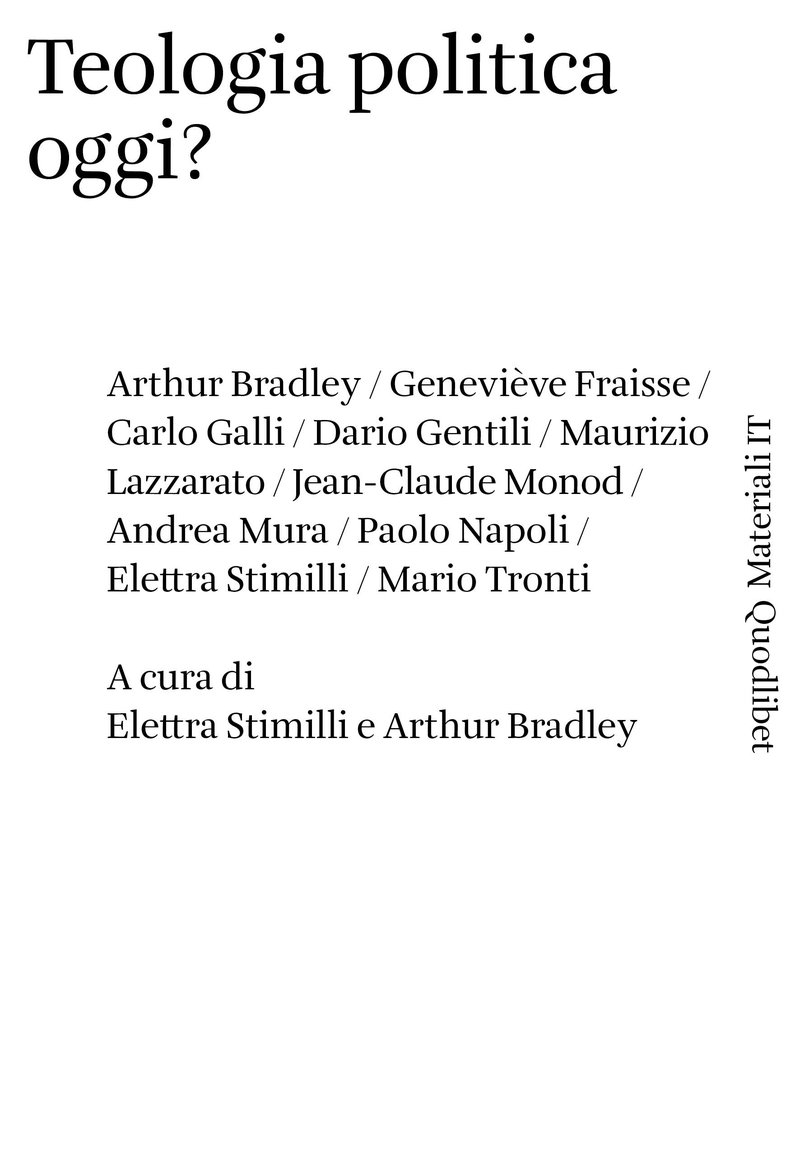
Teologia politica oggi? A cura di Elettra Stimilli e Arthur Bradley – Quodlibet, 2023

Teologia politica oggi? A cura di Elettra Stimilli e Arthur Bradley – Quodlibet, 2023

Nel 1922 Carl Schmitt pubblica il famoso saggio Teologia politica. L’intento di questo libro è quello di interrogarsi sul testo di Schmitt, esattamente cento anni dopo la sua pubblicazione, in un nuovo tempo di crisi politica. Ma non si tratta solo di un confronto con il saggio schmittiano e con le sue interpretazioni a un secolo di distanza. Piuttosto, la domanda da cui muove questo lavoro è se la teologia politica sia ancora utile per affrontare il nostro tempo. Se il contesto politico in cui viviamo per molti aspetti assomiglia incredibilmente ai tumultuosi primi anni della Repubblica di Weimar – una guerra nel cuore dell’Europa, crisi politiche di legittimità, crolli finanziari, nazionalismi di destra, populismi antiliberali e persino una pandemia globale accomunano le due epoche – oggi, tuttavia, stiamo vivendo una serie di sfide completamente nuove e singolari, che non solo Schmitt non avrebbe potuto prevedere, ma che possono mettere in crisi l’efficacia stessa di questa categoria interpretativa. Tornando all’archivio teologico politico, questo lavoro cerca, allora, in qualche modo di estenderlo, nel tentativo di mettere in luce, anche solo indirettamente, la specificità di alcune questioni centrali della nostra epoca. 

In 1922, Carl Schmitt published his famous essay Political Theology. The intent of this book is to question Schmitt’s text, exactly one hundred years after its publication, in a new time of political crisis. But it is not just a question of a comparison with Schmitt’s essay and with his interpretations a century later. Rather, the question from which this work starts is whether political theology is still useful for dealing with our time. If the political context in which we live in many respects bears a striking resemblance to the tumultuous early years of the Weimar Republic – a war in the heart of Europe, political legitimacy crises, financial collapses, right-wing nationalisms, anti-liberal populisms and even a global pandemic unite the two eras – today, however, we are experiencing a series of completely new and singular challenges, which not only could Schmitt not have foreseen, but which can undermine the very effectiveness of this interpretative category. Returning to the political theological archive, this work seeks, therefore, in some way to extend it, in an attempt to highlight, even if only indirectly, the specificity of some central issues of our age.

Indice/Contents:

Elettra Stimilli (Sapienza Università di Roma) e Arthur Bradley (Lancaster University), “Introduzione”

Mario Tronti, “La teologia politica al tempo della geopolitica”

Carlo Galli (Università di Bologna) “Eclissi e ritorno della teologia politica”

Maurizio Lazzarato, “Schmitt e la guerra”

Jean-Claude Monod (ENS), “Il sovrano senza monopolio decisionale?”

Dario Gentili (Università degli Studi Roma Tre), “Decisione, scelta, dischiusura. Neutralizzazione e uso neoliberale del decisionismo di Carl Schmitt”

Andrea Mura, (Goldsmiths College, University of London), “Cent’anni dopo Teologia politica. Pensiero tecnico-economico e Impresa di Sé”

Arthur Bradley (Lancaster University), “Nell’anticamera del potere. Sovranità divisa”

Paolo Napoli (EHESS), “Un esperimento casistico sulla sovranità”

Geneviève Fraisse (CNRS), “Democrazia esclusiva. Riconoscimento concesso / Riconoscimento affermato”

Elettra Stimilli (Sapienza Università di Roma) “La teologia politica alla prova dell’imprevisto”

Posted in Uncategorized | Leave a comment

Books received – Milner, Lévi-Strauss, Lefebvre, Guattari, Saussure, Walters & Tazzioli

Some books for the Indo-European thought project, together with the copy of Musset Henri Lefebvre gave to Georges Bataille (more here) and William Walters and Martina Tazzioli (eds.), Handbook on Governmentality, in which I have a chapter on Foucault and Dumézil.

Update: I say something of why Le Leggende Germaniche is such a useful collection here.

Posted in Claude Lévi-Strauss, Felix Guattari, Ferdinand de Saussure, Georges Bataille, Georges Dumézil, Henri Lefebvre, Mapping Indo-European Thought in Twentieth Century France, Michel Foucault | 4 Comments

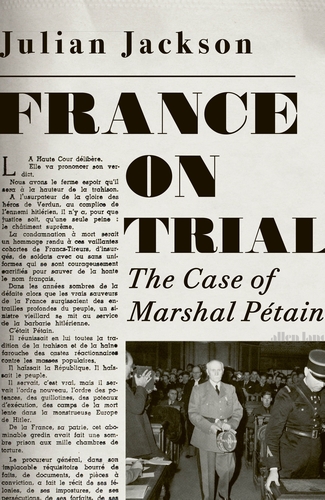
Julian Jackson, France on Trial: The Case of Marshal Pétain – Harvard University Press/Allen Lane, June 2023

Julian Jackson, France on Trial: The Case of Marshal Pétain – Harvard University Press/Allen Lane, June 2023

One of the great contemporary historians of France on one of the most controversial periods of twentieth-century French history

Few images more shocked the French population during the Occupation than the photograph of Marshal Philippe Pétain – the great French hero of the First World War – shaking the hand of Hitler on 20 October 1940. In a radio speech after this meeting, Pétain told the French people that he was ‘entering down the road of collaboration’. He ended with the words: ‘This is my policy. My ministers are responsible to me. It is I alone who will be judged by History.’ Five years later, in July 1945, the hour of judgement – if not yet the judgement of History – arrived. Pétain was brought before a specially created High Court to answer for his conduct between the signing of the armistice with Germany in June 1940 and the Liberation of France in August 1944.

Julian Jackson uses Pétain’s three-week trial as a lens through which to examine the central crisis of twentieth-century French history – the defeat of 1940, the signing of the armistice and Vichy’s policy of collaboration – what the main prosecutor Mornet called ‘four years to erase from our history’. As head of the Vichy regime in the Second, Pétain became one of France’s most notorious public figures, and the lightening-rod for collective guilt and retribution immediately after the Second World War. In France on Trial Jackson blends politics and personal drama to explore how different national factions sought to try to claim the past, or establish their interpretation of it, as a way of claiming the present and future.

Review in The Guardian; New Books discussion linked on the Harvard University Press page

Posted in Uncategorized | Leave a comment

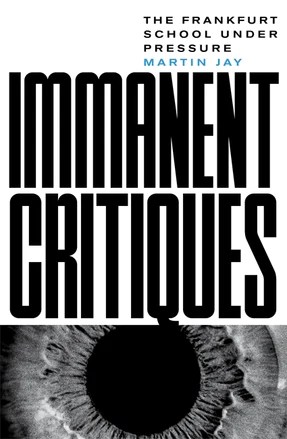
Martin Jay, Immanent Critiques: The Frankfurt School under Pressure – Verso, October 2023

Martin Jay, Immanent Critiques: The Frankfurt School under Pressure – Verso, October 2023

update November 2023: there is a New Books discussion with Ryan Tripp here

Fifty years after the appearance of The Dialectical Imagination, his pioneering history of the Frankfurt School, Martin Jay reflects on what may be living and dead in its legacy. Rather than treating it with filial piety as a fortress to be defended, he takes seriously its anti-systematic impulse and sensitivity to changing historical circumstances. Honouring the Frankfurt School’s practice of immanent critique, he puts critical pressure on a number of its own ideas by probing their contradictory impulses. Among them are the pathologization of political deviance through stigmatizing “authoritarian personalities,” the undefended theological premises of Walter Benjamin’s work, and the ambivalence of its members’ analyses of anti-Semitism and Zionism. Additional questions are asked about other time-honored Marxist themes: the meaning of alienation, the alleged damages of abstraction, and the advocacy of a politics based on a singular notion of the truth. 

Rather, however, than allowing these questions to snowball into an unwarranted repudiation of the Frankfurt School legacy as a whole, the essays also acknowledge a number of its still potent arguments. They explore its neglected, but now timely analysis of “racket society,” Adorno’s dialectical reading of aesthetic sublimation, and the unexpected implications of Benjamin’s focus on the corpse for political theory. Jay shows that it is a still evolving theoretical tradition which offers resources for the understanding of – and perhaps even practical betterment – of our increasingly troubled world.

Posted in Uncategorized | 1 Comment

Daniel Loick, The Abuse of Property, trans. Jacob Blumenfeld – MIT Press, August 2023

Daniel Loick, The Abuse of Property, trans. Jacob Blumenfeld – MIT Press, August 2023

A fundamental critique of the current property regime, calling for radical social and political change.

In The Abuse of Property, Daniel Loick offers a multifaceted philosophical critique of the concept of property, broadly understood. He argues that property should not be the dominant framework in which human beings regulate the use of things, that property is not the same as use. Property rights, in his view, are not conditions of freedom or justice, but deficient, dysfunctional, and harmful ways of interacting with other people and the natural environment. He dissects not only the classic justifications of property (from John Locke’s justification of property as a natural right based on individual freedom to Hegel’s justification of property as a form of mutual recognition) but also the classic critiques of property, from Proudhon and Marx up to Adorno and Agamben.

Through an innovative critical approach to legal studies, Loick demonstrates how the concept of property, historically applied to things and people and still a linchpin of our distorted relation with the world, forms a direct line from the Occupy movement to Black Lives Matter and beyond.

Untimely Meditations series

Posted in Uncategorized | Leave a comment

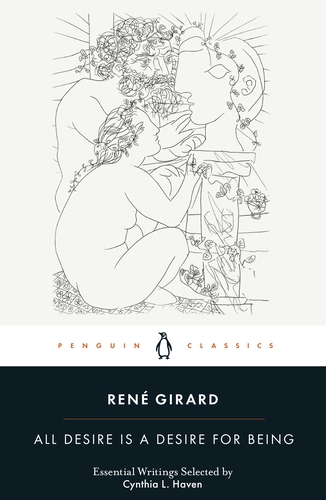
René Girard, All Desire is a Desire for Being: Essential Writings, ed. Cynthia L. Haven – Penguin, June 2023

René Girard, All Desire is a Desire for Being: Essential Writings, ed. Cynthia L. Haven – Penguin, June 2023

A new selection of foundational works from the influential philosopher who developed the theory of mimetic desire

Why do humans have such a remarkable capacity for conflict? From ancient foundational myths to the modern era, the visionary thinker Rene Girard identified the constant, competing desires at the heart of our existence – desires that we copy from others, igniting a contagious violence. This remarkable and accessible new selection of Girard’s work shows him as a writer for our times, as he ranges over human imitation and rivalry, herd behaviour, scapegoating and how our violent longings play out in stories, from Shakespeare to religion.  

‘The explosion of social media, the resurgence of populism, and the increasing virulence of reciprocal violence all suggest that the contemporary world is becoming more and more recognizably “Girardian” in its behaviour’ The New York Review of Books

Edited with an Introduction by Cynthia L. Haven 

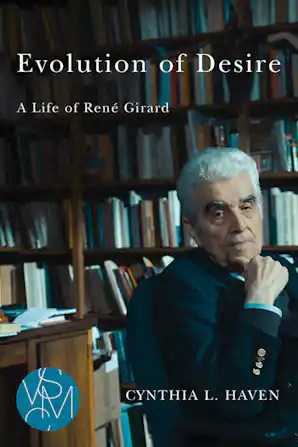
Haven’s biography of Girard, Evolution of Desire, was published in 2018.

Posted in Uncategorized | Leave a comment

Theory, Culture and Society Special Issue: ‘Foucault Before the Collège de France’ – *open access until mid-June*

Theory, Culture and Society Special Issue: ‘Foucault Before the Collège de France‘, edited by Stuart Elden, Orazio Irrera and Daniele Lorenzini

A reminder that all papers are open access until mid June 2023 – after that date only a few papers are available without subscription

[update 15 June 2023: It would appear that most pieces – but not all – are now back behind the paywall. Hopefully people who were interested downloaded before today.]

The issue includes papers by most of the editors of the early Foucault courses and manuscripts, pieces on Foucault on art, literature and Nietzsche, translations of Foucault, Macherey and several others.

Posted in Bernard E. Harcourt, Friedrich Nietzsche, Georg Wilhelm Friedrich Hegel, Michel Foucault, Pierre Macherey, Uncategorized | Leave a comment

Colin McFarlane, Waste and the City: The Crisis of Sanitation and the Right to Citylife – Verso, August 2023

Colin McFarlane, Waste and the City: The Crisis of Sanitation and the Right to Citylife – Verso, August 2023

[update September 2023 – Colin reflects on the book’s writing here; and provides an open access link]

In an age of pandemics the relationship between the health of the city and good sanitation has never been more important. Waste and the City is a call to action on one of modern urban life’s most neglected issues: sanitation infrastructure. The Covid-19 pandemic has laid bare the devastating consequences of unequal access to sanitation in cities across the globe. At this critical moment in global public health, Colin McFarlane makes the urgent case for Sanitation for All.

The book outlines the worldwide sanitation crisis and offers a vision for a renewed, equitable investment in sanitation that democratises and socialises the modern city. Adopting Henri Lefebvre’s concept of ‘the right to the city’, it uses the notion of ‘citylife’ to reframe the discourse on sanitation from a narrowly-defined policy discussion to a question of democratic right to public life and health. In doing so, the book shows that sanitation is an urbanizing force whose importance extends beyond hygiene to the very foundation of urban social life.

Posted in Uncategorized | Leave a comment