Marco Filoni, L’azione politica del filosofo: La vita e il pensiero di Alexandre Kojève, 2021 – English review, French interview

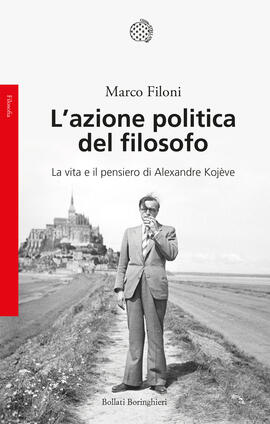
I have the French translation of the first edition of Marco Filoni’s biography of Alexandre Kojève, which stops rather abruptly in the early 1940s. It’s good to know that there is a new edition which completes the story – Marco Filoni, L’azione politica del filosofo: La vita e il pensiero di Alexandre Kojève, 2021.

There is an English-language review by Kyle Moore in Studies in East European Thought.

And a French interview with Gerardo Muñoz in Grand Continent Alexandre Kojève, philosophe de la politique mondiale, une conversation avec Marco Filoni

Update: Marco tells me there will be a French translation of the second edition with Gallimard. No plans for an English version as far as I know. In English, Jeff Love’s The Black Circle: A Life of Alexandre Kojève came out with Columbia University Press a few years ago. Update 2: There is an English version of Filoni’s biography forthcoming]
Posted in Uncategorized | Leave a comment

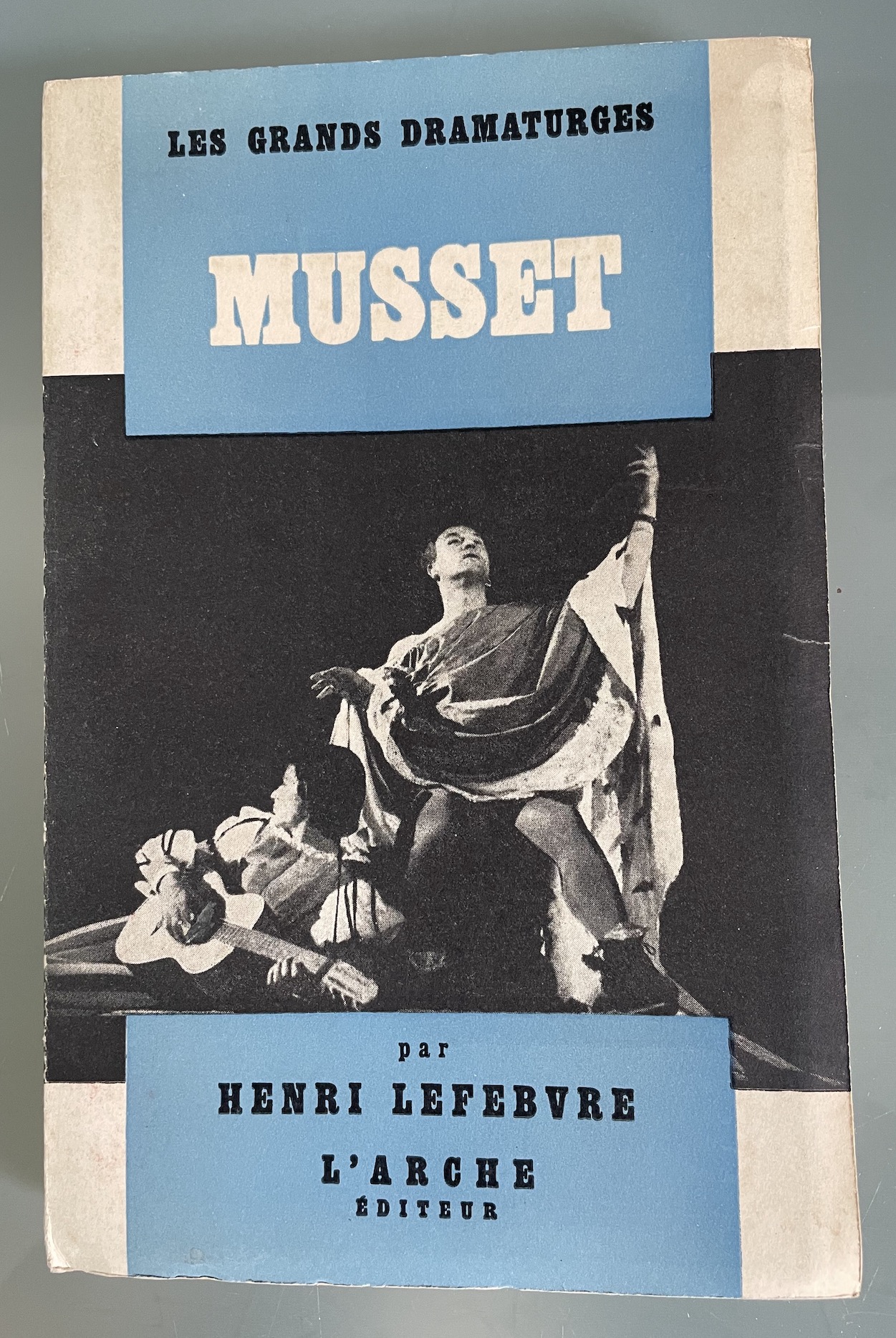
Henri Lefebvre’s Musset – the copy he gave to Georges Bataille

I’ve previously mentioned that parts of Georges Bataille’s library are for sale – story here. The catalogue is on sale as a book La bibliothèque de Georges Bataille – and available to download as a pdf here; with the full inventaire here.

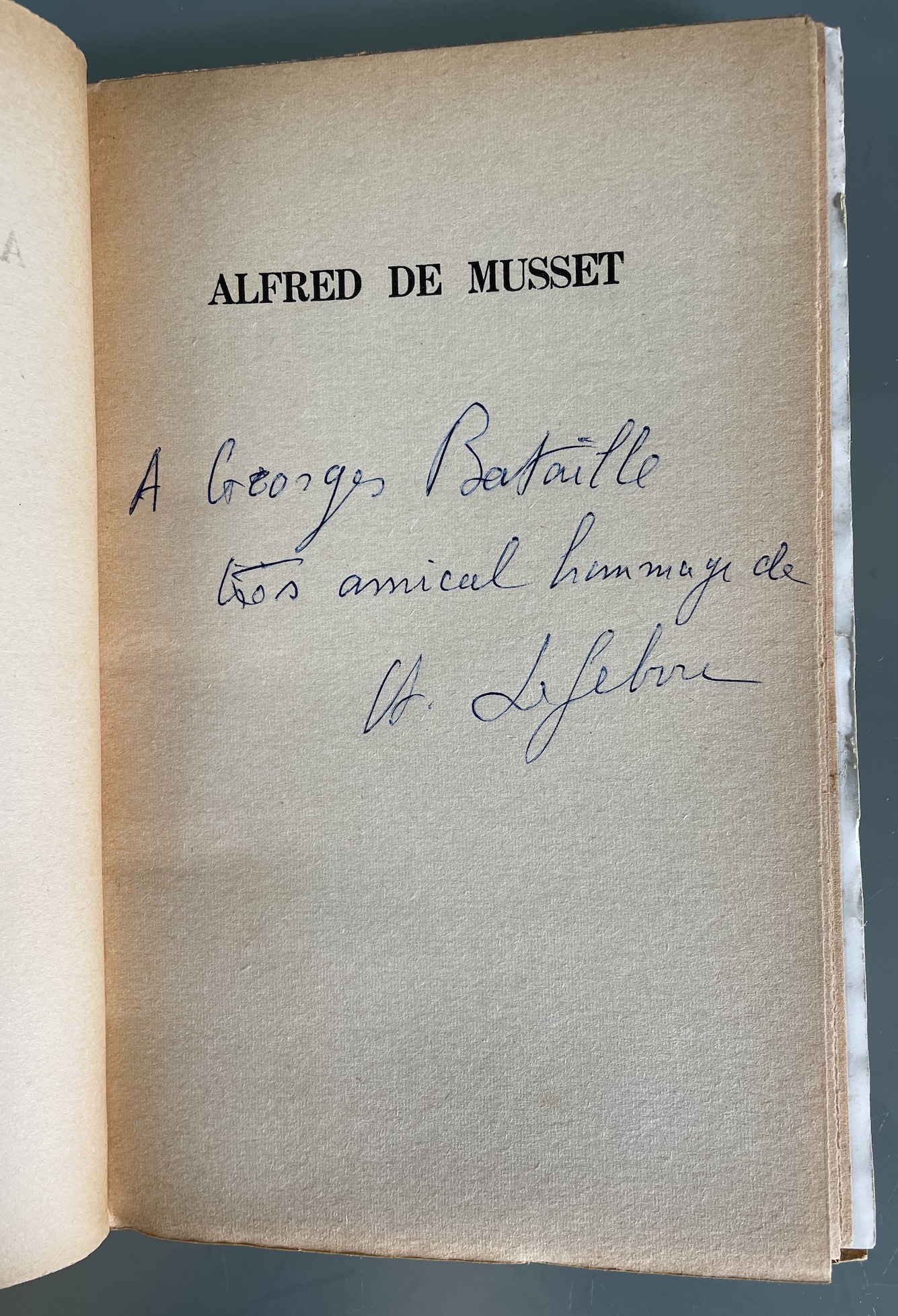
I decided to get one book from the collection – Henri Lefebvre’s 1955 book on the dramatist Alfred de Musset, with a handwritten dedication. The pages are uncut, so Bataille didn’t read it. I still think it’s a tragedy that this library has not been preserved intact, especially as other volumes have been read and marked by Bataille, but it’s nice to have a little piece of the history.

Posted in Georges Bataille, Henri Lefebvre, Uncategorized | 3 Comments

Alexandra Homolar, The Uncertainty Doctrine: Narrative Politics and the US Hard Power after the Cold War – Cambridge University Press, October 2023

Alexandra Homolar, The Uncertainty Doctrine: Narrative Politics and the US Hard Power after the Cold War – Cambridge University Press, October 2023

The post-Cold War era is often seen as a missed opportunity of epic proportions for the United States to turn swords into ploughshares, with much of the blame placed on international developments. The Uncertainty Doctrine challenges the conventional take on post-Cold War history as imposed on the US by events largely outside its control. It shows in rich empirical detail how America’s ‘peace dividend’ did not merely fall by the wayside but was actively undermined by the narrative contests over the security implications of the New World Order. Committed to understanding the ontological significance of narrative in (inter)national security, Alexandra Homolar demonstrates that political agents have the capacity to respond to a systemic shock through discursive adaptation and reorganization. While narrative politics may not always matter in US defense policy, at moments perceived as bifurcation points it can be decisive in why some strategic responses prevail over possible alternatives.

‘A deeply impressive and sustained disquisition on one of the most vexed and contentious areas of study: US foreign policy since the end of the cold war. This is a work brimming with ideas and arguments: it deserves a large audience and to become a seminal scholarly text.’

Timothy J. Lynch – Professor of American Politics, the University of Melbourne

Posted in Uncategorized | Leave a comment

G.W.F. Hegel, Lectures on the Philosophy of Right, 1819-1820, trans. Alan Brudner, University of Toronto Press, April 2023

G.W.F. Hegel, Lectures on the Philosophy of Right, 1819-1820, trans. Alan Brudner, University of Toronto Press, April 2023

very expensive…

Published in 1821, Outlines of the Philosophy of Right is considered the definitive articulation of the legal, moral, social, and political philosophy of G.W.F. Hegel. However, shortly before its publication, Hegel delivered a series of lectures on the subject matter of the work at the University of Berlin. These lectures are unlike any others Hegel gave on the philosophy of Right in that they do not supplement a published text but rather give a full and independent presentation of his mature political thought. Yet, they are also unlike Hegel’s formal treatise in that they form a smooth and flowing discourse, much like Hegel’s lectures on the philosophy of history, philosophy of art, philosophy of religion, and history of philosophy. Substantively, these lectures contain more extensive discussions of poverty and the proletariat than are found in Hegel’s published text – discussions that carry out the retreat from optimism about the present age intimated in the preface to Outlines but nowhere evident in the text itself.

Translated with an introduction and notes by Alan Brudner, Hegel’s 1819/20 lectures on the philosophy of Right present his complete thoughts on law and the state in a manner that is more accessible and engaging than any other Hegelian text on these subjects.

Posted in Georg Wilhelm Friedrich Hegel | Leave a comment

“Deleuze/Guattari and A Thousand Plateaus”: Michael Hardt in conversation with Brad Evans

Deleuze/Guattari and A Thousand Plateaus“: Michael Hardt in conversation with Brad Evans

“A Century of Violence” – co-hosted with the Centre for the Study of Violence at the University of Bath: https://www.bath.ac.uk/research-centr…

To coincide with the 100th year anniversary of The Philosopher, renowned philosopher of violence Brad Evans will discuss five of the seminal philosophical texts on violence from the past century.

At the time of its publication in 1980, Deleuze & Guattari’s “A Thousand Plateaus” was seen as a cluster bomb of concepts. A book that breaks apart the very idea, form and structure of what a book could be, it has since become one of the defining texts of post-structuralism. It is also a book that has had a marked impact on how we understand the spatial and temporal dimensions of violence. Navigating through a number of key concepts in the text, from multiplicity to nomadism and revolution, this conversation with eminent political philosopher Michael Hardt situates “A Thousand Plateaus” in the radical moment in which it was written, while asking what relevance it has today.

Michael Hardt is professor of literature at Duke University. His writings explore the new forms of domination in the contemporary world as well as the social movements and other forces of liberation that resist them. In the Empire trilogy (Empire (2000), Multitude (2004), and Commonwealth (2009)), Hardt and Antonio Negri investigated the political, legal, economic, and social aspects of globalization, along with the political and economic alternatives that could lead to a more democratic world. Their pamphlet Declaration (2012) attempted to articulate the significance of the encampments and occupations that began in 2011, from Tahrir Square to Zuccotti Park, and to recognize the primary challenges faced by emerging democratic social movements today. Homepage: https://scholars.duke.edu/person/hardt

Brad Evans is a political philosopher, critical theorist, and writer whose work focuses on the problem of violence. He is the author of twenty books and edited volumes, along with over a hundred and fifty academic and international media articles. He is the founding director of the Centre for the Study of Violence (to be launched 2023) and holds a Chair in Political Violence & Aesthetics at the University of Bath.

Website: https://www.brad-evans.co.uk

Research Centre: https://www.bath.ac.uk/research-centr…

Thanks to dmf for the link.

Posted in Uncategorized | 1 Comment

Recasting the Political: Perspectives from Deep History – Cambridge, 3-4 July 2023

Recasting the Political: Perspectives from Deep History – Cambridge, 3-4 July 2023

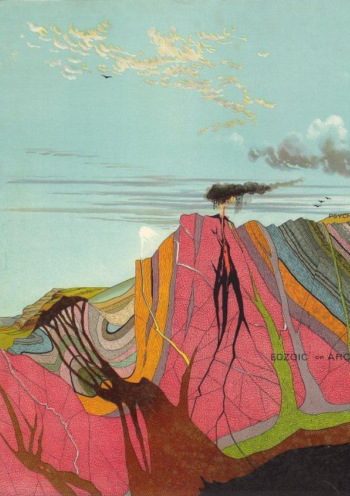
Image: Geological Chart by Levi Walter Yaggy (1893)

This conference brings together historians, archaeologists, anthropologists, sociologists, political theorists, and global studies and international relations scholars to showcase and discuss the merits and challenges of adopting a deep historical perspective on the political, and what contribution a deeper historicisation of power, domination, inequality, order, hierarchy, community, security, or rule can make to our empirical and conceptual understanding of the political sphere of human existence, beyond—or against—the established canon of political theory/philosophy. As deep history transcends the boundaries, methods, and scales of traditional ‘history’ and invites us to examine the transformation of political forms in relation to wider life-processes evolving in deep time, the discussion will also assess how deep history might help us illuminate—and potentially transform—the politics of the Anthropocenic present and future.

Attendance: In person.

Registration: Places are limited. Please book here.

Venue: Bradfield Room, Darwin College (Silver Street, CB3 9EU, Cambridge).

Barry Buzan (London School of Economics)

Yale Ferguson (Rutgers University)

Barry K. Gills (University of Helsinki)

Håkon Glørstad (Museum of Cultural History, Oslo)

Inanna Hamati-Ataya (University of Cambridge)

Jaakko Heiskanen (Queen Mary University of London)

Martin Jones (University of Cambridge)

Maarten Meijer (University of Groningen)

Jan Nederveen Pieterse (University of California, Santa Barbara)

Iver B. Neumann (Fridtjof Nansen Institute)

Nicholas G. Onuf (Florida International University)

Amanda Rees (University of York)

Susan Sherratt (University of Sheffield)

Daniel Lord Smail (Harvard University)

Fred Spier (University of Amsterdam)

Ayşe Zarakol (University of Cambridge)

Posted in Uncategorized | Leave a comment

Karine Varley, Vichy’s Double Bind: French Collaboration between Hitler and Mussolini during the Second World War – Cambridge University Press, May 2023

Karine Varley, Vichy’s Double Bind: French Collaboration between Hitler and Mussolini during the Second World War – Cambridge University Press, May 2023

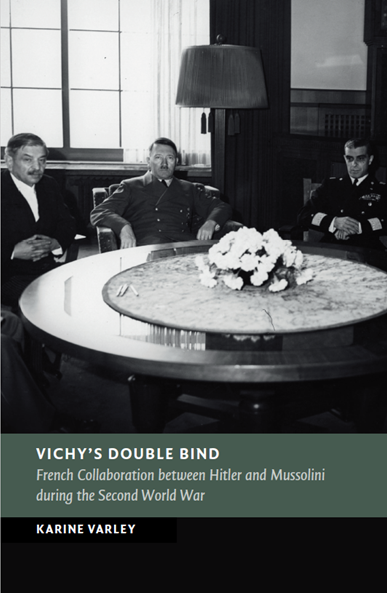
Vichy’s Double Bind advances a significant new interpretation of French collaboration during the Second World War. Arguing that the path to collaboration involved not merely Nazi Germany but Fascist Italy, it suggests that the Vichy French government was caught in a double bind. On the one hand, many of the threats to France’s territory, colonial empire and power came from Rome as well as Berlin. On the other, Vichy was caught between the irreconcilable yet inescapable positions of the two Axis governments. Unable to resolve the conflict, Vichy sought to play the two Axis powers against each other. By exploring French dealings with Italy at diplomatic, military and local levels in France and its colonial empire, this book reveals the multi-dimensional and multi-directional nature of Vichy’s policy. It therefore challenges many enduring conceptions of collaboration with reference to Franco-German relations and offers a fresh perspective on debates about Vichy France and collaboration with Nazi Germany and Fascist Italy.

Posted in Uncategorized | Leave a comment

“Indo-European Thought in Post-War France“, Warwick Seminar for Interdisciplinary French Studies, 31 May 2023 (video)

My talk to the Warwick Seminar for Interdisciplinary French Studies was recorded and is available online – “Indo-European Thought in Post-War France

I begin with two stories – one about the Mission Paul Pelliot and its importance to the early work of Émile Benveniste; and the other about the inquiry into racism and holocaust denial at Lyon III, and the links between Jean Haudry, Alain de Benoist and Georges Dumézil. I use these two stories to frame the project, though most of the talk is on Benveniste, Dumézil and Mircea Eliade in the war and the decade or so after.

There is a lot more information about the project here – the overall scope, updates on the research, publications, and a few textual analyses.

opening slide of the talk - Jacques-Louis David's painting of Le Serment des Horaces, 1784-85
Posted in Books, Emile Benveniste, Georges Dumézil, Mapping Indo-European Thought in Twentieth Century France, Mircea Eliade, Uncategorized | 1 Comment

‘Indo-European Thought in Post-War France’, Warwick Seminar for Interdisciplinary French Studies, 31 May 2023, 4pm

Update: the recording is available here

For anyone interested in my new project, I’ll be speaking about some of it in an online seminar today at 4pm: ‘Indo-European Thought in Post-War France’, Warwick Seminar for Interdisciplinary French Studies

This talk will report on preliminary work on a new research project on Indo-European thought in twentieth-century France. It will particularly focus on the post-war period when Georges Dumézil was elected to the Collège de France, Émile Benveniste regained his chair there after his war-time exile in Switzerland, and Mircea Eliade held visiting positions when unable to return to Romania.

This was a period when Dumézil completed his Jupiter Mars Quirinus and Les Mythes Romains series, and published a revision of his book Mitra-Varuna; Benveniste wrote a comparative study of Indo-European nouns; and Eliade started to publish his first books in French, including Traité d’histoire des religions

Using published texts, reports of teaching, memoirs, and some archival sources, the talk will try to situate the intellectual relations between these and other figures, especially in light of a post-war reckoning about political positions.

Stuart Elden is Professor of Political Theory and Geography at the University of Warwick. He has recently completed a four-part intellectual history of Foucault’s entire career. He is currently funded by a Leverhulme Major Research Fellowship on Indo-European thought in twentieth-century France.

Posted in Emile Benveniste, Georges Dumézil, Mapping Indo-European Thought in Twentieth Century France, Mircea Eliade | Leave a comment

John Forrester, Freud and Psychoanalysis: Six Introductory Lectures, ed. Lisa Appignanesi – Polity, May 2023

John Forrester, Freud and Psychoanalysis: Six Introductory Lectures, ed. Lisa Appignanesi – Polity, May 2023

Editor’s Preface       Lisa Appignanesi

Foreword       Darian Leader

Lecture One: A Whole Climate of Opinion

Lecture Two: The Historical Foundations of Psychoanalysis

Lecture Three: Dreams and Sexuality

Lecture Four: Psychoanalysis as a Theory of Culture

Lecture Five: Psychoanalysis as a Movement

Lecture Six: The Significance of Psychoanalysis in the Twentieth Century

Endnotes

Further Reading

“Clear and compelling, these lectures are at once more than accessible and often startlingly informative. In his characteristically lucid and incisive way, Forrester makes Freud new and intriguing. This book is that rare thing: a collection as much for the curious as for the knowledgeable, and the best book on Freud for many years.”
Adam Phillips

Posted in Sigmund Freud | Leave a comment