Achille Mbembe and Felwine Sarr eds, To Write the Africa World and The Politics of Time: Imagining African Becomings – Polity 2023

Achille Mbembe & Felwine Sarr eds, To Write the Africa World – Polity 2023, trans. Drew Burk

In October 2016, thirty intellectuals and artists from Africa, its diasporas, and beyond gathered together in Dakar and Saint-Louis, Senegal, to reflect on the present and future of Africa in the midst of transformations that are sweeping through the contemporary world. The aim was to take stock of the renewal of Afro-diasporic critical thought and to discuss the new perspectives emerging from the ongoing projects constructing political, cultural, and social imaginaries for and from the African continent. 

This book brings together and makes available to the English-speaking world the material presented at the 2016 Ateliers de la pensée – Workshops of Thought – in Dakar. The authors deal with a wide range of issues, including decolonization, the development of social utopias, and the pursuit of new forms of political, economic, and social production on the African continent. Running throughout is a constant concern to interrogate the categories and frames of meaning that have served to characterize the dynamics of the African continent and a shared desire to produce new frames of intelligibility through which to see Africa’s present realities and its future. The contributions also attest to the view that there is no African question that is not also a global question, and that the Africanization of the global question will be a decisive feature of the twenty-first century.

To Write the Africa World and its companion volume The Politics of Time will be indispensable for anyone interested in Africa – its past, present, and future – and in the new forms of critical thought emerging from Africa and the Global South.

Achille Mbembe & Felwine Sarr eds, The Politics of Time: Imagining African Becomings – Polity 2023, trans. Philip Gerard

As we enter the third decade of the twenty-first century, the world is undergoing a major historical shift: Africa, and the Global South more generally, is increasingly becoming a principal theatre in which the future of the planet plays itself out. But not only this: Africa is at the same time emerging as one of the great laboratories for novel forms of social, economic, political, intellectual, cultural, and artistic life. Often arising in unexpected places, these new forms of life materialize in practices that draw deeply from collective memory while simultaneously assuming distinctly contemporary, even futuristic, guises.

In November 2017, the second session of the Ateliers de la pensée – Workshops of Thought – was held in Dakar, Senegal. Fifty African and diasporic intellectuals and artists participated and their debates unfolded along numerous thematic lines, approached from the standpoints of many different disciplines. This volume is the result of that encounter. Among the many topics discussed were the concurrence and entanglement of multiple temporalities, the politics of life in the Anthropocene, the project of decolonization, and the preservation and transmission of different ways of knowing. At a time when the world is haunted by the specter of its own end, the contributors to this volume ask whether one can, by taking Africa as a point of departure, seize hold of other options for the future – not only for Africa, but for the world. 

The Politics of Time and its companion volume, To Write the Africa World, will be indispensable works for anyone interested in Africa – its past, present, and future – and in the new forms of critical thought emerging from Africa and the Global South.

Posted in Achille Mbembe | Leave a comment

Stefan Kipfer, Urban Revolutions: Urbanisation and (Neo-)Colonialism in Transatlantic Context – Brill, September 2022; paperback Haymarket September 2023

Stefan Kipfer, Urban Revolutions: Urbanisation and (Neo-)Colonialism in Transatlantic Context – Brill, September 2022

A paperback is forthcoming from Haymarket in September 2023 [update – now published]

What do struggles over pipelines in Canada, housing estates in France, and shantytowns in Martinique have in common? In Urban Revolutions, Stefan Kipfer shows how these struggles force us to understand the (neo-)colonial aspects of capitalist urbanization in a comparatively and historically nuanced fashion. In so doing, he demonstrates that urban research can offer a rich, if uneven, terrain upon which to develop the relationship between Marxist and anti-colonial intellectual traditions. After a detailed dialogue between Henri Lefebvre and Frantz Fanon, Kipfer engages creole literature in the French Antilles, Indigenous radicalism in North America and political anti-racism in mainland France.

Posted in Uncategorized | Leave a comment

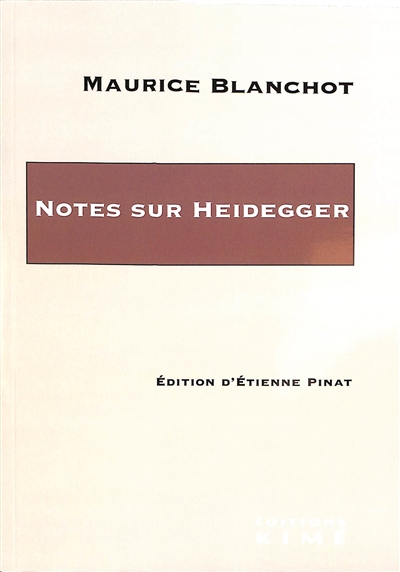
Maurice Blanchot, Notes sur Heidegger, ed. Étienne Pinat – Éditions Kime, 2023

Maurice Blanchot, Notes sur Heidegger, ed. Étienne Pinat – Éditions Kime, 2023

Doesn’t seem to gave a publisher page yet, but listed here.

Dans une lettre de 1987, Maurice Blanchot revient dans un post-scriptum essentiel sur son rapport à l’œuvre du philosophe : « Grâce à Emmanuel Levinas, sans qui, dès 1927 ou 1928, je n’aurais pu commencer à entendre Sein und Zeit, c’est un véritable choc intellectuel que la lecture de ce livre provoqua en moi. Un événement de première grandeur venait de se produire : impossible de l’atténuer, même aujourd’hui, même dans mon souvenir » . Ce choc intellectuel se produit quelques années avant le commencement de l’œuvre critique de Blanchot et demeure en sa force jusqu’à la fin. Si, du vivant de l’auteur, le lecteur avait pu voir le nom de Heidegger réapparaître dans bien des articles, ce qui lui permettait de savoir cet intérêt, c’est seulement la mort de l’auteur qui révéla, dans ses archives, aujourd’hui déposées à la Houghton Library de Harvard, plus trois cent pages pour l’essentiel tapuscrites du travail que Blanchot aura consacré de la fin des années 40 au début des années 60 à l’étude de l’œuvre de Heidegger et de la maigre bibliographie secondaire alors existante. Excellent germaniste, Blanchot lit tout ce qui paraît en allemand, et se confronte à la difficulté de faire passer en français le travail de Heidegger sur la langue allemande, une lettre inédite de 1959 à un destinataire inconnu révélant que c’est là, à ses yeux, « l’amitié intellectuelle » que nous devons au philosophe.

Posted in Martin Heidegger, Maurice Blanchot | Leave a comment

Luke Munn, Technical Territories: Data, Subjects, and Spaces in Infrastructural Asia – University of Michigan Press, July 2023 (print & open access)

Luke Munn, Technical Territories: Data, Subjects, and Spaces in Infrastructural Asia – University of Michigan Press, July 2023

Territory is shifting. No longer defined by the dotted line of the border or the national footprint of soil, today’s territories are enacted through data infrastructures. From subsea cables to server halls, these infrastructures underpin new forms of governance, shaping subjects and their everyday lives. Technical Territories moves from masked protestors in Hong Kong to asylum-seekers in Christmas Island and sand miners in Singapore, exploring how these territories are both political and visceral, altering the experience of their inhabitants.

Infrastructures have now become geopolitical, strategic investments that advance national visions, extend influence, and trigger trade wars. Yet at the same time, these technologies also challenge sovereignty as a bounded container, enacting a more distributed and decoupled form of governance. Such “technical territories” construct new zones where subjects are assembled, rights are undermined, labor is coordinated, and capital is extracted. The stable line of the border is replaced by more fluid configurations of power. Luke Munn stages an interdisciplinary intervention over six chapters, drawing upon a wide range of literature from technical documents and activist accounts, and bringing insights from media studies, migration studies, political theory, and cultural and social studies to bear on these new sociotechnical conditions.

Posted in Uncategorized | Leave a comment

Theory, Culture and Society Special Issue: ‘Foucault Before the Collège de France’ – all papers open access until mid June 2023

Theory, Culture and Society Special Issue: ‘Foucault Before the Collège de France

all papers open access until mid June 2023

co-edited by Stuart Elden, Orazio Irrera and Daniele Lorenzini

The issue includes papers by most of the editors of the early Foucault courses and manuscripts, pieces on Foucault on art, literature and Nietzsche, translations of Foucault, Macherey and several others. All open access for a limited time.

Posted in Michel Foucault | 2 Comments

Thomas Wheatland, The Frankfurt School in Exile – University of Minnesota Press, April 2023

Thomas Wheatland, The Frankfurt School in Exile – University of Minnesota Press, April 2023

Members of the Frankfurt School have had an enormous effect on Western thought, beginning soon after Max Horkheimer became the director of the Institute for Social Research at the University of Frankfurt am Main in 1930. Also known as the Horkheimer Circle, the group included such eminent intellectuals as Theodor Adorno, Herbert Marcuse, Erich Fromm, Leo Lowenthal, and Friedrich Pollock. Fleeing Nazi oppression, Horkheimer moved the Institute and many of its affiliated scholars to Columbia University in 1934, where it remained until 1950. 

Until now, the conventional portrayal of the Institute has held that its members found refuge by relocating to Columbia but that they had little contact with, or impact on, American intellectual life. With insight and clarity, Thomas Wheatland demonstrates that the standard account is wrong. Based on deep archival research in Germany and in the United States, and on interviews conducted with luminaries such as Daniel Bell, Bernadine Dohrn, Peter Gay, Todd Gitlin, Nathan Glazer, Tom Hayden, Robert Merton, and others, Wheatland skillfully traces the profound connections between the Horkheimer Circle’s members and the intellectual life of the era. Reassessing the group’s involvement with the American New Left in the 1960s, he argues that Herbert Marcuse’s role was misunderstood in shaping the radical student movement’s agenda. More broadly, he illustrates how the Circle influenced American social thought and made an even more dramatic impression on German postwar sociology.

Although much has been written about the Frankfurt School, this is the first book to closely examine the relationship between its members and their American contemporaries. The Frankfurt School in Exile uncovers an important but neglected dimension of the history of the Frankfurt School and adds immeasurably to our understanding of the contributions made by its émigrés to postwar intellectual life.

Posted in Uncategorized | Leave a comment

Jeffrey J. Cohen and Julian Yates, Noah’s Arkive – University of Minnesota Press, June 2023

Jeffrey J. Cohen and Julian Yates, Noah’s Arkive – University of Minnesota Press, June 2023

Most people know the story of Noah from a children’s bible or a play set with a colorful ship, bearded Noah, pairs of animals, and an uncomplicated vision of survival. Noah’s ark, however, will forever be haunted by what it leaves to the rising waters so that the world can begin again. 

In Noah’s Arkive, Jeffrey J. Cohen and Julian Yates examine the long history of imagining endurance against climate catastrophe—as well as alternative ways of creating refuge. They trace how the elements of the flood narrative were elaborated in medieval and early modern art, text, and music, and now shape writing and thinking during the current age of anthropogenic climate change. Arguing that the biblical ark may well be the worst possible exemplar of human behavior, the chapters draw on a range of sources, from the Epic of Gilgamesh and Ovid’s tale of Deucalion and Pyrrah, to speculative fiction, climate fiction, and stories and art dealing with environmental catastrophe. Noah’s Arkive uncovers the startling afterlife of the Genesis narrative written from the perspective of Noah’s wife and family, the animals on the ark, and those excluded and left behind to die. This book of recovered stories speaks eloquently to the ethical and political burdens of living through the Anthropocene. 

Following a climate change narrative across the millennia, Noah’s Arkive surveys the long history of dwelling with the consequences of choosing only a few to survive in order to start the world over. It is an intriguing meditation on how the story of the ark can frame how we think about environmental catastrophe and refuge, conservation and exclusion, offering hope for a better future by heeding what we know from the past.

Posted in Uncategorized | Leave a comment

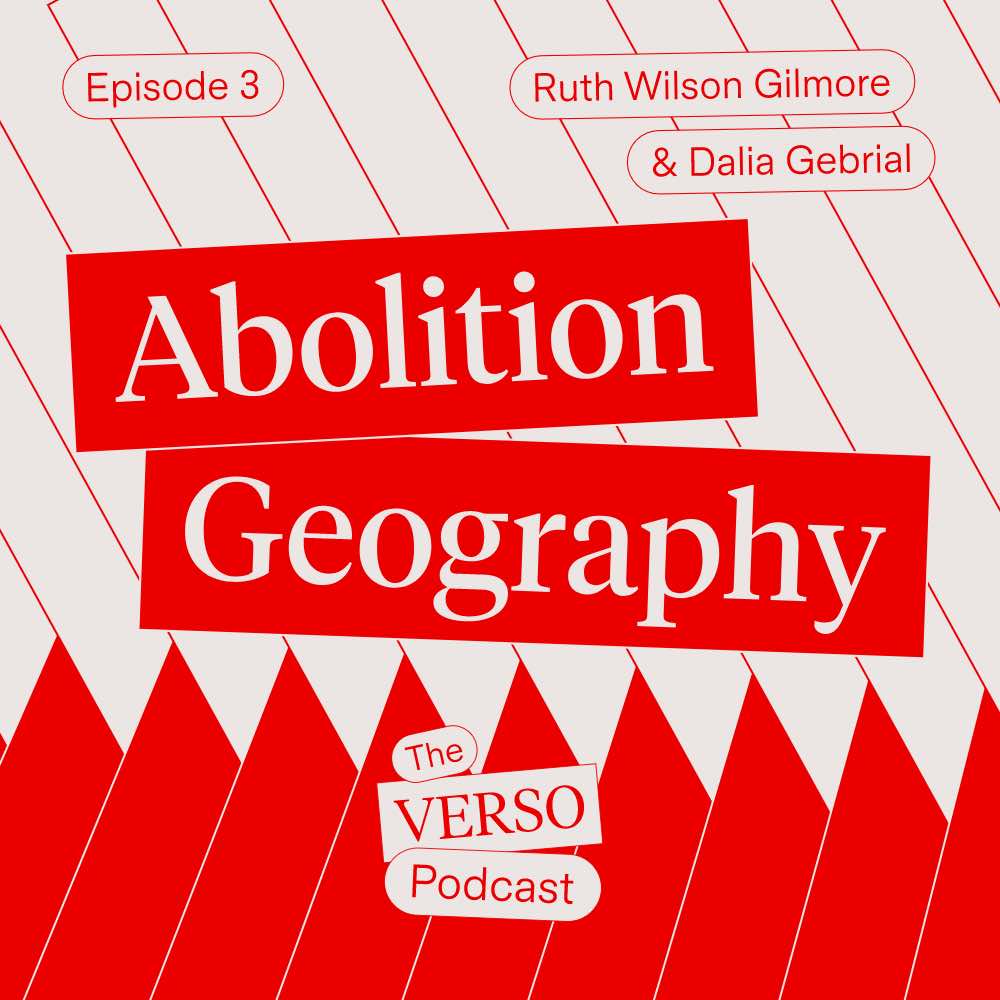
Ruth Wilson Gilmore and Dalia Gebrial discuss prison abolition, racial capitalism, and critical geography – Verso podcast

Ruth Wilson Gilmore and Dalia Gebrial discuss prison abolition, racial capitalism, and critical geography on the Verso podcast:

On the Verso Podcast this week Ruth Wilson Gilmore and Dalia Gebrial join our host, Eleanor Penny, for an eye-opening discussion that uncovers the intricate logic and connections between the prison system, the modern digital platform, and the transformative potential of abolitionist politics.

Subscribe and listen via the links below, and keep your eyes (and ears!) peeled for upcoming episodes from Nancy Fraser, Robin Kelley and Helen Hester.

Read more about the Verso podcast here.

Posted in Uncategorized | Leave a comment

How Nietzsche came in from the Cold – Philipp Felsch’s book and a two-part interview

Philipp Felsch’s book Wie Nietzsche aus der Kälte kam [How Nietzsche came in from the cold] was mentioned at the workshop on translation and the archive yesterday. It’s a study of the two Italian editors and translators of Nietzsche, Colli and Montinari.

On looking for more detail today, I discover that there is an English translation in progress for Polity Books.

There is an interview with Felsch at the Journal of the History of Ideas blog, by Isabel Jacobs (part Ipart II).

Felsch’s earlier book, The Summer of Theory: History of a Rebellion, 1960-1990 was translated by Tony Crawford by Polity in 2021.

Update: The English translation is out in March 2024 – Philipp Felsch, How Nietzsche Came in from the Cold: Tale of a Redemption – trans. Daniel Bowles, Polity, March 2024

Posted in Friedrich Nietzsche | Leave a comment

György Lukács’s History and Class Consciousness – 100 years on, an online collection of German and Russian reviews of and essays about the book

From the Historical Materialism mailing list

György Lukács’s History and Class Consciousness, the book that has won him enthusiastic supporters and bitter enemies, was published 100 years ago. To mark the occasion, a collection of German and Russian reviews of and essays about the book (and the Lenin booklet published a year later) from the 1920s has been published on the website of the Lukács Archive International Foundation: https://www.lana.info.hu/en/lukacs/writings-about-lukacs/history-and-class-consciousness-in-the-debates-of-the-twenties/

Posted in Georg Lukács | Leave a comment