Disturbing Development in the Jim Crow South documents how Black employees of the cooperative extension service of the USDA practiced rural improvement in ways that sustained southern Black farmers’ lives and livelihoods in the early decades of the twentieth century, resisting the white supremacy that characterized the Jim Crow South.
Mona Domosh details the various mechanisms—the transformation of home demonstration projects, the development of a movable school, and the establishment of Black landowning communities—through which these employees were able to alter USDA’s mandates and redirect its funds. These tweakings and translations of USDA directives enabled these employees to support poor Black farmers by promoting food production, health care, and land and home ownership, thus disturbing a system of plantation agriculture that relied on the devaluing of Black lives.
Through the documentation of these efforts, Domosh uncovers an important and previously unknown episode in the long history of international development that highlights the roots of liberal development schemes in the anti-Black racism that constituted plantation agriculture and illustrates how racist systems can be quietly and subtly resisted by everyday people working within the confines of white supremacy.
A seminar on the book is being held online tomorrow – 16 May 2023 (details here; registration here). Apologies for the lack of notice.
A panel discussion of Disturbing Development in the Jim Crow South (2023) by Mona Domosh, involving: Archie Davies (Queen Mary University of London) LaToya E. Eaves (University of Tennessee, Knoxville) Morgan P. Vickers (University of California, Berkeley)
Hardback only at the moment, but paperback forthcoming.
In this book, Mairéad Hanrahan examines the shifts in political focus in Genet’s writing, from the intimate fantasies of the early novels to the struggle for emancipation of the Palestinians in the posthumously published Un Captif amoureux. She argues that his texts have always been centrally concerned with power relations, challenging from the very beginning the opposition that traditionally confines the political to the public sphere. Genet’s writing has always been political — but Hanrahan argues also that it was never solely political. On the contrary, a tension always existed for him between the poetic and the political.
Genet’s changing focus from the personal to the public is explored via the shifts in his practice of genre. Analysing how genre and politics are inextricably involved in Genet’s writing, Hanrahan highlights a core paradox in its evolution. This writer who remained constant over the course of his life in his opposition to hegemonic power relations grappled throughout his work with the suspicion that his art may serve to shore up the very structures he unreservedly contests. Yet his writing also testifies, in both what it says and what it does, to the idea that literature is fundamentally at odds with the social order of the world.
About this book
This book offers a systematized overview of Ian Hacking’s work. It presents Hacking’s oeuvre as a network made up of four interconnected key nodes: styles of scientific thinking & doing, probability, making up people, and experimentation and scientific realism.
Its central claim is that Michel Foucault’s influence is the underlying thread that runs across the Canadian philosopher’s oeuvre. Foucault’s imprint on Hacking’s work is usually mentioned in relation to styles of scientific reasoning and the human sciences. This research shows that Foucault’s influence can in fact be extended beyond these fields, insofar the underlying interest to the whole corpus of Hacking’s works, namely the analysis of conditions of possibility, is stimulated by the work of the French philosopher.
The update was to provide references to the recently-published The Limit of the Useful, translated by Cory Knutson and Thomas Elliott – MIT Press, February 2023.
It’s a good and valuable translation, but it took me longer to work out which bits of volume VII of the Oeuvres complètes [OC] were translated than I expected, so maybe this list is useful for others.
The centre-piece of the book is naturally “The Limit of the Useful”, pp. 1-134, which translates OC VII, 181-280.
They also provide a new translation of the related essay “Economy at the Scale of the Universe”, pp. 137-47 (OC VII, 7-16).
What OC calls the notes to “L’économie à la mesure de l’univers” are translated as “Preliminary Notes to the Writing of The Accursed Share“, pp. 149-57 (OC VII, 465-69).
The ‘notes’ to “La limite de l’utile” are translated as follows: “The Accursed Share, or, The Limit of the Useful”, pp. 159-69 translates OC VII, 502-7; the notes on pp. 317-44 incorporate the material in OC VII, 507-19; “Dossier of Bataille’s Notes and Outlines for The Limit of the Useful, pp. 171-311 translates OC VII, 519-98.
Vol VII also includes two other books by Bataille: “La Part Maudite, I. La Consumation” and “Théorie de la religion”. The books are translated into English, but without the variant passages provided in OC VII. Understandably Knutson and Elliott have not translated the notes and variant texts for these other books in The Limit of the Useful, but what they have done for the texts shows the interest of the other material.
I’d be pleased to receive corrections or additions if I’ve missed something here, and certainly to the overall listing of material on the main page.
The first of three volumes of essays from Critique is forthcoming. Georges Bataille, Critical Essays Volume I: 1944-1948, ed. Alberto Toscano and Benjamin Noys, trans. Chris Turner – Seagull, May 2023. I’ll try to update the listing when I’ve seen a copy.
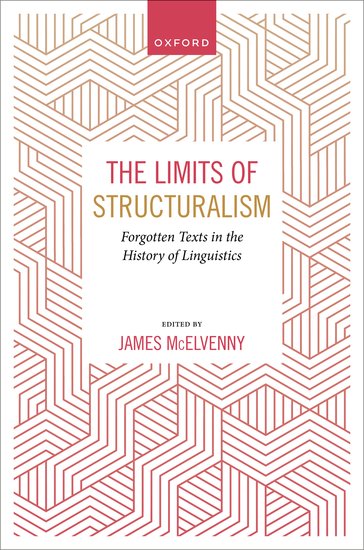
Based around seven primary texts spanning 130 years, this volume explores the conceptual boundaries of structuralism, a scholarly movement and associated body of doctrines foundational to modern linguistics and many other humanities and social sciences. Each chapter in the volume presents a classic — and yet today underappreciated — text that addresses questions crucial to the evolution of structuralism. The texts are made accessible to present-day English-speaking readers through translation and extensive critical notes; each text is also accompanied by a detailed introduction that places it in its intellectual and historical context and outlines the insights that it contains. The volume reveals the complex genealogy of our ideas and enriches our understanding of their contemporary form and use.
The contributors 1:Scouting the limits of structuralism, James McElvenny 2:’Primitive structures’, polysynthesis, and Peter Stephen du Ponceau, Floris Solleveld 3:Franz Boas’ ‘purely analytical approach’ to language classification in the backdrop to American structuralism, Margaret Thomas 4:Georg von der Gabelentz’s typology: Humboldtian linguistics on the threshold of structuralism, James McElvenny 5:Grammaticalization and the sentimental evolution of Antoine Meillet, John E. Joseph 6:Roman Jakobson, language unions, and structuralism in Russia: Encounter or misunderstanding?, Patrick Sériot 7:Louis Hjelmslev on the correlational structure of language: The place within the system, Lorenzo Cigana 8:Émile Benveniste on the relation between linguistic and social structures: ‘Let us then consider that language interprets society’, Chloé Laplantine References Index
At the dawn of the 20th century, a wide-ranging utopianism dominated popular and intellectual cultures throughout Europe and America. However, within just a few years, dystopia would overtake utopia in the public imagination.
In the aftermath of the World Wars, with such canonical examples as Brave New World and Nineteen-Eighty-Four, dystopia appeared to have become a dominant genre, in literature and in social thought more generally. The continuing presence and eventual dominance of dystopian themes in popular culture – e.g., dismal authoritarian future states, sinister global conspiracies, post-apocalyptic landscapes, a proliferation of horrific monsters, and end-of-the-world fantasies – have confirmed the degree to which the 21st is also a dystopian century.
Drawing on literature such as varied as H.G. Wells’s The Time Machine, Neil Gaiman’s American Gods, and Margaret Atwood’s The Handmaid’s Tale, and on TV and film such as The Walking Dead, Game of Thrones, and The Lord of the Rings, Robert T. Tally Jr. explores the landscape of angst created by the monstrous accumulation of dystopian material. The Fiction of Dread provides an innovative reading of the present cultural climate and offers an alternative vision for critical theory and practice in a moment in which, as has been famously observed, it is easier to imagine the end of the world than the end of capitalism.
For fifty years David Harvey has written and lectured on Capital, becoming one of the world’s foremost Marx scholars. In addition, his work on the history and geography of capitalist development has transformed our understanding of neoliberalism and the spread of inequalities across the globe.
In this interview David Harvey recalls the formation of his Marxist ideas, intellectual influences, and writing. He also talks about the growth of the populist right and how that is connected to geographical electoral splits, Marx’s Grundrisse (which he has written a companion to – see below), and Marx’s theories more broadly.
David Harvey teaches at the Graduate Center of the City University of New York and is the author of many books, including:
Kostas Axelos, The Game of the World, trans. Justin Clemens and Hellmut Munz – Edinburgh University Press, 2023 – now published. Congratulations to Justin and Hellmut for this major translation.
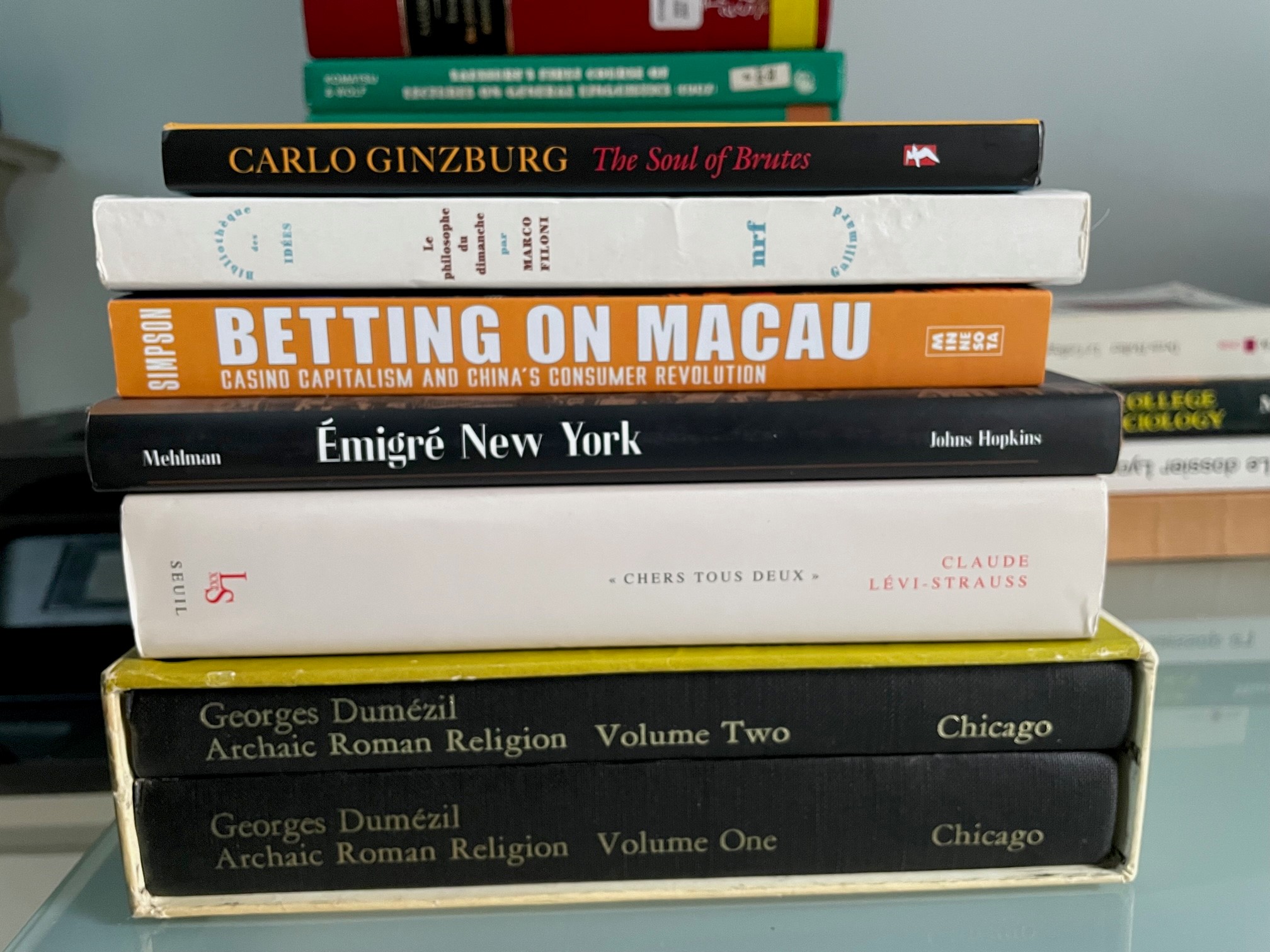
Mainly bought second-hand, but also Tim Simpson, Betting on Macau, sent by University of Minnesota Press. Dumézil’s Archaic Roman Religion was hard to find in its original two-volume form, with case – before I had a mismatched set of one of the Chicago volumes and one of the Johns Hopkins paperback reprint.
Participants are welcome to apply for the Theory, Culture & Society inaugural Summer School, taking place 11-16 September 2023 at University of Klagenfurt, Austria. Apply online here.
The Summer School provides a dynamic and inclusive forum for research, aimed at established and early career researchers, and also providing opportunities for postgraduate students. Participants will be able to:
explore contemporary critical debates and perspectives;
enhance skills and literacies for research and publishing;
share in a cultural programme.
Situated in the Austrian Alps, the University of Klagenfurt provides an inspiring location for a diversity of scholars to come together from across disciplines and geographies, to work with the experienced editorial teams of the journals Theory, Culture & Societyand Body & Society, alongside invited speakers and guests, and staff from the University of Klagenfurt from a broad disciplinary spectrum (Media & Communications, Cultural Studies, Sociology, Philosophy, Slavonic Studies and Robert Musil Institute for Literary Research), who will be on hand to discuss your ongoing research projects.
The intensive programme spans 5 days and is divided into four strands (for which 5 ECTS credits can be awarded):
Scholarly Apparatus: The 40-year history of the journal has witnessed many shifts and trends in research. Workshops will explore the current contexts of research, questioning, for example, the post-university condition and the changing ‘scholarly apparatus’, mapping new ways of working and post-media literacies.
Work-in-Progress: A special dedicated series invitesparticipants to present on aspects of their own work, with a view to supporting publication and public engagement. Time is also afforded for writing, giving participants an opportunity for quiet study, but within a shared environment.
Global Public Life: Building on the journal’s dedicated annual section, ‘Global Public Life’, the Summer School presents a cultural strand of film screenings, engagement with artists, media practices and guest speakers. Held during the evenings, these events provide a relaxed atmosphere, allowing for speculative debate and shared reflections. The programme is also supplemented with a day trip into the mountains.