This book addresses the social, political and economic turbulence in which the UK is embroiled. Drawing on Cultural Studies, it explores proliferating crises and conflicts, from the multiplying varieties of social dissent through the stagnation of rentier capitalism to the looming climate catastrophe.
Examining arguments about Brexit, class and ‘race’, and the changing character of the state, the book is underpinned by a transnational and relational conception of the UK. It traces the entangled dynamics of time and space that have shaped the current conjuncture.
Questioning whether increasingly anti-democratic and authoritarian strategies can provide a resolution to these troubles, it explores how the accumulating crises and conflicts have produced a deepening ‘crisis of authority’ that forms the terrain of the Battle for Britain.
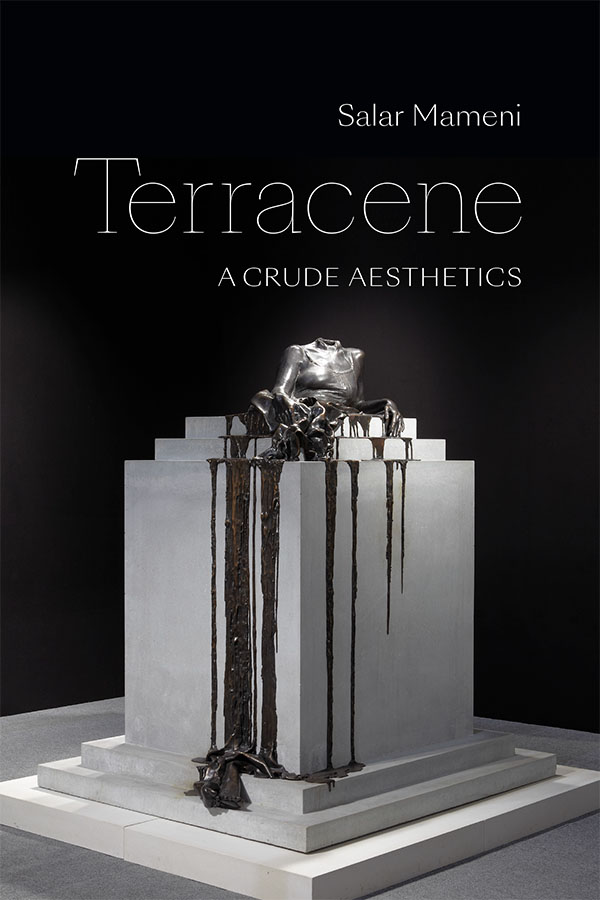
In Terracene Salar Mameni historicizes the popularization of the scientific notion of the Anthropocene alongside the emergence of the global war on terror. Mameni theorizes the Terracene as an epoch marked by a convergence of racialized militarism and environmental destruction. Both the Anthropocene and the war on terror centered the antagonist figures of the Anthropos and the terrorist as responsible for epochal changes in the new geological and geopolitical world orders. In response, Mameni shows how the Terracene requires radically new engagements with terra (the earth), whose intelligence resides in matters such as oil and phenomena like earthquakes and fires. Drawing on the work of artists whose practices interrogate histories of settler-colonial and imperial interests in land and resources in Iran, Iraq, Yemen, Kuwait, Syria, Palestine, and other regions most affected by the war on terror, Mameni offers speculative paths into the aesthetics of the Terracene.
The social consequences of anti-parasitic urbanism, as efforts to expunge noise and biological parasites penalize those viewed as social parasites.
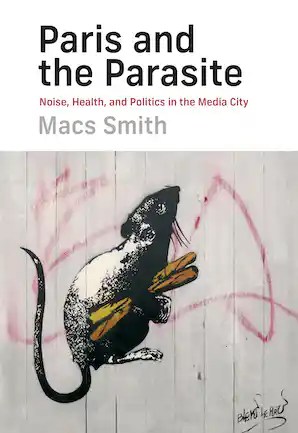
According to French philosopher Michel Serres, ordered systems are founded on the pathologization of parasites, which can never be fully expelled. In Paris and the Parasite, Macs Smith extends Serres’s approach to Paris as a mediatic city, asking what organisms, people, and forms of interference constitute its parasites. Drawing on French poststructuralist theory and philosophy, media theory, the philosophy of science, and an array of literary and cultural sources, he examines Paris and its parasites from the early nineteenth century to today, focusing on the contemporary city. In so doing, he reveals the social consequences of anti-parasitic urbanism.
Smith examines how media shape the design and experience of urban space, as well as how the city passes through layers of mediation. He asks what constitutes noise within a media city. Paris’s municipal government views acoustic noise as a public health threat and calls for its elimination. But the government’s proposals focus on reducing automobile traffic, making it harder for marginalized people to access the city. Thus, a push to eliminate a supposedly biological parasite banishes the so-called social parasites. Questioning the informatic ideologies undergirding modern urbanism, Smith shows both how this anti-parasitic urbanism works and how the banished outsiders noisily intervene, despite their exclusion from the centers of power. The expulsion of social, biological, and mediatic parasites is a governing theme of modern Paris, yet its parasites continually resurge. What is ultimately at stake is how we understand collective life.
There is a discussion at the New Books Network. Thanks to dmf for the link
Now published, though as an expensive hardback and e-book. The front matter, Introduction and first chapter by Daniele Lorenzini are available open access.
My piece in here is entitled “The Yoke of Law and the Lustre of Glory: Foucault and Dumézil on Sovereignty”. It’s the first in a series of pieces exploring the links between Foucault and Dumézil through Foucault’s career. I’m happy to share if you email me.
The Handbook on Governmentality discusses the development of an interdisciplinary field of research, focusing on Michel Foucault’s post-foundationalist concept of governmentality and the ways it has been used to write genealogies of modern states, the governance of societal problems and the governance of the self.
Contributors include: Claudia Aradau, Carol Bacchi, Wendy Brown, Graham Burchell, Partha Chatterjee, Sahil Jai Dutta, Stuart Elden, Ben Golder, Colin Gordon, Jef Huysmans, Jonathan Xavier Inda, Hans-Martin Jaeger, Samuel Knafo, Susanne Krasmann, Clara Lecadet, Emanuele Leonardi, Daniele Lorenzini, Ian Alexander Lovering, Brett Neilson, Luigi Pellizzoni, Cristina Rojas, Nikolas Rose, Srila Roy, Ranabir Samaddar, Maurice Stierl, Martina Tazzioli, Miriam Ticktin, William Walters, Richard Weiskopf, Chenchen Zhang
‘Nearly forty years after his death, governmentality remains Michel Foucault’s most elusive and productive theoretical concept; especially in generating interdisciplinary empirical scholarship. Now with its revelatory introductory chapter and powerhouse collection of leading contemporary scholars, Walters and Tazzioli’s Handbook on Governmentality has demystified the topic and opened governmentality to a new generation of critical researchers across the social sciences and humanities.’ – Jonathan Simon, University of California, Berkeley, US
‘Governmentality has become a ubiquitous term in social and political theory. Stemming from Foucault, the concept has been stretched and even squeezed over the last years. This impressive Handbook lays the basis for a new season in governmentality studies, exploring new geographical and conceptual frontiers. An amazing achievement!’ – Sandro Mezzadra, University of Bologna, Italy
And the abstract for my chapter:
In his 1975-76 course ‘Society Must Be Defended’ Foucault briefly comments on Indo-European sovereignty. His auditors would have recognised a reference to Georges Dumézil, and the editors provide a reference indicating his work. In a series of books, Dumézil proposed his influential tripartite hypothesis, with a division between kings and priests, warriors, and farmers or traders. The first function of sovereignty is itself split between a worldly, juridical form and a magical, supernatural one. It is this distinction, particularly discussed in Mitra-Varuna: An Essay on Two Indo-European Representations of Sovereignty, to which Foucault alludes. Dumézil and Foucault met in the mid-1950s, and Foucault pays tribute to Dumézil in key places, including the History of Madness and his inaugural lecture to the Collège de France. Here the focus is an examination of the sense of sovereignty Foucault develops from Dumézil, and how it relates to the notion of governmentality.
Chris Kraus and Hedi El Kholti discuss the work of the publisher Semiotext(e) at the New Books Network
Best known for its introduction of French theory to American readers, Semiotext(e) has been one of America’s most influential independent presses since its inception more than three decades ago. Publishing works of theory, fiction, madness, economics, satire, sexuality, science fiction, activism and confession.
In this interview Chris Kraus and Hedi El Kholti, who run Semitext(e) alongside Sylvère Lotringer, discuss the history of the press.
Online & River Room, King’s College London, The Strand, London WC2R 2LS, May 19–20, 2023
Culture has always been on the move, but the notion that culture is itself a product of movement is relatively recent. Beginning in the late nineteenth century, scholars hypothesised that the world’s cultures developed not by linear evolution, but through migration, invasion, conquest, trade and exchange. Diffusionism became a master paradigm across several disciplines. The fascination and concern with how movement had shaped cultures historically reflected the anxieties of a time that witnessed more global migrations of people than ever before. Further, the modern quest for lost origins was (and is) inherently entangled in contemporary debates about the rights to land and resources.
This conference explores the relation between scientific and artistic imaginings of prehistoric migrations. To map cultural diffusion is also to theorize the relationship between bodies, place, art, and innovation. When investigating societies who have left no written records, the visual has a dual role: it is both the means by which these cultures are reconstructed, and the tool by which knowledge about them is disseminated. We ask how artists and scholars influenced one another in reconstructing lost origins, and probe the ways that these images were embedded in contemporary debates about race and migration.
Registration details and programme here. Thanks to Adalbert Saurma for the link.
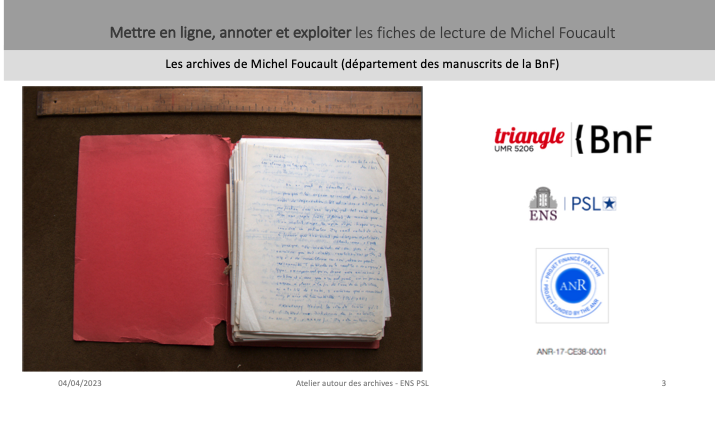
Avec près de 20 000 feuillets numérisés et mis en ligne, la plateforme Eman a permis au projet Foucault fiches de lecture de diffuser très largement le fonds Foucault de la BnF. Nous verrons comment cet outil modulaire a pu être adapté, moins pour la production des données de description et d’indexation que pour leur exposition et exploitation. En particulier, nous présenterons la chaîne de traitement et l’articulation avec les autres outils du projet FFL, le prototype de plateforme collaborative et Transkribus, et les développements informatiques réalisés pour Eman au cours du projet.
Update January 2025: A revised and expanded version of this post is here.
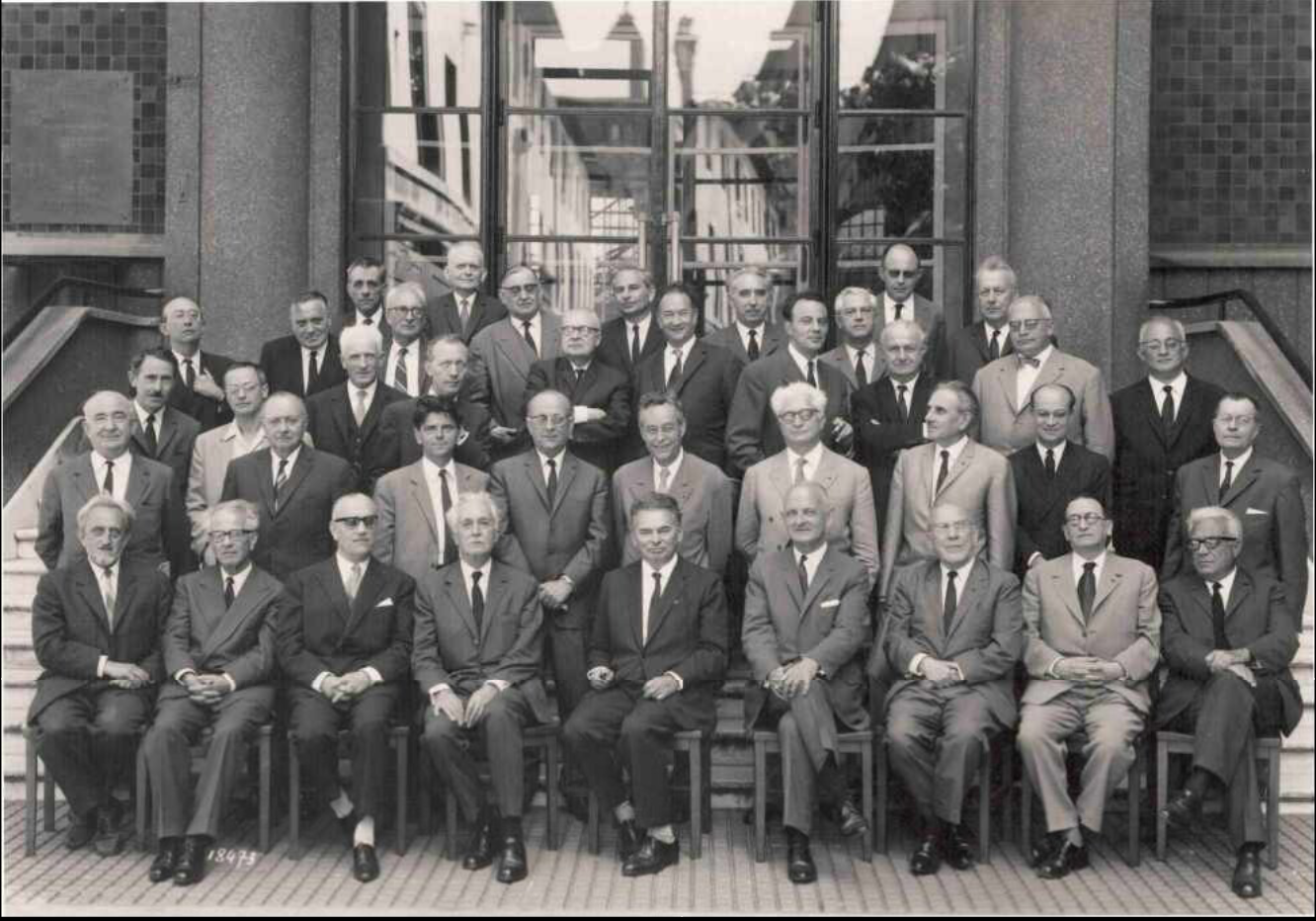
One of the problems with my current project on Indo-European thought in France is how male-dominated it is. If you look at a photograph of the Collège de France in 1967, you can perhaps see why. It wasn’t much better at the Collège de France almost 20 years later (1985).
Professors at the Collège de France, 1967; source: Collège de France archives 4 Fi 4
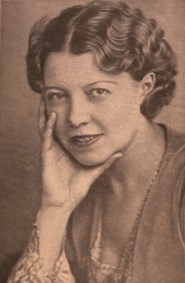
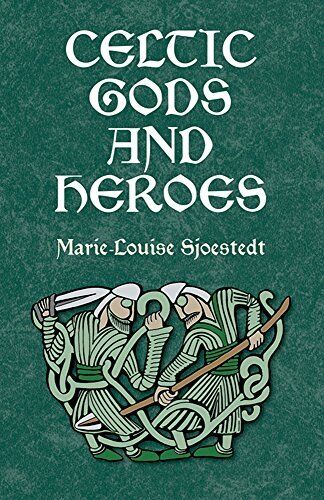
Marie-Louise Sjoestedt is one exception, though she died at the age of just 40. She was the author of several technical works on the Welsh and Irish languages, but also Dieux et héros des Celtes, which is translated as Gods and Heroes of the Celts. Her thesis was supervised by Joseph Vendryes, she studied with Antoine Meillet, was a colleague of Émile Benveniste at the Ecole Pratique des Hautes Études, and one of the editors of Études celtiques. She attended some of Georges Dumézil’s classes but he also notes that he was also her student, and that he taught him Welsh and Irish. Dumézil references her work in Mitra-Varuna, and in the preface to the second edition mentions her as one of those lost in the war – “she was not to survive France’s first misfortunes”.
Natalie Zemon Davis, in a valuable essay on “Women and the World of the Annales” situates Sjoestedt in relation to a wider intellectual network.
Joining [Germaine] Rouillard at the Ecole Pratique in 1926 and under like auspices was a young woman whose family was of Swedish origin, Marie-Louise Sjoestedt. She had published her doctoral thesis that year, a technical linguistic study directed by the great Celtic specialist at the Sorbonne, Joseph Vendryes. Vendryes had just taken over the Celtic program at the Ecole Pratique and brought Sjoestedt along as Chargie de conferences to teach both middle and modern Irish. She continued to work as his associate over the years: in 1936, when the Etudes Celtiques were founded (published by Eugénie Droz), Vendryes was the editor and Sjoestedt was the Secretaire de la Rédaction, while writing reviews and articles for the journal. But, a Directeur d’études from 1930 on, she also developed on her own, marrying a fellow linguist who worked on Baltic languages and Latvian myth, discussing linguistic matters with her colleague at the Ecole, Emile Benveniste, and returning often to Ireland for field work in language and folklore. In 1938, she reviewed a new History of Ireland for the Annales. Her important book on the structure of Celtic myths about gods and heroes was under press as the Germans invaded France. She committed suicide in early December 1940 at age forty; her Dieux et héros des Celtes appeared a few weeks later.
Reviewing the book in the first Annales to appear under the Occupation, [Lucien] Febvre praised Sjoestedt’s ‘remarkable knowledge of the languages, beliefs and customs of the Celtic world’ and regretted that she was gone when so much was still to be expected from her labour.
A collection of tributes – including ones by Benveniste and Dumézil and a brief biography by Louis Renou was published in 1941: Marie-Louise Sjoestedt (1900–1940). In Memoriam, suivi de Essai sur une littérature nationale, la littérature irlandaise contemporaine (Paris: E. Droz, 1941). Vendryes’s obituary was published in Études Celtiques. Her entry in the Dictionary of Irish Biography gives some more details.
I was pleased to be Gabriel’s guest on the Urban Nature podcast for a discussion of several different aspects of my work – on territory, terrain, Lefebvre, Foucault, Shakespeare and even the new Indo-European project.
In this episode of URBAN NATURE, Professor of Political Theory and Geography at the University of Warwick Stuart Elden and Gabriel Kozlowski talk about the intersections between people, place, and power, in relation to concepts such as territory, understood as a political technology, and terrain, as the physical materiality of territory. The discussion touches on Lefebvre’s formulations on the rural, Foucault’s notion of milieu, and ideas around a Politics of the Earth.
“It’s very easy to think that in the past the world was organized in a similar way it is today, except that the borders were different places and that there were different regimes within them.” – Stuart Elden, Professor of Political Theory and Geography at University of Warwick
A ’74PODCAST Series, URBAN NATURE is hosted by Gabriel Kozlowski, Brazilian architect and curator working on urbanization from the perspective of political ecology. The Series presents guests from a diverse set of disciplines—including Anthropology, Biology, Philosophy, Political Science, Political Theory, Geography, Architecture, and the Arts, among others—that have been reflecting on the relationship between humans and nature. Produced by ISTANBUL’74.
Michel Foucault, Le Discours philosophique, eds. Daniele Lorenzini and Orazio Irrera – Gallimard/Seuil/EHESS, 2023
Qu’est-ce que la philosophie et quel est son rôle aujourd’hui ? Entre juillet et octobre 1966, quelques mois après la parution des Mots et les Choses, Michel Foucault, dans un manuscrit très soigneusement rédigé mais qu’il ne publiera pas, apporte sa réponse à cette question tant débattue.
À la différence de ceux qui, à l’époque, s’attachent à dévoiler l’essence de la philosophie ou à en prononcer la mort, Foucault l’appréhende, dans sa matérialité, comme un discours dont il convient de dégager l’économie eu égard aux autres discours (scientifique, fictif, ordinaire, religieux) qui circulent dans un contexte donné.
Le Discours philosophique propose ainsi une nouvelle manière de faire l’histoire de la philosophie, qui la décentre du commentaire des grands philosophes. Nietzsche y occupe toutefois une place particulière car il inaugure une conjoncture où la philosophie…