Indo-European thought in twentieth-century France update 11: Dumézil and Charachidzé’s work on Ubykh; Lévi-Strauss and his archive; Eliade’s correspondence; Koyré’s networks; and continuing work with Dumézil’s archive

My attempt with this project to keep to a broadly chronological order of working through of Georges Dumézil’s major publications (see last update) took a bit of a detour, as his 1931 book La Langue des Oubykhs led me to follow the thread of his career-long work on the Ubykh language, part of the Northwest Caucasian group of languages. I already knew the broad outcline of the story, but there is a lot of detail which I’m trying to piece together. Dumézil was appointed to the University of Istanbul in 1925, and used the opportunity to learn languages and travel. 1930 is really when the Ubykh story begins, when Dumézil follows the lead of work done by Adolf Dirr and visits some of the few villages where exiled Ubykh speakers still lived in Anatolia. Quickly – and as he’d later recognise, too quickly – this leads to La Langue des Oubykhs, which appeared shortly before Julius von Mészáros’s Die Päkhy-Sprache on the same subjectTheir informants were all elderly, and researchers initially thought the language had died out around the time of the Second World War. Dumézil moves from the University of Istanbul to Uppsala in 1931, and during his time there and for a while after his return to Paris in 1933 he concentrates on writing up the research he had done in Turkey on Caucasian linguistics and folktales. He produces a large number of book publications between 1930 and 1939 on these questions, before he takes quite a long break from this topic, at least in book-form. But Dumézil’s work on Ubykh restarts in the 1950s when he is informed that there are still a few isolated speakers left in Turkey.

For the next twenty or so years Dumézil’s work continues with many visits to Turkey, until his health problems in the early 1970s prevented him from travelling. Instead, in the last decade of his life he and his colleague (and former student) Georges Charachidzé bring the last native Ubykh speaker Tevfik Esenç to Paris for long research visits. Esenç had been brought up by his grandparents, which helps to explain the generation gap between him and the other last speakers. One interesting aspect of the story is a rivalry between Dumézil and the Norwegian linguist Hans Vogt, who Dumézil had introduced to his informants. Vogt publishes an Ubykh dictionary in 1963, which Dumézil and Charachidzé work on revising and correcting, then reconstructing the grammar, and develop plans for a brand-new dictionary that continue until Dumézil’s death in 1986. 

Charachidzé continues working with Esenç, including making several visits to Turkey, until Esenç died in 1992, at which point the language is functionally extinct. Charachidzé continues work on his own, and provides various reports of progress, but when he dies in 2010 the dictionary is still unfinished. It remains unpublished. Along the way Dumézil publishes many works on the language, including recording and transcribing Esenç, collections of folktales, elements of the grammar, including the co-authored book Le Verbe Oubykh in 1975, and many shorter pieces often in some unbelievably obscure outlets. Apparently, half the extant corpus of the language is based on work with Esenç, mainly conducted by Dumézil and Charachidzé. Charachidzé publishes some of Dumézil’s work posthumously and adds his own pieces with Esenç to the record. But this work is often unsystematic, and there are many pieces which are correcting previous ones. I have a few of Charachidzé’s own books, which are on Caucasian mythology, history and language, but have also been tracking down copies of some of his shorter publications. The work has taken me to London, Oxford and Paris on the trail of published traces.

I can’t pretend to have any understanding of the grammatical work in itself, or the textual record of the language. Rhona Fenwick published a very expensive English grammar of the language over a decade ago, and has plans for a dictionary. But even though that work is in the hands of experts, I hope I can say something interesting about the history of the project from Dumézil and Charachidzé’s perspective, even though some of the most valuable archival traces are difficult to locate. 

I also did some more work on Claude Lévi-Strauss, particularly his letters. Some of Lévi-Strauss’s correspondence has been published, notably with his parents and with Roman Jakobson, but also letters from Benveniste. There is a lot more in the Lévi-Strauss archive at the Bibliothèque nationale de France. I spent a few useful days going through some of these files, after getting permission from Madame Lévi-Strauss to access the material. In particular I was interested in his correspondence with Dumézil and a few related figures. And I found a really interesting document in the correspondence which was a great surprise to me.

Related to this, I also tried to find out what traces there might be of Lévi-Strauss’s 1950 Loubat Fondation lectures at the Collège de France. These lectures were never published, and I couldn’t work out where they might be held in manuscript. Patrice Maniglier and Emmanuelle Loyer kindly confirmed to me that there is no trace in the BnF archives. I followed some other leads in a different archive which led me to a short summary of the lectures, which hasn’t been published, so that was another interesting discovery. Bernard Dionysius Geoghegan shared some other very interesting documents from Lévi-Strauss’s early career.

I’ve also been getting hold of the published correspondence between Mircea Eliade and Dumézil, Carl Jung, Stig Wikander, and others. His letters to Henry Pernet and Raffaele Pettazzoni are extensive enough to be books, one of which I have and the other I’ve ordered. Some of this correspondence is available in a three volume Romanian collection – with the letters in the language they were written, and a translation into Romanian – but it is certainly incomplete, and more thorough records are in some very hard-to-find places. Alin Constantine has been helpful again here, but some of the outlets have defeated even Warwick’s diligent inter-library loan specialists. At some point I plan to go to the Eliade archive in Chicago, but that’s probably some way in the future.

Most of my time in Paris was spent going through further boxes of the Fonds Dumézil at the Collège de France. There is a huge amount here, and it’s taking me a lot of time. I find useful things in almost every folder, so it’s hard to know which boxes to concentrate my time on. At the moment I’m working through it all, chronologically for the most part, but moving between lectures, material for books and other publications. Apart from the cost of visits to Paris, helpfully mostly covered by the Leverhulme fellowship and department funds, I’ve realised I’m close to breaching the 90 days in any 180 days EU limit. This is a direct result of Brexit, which seems continually to provide more problems. So I am keeping a check on this. For various reasons I’m unable to come back to Paris again until July, which helps with keeping the days limited.

Among the highlights of this trip were Dumézil’s Haskell lectures at the University of Chicago, which exist in the archive as handwritten French originals, French typescripts and English translations with a ton of handwritten annotations. The lectures were published in Mythe et Épopée volume 2, and translated as The Destiny of a King (see my note on how the Mythe et Épopée volumes are partly available in English). There is some correspondence with the translator, Alf Hiltebeitel, who died very recently (obituary note here). Dumézil was asked to contribute something to a Chicago in-house journal, and provided a short and interesting summary text, which was in the archive in a French typescript. I was imagining finding the published translation was going to be a challenge, especially as this text as missed from Hervé Coutau-Bégarie’s very detailed book-length bibliography of Dumézil’s publications. But a bit of hunting around found that almost all the issues of this journal are online.

I was also pleased to discover the name ‘Calvino’ in one of Dumézil’s notebooks, which indicated that they’d met. I wondered if this could be the novelist and essayist Italo Calvino, and yes it was – they both attended a conference in Palermo in 1972, as did Umberto Eco. 

While in Paris I also had a half-day at the Archives Nationales, mainly for some CNRS records, but also found an extensive file of administrative records which shed valuable light on different parts of Dumézil’s career. Benveniste’s letters to Ignace Meyerson were interesting too. I also made several visits to the Mitterand site of the BnF, tracking down some of Dumézil’s more obscure publications like pieces in conference proceedings, and checking a host of references. Coutau-Bégarie’s bibliography is really helpful here, and with some of this stuff I’m trying to get ahead of the broadly chronological approach, so that when I need something I’ve already got a copy. 

And finally, as a post on this site indicated (with an update here), I’ve also been looking at the work of Alexandre Koyré again – someone I have read for many years, and cited in my work on territory, Foucault, Canguilhem and Heidegger. I’m now particularly interested in his role in introducing some key figures to each other – particularly Lévi-Strauss to Jakobson, Dumézil, Benveniste, and Lacan.

Previous updates on this project can be found here, along with links to some research resources and forthcoming publications, including the reedition of Dumézil’s Mitra-Varuna. There is a lot more about the earlier Foucault work here. The final volume, The Archaeology of Foucault, is now out worldwide.
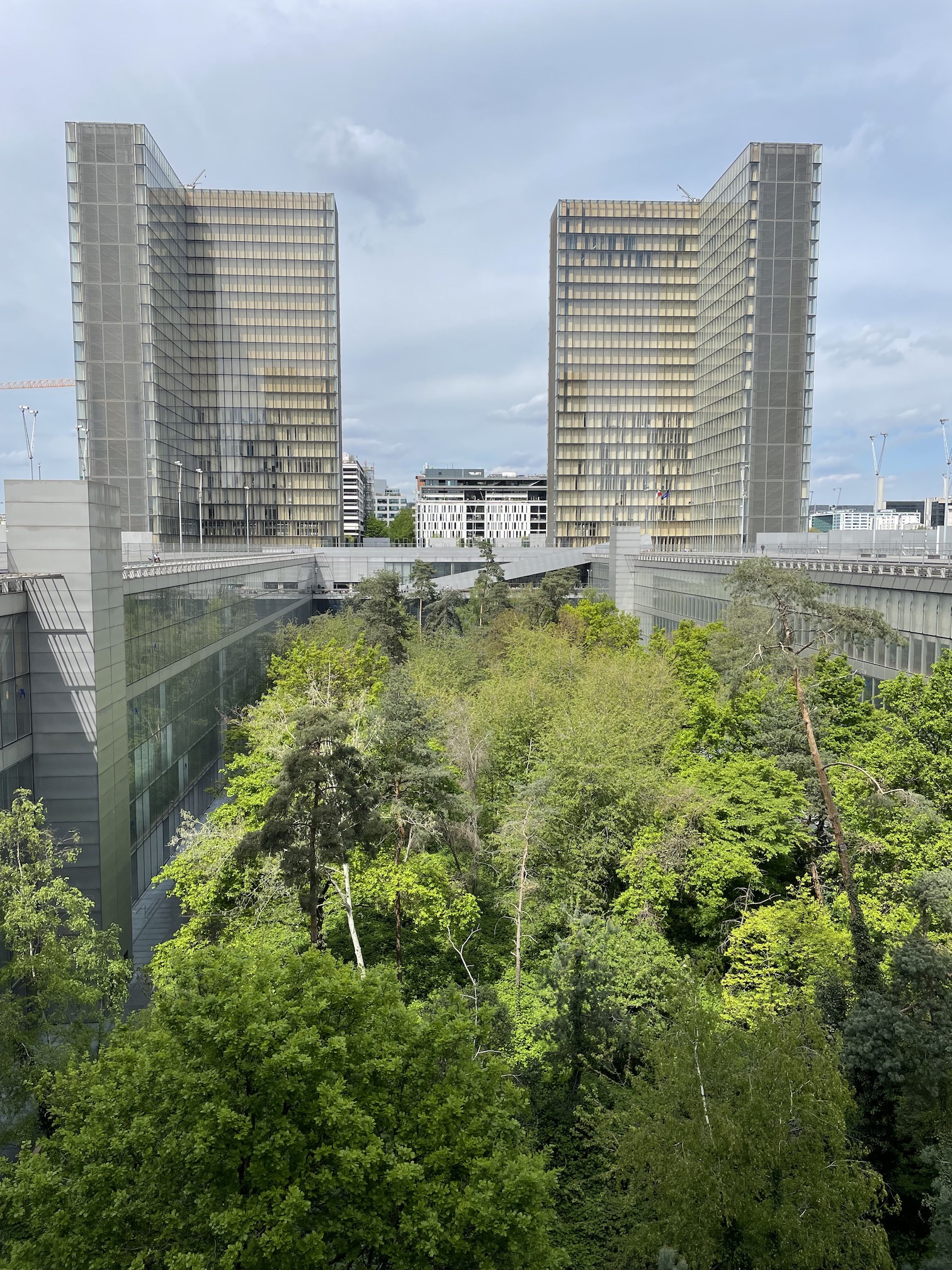
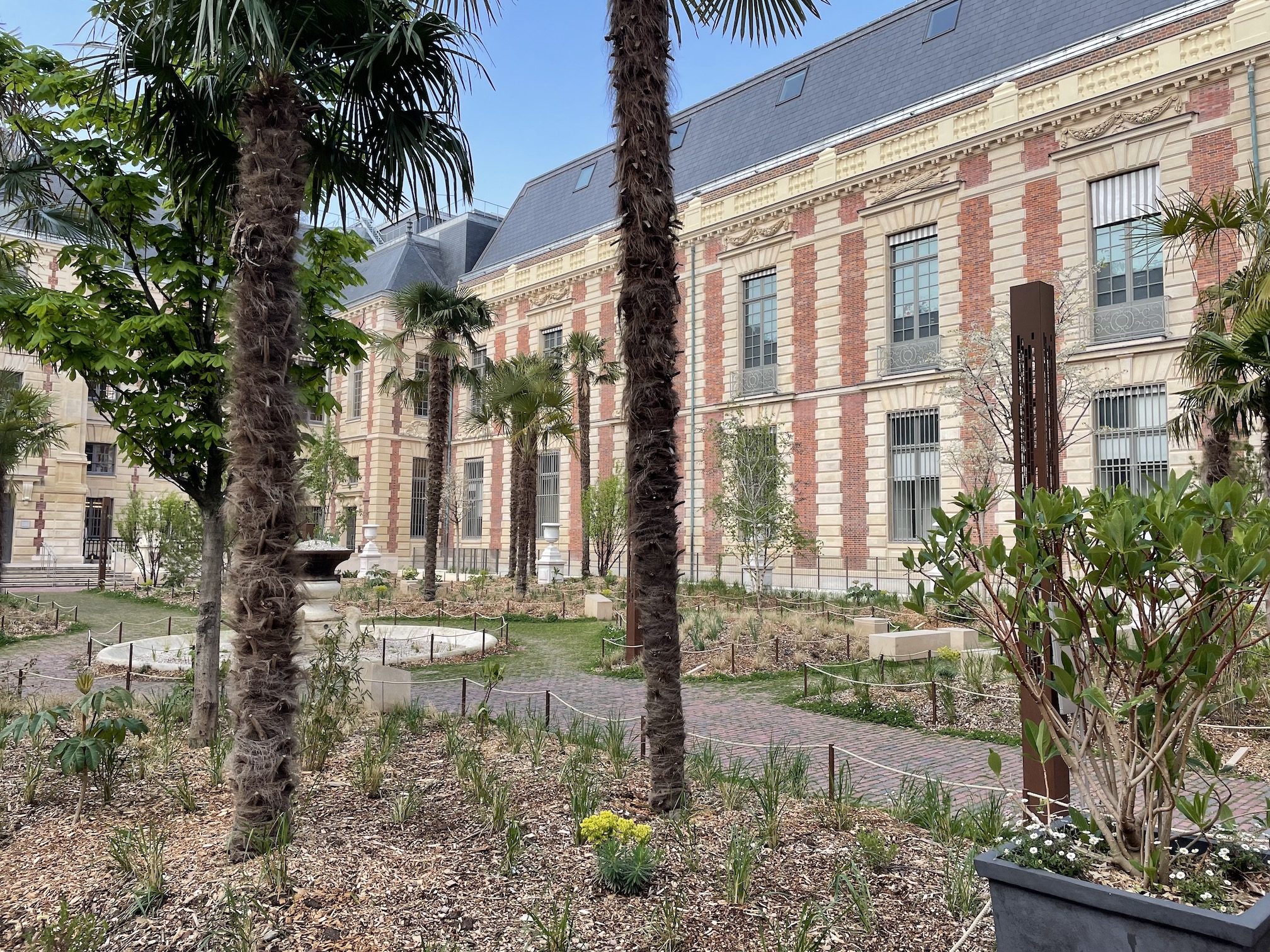
images of the BnF Mitterand, BnF Richelieu, Archives Nationales and Collège de France

Posted in Alexandre Koyré, Claude Lévi-Strauss, Emile Benveniste, Georges Dumézil, Italo Calvino, Jacques Lacan, Mapping Indo-European Thought in Twentieth Century France, Mircea Eliade, Roman Jakobson, Umberto Eco, Uncategorized | 1 Comment

Charisse Burden-Stelly, Black Scare/Red Scare: Theorizing Capitalist Racism in the United States – University of Chicago Press, November 2023

Charisse Burden-Stelly, Black Scare/Red Scare: Theorizing Capitalist Racism in the United States – University of Chicago Press, November 2023

A radical explication of the ways anti-Black racial oppression has infused the US government’s anti-communist repression.
 
In the early twentieth century, two panics emerged in the United States. The Black Scare was rooted in white Americans’ fear of Black Nationalism and dread at what social, economic, and political equality of Black people might entail. The Red Scare, sparked by communist uprisings abroad and subversion at home, established anticapitalism as a force capable of infiltrating and disrupting the American order. In Black Scare / Red Scare, Charisse Burden-Stelly meticulously outlines the conjoined nature of these state-sanctioned panics, revealing how they unfolded together as the United States pursued capitalist domination. Antiradical repression, she shows, is inseparable from anti-Black oppression, and vice versa.
 
Beginning her account in 1917—the year of the Bolshevik Revolution, the East St. Louis Race Riot, and the Espionage Act—Burden-Stelly traces the long duration of these intertwined and mutually reinforcing phenomena. She theorizes two bases of the Black Scare/Red Scare: US Capitalist Racist Society, a racially hierarchical political economy built on exploitative labor relationships, and Wall Street Imperialism, the violent processes by which businesses and the US government structured domestic and foreign policies to consolidate capital and racial domination. In opposition, Radical Blackness embodied the government’s fear of both Black insurrection and Red instigation. The state’s actions and rhetoric therefore characterized Black anticapitalists as foreign, alien, and undesirable. This reactionary response led to an ideology that Burden-Stelly calls True Americanism, the belief that the best things about America were absolutely not Red and not Black, which were interchangeable threats.
 
Black Scare / Red Scare illuminates the anticommunist nature of the US and its governance, but also shines a light on a misunderstood tradition of struggle for Black liberation. Burden-Stelly highlights the Black anticapitalist organizers working within and alongside the international communist movement and analyzes the ways the Black Scare/Red Scare reverberates through ongoing suppression of Black radical activism today. Drawing on a range of administrative, legal, and archival sources, Burden-Stelly incorporates emancipatory ideas from several disciplines to uncover novel insights into Black political minorities and their legacy.

Posted in Uncategorized | Leave a comment

Alexandre Koyré and a network of ideas – some additional reading suggestions

Thank you to everyone who engaged with yesterday’s post Alexandre Koyré and a network of ideas. A few comments here and on Mastodon, but mostly on Twitter. Despite all its problems, I’ve yet to find anything which can replicate the engagement that still provides.

I said I’d link to the suggestions I received, so they are listed below. There are a lot of journal articles on Koyré or related questions, which I didn’t survey in the initial post, but I’ve included suggestions made by others below. I am aware there is a lot more, in multiple languages.

Stefanos Geroulanos, An Atheism that Is Not Humanist Emerges in French Thought (Stanford, 2010) – a great book which I used for The Early Foucault, but to which I should return. Koyré is one of several figures treated.

Jacques Lacan, “Science and Truth”, Cahiers pour l’analyse, reprinted in Écrits – “Koyré is my guide here and, as we know, he is still unrecognised [Koyré ici est notre guide et l’on sait que il est encore méconnu]”. Short bio of Koyré at the Concept and Form website on the Cahiers.  

On Lacan’s use of Koyré, Jean-Claude Milner, L’œuvre claire: Lacan, la science, la philosophie (Seuil, 1995) and Samo Tomšič, “Mathematical Realism and the Impossible Structure of the Real“, Psychoanalytische Perspectieven 35 (1), 2017, 9-34.

The work of Hallhane Machado (researchgate) and Marlon Salomon (cv).

Thanks to Justin Clemens, Stefanos Geroulanos, Marcela Becerra Batán, Marcio Miotto, Dany Nobus, Ted Byfield, Lachy Wells for these suggestions, and others who liked or retweeted to boost the post’s reach.

I’ll add more if there are further suggestions.

Dany said that an in-depth biography is long overdue, and while Zambelli has done a lot I too think much more could be done. But formidable challenges would lie ahead for anyone who tried to tackle it. The breadth of subject matter, from mathematics, physics, philosophy, religion and other themes; he worked in Russian, French, German and English, at least, and I suspect correspondence is in those multiple languages; issues of access to archives, perhaps especially in Russia given the current situation. His position in a network of thinkers and ideas would be part of the appeal of such a project, but it would mean a real challenge in terms of tracking down material and tracing connections.

Update: Rafael Garcia-Suarez has suggested Émilie Hache (ed.), De l’Univers Clos au Monde Infini (Editions Dehors, 2014) and Patrick Flack indicated Michel Espagne’s chapter, “Le détour par l’Allemagne : itinéraires intellectuels de Koyré, Kojève, Gurvitch” in his book L’Ambre et le fossile, 2014.

Update 2: David Liakos has suggested the work of Karsten Harries particularly Infinity and Perspective (MIT, 2001).

Update 3: Zambelli’s biography is translated into French as Alexandre Koyré, un juif errant? and available open access.

Posted in Alexandre Koyré, Jacques Lacan | 4 Comments

Alexandre Koyré and a network of ideas

In several previous projects – on Foucault, Heidegger, Canguilhem, territory – I’ve briefly mentioned the work of Alexandre Koyré. He’s coming up again in the new work in relation to Benveniste, Dumézil, Lévi-Strauss and Jakobson. Koyré introduced Lévi-Strauss to Jakobson in New York, and Jakobson recommended Lévi-Strauss contact Dumézil when back in Paris. Apparently Lacan and Lévi-Strauss first met at a dinner at Koyré’s house. For such a significant figure, there seems to be limited literature.

Koyré had an extraordinary life – born in Russia, exiled to Germany and France, attended lectures by Bergson, Husserl and Heidegger, French foreign legion, taught in Cairo, Paris and New York, colleague of Leo Strauss and Alexandre Kojève, possibly a spy. Koyré was the first administrator of the Ecole libre des hautes études in New York, defeated for a chair at Collège de France (Martial Gueroult was successful), visiting positions at the Princeton IAS, and other major US institutions. He brought notes on some of Heidegger’s lecture courses to Paris, where Jean Wahl used them for his teaching, and these were read by Foucault. Koyré wrote important works on Galileo, Descartes, Newton, on the philosophy of space and mathematics, but also on Heidegger, Hegel, Plato, religion. The Astronomical Revolution and From the Closed World to the Infinite Universe are both great books. He did important editorial and introductory work on several of the thinkers mentioned. He’s a fascinating and historically significant figure.

So why is there so little work on Koyré? I know a biography in Italian by Paola Zambelli, the book-length bibliography of Jean-François Stoffel, Gérard Jorland’s much older French study, and a couple of recent edited collections mainly on the philosophy and history of science – i.e. Jean Seidengart, Vérité scientifique et vérité philosophique dans l’œuvre d’Alexandre Koyré and Raffaele Pisano, Joseph Agassi & Daria Drozdova, Hypotheses and Perspectives in the History and Philosophy of Science.

There is a Centre Alexandre-Koyré as part of the EHESS. His papers are archived there. There are obviously lots of references to Koyré in studies of movements and other people. But that still seems limited, and especially little in English. Am I missing anything good?

Update: some suggestions are listed here. I’ll add more if any are provided. Thanks to everyone for the engagement.

Update 2: Zambelli’s biography is translated into French as Alexandre Koyré, un juif errant? and available open access (a few details on how this expands the Italian edition here).

Update August 2024: My article “Alexandre Koyré and the Collège de France”, is now available online first in History of European Ideas, and it’s open access. I hope this is just the first piece I write about him.

Update September 2024: I say what I’ve found about one of his teaching positions in a post on Koyré in Cairo, and about some of the archival links to Georges Canguilhem and Jean Gottmann.

Posted in Alexandre Koyré, Claude Lévi-Strauss, Edmund Husserl, Emile Benveniste, Georges Canguilhem, Georges Dumézil, Martin Heidegger, Michel Foucault, Roman Jakobson, Territory | 13 Comments

Whatever happened to the Festschrift? And has anyone written about them?

Has anyone written about the history of publishing Festschrift ? There doesn’t seem to be an obvious English equivalent term. They are/were books dedicated to an author at the time of a significant birthday or retirement. Books of celebration, homage or tribute, or commemoration. In French they are sometimes titled as Mélanges, or hommage to someone. They are very often uneven, sometimes including stuff which might never have been published otherwise, and I can understand why publishers were or became reluctant to do them. I can’t imagine they sold very well, and like other edited collections they probably suffered from people only wanting a few pieces, which they might photocopy, but not buy the whole text. The only time I remember being asked to be involved in one it didn’t happen, partly because publishers were reluctant, and the idea shifted to be a thematic collection which was dedicated to the person. But for a period – possibly post-second world war until the 1970s – they were quite common, some people published in them frequently – often making it hard to find copies of their work.

Did anyone ever get invited, contribute something, and then get told that it didn’t fit or wasn’t good enough? How did they handle review, if at all? Was the selection process just about who got invited, and then it was too hard to turn someone down? Some of the pieces seem like “I had an idea, here’s some odd notes on it” – the sort of thing which might, today, be very hard to place. (Possibly with good reason. Though the difficulty of publishing things which are more than a review and not quite an article might be a different discussion.) Did people contribute both to honour the recipient, or because they couldn’t say no, but also to get a contributor copy of something which might have some other interesting pieces in it, and which might be hard to track down otherwise?

They seem like a relic of a different kind of publishing – doubtless filled with problematic gender, race and class discrimination in terms of who was honoured, invited to contribute, etc. or even had the sort of academic position that might be honoured in the first place. We might say then that whatever happened didn’t happen soon enough. But despite all this, which is certainly not minor, they can contain some interesting work…

A bit of looking led to how Alan Soble formulated 13 semi-serious conditions of which 11 are viewable without subscription, and the longest discussion I’ve found is a chapter in Irving Louis Horowitz, Communicating Ideas: The Politics of Scholarly Publishing.

But the semi-curious look for something on them is hindered by searches bringing up things that are themselves Festschriften, not about them. So, a semi-serious question about what happened to them – I think I know, but a more genuine one about whether anyone has tried to write a history of the genre.

[Update: thanks for the various comments online about this post. The best piece I’ve been told about is Graham Whitaker, “Unwrapping the Classical Festschrift” in Stephen Harrison and Christopher Pelling (eds.), Classical Scholarship and Its History: From the Renaissance to the Present. Essays in Honour of Christopher Stray, De Gruyter, 2021. Thanks to Nathan Uglow for this suggestion.]

Posted in Uncategorized | 2 Comments

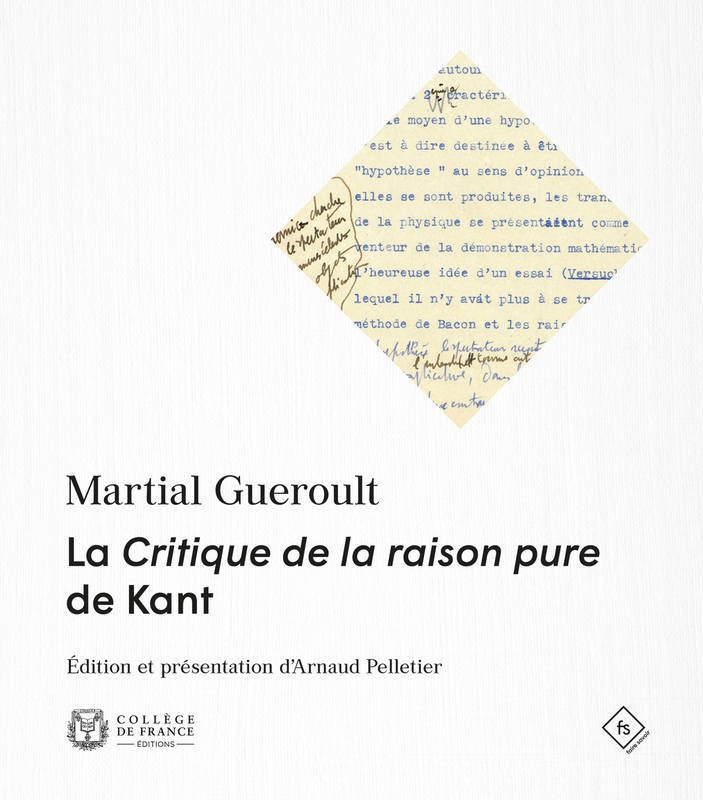
Martial Gueroult, Critique de la raison pure de Kant – previously unpublished lecture course, Éditions du Collège de France, November 2022

Martial Gueroult, Critique de la raison pure de Kant – Éditions du Collège de France, edited by Arnaud Pelletier, November 2022

A previously unpublished lecture course, from 1957-58. Gueroult held the history of philosophy chair at the Collège de France, succeeded by Jean Hyppolite (history of philosophical thought) and then Michel Foucault (history of systems of thought). Also available as text online, though the e-book isn’t open access. There is a piece on the edition by Laure Léveillé here.

Martial Gueroult introduit ainsi le cours qu’il donna au Collège de France en 1957-1958 : « La richesse du sujet choisi : Kant, Critique de la raison pure, nous a conduits à le limiter à l’Esthétique transcendantale et à l’Analytique transcendantale et à lui consacrer nos deux conférences hebdomadaires. Notre propos a été double : donner du texte un exposé aussi clair et précis que possible, élucider non tous les problèmes – ils sont innombrables – mais les plus importants d’entre eux, relatifs à la signification et à l’économie structurale du système. »

D’emblée, le cours s’adresse à deux lecteurs : l’étudiant y lit une présentation remarquable des concepts et arguments fondamentaux de la Critique ; le chercheur y trouve une discussion technique de quelques points centraux, dans laquelle Gueroult se confronte à des commentaires magistraux, surtout allemands, et parfois oubliés de nos jours. Cet ouvrage est l’édition de la version finale de ce cours, retravaillé pendant plus de trente ans et resté inédit jusqu’à aujourd’hui. Sa valeur tant philosophique que pédagogique en fait un livre incontournable pour éclairer une lecture de la Critique de la raison pure.

Né au Havre, Martial Gueroult (1891-1976) fut l’un des grands historiens de la philosophie au XXe siècle. Professeur à l’université de Strasbourg puis à la Sorbonne, il est élu au Collège de France en 1951 sur la chaire Histoire et technologie des systèmes philosophiques. Il est l’auteur d’études d’envergure sur Descartes, Spinoza, Leibniz, Malebranche, Berkeley, Maïmon et Fichte.

Arnaud Pelletier est professeur de philosophie moderne et directeur du Centre de recherche en philosophie de l’Université libre de Bruxelles.

Posted in Immanuel Kant, Jean Hyppolite, Michel Foucault | Leave a comment

Roland Barthes, Le Neutre: Cours au Collège de France (1978) – new edition, ed. Eric Marty, Seuil, April 2023

Roland Barthes, Le Neutre: Cours au Collège de France (1978) – new edition, ed. Eric Marty, Seuil, April 2023

Published today, newly edited, based on the recordings rather than Barthes’s notes. Unlike the other reedited Barthes courses, this isn’t in the Points series, but ‘grand format’. (See my questions and their answers about the reediting practices here.)

Update: there is an interview with Eric Marty at Diakritik.

Le Neutre est le fil rouge de l’œuvre de Roland Barthes, qu’on trouve dès Le Degré zéro de l’écriture et jusqu’à La chambre claire, aussi bien dans les livres, les articles et les entretiens, comme une préoccupation ou une aspiration éthique. Il apparaît pour la première fois au grand jour, explicité comme tel, dans ce cours du Collège de France donné en 1978.

Autrefois publiées sous la forme des notes préparatoires, les treize séances paraissent ici sur la base d’une transcription des enregistrements. On retrouve ainsi l’une des dimensions décisives de la parole de Barthes telle qu’elle se déployait dans son enseignement : la germination du discours, ses dérives, ses boucles, ses excroissances, et le charme incomparable de la phrase.

C’est dire l’importance de ce cours, où le Neutre trouve une formulation ample, détaillée, ouvertement placée sous le signe du fantasme, du projet, ou de la projection.

« On a défini comme relevant du Neutre toute inflexion qui esquive ou déjoue la structure paradigmatique, oppositionnelle, du sens, et vise par conséquent à la suspension des données conflictuelles du discours. […] On a essayé de faire entendre que le Neutre ne correspondait pas forcément à l’image plate, foncièrement dépréciée qu’en a la Doxa, mais pouvait constituer une valeur forte, active. »

Éric Marty a établi l’édition définitive de ce cours et a assuré un système de notes à la fois sobre et efficace. Sa préface rappelle le contexte de la fin des années 1970 et situe les enjeux les plus actuels du Neutre.

Posted in Roland Barthes | Leave a comment

Daniele Lorenzini, The Force of Truth: Critique, Genealogy, and Truth-Telling in Michel Foucault – University of Chicago Press, September 2023

Daniele Lorenzini, The Force of Truth: Critique, Genealogy, and Truth-Telling in Michel Foucault – University of Chicago Press, September 2023

Great to see this book going through production – and three great endorsements at the UCP site, from Arnold Davidson, Verena Erlenbusch-Anderson and Martin Hägglund. [Update there is also a fourth, from Bernard Harcourt.]

[Update November 2023: there is a New Books discussion with Richard Grijalva here]

A groundbreaking examination of Michel Foucault’s history of truth.

Many blame Michel Foucault for our post-truth and conspiracy-laden society. In this provocative work, Daniele Lorenzini argues that such criticism fundamentally misunderstands the philosopher’s project. Foucault did not question truth itself but what Lorenzini calls “the force of truth,” or how some truth claims are given the power to govern our conduct while others are not. This interest, Lorenzini shows, drove Foucault to articulate a new ethics and politics of truth-telling precisely in order to evade the threat of relativism. The Force of Truth explores this neglected dimension of Foucault’s project by putting his writings on regimes of truth and parrhesia in conversation with early analytic philosophy and by drawing out the “possibilizing” elements of Foucault’s genealogies that remain vital for practicing critique today.

Posted in Michel Foucault | Leave a comment

Eglė Rindzevičiūtė, The Will to Predict: Orchestrating the Future Through Science – Cornell University Press, 2023

Eglė Rindzevičiūtė, The Will to Predict: Orchestrating the Future Through Science – Cornell University Press, 2023

In The Will to Predict, Eglė Rindzevičiūtė demonstrates how the logic of scientific expertise cannot be properly understood without knowing the conceptual and institutional history of scientific prediction. She notes that predictions of future population, economic growth, environmental change, and scientific and technological innovation have shaped much of twentieth and twenty-first-century politics and social life, as well as government policies. Today, such predictions are more necessary than ever as the world undergoes dramatic environmental, political, and technological change. But, she asks, what does it mean to predict scientifically? What are the limits of scientific prediction and what are its effects on governance, institutions, and society? 

Her intellectual and political history of scientific prediction takes as its example twentieth-century USSR. By outlining the role of prediction in a range of governmental contexts, from economic and social planning to military strategy, she shows that the history of scientific prediction is a transnational one, part of the history of modern science and technology as well as governance. Going beyond the Soviet case, Rindzevičiūtė argues that scientific predictions are central for organizing uncertainty through the orchestration of knowledge and action. Bridging the fields of political sociology, organization studies, and history, The Will to Predict considers what makes knowledge scientific and how such knowledge has impacted late modern governance.  

Posted in Uncategorized | Leave a comment

Hugh Lopes Williams, ‘Claude Lévi-Strauss and the Political Paradoxes of Structural Anthropology’ – Journal of the History of Ideas blog

Hugh Lopes Williams, ‘Claude Lévi-Strauss and the Political Paradoxes of Structural Anthropology‘ – Journal of the History of Ideas blog

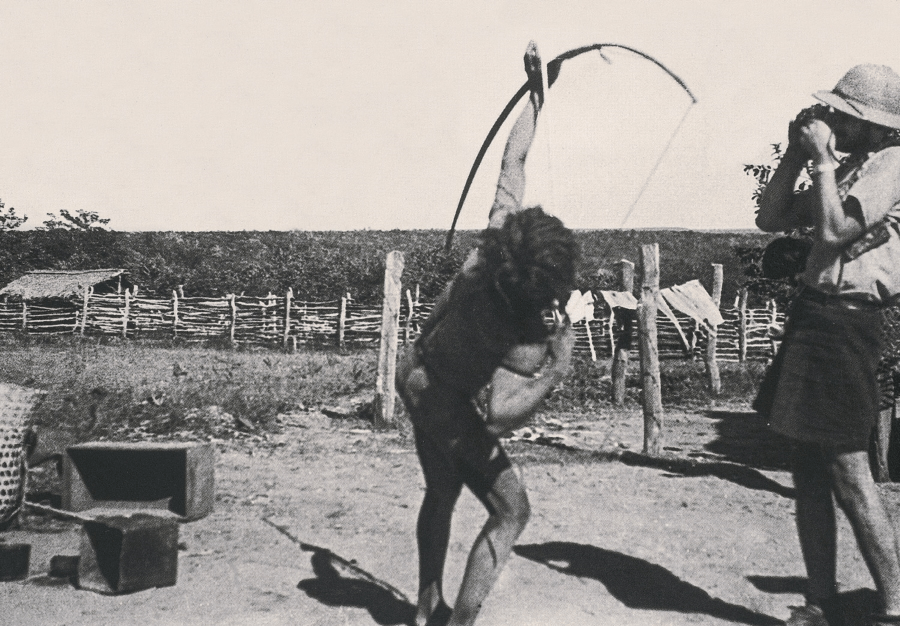
Levi-Strauss photographing a Nambikwara person – Luiz de Castro Faria Archive.

In 1952, Claude Lévi-Strauss, then a respected but by no means famous anthropologist, published the short book Race and History, commissioned by UNESCO as part of its drive to present arguments against racial prejudice from a variety of social-scientific perspectives. Apart from sparking an acrimonious exchange in French intellectual circles between Lévi-Strauss and the colonial apologist Roger Caillois, the book was largely a non-event for Lévi-Strauss’s career, which would only blossom into its maturity later that decade. The book’s argument centered around the premise that evolutionist frameworks in cultural history and anthropology were overly convenient and politically suspect ways of interpreting the fact of cultural diversity, which were by then, comfortably situated in the ethical paradigm of cultural relativism developed by Franz Boas forty years earlier.

Posted in Claude Lévi-Strauss, Uncategorized | Leave a comment