Every Sunday through 2025 I’ve posted a short essay to Progressive Geographies. They are tangential to my main research focus, a home for odd pieces which would not find a more formal place in print, but stories or ideas I thought were interesting enough to develop into these little pieces. They come with references and indications of further reading, and most of them will likely remain just as these fragments, rather than being developed into something else. A few though have had a life beyond this – one was extended into an article, a couple of others became the basis for a grant proposal for a future project. A handful of usually shorter pieces were posted mid-week.
So, if you want to know how Ernst Kantorowicz helped to buy a dog for Erwin Panofsky, why a linguist was asked to help with the disposal of nuclear waste, why Vladimir Nabokov and Roman Jakobson fell out, something about Hannah Arendt’s intellectual friendships, the murder of Ioan Culianu in the bathroom of the University of Chicago’s Divinity School, a Soviet historian with an interest in cryptozoology, or why Edward Said never wrote his planned book on Jonathan Swift, then some of these might be of interest.
I also explore Claude Lévi-Strauss’s visiting lectures at the Collège de France about the wolverine, and why he and Georges Dumézil opposed French reforms about feminine names for professions; what we know about Michel Foucault’s early visits to North America, and his early English translations; or whether Émile Benveniste really did read Jacques Derrida’s Of Grammatology. I discuss a planned co-translation of Hegel’s Phenomenology by Henri Lefebvre and Alexandre Kojève, why Jacques Lacan thought the best image of the unconsciousness was Baltimore in the early morning, and why American Slavic Studies during the Cold War was partly funded by an investment banker who told the world about hallucinogenic mushrooms.
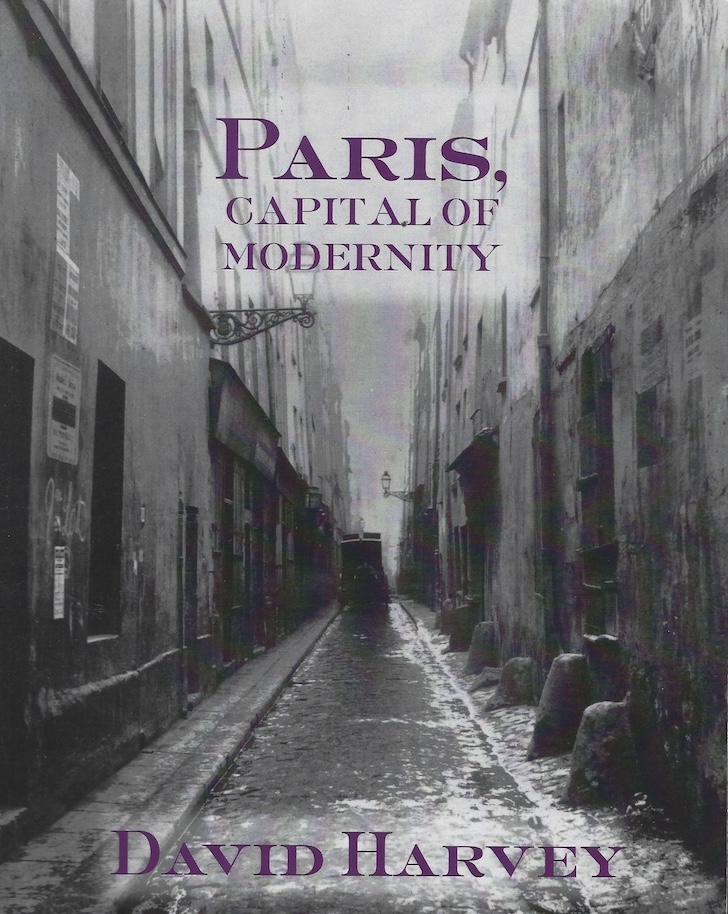
Along the way I say something about what Hegel’s great-grandson wrote about the Aryans, and his translation of Saussure; different aspects of Foucault’s project on sexuality, including his abandoned book on hermaphrodites; what Alexandre Koyré taught in New York and Cairo; how analysis of vocabulary can be helpful in understanding the history of territory; why David Harvey considered his book on Paris to be one of his two most important; and discuss the books written and lectures given by French professors while they were German prisoners of war.
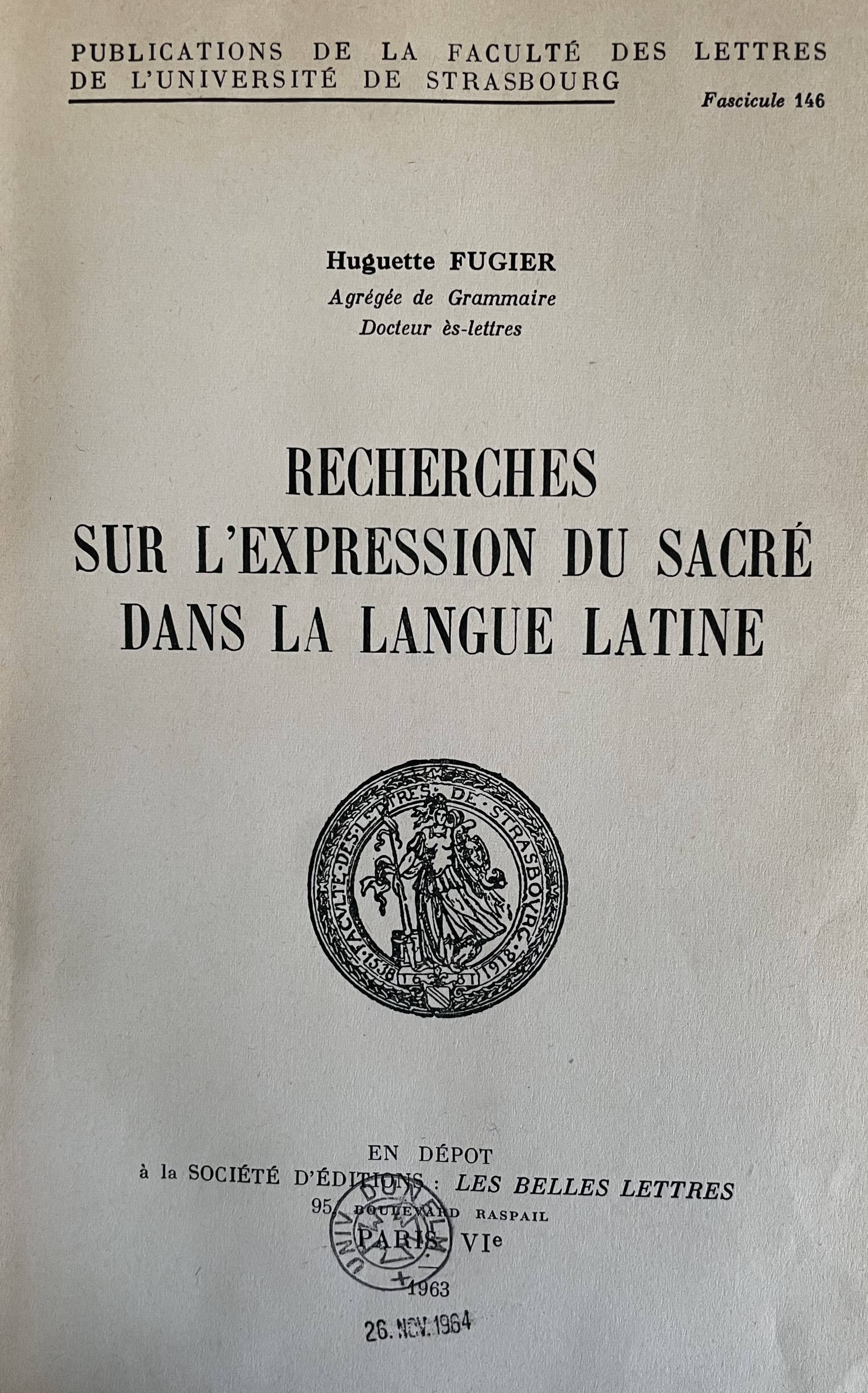
I’m well aware that there are a lot more posts about men than women – this is partly because of the relatively few women in academic posts, especially in France, in the periods I’m working on. But as well as two pieces on Hannah Arendt, I have written about Marie-Louise Sjoestedt’s work on Celtic language and myth, Elisabeth Raucq’s examination of Indo-European animal names, Elizabeth Palmer’s translations, Gillian Rose’s limited connection to the Indo-Europeanists, Huguette Fugier’s research on Latin words for the sacred, and I have ones planned on Clémence Ramnoux’s writings on the pre-Socratics and Marie-Madeleine Davy on mysticism.
There are lots more things discussed in these. There is a chronological listing here, and a thematic one here.
I began the year thinking I had ideas for a few of these, and said I’d try to keep to a regular schedule in February, when I felt reasonably confident I’d be able to do this for a few more months. In June, after six months, I said I was somewhat surprised that I’d managed one every week, but I’ve kept this up throughout the year. I’ve usually had a few in development at the same time, since most require a bit of library work to complete, and that can’t always be done immediately. I’ve returned to a few topics with a bit more detail – sometimes provided an update to an earlier piece, sometimes written a sequel.
These pieces are also a bit of a reaction against academic publishing – its slow processes, its costs, and its metrics. These pieces are posted when I’ve finished them, though they might be revised later; they are free to access (I have no plans to turn these into subscription-only); and they are not intended as ‘outputs’ in the tradition sense.
Those things all still apply – I’ve resisted the idea of turning these into a separate newsletter, so they appear interspersed with the more usual posts about interesting books, conferences and other links. I’ve long known that most people come to this blog because I provide what I hope is a useful service of sharing other people’s work, rather than because of an interest in mine. But hopefully these posts this year have given something else in addition.
It’s hard to know how these are being received, since the comments are relatively few. I don’t trust WordPress stats, since that obviously doesn’t distinguish between someone just landing on a page and actually reading it. I have definitely lost readers since I quit Twitter/X this year. There have been few comments or other indications of how they are being read. But occasionally I’ll get a message out of the blue of how someone chanced on a piece and it made a connection. And one time at a conference I was talking to someone who told me they’d read an interesting piece on a topic which… and I had to point out that I was its author.
I’m not sure I’ll be able to keep up this weekly frequency in 2026, but there will be at least a few more through the year. Thank you to anyone who has read one or more of these pieces.
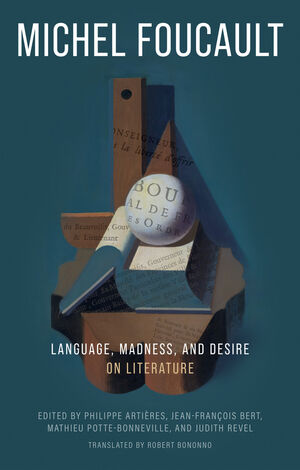
As a transformative thinker of the twentieth century, whose work spanned all branches of the humanities, Michel Foucault had a complex and profound relationship with literature. And yet this critical aspect of his thought, because it was largely expressed in speeches and interviews, remains virtually unknown to even his most loyal readers. This book brings together previously unpublished transcripts of oral presentations in which Foucault speaks at length about literature and its links to some of his principal themes: madness, language and criticism, and truth and desire.
The associations between madness and language — and madness and silence — preoccupy Foucault in two 1963 radio broadcasts, presented here, in which he ranges among literary examples from Cervantes and Shakespeare to Diderot, before taking up questions about Artaud’s literary correspondence, ‘lettres de cachet’, and the materiality of language. In his lectures on the relations among language, the literary work, and literature, he discusses Joyce, Proust, Chateaubriand, Racine, and Corneille, as well as the linguist Roman Jakobson. What we know as literature, Foucault contends, begins with the Marquis de Sade, to whose writing — particularly La Nouvelle Justine and Juliette — he devotes a full two-part lecture series focusing on notions of literary self-consciousness.
This volume makes clear the importance of literature to Foucault’s thought and it is an indispensable text for anyone interested in his work and intellectual development.
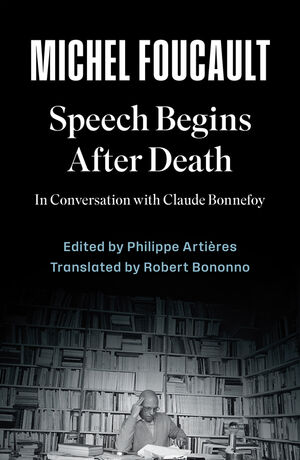
In 1968, Michel Foucault agreed to a series of interviews with critic Claude Bonnefoy, which were to be published in book form. Bonnefoy wanted a dialogue with Foucault about his relationship to writing rather than about the content of his books. The project was abandoned, but a transcript of the initial interview survived and is published here. In this brief and lively exchange, Foucault reflects on how he approached the written word throughout his life, from his school days to his discovery of the pleasure of writing.
Wide ranging, characteristically insightful, and unexpectedly autobiographical, the discussion sheds light on Foucault’s intellectual development, his aims as a writer, his clinical methodology (“let’s say I’m a diagnostician”), and his interest in other authors, including Raymond Roussel and Antonin Artaud. Foucault discloses, in ways he never had previously, details about his home life, his family history, and the profound sense of obligation he feels to the act of writing.
Speech Begins after Death shows Foucault adopting a new language, an innovative autobiographical communication that is neither conversation nor monologue, and is one of his most personal statements about his life and writing.
Some of the largest architecture firms have effectively become war corporations. At the same time as designing Olympic parks and world-famous buildings, they have constructed military bases, maintained weaponry, and trained personnel for wars in which hundreds of thousands of people have been killed. In some conflicts, the same firms have been contracted from invasion to reconstruction, including facilitating military attacks, rebuilding war-damaged infrastructure, and establishing new governments. Architecture for Warfare tells the story of a form of multidisciplinary corporation that employs architects skilled in designing structures alongside former military personnel with experience handling live-fire weapons. It highlights the tensions and contradictions within these architecture-led firms that claim to make the world a better place. The book combines personal narrative with detailed research to reveal unsettling relations between design, planning, and armed conflict.
Describes the emergence of architectural “war corporations”
Combines firsthand accounts with research supported by the Graham Foundation
Roger Caillois and Claude Lévi-Strauss both spent the war in exile from France. Lévi-Strauss had done fieldwork in Brazil in the 1930s, but when he left France he went through Martinique and was detained in Puerto Rico before going to New York City. Caillois spent most of the war in Argentina – he was there when the war broke out, and was unable to return. They were in contact in at least 1942 and 1943 (letters in Odile Felgine, Claude Lévi-Strauss, Roger Caillois…,pp. 109-17). Lévi-Strauss taught at the École Libre des Hautes Études in New York, alongside Alexandre Koyré, Henri Grégoire and Roman Jakobson, among many others. Caillois and Lévi-Strauss both contributed to the École Libre’s short-lived journal Renaissance – it published issue I in 1943 and the double issue II-III in 1944-45.
Caillois was a student and friend of Georges Dumézil, who would provide a lot of support to Lévi-Strauss after the war. But despite their linked lives and intellectual lineages they were to clash violently about Lévi-Strauss’s “Race and History” lecture for UNESCO. Lévi-Strauss’s text was first published in both French and English as short books in 1952, before later being included in his second Structural Anthropology collection. Lévi-Strauss’s piece is very dated today, but the general sentiment seems appropriate – different races cannot be simply compared, much less ranked, and ideas of progress need to be questioned rather than uncritically adopted. Rather than humanity climbing stairs, one step after another, it was more like rolling dice, sometimes getting a good score and sometimes not, new failures and past successes in an unsystematic pattern. Or, to take the example of the roulette wheel, two consecutive numbers might be quite common, but three consecutive ones is rarer, and more than that is very uncommon. Humanity is not advancing on a single path. Claims of superiority of one culture, or the ability to judge another from a privileged viewpoint need to be rejected. Most developments happen through contact between cultures, not internally to a single one.
Caillois’s critique “Illusions à rebours [Reverse illusions]” was published in La Nouvelle Revue française – a journal which was relaunched after the war and, to distance itself from its collaborationist past, was now La Nouvelle Nouvelle Revue française. Although Caillois principally wants to challenge the idea that development is random, there was a colonial viewpoint in his comments. He believed the West was more advanced, and could use that position to appreciate other cultures. Lévi-Strauss replied in 1955 in Les Temps Modernes, with “Diogène Couché [Diogenes asleep]”, a title mocking Caillois’s multi-lingual journal Diogène/Diogenes, also published by UNESCO. A briefer letter from Caillois and a response from Lévi-Strauss, “À propos de ‘Diogène couché’”, appeared in Les Temps modernes later that year.
Although the debate is mentioned in biographies of Lévi-Strauss and Caillois (i.e. Wilcken, Claude Lévi-Strauss, p. 191; Loyer, Lévi-Strauss, pp. 404-45/316-17; Felgine, Roger Caillois, pp. 321-23, 377, 380), and in Pajon’s history of the Diogenes journal (pp. 134-35), the fullest accounts of the rivalry are Michel Panoff’s Les Frères ennemis and Thierry Wendling, “Une joute intellectuelle au détriment du jeu?” There is a discussion by Hugo Lopes Williams of the wider implications for Lévi-Strauss’s work on the Journal of the History of Ideas blog. Bernard Dionysus Geoghegan summarises the stakes well:
In an acid critique, French sociologist Roger Caillois suggested ethnography was not about playing games, like roulette, but about putting together pieces of a puzzle that was the total expanse of humankind. Lévi-Strauss’s 1955 retort to Caillois captured his discontent with traditional ethnographic museums. ‘There exists a major difference between roulette and puzzles [le puzzle]: In the former, play is never complete, while… in the latter every piece of the puzzle has its final place’. The human sciences could never produce a total archive of cultures, for they were defined by virtual relations—structures—rather than physical artifacts (Geoghegan, Code, p. 128; quoting Lévi-Strauss, “Diogène Couché”, 138).
The pieces by Caillois and Lévi-Strauss are the main sources for the positions in the debate, analysed by those secondary accounts. I’ve not been able to find many other primary sources. For example, there is a gap between March 1954 and February 1958 in the published Jakobson-Lévi-Strauss correspondence which therefore does not provide an insight into Lévi-Strauss’s personal reaction. (Pierre-Yves Testenoire adds one 1955 letter to the record, but it is not about this debate.)
A decade later Lévi-Strauss made a few generous remarks about Caillois’s book Pierres in a letter of 12 December 1966 (in Felgine, Claude Lévi-Strauss, Roger Caillois…,pp. 115-17). When he was asked to give another lecture by UNESCO in 1971, entitled “Race and Culture”, he did not mention Caillois. This was a debate he was seemingly happy to let lie. This second UNESCO lecture was included in his The View from Afar collection, effectively the third volume of Structural Anthropology.
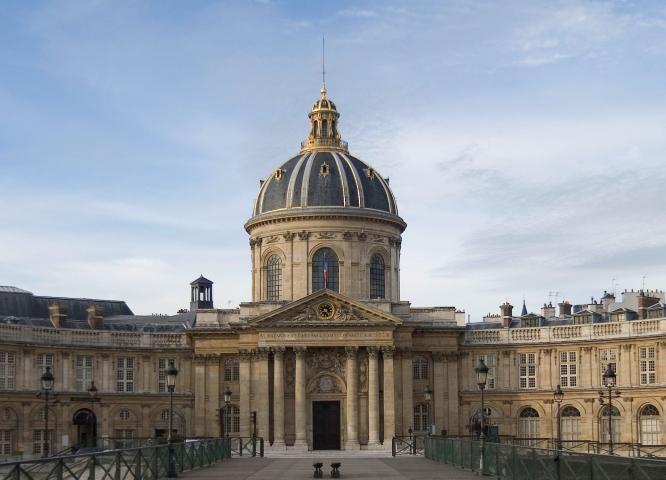
The final resolution was intended to be with Lévi-Strauss’s May 1973 election to the Académie Française. The ceremony was held in June 1974 and, as usual, was marked by two speeches. First, the newly elected academician would eulogise their predecessor in the specific chair, or fauteuil, to which they had been elected; and then an existing member would speak about the new one. Caillois had supported Lévi-Strauss’s election, which had not been straight-forward, and as a token of appreciation, Lévi-Strauss asked him to give the induction speech. He hoped that this would provide closure to the exchange. Lévi-Strauss told Didier Eribon in their dialogues that “the only way I could thank him was to give him the last word. He equivocated a bit, and then accepted” (Lévi-Strauss and Eribon, De près et de loin,p. 124; Conversations, p. 85).
But Caillois did not do what Lévi-Strauss expected. As his biographer Emmanuelle Loyer indicates: “The staid academic ritual was slightly unsettled by the striking speech, of high literary quality… that nonetheless included a scathing critique… of the man whose praises he was supposed to sing” (p. 636/497). As was the custom, the speech had been shared with Lévi-Strauss beforehand, and he wrote to Caillois in reply: “The style is superb, and I find it full of poetry, charm, and even joy, which is no small feat on such a tedious subject” (undated, early 1974, cited in Loyer, Lévi-Strauss, p. 636/497). However, he also indicated several points which he thought were misjudged.
Caillois died in 1978, and as far as I know was never questioned about the Académie française speech. Over a decade later, Eribon asked Lévi-Strauss about the “barbed comments” from Caillois. Lévi-Strauss said that his attempt at resolving the past had not worked: “Caillois took up his old grudge and gave a speech with an ending that had the grating effect you mentioned (the first draft was even more acrimonious)” (Lévi-Strauss and Eribon, De près et de loin,123-24; Conversations, 84-85). The formal speeches were, as was usual, published together and are available online. Once in place, Lévi-Strauss used his position in the Académie to support the election of, among others, Dumézil, Fernand Braudel, Georges Duby and Pierre Nora. He and Dumézil also led the Académie’s resistance to feminine nouns for professions, which I write about here.
A copy of Caillois’s final speech is in Lévi-Strauss’s archives, along with the design of the ceremonial sword, the épée, the commission to fund it, details of investiture, lists of previous occupants of fauteuil 29 and other material (BNF 28150 box 218, folder 4). Press clippings relating to his election and investiture are in folder 3. Another archival find shed a little light on the process. Gordon Wasson – whom I write about here – and Roman Jakobson were both asked to subscribe to the fund for his épée. These individually designed swords, and the ornate green outfit, l’habit vert, are extremely expensive, tens of thousands of euros at today’s prices. It was usual that friends and colleagues would contribute to the cost. Wasson, who had made a fortune as a banker and funded a lot of Slavic studies research in the United States, asked Jakobson on 9 March 1974 how much would be an appropriate amount: “I wish to give enough but I do not wish to be conspicuous by the amount of my gift”. Jakobson replied four days later to say “it was a very luxurious and thus expensive sword”. He had given “$20 but have no idea whether it is too little or too much”. He added: “the whole business with the French Academy and its epee seems ridiculous to me, but c’est la France”.
References
Roger Caillois, “Illusions à rebours”, La Nouvelle Nouvelle Revue française 24, 1954, 1010-24; and 25, 1955, 58-70.
Roger Caillois and Claude Lévi-Strauss, “À propos de ‘Diogène couché’” Les Temps modernes 111, 1955, 1533-36.
Roger Caillois, Pierres (1966) reprinted in Œuvres, ed. Dominique Rabourdin, Paris: Quarto Gallimard, 2008, 1037-86.
Roger Caillois, “Réponse de M. Roger Caillois au discours de M. Claude Lévi-Strauss: Discourse prononcé dans la séance publique, le jeudi 27 juin 1974”, in Discours prononcés dans la séance publique tenue par l’Académie française pour la réception de M. Claude Lévi-Strauss le… 27 juin 1974, Paris: Institut de France, 1974, 19-38, https://www.academie-francaise.fr/reponse-au-discours-de-reception-de-claude-levi-strauss
Odile Felgine, Roger Caillois: biographie,Paris: Éditions Stock, 1994.
Odile Felgine, Claude Lévi-Strauss, Roger Caillois, Jorge Luis Borges, Victoria Ocampo, Jules Superville, Georges Bernados, Antoine de Sainte-Exupéry et L’Ecriture en Exil, Chennevières-sur-Marne: Dianoïa, 2014.
Bernard Dionysius Geoghegan, Code: From Information Theory to French Theory, Durham: Duke University Press, 2023.
Roman Jakobson and Claude Lévi-Strauss, Correspondance 1942-1982, eds. Emmanuelle Loyer and Patrice Maniglier, Paris: Seuil, 2018.
Claude Lévi-Strauss, Race et histoire, Paris: UNESCO, 1952, reprinted in Anthropologie structurale II, 377-422; Race and History, Paris: UNESCO, 1952; reprinted as “Race and History”, Structural Anthropology Volume 2, 323-62.
Claude Lévi-Strauss, “Diogène Couché”, Les Temps Modernes 110, 1955, 1187-1220;reprinted in Cités 81 (1), 2020, 137-68.
Claude Lévi-Strauss, “Race et culture”, reprinted in Le Regard éloigné, Paris: Plon, 1983, 21-48; “Race and Culture”, The View from Afar, trans. Joachim Neugroschel and Phoebe Hoss, New York: Basic Books, 1985, 3-24.
Claude Lévi-Strauss and Didier Eribon, De près et de loin suivi de «Deux ans après», Paris: Odile Jacob, 1990; Conversations with Claude Lévi-Strauss, trans. Paula Wissing, Chicago: University of Chicago Press, 1991.
Emmanuelle Loyer, Lévi-Strauss, Paris: Flammarion, 2015; Lévi-Strauss: A Biography, trans. Ninon Vinsonneau and Jonathan Magidoff, Cambridge: Polity, 2018.
Alexandre Pajon, “In Search of a Journal: Caillois and Diogenes”, Diogenes 40 (160), 1992, 113-43.
Michel Panoff, Les Frères ennemis: Roger Caillois et Claude Lévi-Strauss, Paris: Payot, 1993.
Pierre-Yves Testenoire, “Compléments à la correspondance Jakobson – Lévi-Strauss”, Acta Structuralica – International Journal for Structuralist Research 4, 2019, https://hal.science/hal-02455825
Thierry Wendling, “Une joute intellectuelle au détriment du jeu? Claude Lévi-Strauss vs Roger Caillois (1954-1974)”, Ethnologies 32 (1), 2010, 29-49.
Patrick Wilcken, Claude Lévi-Strauss: The Poet in the Laboratory, London: Bloomsbury, 2010.
Archives
Papers of Roman Jakobson, MIT MC 0072, MIT Distinctive Collections, box 4, folder 31
Fonds Claude Lévi-Strauss, BNF 28150, Bibliothèque nationale de France, box 218, folders 3 and 4
This is the 52nd post of a weekly series, which has been posted throughout 2025. Every Sunday I’ve posted short essays with indications of further reading and sources. They are not as formal as something I’d try to publish more conventionally, but are hopefully worthwhile as short sketches of histories and ideas. They are usually tangential to my main writing focus, a home for spare parts, asides, dead-ends and possible futures. I hope there is some interest in them. They are provisional and suggestions are welcome. A few, usually shorter, pieces in a similar style have been posted mid-week. I’m not sure I’ll keep to a weekly rhythm in 2026, but there will be at least a few more pieces.
The full chronological list of ‘Sunday histories’ is here, with a thematic ordering here.
Examines the formation of a surveillance state through a close examination of Thomas Jefferson’s plantation management techniques and political actions. With the 250th anniversary of the signing of the Declaration of Independence on the horizon, Melissa Adler leads readers to reexamine the principles and foundations upon which the United States is based. By analyzing Thomas Jefferson’s surveillance technologies and practices, including his Farm Book, algorithmic formulas, and land management policies, this book provides a new understanding of the limits to aspirations toward good government, liberty, security, and equality in the United States. In addition to being the principal author of the Declaration of Independence, which famously states that “all men are created equal,” many of Jefferson’s writings feature the rationalization of the enslavement, displacement, and killing of Black and Indigenous peoples. Adler argues that information architectures are mechanisms by which cultural and political divisions endure, and that close examination of Jefferson’s surveillance techniques reveals some of the processes by which problems associated with settler colonialism, racism, and heteropatriarchy have become systemic.
‘Logic of the fantasy’: the expression recurs throughout the Seminar as a leitmotif, yet not a single lesson is devoted to it; not even a briefly sustained development. Does this mean that the logic of the fantasy is here playing the role of some new-fangled mirage? No it doesn’t, not if we can take on board how this logic is the very site at which Lacan’s comments converge, which is what I have sought to indicate by entitling the final chapter ‘The axiom of the fantasy’.
It begins with him audaciously blending the mathematical Klein group and the Cartesian cogito, modified in such a way as to offer up the alternative, ‘Either I am not, or I am not thinking’. On this basis, Lacan summarises the course of an analysis in four phases.
A further mathematico-psychoanalytic blend: the sexual act is illuminated by the light of the Golden number. What ensues is that ‘there is no sexual act’, this being the first trace of what was to become a pons asinorum: ‘there is no sexual relating’.
The reader will also come across the invention of a ‘value of jouissance’, inspired by Marx, and will be surprised to see the big Other, the ‘locus of speech’, being newly defined as ‘the body’, the primordial locus of writing.
A good many other gripping insights and constructions await this reader, if he is minded to follow the meandering, the stalling and the about-turns, along with advances and flashes of brilliance, an obstinate and profoundly honest thinking that, whenever it comes up against a stumbling block, never skirts around it but endeavours to turn it into a cornerstone.
Live, I enjoyed Dream Theater, Steven Wilson, Neal Morse, Remain in Light, Nik Bärtsch’s Ronin, Nik Bärtsch and Kaspar Rast at the Exil club in Zürich, and PKT (PAKT, missing the ‘A’) at a small venue in Brooklyn.
Ethics Across Borders assembles perspectives from geographers, historians, theologians, philosophers, and scientists to explore ethically relevant connections across multiple types of borders.
The contemporary global order is fluid, increasingly unstable, and riven with borders at countless and complex points. Religious, political, and ecological borders hold particular significance, where interactions carry compounding social and environmental consequences. As the first collected volume to look at these three types of borders, both from an interdisciplinary perspective and as distinct forms, it demonstrates the value of thinking across borders as an ethical project. Taking Simone Weil’s perspective that every separation is a link, it posits that separations within sovereignty, species, and religion become links between political, ecological, and theological perspectives, and that boundaries within human life have taken on ecological significance in the age of the Anthropocene. In this framing, religion interacts with the political and the ecological in three ways: as foundational to sovereignty, as an influence on perspectives on contemporary boundaries, and as morally and philosophically implicated in the human/nonhuman interactions that ground environmental ethics.
Ethics Across Borders offers lessons on how to reimagine borders and how to engage more justly with ecological systems and human communities. It will appeal to readers in environmental and religious ethics, philosophy, and border studies.