Stephanie C. Kane, Just One Rain Away: The Ethnography of River-City Flood Control – McGill-Queen’s University Press, December 2022

Stephanie C. Kane, Just One Rain Away: The Ethnography of River-City Flood Control – McGill-Queen’s University Press, December 2022
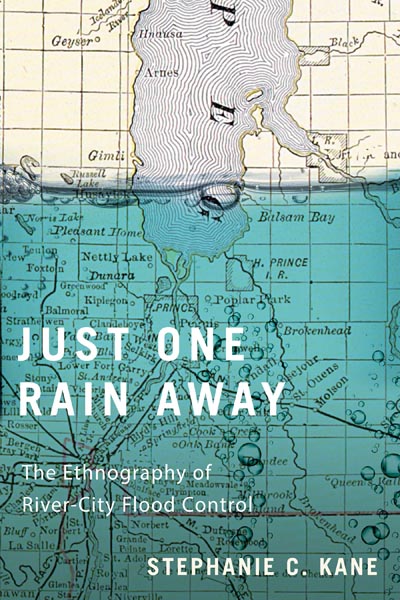
Not long ago it seemed flood control experts were close to mastering the unruly flows funnelling toward Hudson Bay and the Prairie city of Winnipeg. But as more intense and out-of-synch flood events occur, wary cities like Winnipeg continue to depend on systems and specifications that will soon be out of date. Rivers have impulses that defy many of the basic human assumptions underpinning otherwise sophisticated technologies. This is the river-city expression of climate change. 

In Just One Rain Away Stephanie Kane shows how geoscience, engineering, and law converge to affect flood control in Winnipeg. She questions technicalities produced and maintained in tandem with settler folkways at the expense of the plural legal cultures of Indigenous nations. The dynamics of this experimental ethnography feel familiar yet strange: here, many of the starring actors are not human. Ice and water – materializing as bodies, elements, and digital signals – act with diatoms, diversions, sensors, sandbags, and satellites, looping theories about glacial erratics and feminist science studies into scenes from neighbourhood parks, conferences, survey maps, plays, archival photos, a novel, an emergency press conference, LiDAR images, and a lab experiment in a bathtub. 

Through storytelling and environmental analytics, Just One Rain Away provides a starting point for cross-cultural discussions about how expert knowledge and practice should inform egalitarian decision-making about flood control and, more broadly, decolonize current ways of thinking, being, and becoming with rivers.
Posted in Uncategorized | 1 Comment

Ellen Meiksins Wood, A Social History of Western Political Thought – Verso, August 2022

Ellen Meiksins Wood, A Social History of Western Political Thought – Verso, August 2022

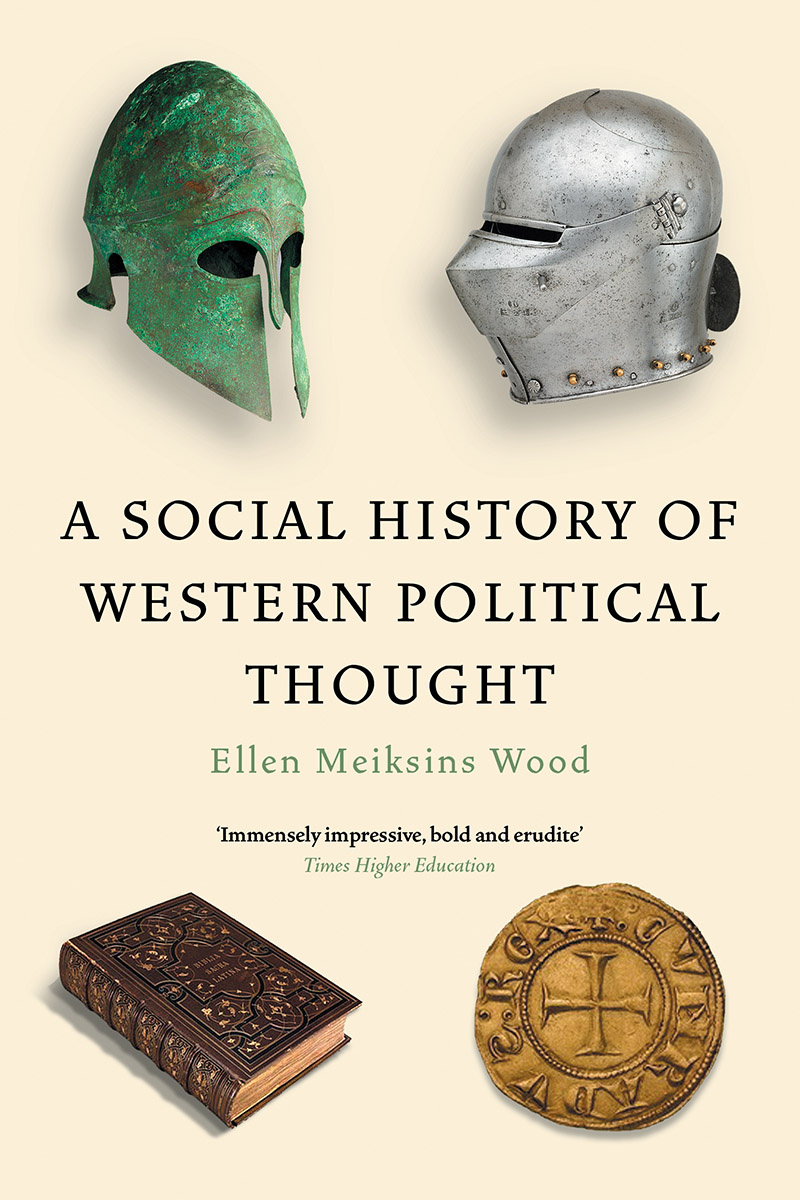
In this groundbreaking work, Ellen Meiksins Wood rewrites the history of political theory, from Plato to Rousseau. Treating canonical thinkers as passionately engaged human beings, Wood examines their ideas not simply in the context of political languages but as creative responses to the social relations and conflicts of their time and place. She identifies a distinctive relation between property and state in Western history and shows how the canon, while largely the work of members or clients of dominant classes, was shaped by complex interactions among proprietors, labourers and states. Western political theory, Wood argues, owes much of its vigour, and also many ambiguities, to these complex and often contradictory relations.

In this new edition, incorporating both volumes, the book takes us from classical antiquity to the age of enlightenement. In the first volume, Wood traces the development of the Western tradition from classical antiquity through to the Middle Ages in the perspective of social history—a significant departure not only from the standard abstract history of ideas but also from other contextual methods. In the second volume, Wood moves on to explore the formation of the modern state, the rise of capitalism, the Renaissance and Reformation, the scientific revolution and the Age of Enlightenment. In her focus on canonical thinkers through the ages, Wood illuminates a rich and provocative legacy of political ideas unmatched in Western history.

Posted in Uncategorized | Leave a comment

Aileen Fyfe, Noah Moxham, Julie McDougall-Waters, and Camilla Mørk Røstvik, A History of Scientific Journals: Publishing at the Royal Society, 1665-2015 – UCL Press, October 2022 (print and open access pdf)

Aileen Fyfe, Noah Moxham, Julie McDougall-Waters, and Camilla Mørk Røstvik, A History of Scientific Journals: Publishing at the Royal Society, 1665-2015 – UCL Press, October 2022 (print and open access pdf)

Modern scientific research has changed so much since Isaac Newton’s day: it is more professional, collaborative and international, with more complicated equipment and a more diverse community of researchers. Yet the use of scientific journals to report, share and store results is a thread that runs through the history of science from Newton’s day to ours. Scientific journals are now central to academic research and careers. Their editorial and peer-review processes act as a check on new claims and findings, and researchers build their careers on the list of journal articles they have published. The journal that reported Newton’s optical experiments still exists. First published in 1665, and now fully digital, the Philosophical Transactions has carried papers by Charles Darwin, Dorothy Hodgkin and Stephen Hawking. It is now one of eleven journals published by the Royal Society of London.

Unrivalled insights from the Royal Society’s comprehensive archives have enabled the authors to investigate more than 350 years of scientific journal publishing. The editorial management, business practices and financial difficulties of the Philosophical Transactions and its sibling Proceedings reveal the meaning and purpose of journals in a changing scientific community. At a time when we are surrounded by calls to reform the academic publishing system, it has never been more urgent that we understand its history.

Posted in Uncategorized | Leave a comment

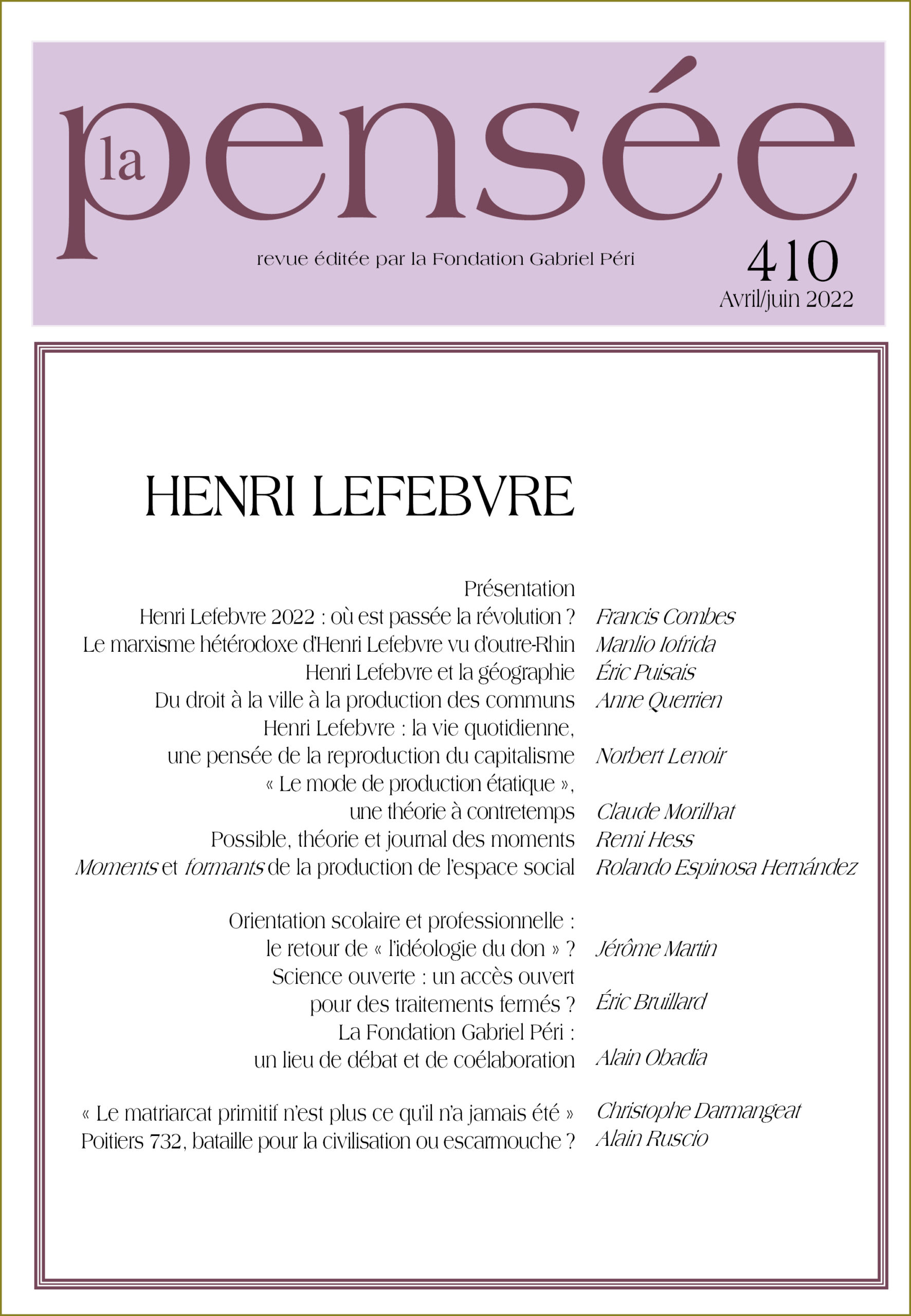
La Pensée 410 – special issue on Henri Lefebvre

La Pensée 410special issue on Henri Lefebvre

Les 24 et 25 mars 2022 s’est tenu à Paris un colloque, organisé par La Pensée, le Groupe d’études du matérialisme rationnel et la Fondation Gabriel Péri, consacré à l’étude et à l’hommage d’Henri Lefebvre.

Henri Lefebvre est un philosophe français mondialement connu, lu et traduit par plusieurs générations dans le monde, son Le marxisme, édité aux PUF dans la collection « Que sais-je ? », est la plus forte vente de cet éditeur depuis 1948.

[…] Le voyage au pays philosophique de Lefebvre peut s’épanouir sous le soleil radieux de l’audace ou s’égarer dans la brume déconcertante des concepts, mais, quoi qu’il en soit, le voyage en vaut la peine. Henri Lefebvre nous oblige à penser dans la bousculade des certitudes ébranlées et dans la résignation d’un confort perdu. Au cours de ce colloque, chacun, tour à tour, a partagé ses enthousiasmes ou confessé ses doutes, pour le plus grand profit de nos lecteurs…

Posted in Henri Lefebvre | Leave a comment

Kristi Sweet, Kant on Freedom, Nature, and Judgment: The Territory of the Third Critique – Cambridge University Press, January 2023 [and open access Introduction]

stuartelden's avatarProgressive Geographies

Kristi Sweet, Kant on Freedom, Nature, and Judgment: The Territory of the Third Critique – Cambridge University Press, January 2023

Another expensive hardback, but looks interesting…

[update: the Introduction is available open access]

Kant’s Critique of Judgment seems not to be an obviously unified work. Unlike other attempts to comprehend it as a unity, which treat it as serving either practical or theoretical interests, Kristi Sweet’s book posits it as examining a genuinely independent sphere of human life. In her in-depth account of Kant’s Critical philosophical system, Sweet argues that the Critique addresses the question: for what may I hope? The answer is given in Kant’s account of ‘territory,’ a region of experience that both underlies and mediates between freedom and nature. Territory forms the context in which purposiveness without a purpose, the Ideal of Beauty, the sensus communis, genius and aesthetic ideas, and Kant’s conception of life and proof…

View original post 78 more words

Posted in Uncategorized | Leave a comment

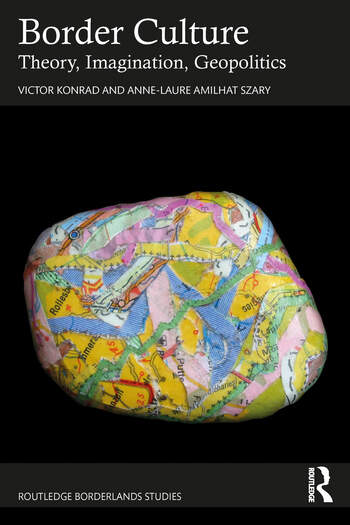
Victor Konrad and Anne-Laure Amilhat Szary, Border Culture: Theory, Imagination, Geopolitics – Routledge, December 2022

Victor Konrad and Anne-Laure Amilhat Szary, Border Culture: Theory, Imagination, Geopolitics – Routledge, December 2022

This book introduces readers to the cultural imaginings of borders: the in-between spaces in which transnationalism collides with geopolitical cooperation and contestation.

Recent debates about the “refugee crisis” and the spread of the COVID-19 pandemic have politicized culture at and of borders like never before. Border culture is no longer culture at the margins but rather culture at the heart of geopolitics, flows, and experience of the transnational world. Increasingly, culture and borders are everywhere yet nowhere. In border spaces, national narratives and counter-narratives are tested and evaluated, coming up against transnational culture. This book provides an extensive and critical vision of border culture on the move, drawing on numerous examples worldwide and a growing international literature across border and cultural studies. It shows how border culture develops in the human imagination and manifests in human constructs of “nation” and “state”, as well as in transnationalism. By analyzing this new and expanding cultural geography of border landscapes, the book shows the way to a fresh, broader dialogue.

Exploring the nature and meaning of the intersection of border and culture, this book will be an essential read for students and researchers across border studies, geopolitics, geography, and cultural studies.

Posted in Boundaries, Territory | 1 Comment

Italo Calvino, The Written World and the Unwritten World: Collected Non-Fiction, translated by Ann Goldstein – Penguin, January 2023

Italo Calvino, The Written World and the Unwritten World: Collected Non-Fictiontranslated by Ann Goldstein – Penguin, January 2023

‘An indispensable writer … Calvino, possesses the power of seeing into the deepest recesses of human minds and then bringing their dreams to life’ Salman Rushdie

The difference between life and literature; the good intentions of holiday reading; the avante-garde; the fate of the novel; the fantastical; the art of translation: these are just some of the ideas in The Written World and the Unwritten World. A collection of essays, articles, interviews, correspondence, notes and other occasional pieces on writing, reading and interpreting books, this work gives us new insight into Italo Calvino’s expansive, curious and generous mind.

Posted in Italo Calvino, Uncategorized | Leave a comment

Michel Foucault Werner Schroeter, la conversation (film) (1981)

Michel Foucault and Werner Schroeter, la conversation (film) (1981)

A not very good quality version is here –

https://www.youtube.com/watch?v=GLcY9Mx8KZ4

French transcript in Dits et écrits, and elsewhere – online here

An English translation is in Foucault at the Movies

Clare O'Farrell's avatarFoucault News

Poster for sale – click picture MICHEL FOUCAULT WERNER SCHROETER, LA CONVERSATION (CARNET FILMÉ : 3 décembre 1981)
Année : 1981. Durée : 1 H 30′

Voir aussi BNF Catalogue Général

An English translation of the conversation between Foucault and Schroeter can be found in Foucault at the Movies

Fiche technique : Réalisation, montage, son, effets spéciaux : Gérard Courant.
Voix : Michel Foucault, Werner Schroeter, Gérard Courant.
Postproduction : Gérard Courant, Pierre Laudijois.
Production : Les Amis de Cinématon, Les Archives de l’Art Cinématonique, La Fondation Gérard Courant.

Présentation

Michel Foucault Werner Schroeter, la conversation (1981) est, après Vivre à Naples et mourir (1978) et Il faut le sauver ! (1980) et avant Werner et Nenad (2009), la troisième des quatre rencontres cinématographiques que j’ai eues avec Werner Schroeter. À la différence des deux premières, cette fois-ci, une personnalité extérieure à l’oeuvre du cinéaste allemand s’est jointe à cette…

View original post 641 more words

Posted in Uncategorized | Leave a comment

Jacques Lacan, Premiers écrits, Seuil, January 2023 [updated]

Updated with some information on the contents, how it relates to a previous out-of-print collection, and plans for a translation.

stuartelden's avatarProgressive Geographies

Jacques Lacan, Premiers écrits, Seuil, January 2023

Avant que d’être psychanalyste, Lacan a été psychiatre. On n’aurait pas republié ses premiers écrits s’ils n’invitaient à une lecture après coup. Que nous apprennent-ils de la formation du futur analyste ?

Sa clinique est enracinée dans l’unicité du cas. Celui-ci n’est jamais choisi que pour sa « singularité ». Il faut qu’il présente un « caractère original », une « atypicité ». On pourrait y reconnaître une orientation vers le « un par un » qu’impose la pratique analytique.

La singularité du cas se retrouve au niveau du détail clinique, serré avec un souci de précision poussé à l’extrême de la minutie. Lacan fera état plus tard de son goût pour « la fidélité à l’enveloppe formelle du symptôme ».

Trois autres traits font traces de l’avenir. C’est l’usage du mot de structure pour désigner l’organisation d’une entité formant un tout…

View original post 147 more words

Posted in Uncategorized | Leave a comment

Mark Atherton, Kazutomo Karasawa, Francis Leneghan (eds), Ideas of the World in Early Medieval English Literature – Brepols, 2002

Mark Atherton, Kazutomo Karasawa, Francis Leneghan (eds), Ideas of the World in Early Medieval English Literature – Brepols, 2002

Looks interesting, but that price!

Across three thematically-linked sections, this volume charts the development of competing geographical, national, and imperial identities and communities in early medieval England. Literary works in Old English and Latin are considered alongside theological and historical texts from a range of disciplinary perspectives. Accounts of travel, foreign contacts, conversion, migration, landscape, nation, empire, and conquest are set within the continual flow of people and ideas from East to West, from continent to island and back, across the period. The fifteen contributors investigate how the early medieval English positioned themselves spatially and temporally in relation to their insular neighbours and other peoples and cultures. Several chapters explore the impact of Greek and Latin learning on Old English literature, while others extend the discussion beyond the parameters of Europe to consider connections with Asia and the Far East. Together these essays reflect ideas of inclusivity and exclusivity, connectivity and apartness, multiculturalism and insularity that shaped pre-Conquest England.

Posted in Uncategorized | 2 Comments