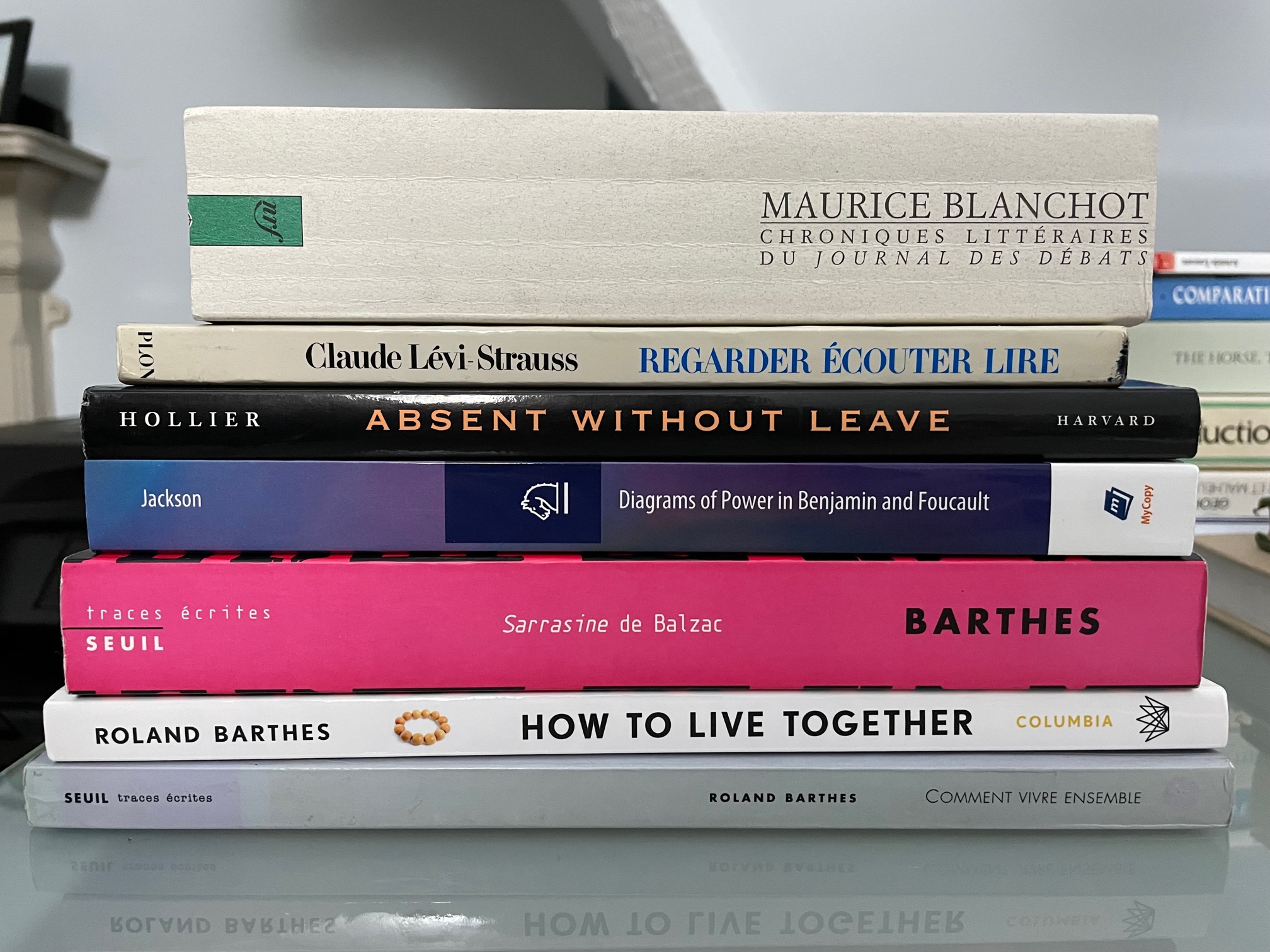
Mainly second-hand books bought for the Indo-European thought project, but also Mark Laurence Jackson, Diagrams of Power in Benjamin and Foucault: The Recluse of Architecture, in recompense for review work.
A must-read follow-up to The Structure of Scientific Revolutions, one of the most important books of the twentieth century.
This book contains the text of Thomas S. Kuhn’s unfinished book, The Plurality of Worlds: An Evolutionary Theory of Scientific Development, which Kuhn himself described as a return to the central claims of The Structure of Scientific Revolutions and the problems that it raised but did not resolve. The Plurality of Worlds is preceded by two related texts that Kuhn publicly delivered but never published in English: his paper “Scientific Knowledge as Historical Product” and his Shearman Memorial Lectures, “The Presence of Past Science.” An introduction by the editor describes the origins and structure of The Plurality of Worldsand sheds light on its central philosophical problems.
Kuhn’s aims in his last writings are bold. He sets out to develop an empirically grounded theory of meaning that would allow him to make sense of both the possibility of historical understanding and the inevitability of incommensurability between past and present science. In his view, incommensurability is fully compatible with a robust notion of the real world that science investigates, the rationality of scientific change, and the idea that scientific development is progressive.
Only a really expensive hardback listed, but this looks to be a major study.
Celestial Inclinations provides a new perspective on the life and career of the first Roman emperor Augustus (63 B.C.-A.D. 14). It presents the case that Augustus used his knowledge of the celestial sphere to confirm for himself and convey to others that the heavens supported his activities on earth and his inevitable greatness. The book is based on fresh assessments of ancient historical, literary, astronomical, astrological, and artistic sources for the years prior to and during the life of Augustus. Anne-Marie Lewis combines these sources with astronomical sky maps and astrological diagrams to offer fresh interpretations of critical events in the life of Augustus at a time when the celestial sphere had come to play an important cultural and political role. Some of those events involve the identification of the celestial object that appeared at the ludi in honor of Caesar in 44 B.C.; the Battle of Actium; the iconography of the Tellus Relief Panel on the Ara Pacis Augustae; the Ludi Saeculares; Augustus’ major building projects in Rome; and Augustus’ interactions with major figures of the period such as Cicero, Caesar, Agrippa, and Antonius.
Proudhon’s anarchist theory of international relations, a 19th-century vision of what might have been and could still be.
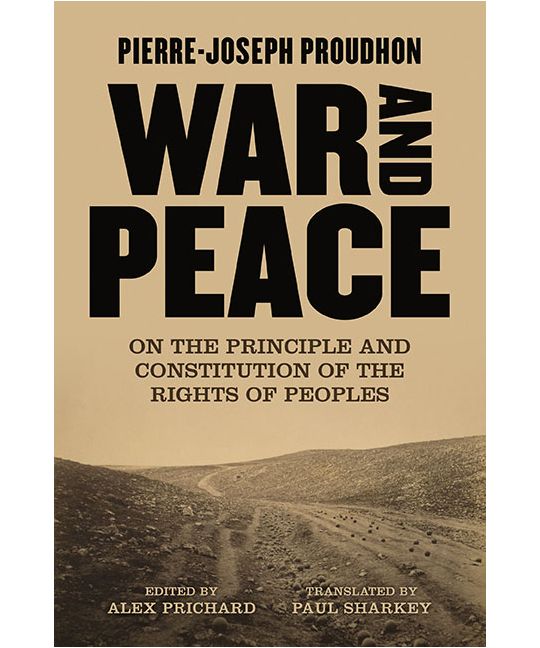
War and Peace by Pierre-Joseph Proudhon, originally published in 1861, is still one of the only extended accounts of anarchist international theory and is one of the earliest in the history of socialist thought. It is a profound contribution to the traditions of jus gentium and just war theory, that puts force and power at the centre of analysis. Alex Prichard’s introduction describes both its specificity and the multiple lines of influence War and Peace had on thinkers as diverse as Tolstoy, Sorel, French sociology more broadly, and post-1945 Anglo-American International Relations theory.
In engaging essays, celebrated anthropologist Marilyn Strathern reflects on the complexities of social life.
Property, Substance, and Effect draws on Marilyn Strathern’s longstanding interest in the reification of social relations. If the world is shrinking in terms of resources and access to them, it is expanding in terms of new candidates for proprietorship. How new relations are brought into being is among the many questions about property, ownership, and knowledge that these essays bring together.
Twenty years have not diminished the interest in the book’s opening challenge: if one were inventing a method of enquiry by which to configure the complexity of social life, one might wish to invent something like the anthropologist’s ethnographic practice. A wide range of studies deliberately brings into conversation claims people make on one another through relations imagined in the form of body-substance along with the increasing visibility of conceptual or intellectual work as property. Whether one lives in Papua New Guinea or Great Britain, categories of knowledge are being dissolved and reformed at a tempo that calls for reflection—and for the kind of lateral reflection afforded through the “ethnographic effect.”
“A timely gift. An exercise in both retrospection and imagining worlds and relations otherwise, the book is full of mind-bending reflections on how we might think with a world marked, as ever, by scale-scrambling change. These essays offer something sorely needed right now: a brilliant model of how to embrace and think with incommensurability and instability.”
— Cori Hayden, author of When Nature Goes Public: The Making and Unmaking of Bioprospecting in Mexico
“Strathern’s reflections on the figures of nature, person, and commodity have if anything gained in actuality and acuity, and her contrastive analyses of Melanesia and Euro-America are absolutely indispensable to an understanding of contemporary themes such as the rights of nature, the ecological politics of property, and the constitution of racialized capital.”
— Alain Pottage, coeditor of Law, Anthropology, and the Constitution of the Social: Making Persons and Things
“A profound theoretical reflection on ethnographic activity, this book frames a set of analytical experiments where the intrinsic recursivity of the language of description as object, method, and instrument of analysis is taken to the highest point of epistemic tension. Marilyn Strathern continues here her paradigm-shifting work on knowledge as social relation and vice versa.”
Just an expensive hardback listed at the moment, unfortunately.
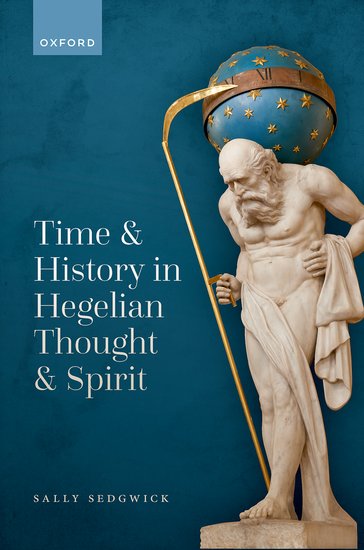
Time and History in Hegelian Thought and Spirit examines a conspicuous feature of Hegel’s major works: that they are progressive narratives. They advance from less to more perfect, abstract to concrete, indeterminate or empty to determinate. This is true, argues the author, of his lectures on aesthetics and on the history of philosophy, and it is also true of his most abstract work, the Science of Logic.
In answer to the question of why is it so important for Hegel to structure his various philosophical works as developmental narratives, this book defends the thesis that Hegel’s motivation is in part metaphysical, intending his developmental accounts to reveal something significant about who we are as thinking, willing natures. He undertakes his study of past in order to demonstrate that there have been advances in the nature of human thought or reason itself and in our resulting freedom and his concern with our reason’s development conveys his interest in how human reason is anchored in and shaped by its past. Ultimately, this book specifies the extent to which we can accurately attribute to Hegel the view that human reason and the freedom it affords us are indebted for their nature to this temporal order of nature and history.
I’m late to noticing this book, which looks interesting:
Serial Forms: The Unfinished Project of Modernity, 1815-1848 proposes an entirely new way of reading the transition into the modern. It is the first book in a series of three which will take the reader up to the end of the First World War, moving from a focus on London to a global perspective. Serial Forms sets out the theoretical and historical basis for all three volumes. It suggests that, as a serial news culture and a stadial historicism developed together between 1815 and 1848, seriality became the dominant form of the nineteenth century. Through serial newsprint, illustrations, performances, and shows, the past and the contemporary moment enter into public visibility together. Serial Forms argues that it is through seriality that the social is represented as increasingly politically urgent. The insistent rhythm of the serial reorganizes time, recalibrates and rescales the social, and will prepare the way for the 1848 revolutions which are the subject of the next book. By placing their work back into the messy print and performance culture from which it originally appeared, Serial Forms is able to produce new and exciting readings of familiar authors such as Scott, Byron, Dickens, and Gaskell. Rather than offering a rarefied intellectual history or chopping up the period into ‘Romantic’ and ‘Victorian’, Clare Pettitt tracks the development of communications technologies and their impact on the ways in which time, history and virtuality are imagined.
There is a review in Critical Inquiry by David Kurnick, which has a little more on how it is part of an ambitious project:
The book is the first of a projected trilogy that will follow its argument through the First World War (the second volume, Serial Revolutions: 1848, is announced as forthcoming): Pettitt’s readers will shortly be able to assess a bit more of her compelling argument’s historical and theoretical reach.
Hardback and e-book, with two chapters open access
What does ‘autonomy’ mean today? Is the Enlightenment understanding of autonomy still relevant for contemporary challenges? How have the limits and possibilities of autonomy been transformed by recent developments in artificial intelligence and big data, political pressures, intersecting oppressions and the climate emergency? The challenges to autonomy today reach across society with unprecedented complexity, and in this book leading scholars from philosophy, economics, linguistics, literature and politics examine the role of autonomy in key areas of contemporary life, forcefully defending a range of different views about the nature and extent of resistance to autonomy today. These essays are essential reading for anyone who wants to understand the predicament and prospects of one of modernity’s foundational concepts and one of our most widely cherished values.
Update: Verso editor Sebastian Budgen comments on the book here
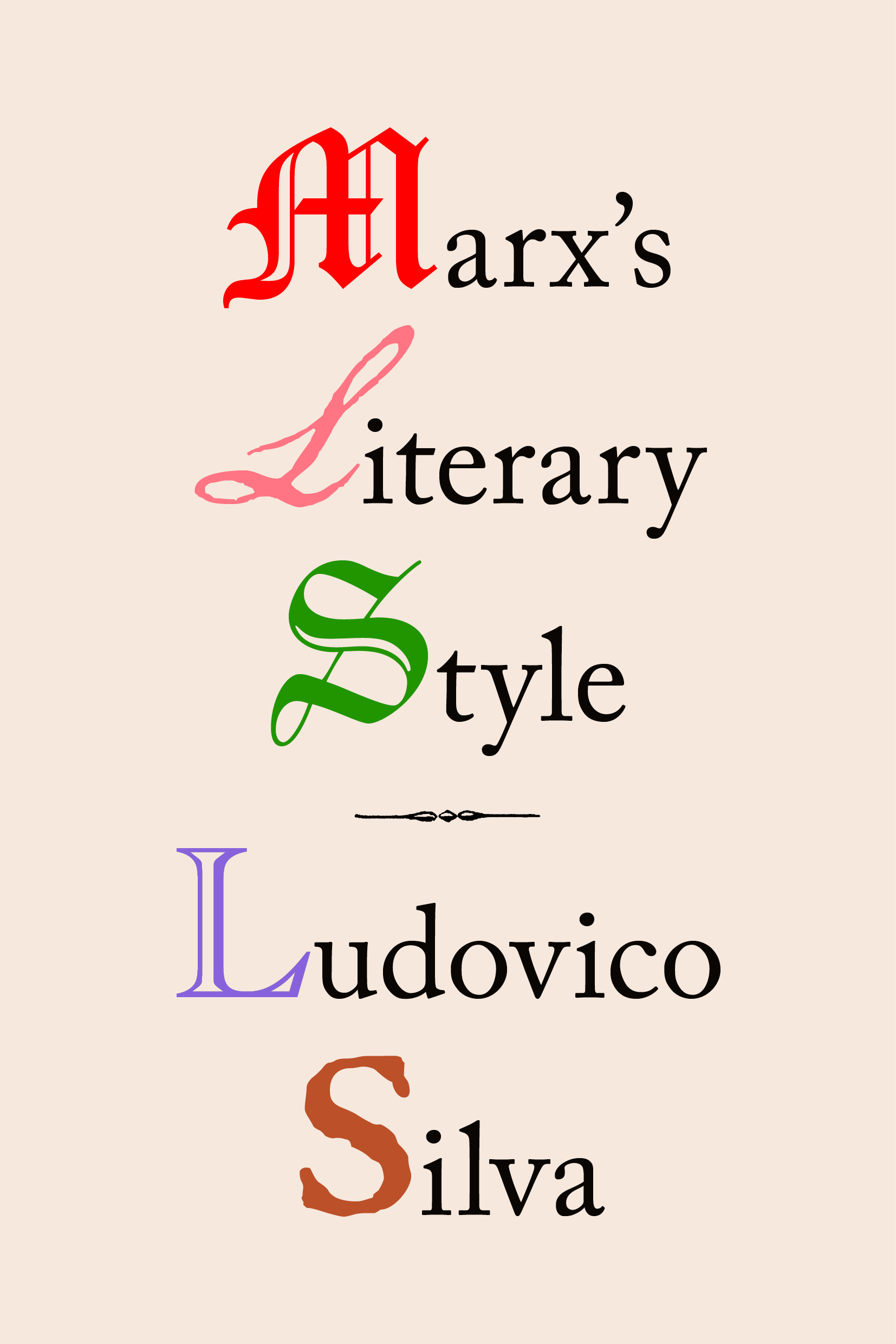
A true understanding of Marx’s work requires a careful study of his literary choices
In Marx’s Literary Style, the Venezuelan poet and philosopher Ludovico Silva argues that much of the confusion around Marx’s work results from a failure to understand his literary mode of expression. Through meticulous readings of key passages in Marx’s oeuvre, Silva isolates the key elements of his style: his search for an “architectonic” unity at the level of the text, his capacity to express himself dialectically at the level of the sentence, and, above all, his great gift for metaphor. Silva’s unique sensitivity to Marx’s literary choices allows him to illuminate a number of terms that have been persistently, and fatefully, misunderstood by many of Marx’s most influential readers, including alienation, reflection, and base and superstructure. At the heart of Silva’s book is his contention that we we cannot hope to understand Marx if we treat him as a scientist, a philosopher, or a literary writer, when he was in fact all three at once.
Originally published in 1971, this is a key work by one of the most important Latin American Marxists of the twentieth century. This edition, which marks the first appearance of one of Silva’s works in English, features an introduction by Alberto Toscano.
“We’ve waited a long time for an English-language edition of this brilliant, agenda-setting work. The book is indispensable. To read it is to learn how inadequate it is to describe any metaphor – and certainly any of Marx’s – as “mere” ever again.” – China Miéville
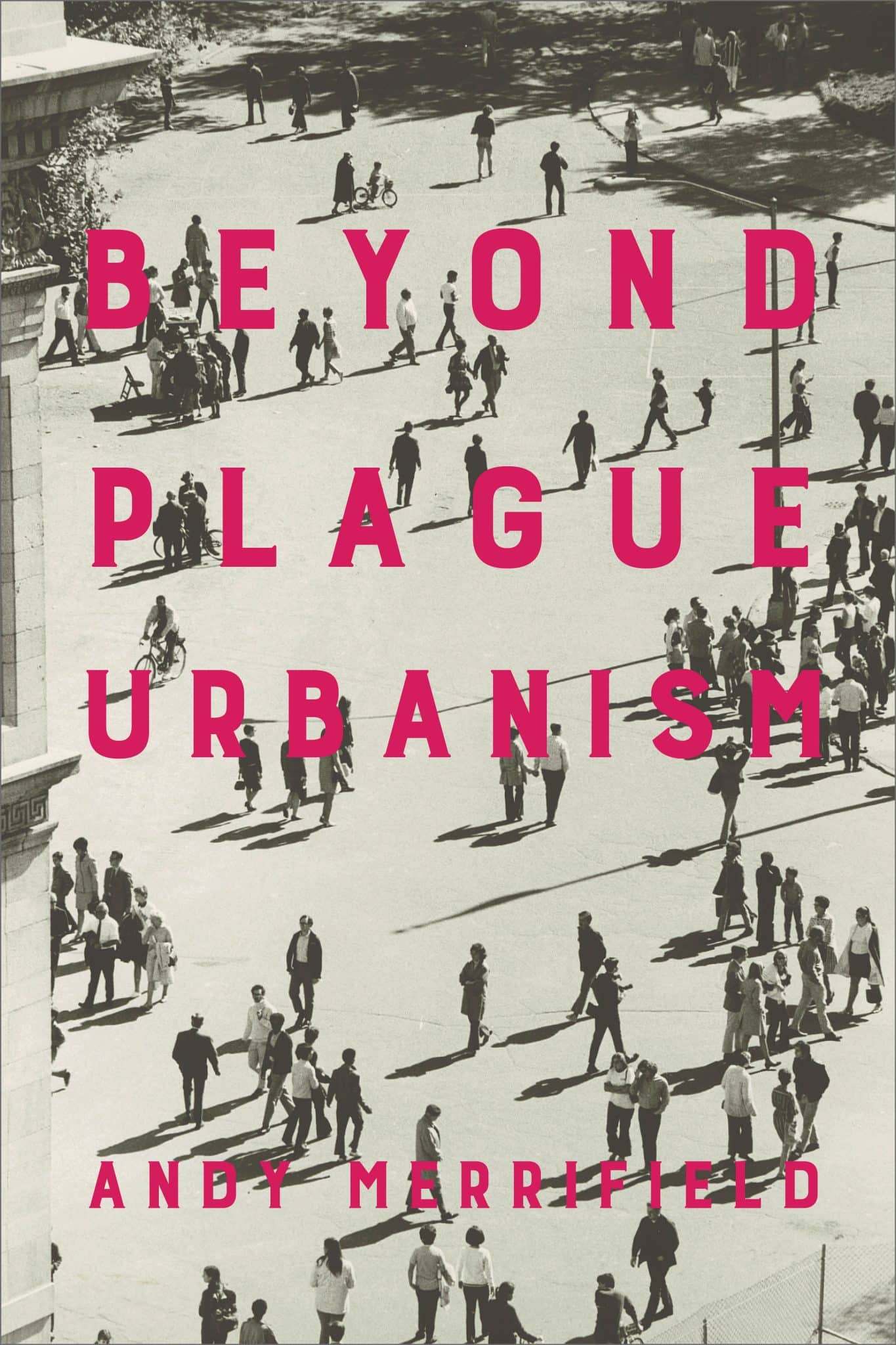
Andy tells me the striking cover image is by André Kertész.
Our cities have been plagued by economic injustices and inequalities long before COVID-19 upended urban life everywhere. Beyond Plague Urbanism delves into this zone of urban pathology and wonders what successive lockdowns and exoduses, remote work and small-business collapse, redundant office space and unaffordable living space portend for our society in cities and our cities in society.
The city has historically been a Great Book inspiring a liberal education, the kind that teaches you how to become a citizen of the world. The city was always an existential rite of passage, especially for young people, broadening horizons, deepening your whole being. But lately our great seat of learning has remaindered a lot of its classics texts, closed down public access, and auctioned off its campus to the highest bidder. The city’s romance is already talking alimony. How to resuscitate the city as a vast open-air public library? How to redraft this Great Book together? How to dialogue anew about its table of contents, re-typesetting the future social life contained within its leaves?
Andy Merrifield journeys intercontinentally as he reflects on these questions, in a narrative that moves imaginatively between literature and life, plague and populist politics, public values and private inclinations, the U.S. Main Street and the British High Street, overcrowding and undercrowding, the right to the city today and eco-cities of tomorrow. Blending modern jazz with French Surrealism, Thomas Pynchon’s rocket science with the odyssey of James Joyce, Henri Lefebvre’s Marxism with the street ballets of Jane Jacobs, this challenging book appears at a timely moment in our fraught political history and opens up an urgent humanist conversation about the future of city life.