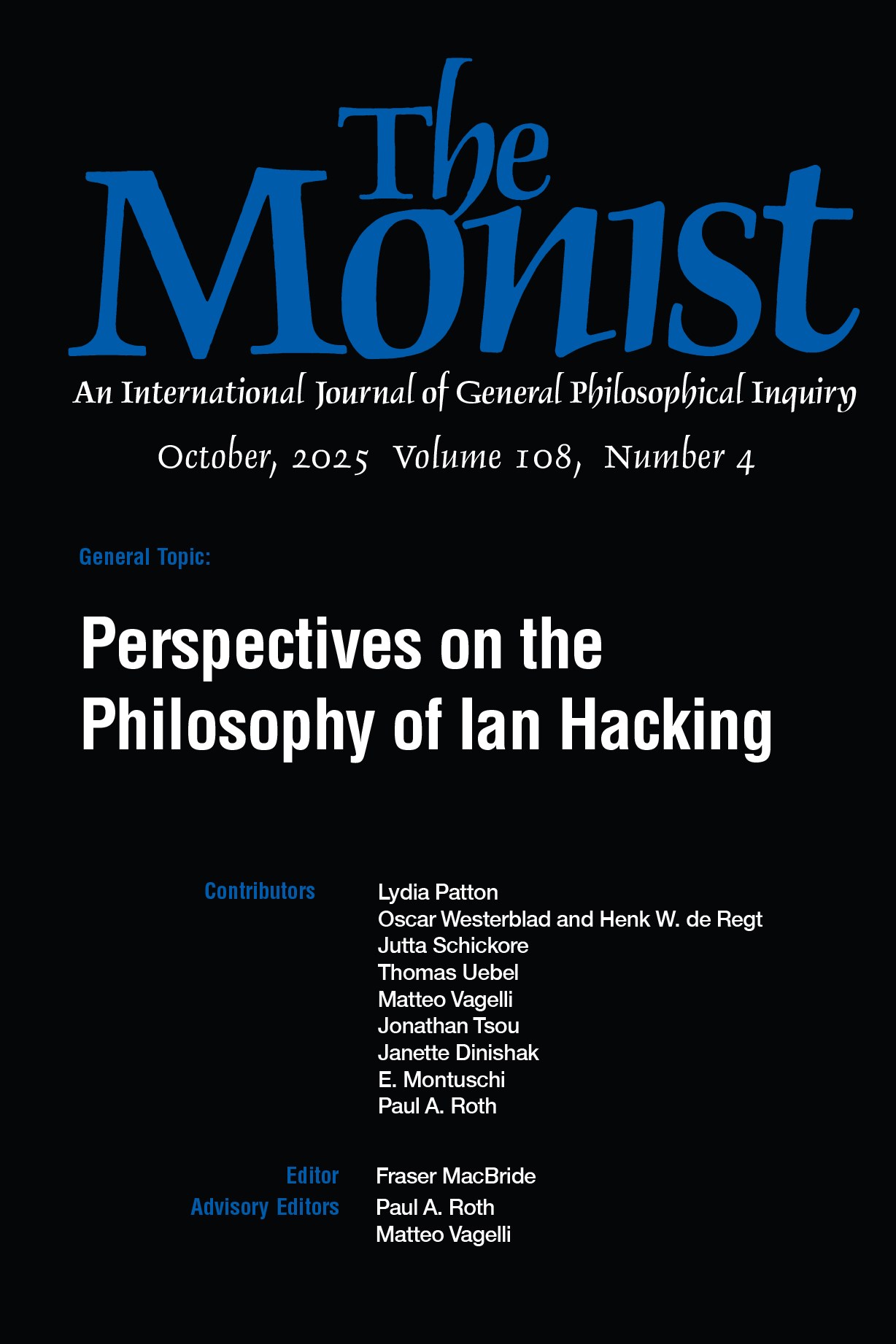
Editor: Fraser McBride Advisory Editors Paul A. Roth and Matteo Vagelli
Does Entity Realism Hold Up? — Lydia Patton Scientific Understanding Beyond Representing: Lessons from Ian Hacking’s Work — Oscar Westerblad and Henk W. de Regt Philosophical Anthropology, Philosophical Technology, and Protocols of Intersubjectivity — Jutta Schickore Language, Truth, and Hacking — Thomas Uebel Hacking’s Styles of Reasoning Between Positivity and Truthfulness — Matteo Vagelli Hacking on Looping Effects and Kinds of People — Jonathan Tsou A Living Experiment in Concept Formation: Hacking on the Creation of a Language for Autistic Experience — Janette Dinishak Objectivity at Rest, Or at Work? — Eleonora Montuschi Hacking’s Historiography? — Paul A. Roth
Thanks to dmf for the link – looks good but expensive, even for the e-book
How does Deleuze’s study of Foucault challenge and deepen our understanding of both philosophers’ thought?
Provides the first book-length study of Deleuze’s Foucault
Establishes a novel, previously untreated conceptual framework that Foucault and Deleuze shared, serving as the basis for the philosophical reconstruction of Foucault’s thought
Includes new insight and analysis from Deleuze’s recently translated and published seminars on Foucault
Treats of recently published primary source material (e.g., Foucault’s Confessions of the Flesh) as independent critical support
Christopher Penfield illuminates the philosophical encounter between Gilles Deleuze and Michel Foucault, developing the first systematic treatment of Deleuze’s book Foucault, originally published in 1986. Using the full spectrum of Foucault’s primary texts, as well as new insights and analysis from Deleuze’s recently translated and published seminars on Foucault, Penfield identifies and elaborates the two thinkers’ shared philosophy of force as the novel conceptual framework of ‘virtual force ontology’.
For the field of Foucault studies, where Foucault still meets with misunderstanding, Penfield clarifies and motivates the demanding, highly abstract portrait of Foucault that Deleuze offers; and in demonstrating Deleuze’s philosophical reconstruction, unlocks unrealized aspects of Foucault’s thought.
For students as well as scholars of Deleuze, Penfield establishes the unique place and importance of Foucault in Deleuze’s oeuvre, illuminating the fundamental impact of Foucault on Deleuze and the ‘common cause’ (Deleuze) that shaped the course of their mutually transformative philosophical relationship.
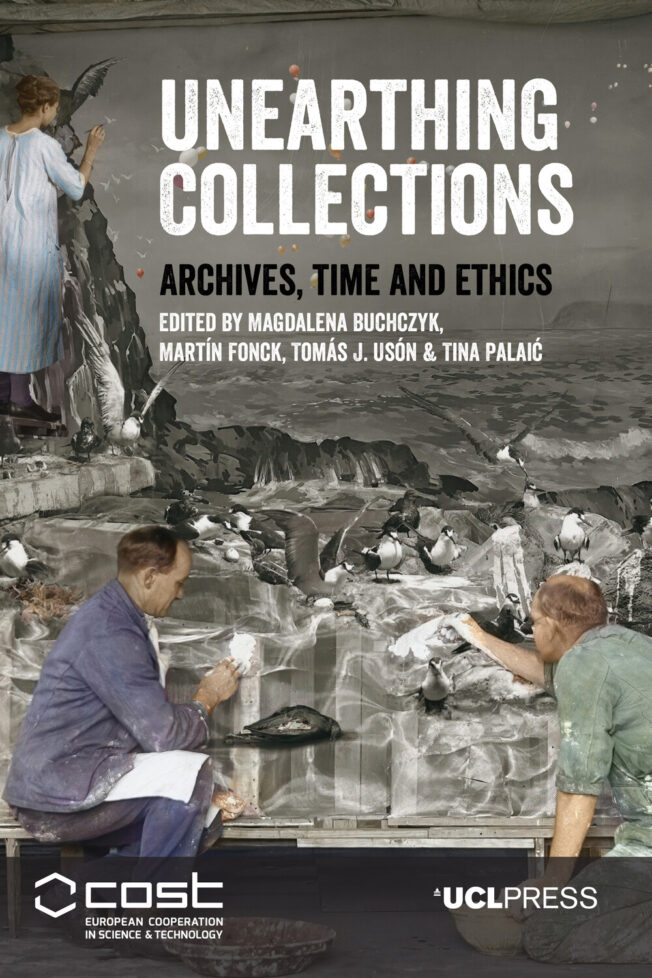
Unearthing Collections invites readers to reconsider the ethics of collections and archives through the lens of temporality. Drawing on case studies that range from community protests over glacial sampling to the ethical dilemmas of housing human remains in museum collections and acquiring ephemeral political art, the authors interrogate the urgent challenges of collecting, displaying and preserving traces.
The book is framed around the concept of ‘unearthing’, the process of revealing hidden truths, excavating layers of history, and uncovering the unknown. It explores how the pursuit of knowledge often comes at the cost of displacement, exploitation, commodification, and the enduring legacies of imperialism and colonialism.
Alongside critique of the extractive practices that shaped many collections and archives, the book proposes a shift towards ‘re-earthing’, a practice that reconfigures how we understand and engage with knowledge about traces. As a critical approach, re-earthing acknowledges the messy, entangled nature of traces of the past, rejecting attempts to purify or control them in collections and archives, so they may evolve into new forms of knowledge. This innovative perspective challenges scholars, archivists, artists, and collection practitioners to rethink their approach to time and trace, urging them to disrupt dominant chronologies and cultivate new ethical approaches for working with collections and archives.
This book explores the challenges facing landscape architecture in the Middle East. It supports the idea that landscape is a multifaceted idea, and examines landscapes architecture as an emerging profession in the region. The book also responds to the limitations of faulty translations of the English ‘landscape’ that, in turn, limit the professional potential in the region.
The authors of the book see landscape as a way of beholding the world that is informed by place and culture. And because landscape is context specific, a landscape framing contextualizes a problem, be it community development, tourism, or nature conservation, to foster place and culture responsive perspectives. The nine chapters are grouped under four broad themes that reflect the multifaceted, ‘expansive’ framing that embraces landscape, natural and cultural heritage, people and livelihoods, and landscape and human rights.
The authors recognize that a landscape framing is not the exclusive domain of landscape architecture, but can be applied by architects, planners, and environmentalists. The ideas advanced and issues discussed will be of interest to researchers, students, and practitioners in landscape architecture, architecture, planning, and urban design, as well as social and environmental scientists.
Publishing Beyond the Market argues that the move to open access should focus less on the free accessibility of research outputs and more on who controls the publications and infrastructures for scholarly communication. By deploying theoretical literature on science and technology studies, care ethics, and the commons, the book critically interrogates open access and reimagines a more ethical future for researcher-led publishing. A case study of Plan S—the multifunder European policy for open access publishing—explores its tendency to rehearse all the failures of commercialisation. Through critical engagement with the open access landscape, the book reveals the shortcomings of market-centric and policy-based approaches to open access book and journal publishing, particularly their tendency to reinforce conservatism, commercialism, and private control of publishing.
Going forward, Publishing Beyond the Market explores the importance of collectivity and democratic governance within the transition to open access publishing. It suggests that developing a commons-based, scholar-led publishing landscape through a series of presses that are each managed by working academics could offer a productive counterpoint to marketised systems of open access and subscription publishing. In weaving themselves together in order to “scale small” these publishing initiatives would act as a counter-hegemonic project based on mutual reliance and care. By illustrating how these projects build toward a commons-based publishing future, and how they may complement other approaches to publishing within university presses and libraries, the book culminates in an argument for the infrastructures, policies, and forms of governance needed to nurture such a collective vision.
In a world shaped by war, climate disaster, and displacement, refugee camps are imagined as indispensable safe havens for millions of people fleeing crises. In Occupied Refuge, Hanno Brankamp challenges the presumed innocence of refugee humanitarianism as a system of civilian protection that can manage global inequalities and forced migration by peaceful means. He shows that although humanitarian missions aim to protect displaced populations in the global South, they often function as militarized occupations that treat camp inhabitants as new colonized subjects. Through ethnographic research in Kenya’s Kakuma refugee camp, Brankamp demonstrates how aid operations rely on a combination of infrastructural expansion, militarized policing, ethno-racial subjugation, indirect rule, and economic extraction. By co-managing these camps with international aid agencies, the Kenyan state becomes not only a willing accomplice in planetary humanitarian containment but seeks to pacify its own peripheral territories, securitize unwanted migrants, and impose national rule. Illuminating how refugee camps serve as key sites where carceral protectionism, postcolonial nation-building, and global mobility control intersect, Brankamp calls for abolitionist futures beyond the violent structures of encampment, borders, and citizenship.
I missed this when it came out last year – thanks to Richard Ashby for the link. Shame about the price though.
Geopolitical Shakespeare: Western Entanglements from Internationalism to Cold War examines the entanglement of Shakespearean culture in the geopolitical dynamics of the post-war West. Taking its cue from a speech given by Albert Einstein in London in 1933, in which Shakespeare is cited as an example of the Western value of personal and intellectual freedom, this book explores a series of events between 1945 and 1955 featuring key historical figures—scientists, international lawyers, diplomats and politicians, writers, actors, and filmmakers—who experienced the tensions of the early Cold War through Shakespeare, or called on him to articulate this new post-war world. Erica Sheen examines political, diplomatic, cultural, and economic interactions within ‘core’ Western power relations—the USA, UK, and Europe, with particular reference to Germany—in which Shakespeare, or the idea of Shakespeare, was entangled in the struggle for new ideas and social structures.
The subjects of this book include John Humphrey and the drafting of the Universal Declaration of Human Rights; the Nuremberg Trials and the foundation of West Germany; Noel Annan and the Berlin Elizabethan Festival; an American production of Hamlet in Elsinore; Laurence Olivier, David Selznick, and the Shakespeare film in post-war Hollywood; Graham Greene and The Third Man; and Carl Schmitt and Salvador de Madariaga on Hamlet in post-war Europe. In each of these case studies, Sheen discovers a Shakespeare for our time: engaged in contestations of territoriality in cultures of international law and human rights, theatre, film, and literature.
A rich resource of Deleuze’s research that is unavailable in his published writing
Includes summaries of 216 seminar sessions available in transcripts and recordings
Summaries are based on research for the Deleuze Seminars project (co-directed by Charles J. Stivale and Daniel W. Smith), where full transcripts and translations, to which readers will have access for simultaneous or subsequent consultation, have been developed by an international team of scholar-translators
Alongside summaries, an attached critical apparatus provides references to corresponding links within Deleuze’s writings, seminars, and other sources to facilitate additional research
The texts in this volume – summaries of the 216 seminars taught by Gilles Deleuze – provide unique insight into the latter half of Deleuze’s teaching career. Deleuze understood his seminars as a laboratory for developing his ongoing research, and this volume is a guide to the creative becomings in the development of his philosophical works through teaching.
From Anti-Oedipus (1972) to The Fold: Leibniz and the Baroque (1987), Deleuze examined a wide range of philosophical perspectives in pursuit of successive thematic topics. These summaries and commentaries serve as incitement for further research, allowing readers familiar with Deleuze’s work to find new angles of approach and providing greater access to readers coming to his work for the first time.
I first read the work of the Soviet historian Boris Fyodorovich Porshnev because of Michel Foucault. (His name is sometimes transliterated, especially in France, as Porchnev.) In his 1971-72 Collège de France lectures, Penal Theories and Institutions, Foucault spends the first half of the course examining the Nu-pieds revolts of the 17th century. In doing so, he reads the work of two historians against each other, Porshnev and Roland Mousnier. Porshnev’s Les soulèvements populaires en France de 1623 à 1648 [Popular Revolts in France from 1623 to 1648] was originally published in Russian in 1948, and translated into French in 1963. The 1972 reedition of this translation unfortunately omits the part on the Nu-pieds (I discuss the differences briefly here). There is no English translation of the whole, but part of the introduction was translated as “The Legend of the Seventeenth Century in French History” in Past & Present, and his chapters “Popular Uprisings in France before the Fronde, 1623–1648” and “The Bourgeoisie and Feudal-Absolutism in Seventeenth-Century France”, both in Peter J. Coveney’s collection France in Crisis 1620–1675, are later parts of the book, providing a summary of some of its arguments. Coveney’s collection also includes three pieces by Mousnier, though his work on this topic is better served in English translation. Mousnier’s comparative Fureurs paysans was published in 1967, and translated into English as Peasant Uprisings in Seventeenth-Century France, Russia, and China in 1971.
Porshnev critically engages with Mousnier in Les soulèvements populaires en France and in 1958 Mousnier wrote a critical review of the German translation of that book. The review, “Recherches sur les soulèvements populaires”, was reprinted in his collection La Plume, la faucille et le marteau [The Pen, the Sickle and the Hammer] in 1970. The same year Madeleine Foisil, La révolte des Nu-Pieds et les révoltes normandes de 1639 [The Nu-Pieds Revolts and the Normandy Revolts of 1639] was published – it was originally a thesis directed by Mousnier. It is Mousnier’s collection and Foisil’s book which seem to have sparked Foucault’s interest. Foucault took very detailed notes on Porshnev’s book, as well as Mousnier’s critique of it (BNF NAF28730 box 2, folder 7, subfolder 2). I discuss that debate in my 2017 book Foucault: The Birth of Power, especially pp. 48-59, following the lead of the Penal Theories and Institutions editor Bernard Harcourt and Claude-Olivier Doron, who adds a very useful essay on “Foucault and the Historians”.
Porshnev also wrote Social Psychology and History, the first chapter of which is available as the separate book Leninist Theory of Revolution and Social Psychology, and a study of another popular uprising in France, the Bonnets rouges revolt of 1675. His work on the latter is discussed in an article by Claude Nières. Porshnev’s book Muscovy and Sweden in the Thirty Years’ War was translated in 1996. He is also the author of a book available in French on the political economy of feudalism. These are unsurprising research and political topics for a Marxist historian. Interestingly, Porshnev references Foucault’s History of Madness in Social Psychology and History (p. 8 n. 1), a work which is generally filled with references to Marxist and Soviet sources. Artemy Magun says that Porshnev knew Foucault’s “early work on madness and held [it] in high esteem” (“Boris Porshnev’s Dialectic of History”, p. 227). Generally, it is only toward the end of Social Psychology and History that Porshnev turns to Western work in anthropology, ethnology and linguistics. Porshnev visited France on a few occasions, debating with both Marxist and non-Marxist historians, and receiving an honorary degree from the University of Clermont-Ferrand.
Porshnev’s career had a surprising parallel track. He was obsessed with stories of the yeti or alma (sometimes spelled as almas or almasty), names for humanoid creatures supposedly living in mountainous regions in the Soviet Union, including the Caucasus and central Asia. Similar animals are called Bigfoot, Sasquatch or the Abominable Snowman in other parts of the world. Porshnev led Soviet expeditions to the Pamir mountains and the Himalayas in search of this creature in the late 1950s, and though they found none, he gathered testimonies and other evidence. Porshnev speculated that the neanderthal man was perhaps not extinct, but had carried on living until modern times, and that this might explain these stories.
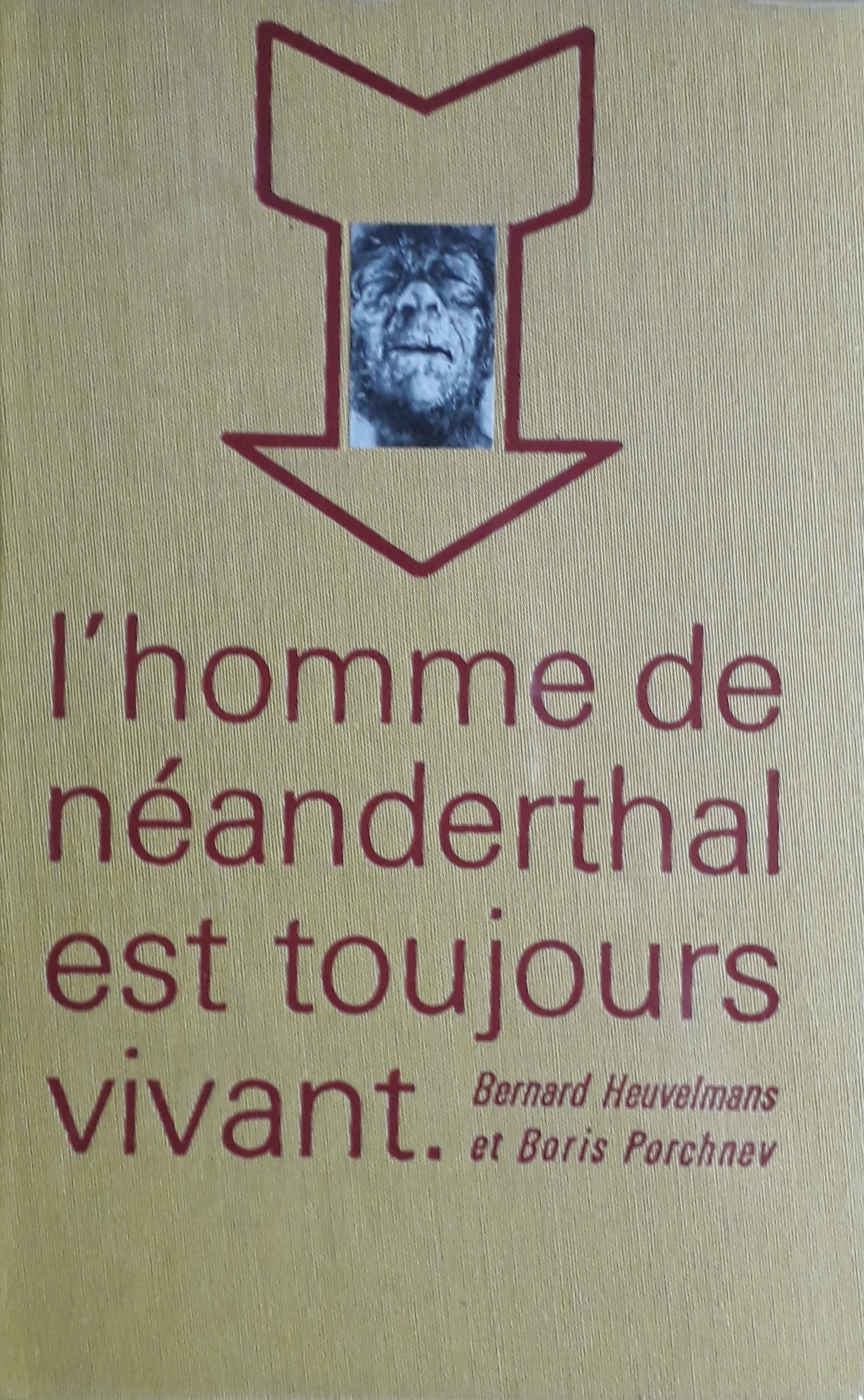
Porshnev wrote a report for the Soviet Academy of Sciences on this topic, but only a few copies circulated, it was not taken very seriously and seems to have damaged his career. Until recently it seems to have become forgotten. Porshnev died in 1972, but a 1968 piece by him on this topic was translated as “La Lutte pour les troglodytes [The struggle for the caveman]” in a French book in 1974, along with a piece by Bernard Heuvelmans. This French book had the title L’Homme de néanderthal est toujours vivant [The Neanderthal man is still alive], and Heuvelmans’s piece is “L’énigme de l’homme congelé [The Enigma of the Frozen Man]” on the so-called Minnesota Iceman. This book is sometimes described as co-authored, but it is really two distinct texts put together after Porshnev’s death.
Older copies of L’Homme de néanderthal est toujours vivant have a fairly sober cover, with a small image of the Iceman; more recent editions have a very silly drawing of Heuvelmans posing for a portrait with a gorilla-like figure. Even before AI, someone couldn’t draw fingers. Heuvelmans is a much-better known figure in cryptozoology, author of Sur la Piste des Bêtes Ignorées, translated as On the Track of Unknown Animals. That book in English has a preface by Gerald Durrell, the British naturalist and conservationist. There are quite a few other books by him in English, including the posthumous collection The Natural History of Hidden Animals, edited by Peter Gwynvay Hopkins.
Heuvelmans had written a scientific study of the Minnesota Iceman for Bulletin de I’Institut Royal des Science Naturelles de Belgique in 1969. His more popular text included in L’Homme de néanderthal est toujours vivant was translated into English as Neanderthal: The Strange Saga of the Minnesota Iceman in 2016. Porshnev’s essay on “troglodytes” uses the classical term for cave dwellers as a descriptor for pre-human ancestors, not primates and not humans. The alma were perhaps still-living relics of a past age, a stage in the evolution of humans, both biologically and politically. There is a translation of Porshnev’s essay on troglodytes, but it appears to be a translation of the French translation, and it is not clear how reliable it is. Pairing Porshnev’s study with Heuvelmans in this French collection seems to have brought Porshnev’s interest in these questions to a wider, Western audience. Heuvelmans believed the Iceman “proved in incontrovertible fashion the legitimacy of the hypothesis of Porshnev, according to which late Neanderthals continued to exist in small numbers from one end of Asia to the other” (The Natural History of Hidden Animals,p. 126). But the Iceman was a fake, and so it proved nothing more than Heuvelman’s wish to believe. A more academic article by Porshnev, “The Troglodytidae and the Hominidae in the Taxonomy and Evolution of Higher Primates”, was translated in Current Anthropology in 1974, along with some responses. Porshnev’s death while the translation was in press meant that the reply was written by Dmitri Bayanov and Igor Bourtsev. There is a useful discussion of Heuvelmans’s interest in the Iceman case from Darren Naish here; and background on the Iceman itself here. Both draw on Naish’s 2016 book Hunting Monsters: Cryptozoology and the Reality behind the Myths.
Porshnev has a minor role in cultural histories such as Joshua Blu Buhs, Bigfoot: The Life and Times of a Legend and Daniel Loxton and Donald R. Prothero’s, Abominable Science! Origins of the Yeti, Nessie, and Other Famous Cryptids. He is discussed most fully, in the accounts I know about, by Brian Regal, Searching for Sasquatch: Crackpots, Eggheads, and Cryptozoology (especially pp. 143-55). These are serious books about non-serious questions, taking an approach of studying the social phenomena, works of unusual science studies. A more popular disproval of various accounts is Naish’s Hunting Monsters. Unsurprisingly, Heuvelmans is much more of a focus of these books, since he is often seen one of the founding fathers of cryptozoology, alongside Ivan Sanderson, author of Abominable Snowman. Stefanos Geroulanos’s remarkable recent book, The Invention of Pre-History, outlines how often prehistorical work has racist, imperial and violent connotations, though he does not engage with the work of Porshnev, Heuvelmans and other cryptozoologists.
In 2021 Porshnev’s Soviet report was translated by the Centre for Fortean Zoology as The Soviet Sasquatch. Some parts are not included in the translation, due to their fragmentary nature. While Heuvelmans and Sanderson were always working on questionable topics, Porshnev was a serious historian of other themes. However, he did not see the work on relic humanoids as a peripheral interest. One indication is an archived version of a website aiming to resurrect Porshnev’s work. “By the Centenary of Boris Fedorovich Porshnev (March 7, 1905 — November 26, 1972)”.
Why Boris Porshnev Piques Our Interest Today?
In his lifetime Boris Porshnev received a wide, even worldwide recognition only in a few fields of his creative work. Some people saw him as a major historian of the XVII-XVIII centuries, others as one of the first Soviet social psychologists, the third recognized his merits in the theoretical analysis of economic and social life, the fourth were aware of his study of the problem of relict paleoanthropes (so-called “snowmen”).
Porshnev himself regarded the book “At the Dawn of the Human History (Problems of Paleopsychology)” as his main scientific study. He distinctly realized that “the dawn” provides the key to the whole complex of sciences concerning “social individual and human society”. This key brings together all fragments of his studies combining them into a single whole, into a solid research program.
As far as I am aware, that book is not available in any Western European language, but it seems indeed to be the work which links his otherwise quite diverse interests. Before his death he had completed only the first volume and part of the second of a planned trilogy, and some of its parts were self-censored for political reasons. One of the most detailed studies of his overall career is Vladimir Ryzhkovskyi, “World History as Revolution: Boris Porshnev and the Experience of Dialectical Defeat”, which makes use of untranslated and archival material. Ryzhkovskyi is helpful in indicating that only an abridged version of his major work was published in 1974, with the full surviving text being edited by Oleg Vite in 2007. The first edition was about 500 pages, in seven chapters; the second over 700 pages. Ryzhkovskyi explains: “In his last diary entry, written ten months before his death, Porshnev willed all the fragments of his project to the future, expecting them to be rediscovered no earlier than half a century later” (p. 191).
Ryzhkovskyi also stresses that the different themes of Porshnev’s work were not sequential but ran in parallel throughout his career. He also indicates Porshnev’s connections to the journal Past & Present, and toFernand Braudel, and that it was Braudel’s publishing network which led to the French translation of his work on popular revolts in 1963 (p. 194 n. 8). Varoujean Poghosyan published the correspondence between Porshnev and Albert Soboul, the Marxist historian of the French revolution, in 2014. I’m sure there are many other connections to explore.
In returning to what I wrote about Porshnev in Foucault: The Birth of Power, I found a comment about how Perry Anderson uses both Mousnier and Porshnev in his work Lineages of the Absolutist State, and this intriguing characterisation of Porshnev, when discussing his work on the Thirty Years War, but which seems a fitting description of his wider career:
Contrary to the intimations of his Western colleagues, it is not a rigid ‘dogmatism’ that is his major failing, but an over-fertile ‘ingenuity’ not always adequately restrained by the discipline of evidence; yet the same trait is in another respect what makes him an original and imaginative historian (p. 37 n. 37).
References
Perry Anderson, Lineages of the Absolutist State, London: Verso, 2013 [1974].
Joshua Blu Buhs, Bigfoot: The Life and Times of a Legend, Chicago: University of Chicago Press, 2009.
Claude-Olivier Doron, “Foucault et les historiens: Le débat sur les «soulèvements populaires»”, in Michel Foucault, Théories et institutions pénales: Cours au Collège de France (1971-1972), ed. Bernard E. Harcourt, Paris: Gallimard/Seuil, 2015, 291-307; “Foucault and the Historians: The Debate on ‘Popular Uprisings’”, in Michel Foucault, Penal Theories and Institutions: Lectures at the Collège de France, 1971-1972,trans. Graham Burchell, London: Palgrave, 2019,285-301.
Stuart Elden, Foucault: The Birth of Power, Cambridge: Polity, 2017.
Michel Foucault, Théories et institutions pénales: Cours au Collège de France (1971-1972), ed. Bernard E. Harcourt, Paris: Gallimard/Seuil, 2015; Penal Theories and Institutions: Lectures at the Collège de France, 1971-1972,trans. Graham Burchell, London: Palgrave, 2019.
Stefanos Geroulanos, The Invention of Pre-History: Empire, Violence, and Our Obsession with Human Origins, Liveright, 2024.
Bernard Heuvelmans, Sur la Piste des Bêtes Ignorées, Paris: Plon, two volumes, 1955; On the Track of Unknown Animals, trans. Richard Garnett, London: Routledge, 2016 [1958].
Bernard Heuvelmans, “Note préliminaire sur un spécimen conserve dans la glace, d’une forme encore inconnue d’hominide vivant Homo pongoides (sp. seu subsp. nov.)”, Bulletin de I’Institut Royal des Science Naturelles de Belgique 45, 1969, 1-24.
Bernard Heuvelmans, Natural History of Hidden Animals, ed. Peter Gwynvay Hopkins, London: Routledge, 2007.
Bernard Heuvelmans, Neanderthal: The Strange Saga of the Minnesota Iceman, trans. Paul LeBlond, San Antonio, Texas: Anomalist Books, 2016.
Roland Mousnier, Fureurs paysans: Les paysans dans les révoltes du XVIIe siècle (France, Russie, Chine), Paris: Calmann-Lévy, 1967; Peasant Uprisings in Seventeenth-Century France, Russia, and China, trans. Brian Pearce, London: George Allen and Unwin, 1971.
Roland Mousnier, La Plume, la faucille et le Marteau: Institutions et société en France, du Moyen Age à la Révolution, Paris: PUF, 1970.
Darren Naish, Hunting Monsters: Cryptozoology and the Reality behind the Myths, London: Arcturus, 2016.
Claude Nières, “Boris Porchnev et les révoltes bretonne de 1675”, Annales de Bretagne et des pays de l’Ouest 82 (4), 1975, 459-75.
Varoujean Poghosyan, “La correspondance de Boris Porchnev et d’Albert Soboul: Un témoignage de l’amitié entre historiens soviétiques et français”, Annales historiques de la Révolution française 376 (2), 2014, 163-77.
B.F. Porshnev, “The Legend of the Seventeenth Century in French History”, Past & Present 8, 1955, 15-27.
Boris Porchnev, Les soulèvements populaires en France de 1623 à 1648, translated by Mme Ranieta and Robert Mandrou, Paris: SEVPEN, 1963; republished in abridged form as Les Soulèvements populaires en France au XVIIe siècle, Paris: Flammarion, 1972 (but note that the abridged edition omits the part on the Nu-Pieds).
Boris Porshnev, Social Psychology and History, trans. Ivan Savin, Moscow: Progress Publishers, 1970; first chapter also available as Leninist Theory of Revolution and Social Psychology, Moscow: Novosti Press Agency Publishing House, 1970.
Boris F. Porchnev, “La Lutte pour les troglodytes”, trans. Cyrille de Neubourg, in Bernard Heuvelmans and Boris Porchnev, L’Homme de neanderthal est toujours vivant, Paris: Plon, 1974, 33-205; “The Struggle for Troglodytes”, The Relict Hominoid Inquiry 6, 2018, 33-170.
Boris Porshnev, O nachale chelovecheskoy istorii (Problemy paleopsikhologii) [On the origin of human history (Problems of paleopsychology)], Moscow: Mysl, 1974.
Boris Porchnev, “Les buts et les revendications des paysans lors de la révolte bretonne de 1675”, trans. Nina Gourfinkel, in Les Bonnets Rouges, Paris: Union Générale d’Éditions (collection 10/18), 1975, 217-349.
Boris Porshnev, “Popular Uprisings in France before the Fronde, 1623–1648”, and “The Bourgeoisie and Feudal-Absolutism in Seventeenth-Century France”, in Peter J. Coveney ed., France in Crisis 1620–1675, London: Macmillan, 1977, pp. 78-102, 103-135.
Boris Porchnev, Essai d’économie politique du féodalisme, trans. Alexandra Gaillard with Geneviève Dupond, Moscow: Éditions du Progrès, 1979.
B.F. Porshnev, Muscovy and Sweden in the Thirty Years’ War, 1630-1635, ed. Paul Dukes, trans. Brian Pearce, Cambridge: Cambridge University Press, 1996.
Boris Porshnev, O nachale chelovecheskoy istorii: problemy paleopsikhologii [On the origin of human history: Problems of paleopsychology], Moscow: Aletheia, 2007.
Boris Porshnev, The Soviet Sasquatch, trans. Lars Thomas, Bideford: CFZ Press, 2021.
Brian Regal, Searching for Sasquatch: Crackpots, Eggheads, and Cryptozoology, New York: Palgrave Macmillan, 2009.
Vladimir Ryzhkovskyi, “World History as Revolution: Boris Porshnev and the Experience of Dialectical Defeat”, Stasis6 (2), 2018, 176-97.
Ivan T. Sanderson, Abominable Snowman: Legend Come to Life, Philadelphia and New York: Chilton, 1961.
Fonds Michel Foucault, NAF28730, Bibliothèque nationale de France
This is the 50th post of a weekly series, where I post short essays with some indications of further reading and sources, but which are not as formal as something I’d try to publish more conventionally. They are usually tangential to my main writing focus, a home for spare ideas, asides, dead-ends and possible futures. I hope there is some interest in them. They are provisional and suggestions are welcome. A few, usually shorter, pieces in a similar style have been posted mid-week.
The full chronological list of ‘Sunday histories’ is here, with a thematic ordering here.
After the collapse of the National Socialist regime in May 1945, France became one of four principal occupying powers in a defeated Germany. Within their zone of occupation along the Upper and Middle Rhine, French occupiers participated in the Allied project to remake German society. In the process, they confronted the long history of Franco-German rivalry in the region and their country’s diminished power in the wake of World War II.
From Occupation to Integration explores how French ideas about civilization and the civilizing process shaped the practice of occupation in the French Zone and the early stages of European integration. The French Zone was set apart from the other Allied zones by the occupiers’ belief that Nazi “barbarism” was deeply rooted in German culture and history. In seeking to transform the Germans along their border into acceptable partners for France within a united western Europe, the French occupiers applied aspects of France’s universal “civilizing” mission, adapting strategies and practices developed in the country’s overseas colonies to fit a European population.
Whether implementing counterinsurgency methods developed in French North Africa in the pacification and control of their zone or attempting to address what they perceived as the deep-rooted flaws of German culture through reeducation and propaganda, the French applied their civilizational thinking, using that vision to justify and guide the first postwar attempts at cross-border economic integration. Through both conflicts and cooperation with the German population, the French in occupied Germany negotiated a shared vision of western European civilization that they hoped would ensure French leadership in Europe.
In this engaging study, Drew Flanagan deftly details and analyzes the entanglement between the Europeanization of the French Zone and decolonization in France’s empire, prompting readers to consider the continued impact of colonial and imperial ideas and practices on contemporary Europe and the European Union.