With its diversity of possible Umwelten or environments for living things, Jakob von Uexküll’s Umwelt theory has been hailed by many readers as the first step toward an innovative, pluralistic conception of nonhuman life. But what is generally ignored is its structural conservatism, its identitarian logic in which everything should remain in its place and nothing should mix, and its proximity to Nazi ideology and politics. By turning the spotlight on these neglected aspects, Uexküll’s Surroundings opens up a new perspective on Uexküll’s Umwelt theory.
… As Foucault tells the story, he turned to pagan antiquity because he needed to break from the secondary accounts he had initially relied upon. Foucault scholarship has long grappled with the choice Foucault made to return to much older material, initially based on the published books and a few traces of teaching or shorter publications. Now, with the publication and translation of all his late lecture courses in Paris, as well as lectures or short courses delivered elsewhere, there is much more material available. In Foucault’s Seminars on Antiquity, Paul Allen Miller, Carolina Distinguished Professor of Classics and Comparative Literature at the University of South Carolina, discusses his final five courses in detail. The result is a convincing and nuanced study of Foucault’s engagement with classical texts…
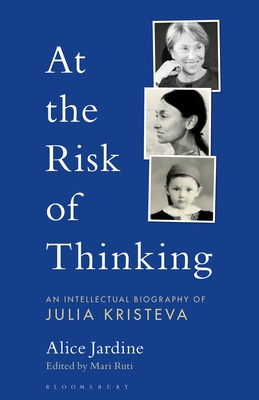
At the Risk of Thinking: An Intellectual Biography of Julia Kristeva(Bloomsbury, 2020) is the first biography of Julia Kristeva–one of the most celebrated intellectuals in the world. Alice Jardine brings Kristeva’s work to a broader readership by connecting Kristeva’s personal journey, from her childhood in Communist Bulgaria to her adult life as an international public intellectual based in Paris, with the history of her ideas. Informed by extensive interviews with Kristeva herself, this telling of a remarkable woman’s life story also draws out the complexities of Kristeva’s writing, emphasizing her call for an urgent revival of bold interdisciplinary thinking in order to understand–and to act in–today’s world.
Discussed at the New Books Network with August Baker. Thanks to dmf for the link.
Characterized by shared, self-managed access to food, housing, and the basic conditions for a creative life, the commons are essential for communities to flourish and protect spaces of collective autonomy from capitalist encroachment. In a narrative spanning more than three centuries, Against the Commons provides a radical counterhistory of urban planning that explores how capitalism and spatial politics have evolved to address this challenge.
Highlighting episodes from preindustrial England, New York City and Chicago between the 1850s and the early 1900s, Weimar-era Berlin, and neoliberal Milan, Álvaro Sevilla-Buitrago shows how capitalist urbanization has eroded the egalitarian, convivial life-worlds around the commons. The book combines detailed archival research with provocative critical theory to illuminate past and ongoing struggles over land, shared resources, public space, neighborhoods, creativity, and spatial imaginaries.
Against the Commons underscores the ways urbanization shapes the social fabric of places and territories, lending particular awareness to the impact of planning and design initiatives on working-class communities and popular strata. Projecting history into the future, it outlines an alternative vision for a postcapitalist urban planning, one in which the structure of collective spaces is ultimately defined by the people who inhabit them.
Updated with the book’s two endorsements:
Against the Commons rewrites the history of capitalist urbanization since the eighteenth century by focusing on the role of planning in struggles around social reproduction. This fresh and exciting book is an invitation to scholars, students, and practitioners in planning, architecture, and urban studies to rethink the past and the future of urbanization.
Łukasz Stanek, University of Manchester
Against the Commons is one of the most important, original, and radical contributions to planning theory and history in the past fifty years. While Álvaro Sevilla-Buitrago offers a sharply critical perspective on the project of planning under capitalism, he also provides an inspiring call for new forms of collective self-management that protect, extend, and empower the commons.
The city of Toronto is often held up as a leader in diversity and inclusion. In Fearing the Immigrant, however, Parastou Saberi argues that Toronto’s urban policies are influenced by a territorialized and racialized security agenda—one that parallels the “War on Terror.” Focusing on the figure of the immigrant and so-called immigrant neighborhoods as the targets of urban policy, Saberi offers an innovative, multidisciplinary approach to the politics of racialization and the governing of alterity through space in contemporary cities.
A comprehensive study of urban policymaking in Canada’s largest city from the 1990s to the late 2010s, Fearing the Immigrant uses Toronto as a jumping-off point to understand how the nexus of development, racialization, and security works at the urban and international levels. Saberi situates urban policymaking in Toronto in relation to the dominant policies of international development and public health, counterinsurgency, and humanitarian intervention. Engaging with the genealogies and contemporary developments of major policy techniques involving mapping and policy concepts such as poverty, security, policing, development, empowerment, as well as social determinants of health, equity, and prevention, she scrutinizes the parallel ways these techniques and concepts operate in urban policy and international relations. Fearing the Immigrant ultimately asserts that the geopolitical fear of the immigrant is central to the formation of urban policy in Toronto. Rather than addressing the root causes of poverty, urban policy as it has been practiced aims to pacify the specter of urban unrest and to secure the production of a neocolonial urban order. As such, this book is an urgent call to reimagine urban policy in the name of equality and social justice.
Cover alt text: Grainy view of downtown Toronto from the lake with CN Tower prominent. Title at top, subtitle and author at bottom.
On Wednesday afternoon, I submitted the final, revised manuscript of The Archaeology of Foucault to Polity. I’d submitted the manuscript for review in February during Warwick’s reading week, and had two very positive and useful reports back at the end of March. The final revisions were completed this week, and the book is now in production.
Finishing The Archaeology of Foucault is not just the end of a single book, but the final part of a four-part study. As I’ve said before, I didn’t imagine that it would be this extensive when I began work on Foucault’s Last Decade. But that book became two, with the first two chapters of Last Decade taken out, each split into three, and then each of those six sections developed into the chapters of Foucault: The Birth of Power. For a while I thought that was it, but decided that I should write a book to precede them, The Early Foucault, and that quickly became a need for two. So chronologically, I wrote the fourth, which became the germ of the third, then decided on two to go before, wrote the first, and then finally the second. Had I began with the idea of a multi-part study of Foucault’s entire career, I would never have done it that way. But then, if I’d had the idea of the scale of what this became, then I probably would never have had the confidence to begin.
It takes a certain type of confidence to begin something, and a determination to complete it. It’s perhaps easier when you don’t know what you’re taking on. It’s not easy to complete things, but I think I’m fairly unusual in that I don’t have many abandoned manuscripts. There are a few papers which didn’t get beyond the conference presentation, and a couple of articles which were rejected and to which I never returned. Often those were cannibalised for something else.
I said recently in a supervision meeting that my own approach to writing is that I try to put off the ‘how it all fits together’ sense until as late as I possibly can. When I’ve reached that point with a couple of books too early, then the final work was an awful slog. If I know exactly what I want to do, then I start to lose interest. If I know, even worse, what I need to do, then the project is effectively dead for me. If I have a contract, or other commitment, then I need to continue, but it is the worst kind of writing for me. Two of my books, Understanding Henri Lefebvre and Canguilhem, reached that point far too early, and they were painful to finish.
With The Archaeology of Foucault, I finished the first chapter last. It wasn’t entirely intended to work that way, but it was partly to do with access to archives, which meant there were parts of that chapter I couldn’t complete until a late stage, and while I had some bits drafted, I didn’t begin the process of putting it all together until right at the end. And for reasons which are not entirely clear to me, I put off one task – writing a fairly brief section about some radio lectures Foucault gave in 1963 – until right at the end. Only two of the five have been published, and the other three are audio recordings. I think I had listened to them before, but didn’t listen again, carefully, taking notes, until very late. And something in one of them made a connection I hadn’t realised before, and then I could see how this chapter all came together. I’m probably slightly over-exaggerating, but it felt like the moment when it did. And this chapter helped to make the whole work fall into place too.
With the book’s Coda, which is now the length of a chapter itself, it was something else which led to this. I had been worrying away at a problem in the book, and in the end wrote a separate short piece about a problem – it is to do with how a text presented as one thing is actually something else, and how what it claims to be was actually unpublished and, I thought, unknown. (Thinking back, there was a somewhat parallel text in Last Decade too.) Writing this problem out both convinced me I was onto something, but also gave me something to show others. And in so doing I was told that, yes, I was onto something, but also that someone else had discovered the same by a quite different path a few weeks before. And they generously shared a transcription of the previously-largely-unknown text which the original had claimed to be. So I could throw away my short piece, whose need had been superseded, and work on the newly-rediscovered piece. But working on that, and consulting the newly-available original in the archive, opened up something else which forced me to revisit material in the Coda, throw away some things, and add some more. I’m obviously well aware that all this work is provisional. It’s intended in part to be a map, and maps need to be revised when new things come to light.
The other thing I was thinking about recently is that an author knows things that a reader doesn’t. A reader might suspect there is a crime in a book – something hurried, something in the wrong place, a bit that drags, a bit where the evidence doesn’t support a point, etc. But the author knows. They know that at one point two chapters were a single, unwieldy and long chapter. That one chapter is maybe a thematic treatment when a chronological one was attempted across sections of different chapters. That another chapter was written in two parts, some distance apart, and stitched together, Frankenstein’s monster like, at a different time. Or that the crucial clue needed to glue together something only came late, and that retrospectively, there was a need to unpick, to put back in a different order, looking like it was always clear and the journey smooth.
This is possibly the last major thing I will do on Foucault (though a book on Foucault and Shakespeare is still possible at some point, and there are a couple of other potential things…). It’s taken most of the past decade to complete this four-volume series. Although there are elements in the books which date back a lot further, from review essays and talks in the late 1990s and early 2000s, and I’d had the idea of a book on Foucault’s Collège de France courses for a long while, I began work on Foucault’s Last Decade in earnest in summer 2013. This Foucault project has been the principal focus since I completed The Birth of Territory. That was the longest single book I’ve written; but these four volumes together are over double its length. And I’m soon to embark on another mammoth project on Indo-European thought in Twentieth-Century France.
It was a liberation these past couple of weeks while the book was under review to turn to different things. One was to write a piece on a different, only tangentially connected topic, for a blog. It came together quickly, and then some days of editing, expanding and reworking. Another was a book review which I’d been putting off until I had a bit of clear time.
Having this Foucault book wrapped up by Easter means I now have about six months before the fellowship begins. There are two things already underway which connect to that work – a journal article, and a critical edition of Dumézil’s Mitra-Varuna. I’m trying to complete everything else I have outstanding before the end of the summer, and, crucially, not take on any new commitments…
Previous updates on this book are here. The Early Foucault was published by Polity in June 2021, and updates for its writing are here. A list of the resources on this site relating to Foucault – bibliographies, audio and video files, some textual comparisons, some short translations, etc. – can be found here. The earlier books in this series are Foucault: The Birth of Power and Foucault’s Last Decade, both available from Polity.
Few individuals made such an impact on nineteenth-century French politics as Louis-Auguste Blanqui (1805-1881). Political organiser, leader, propagandist and prisoner, Blanqui was arguably the foremost proponent of popular power to emerge after the French Revolution. Practical engagement in all the major uprisings that spanned the course of his life – 1830, 1848, 1870-71 – was accompanied by theoretical reflections on a broad range of issues, from free will and fatalism to public education and individual development. Since his death, however, Blanqui has not been simply overlooked or neglected; his name has widely become synonymous with theoretical misconception and practical misadventure.
Auguste Blanqui and the Politics of Popular Empowerment offers a major re-evaluation of one the most controversial figures in the history of revolutionary politics. The book draws extensively on Blanqui’s manuscripts and published works, as well as writings only recently translated into English for the first time. Through a detailed reconstruction and critical analysis of Blanqui’s political thought, it challenges the prevailing image of an unthinking insurrectionist and rediscovers a forceful and compelling theory of collective political action and radical social change. It suggests that some of Blanqui’s fundamental assumptions – from the insistence on the primacy of subjective determination to the rejection of historical necessity – are still relevant to politics today.
See also The Blanqui Reader: Political Writings 1830-1880 – edited by Peter Hallward and Philippe Le Goff, translated by Mitchell Abidor, Peter Hallward, and Philippe Le Goff, Verso, 2018 (still hardback only unfortunately).
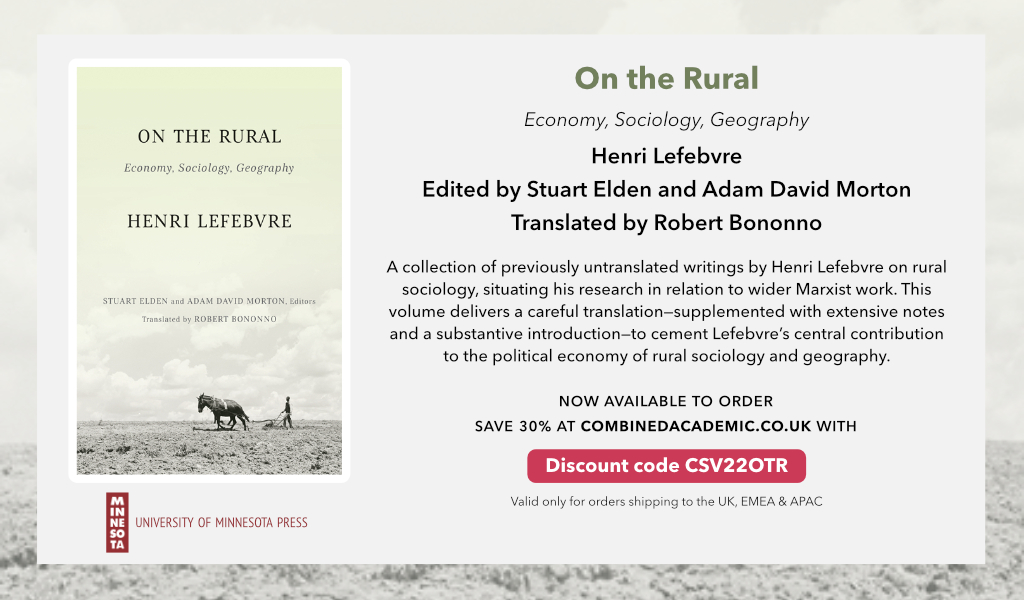
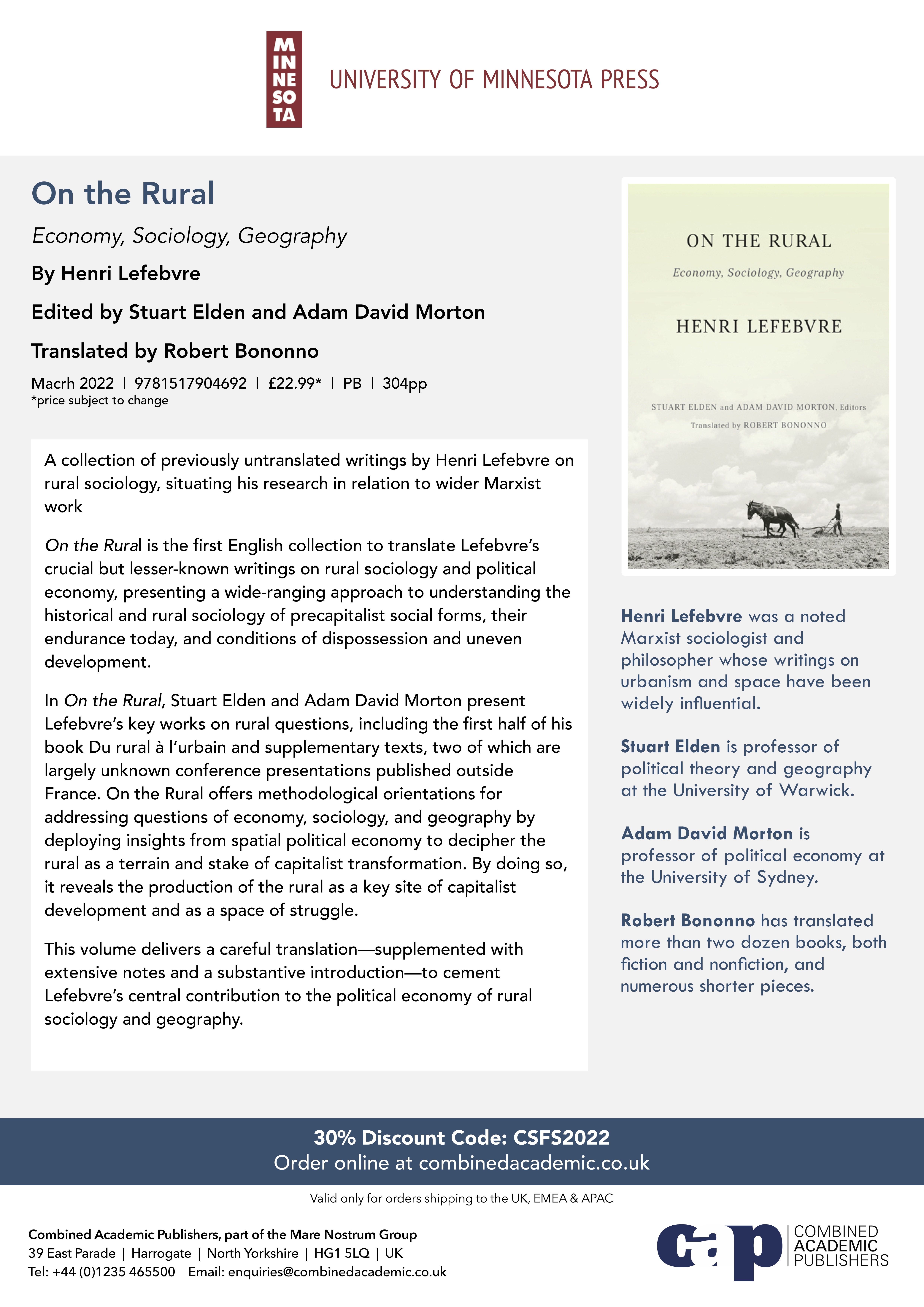
Henri Lefebvre, On the Rural: Economy, Sociology and Geography– University of Minnesota Press, 2022. Edited by Stuart Elden and Adam David Morton, translated by Robert Bononno, with one essay each by Matthew Dennis and Sîan Rosa Hunter Dodsworth.
Discount codes – in the Americas use code MN88740 at the UMinn Press site; other regions use code CSFS2022 or CSV22OTR (in the latter, note letter O, not number 0) at combinedacademic.co.uk Limited duration for the discount codes…
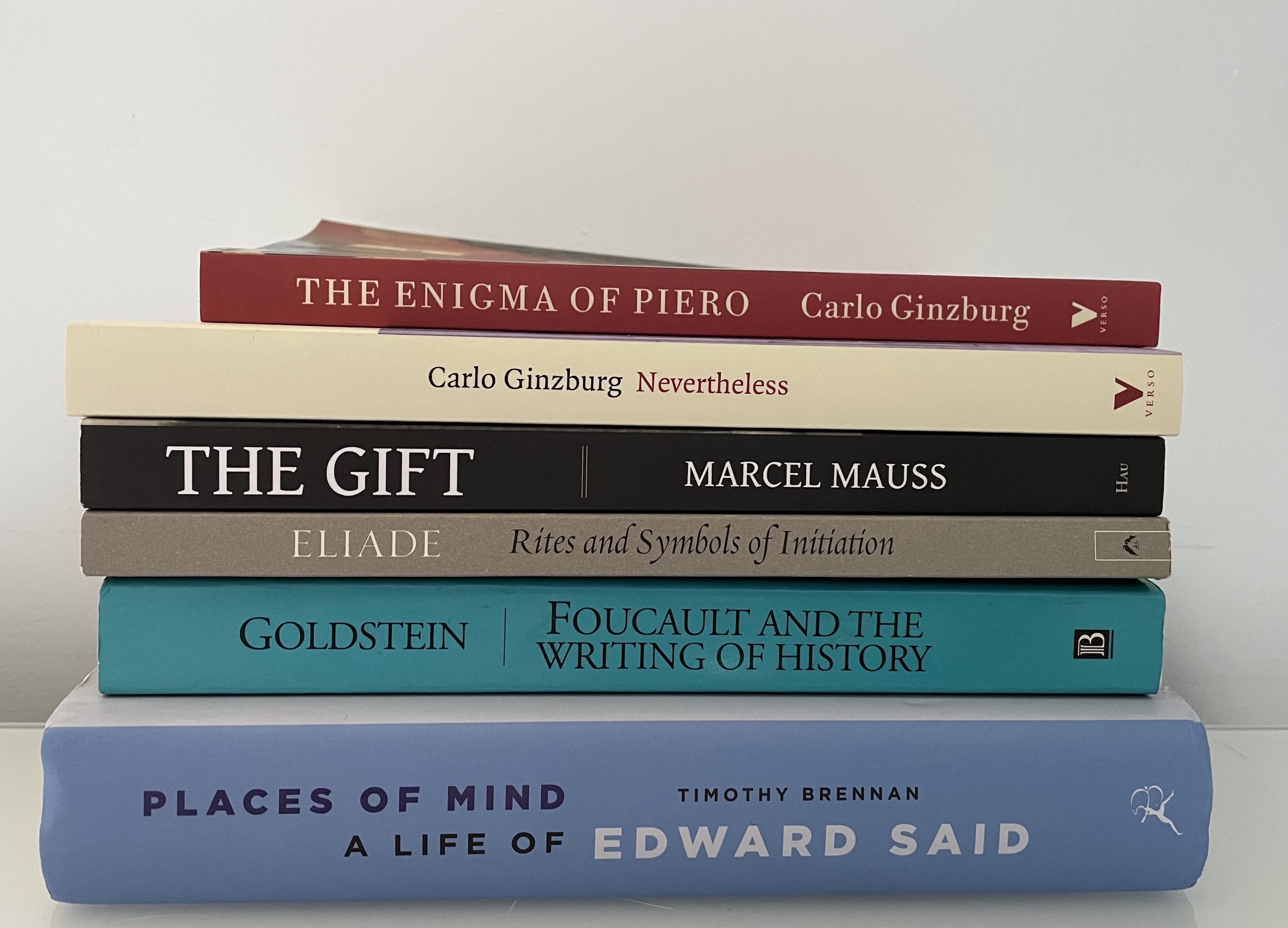
A couple by Carlo Ginzburg, including his new Nevertheless: Machiavelli, Pascal, the Hau books edition of Marcel Mauss, The Gift, translated by Jane Guyer with additional material, an older book by Mircea Eliade, Jan Goldstein’s Foucault and the Writing of History collection, and Timothy Brennan’s Places of Mind: A Life of Edward Said.
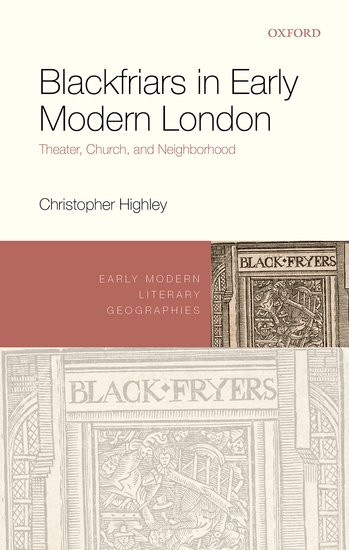
Blackfriars: Theater, Church, and Neighborhood in Early Modern London is a cultural history of an urban enclave best known in the later sixteenth and seventeenth centuries for the incongruous juxtaposition of playing and godly preaching. As the former site of one of London’s great religious houses, the post-Reformation Blackfriars was a Liberty free from mayoral control. The legal exemptions and privileges enjoyed by its residents helped attract an unusual mix of groups and activities. Zealous preachers and puritan parishioners mingled with playhouse workers and playgoers, as well as with the immigrant ‘strangers’ who settled here. The book focuses on local playhouse-church relations and asks how a theatrical culture was able to flourish in a parish dominated by committed puritans. Physically, the church of St Anne’s and the playhouse were virtually next-door, but ideologically they seemed poles apart. Yet despite the occasional efforts of some residents to close the playhouse, godly religion and commercial playing managed to coexist. In explanation, the book examines the conflicting economic and ideological priorities of residents and the overriding desire to promote order and neighborliness. More provocatively, I argue that the Blackfriars pulpit and stage could be mutually reinforcing sites of performance. Preachers as well as playwrights exploited the Liberty’s vexed relations with authority to air satirical and dissident views of the established church and state. By examining Blackfriars sermons and plays side-by-side, the book reveals a synergy between two institutions usually considered implacable enemies.