Oliver Davis and Tim Dean, Hatred of Sex – University of Nebraska Press, April 2022

Oliver Davis and Tim Dean, Hatred of Sex – University of Nebraska Press, April 2022

Hatred of Sex links Jacques Rancière’s political philosophy of the constitutive disorder of democracy with Jean Laplanche’s identification of a fundamental perturbation at the heart of human sexuality. Sex is hated as well as desired, Oliver Davis and Tim Dean contend, because sexual intensity impedes coherent selfhood and undermines identity, rendering us all a little more deplorable than we might wish. Davis and Dean explore the consequences of this conflicted dynamic across a range of fields and institutions, including queer studies, attachment theory, the #MeToo movement, and “traumatology,” demonstrating how hatred of sex has been optimized and exploited by neoliberalism.

Advancing strong claims about sex, pleasure, power, intersectionality, therapy, and governance, Davis and Dean shed new light on enduring questions of equality at a historical moment when democracy appears ever more precarious.
Posted in Uncategorized | Leave a comment

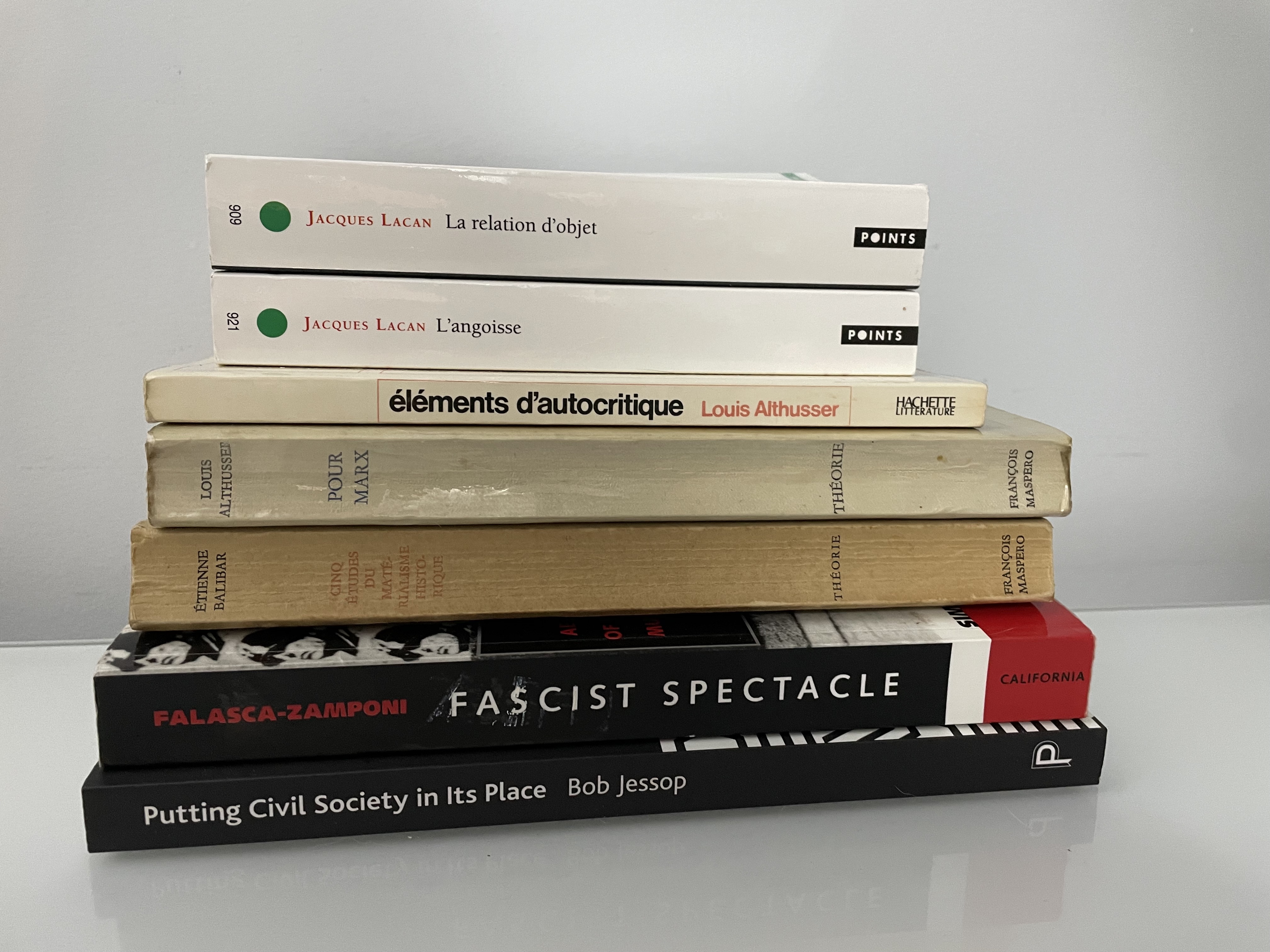
Books received – Lacan, Althusser, Balibar, Falasca-Zamponi, Jessop

Some second-hand books by Althusser and Balibar, two new Points editions of Lacan seminars, Simonetta Falasca-Zamponi’s Fascist Spectacle: The Aesthetics of Power in Mussolini’s Italy, and Bob Jessop’s new book, Putting Civil Society in its Place, pre-ordered in recompense for review work.

Posted in Bob Jessop, Etienne Balibar, Jacques Lacan, Louis Althusser | 1 Comment

Mark Neocleous, The Politics of Immunity: Security and the Policing of Bodies – Verso, March 2022 (and New Books Network discussion)

Mark Neocleous, The Politics of Immunity: Security and the Policing of Bodies – Verso, March 2022

Our contemporary political condition is obsessed with immunity. The immunity of bodies and the body politic; personal immunity and herd immunity; how to immunize the social system against breakdown. The obsession intensifies with every new crisis and the mobilization of yet more powers of war and police, from quarantine to border closures and from vaccination certificates to immunological surveillance. Engaging four key concepts with enormous cultural weight—Cell, Self, System and Sovereignty—Politics of Immunity moves from philosophical biology to intellectual history and from critical theory to psychoanalysis to expose the politics underpinning the way immunity is imagined. At the heart of this imagination is the way security has come to dominate the whole realm of human experience. From biological cell to political subject, and from physiological system to the social body, immunity folds into security, just as security folds into immunity. The book thus opens into a critique of the violence of security and spells out immunity’s tendency towards self-destruction and death: immunity, like security, can turn its aggression inwards, into the autoimmune disorder.

Wide-ranging and polemical, Politics of Immunity lays down a major challenge to the ways in which the immunity of the self and the social are imagined.

Update: there is a discussion at the New Books Network with Catriona Gold here.

Posted in Uncategorized | 1 Comment

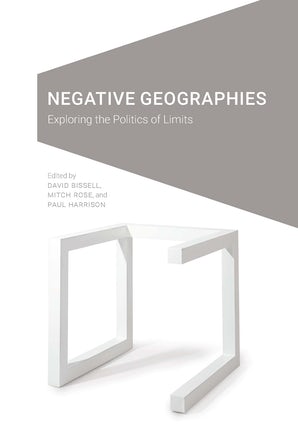
David Bissell, Mitch Rose and Paul Harrison (eds.), Negative Geographies: Exploring the Politics of Limits – University of Nebraska Press, November 2021

David Bissell, Mitch Rose and Paul Harrison (eds.), Negative Geographies: Exploring the Politics of Limits – University of Nebraska Press, November 2021

Negative Geographies is the first edited collection to chart the political, conceptual, and ethical consequences of how the underexplored problem of the negative might be posed for contemporary cultural geography. Using a variety of case studies and empirical investigations, these chapters consider how the negative, through annihilations, gaps, ruptures, and tears, can work within or against the terms of affirmationism. The collection opens up new avenues through which key problems of cultural geography might be differently posed and points to the ways that it might be possible and desirable to think, theorize, and exemplify negation.

Posted in Uncategorized | 1 Comment

Angharad Closs Stephens, National Affects: The Everyday Atmospheres of Being Political – Bloomsbury, September 2022

Angharad Closs Stephens, National Affects: The Everyday Atmospheres of Being Political – Bloomsbury, September 2022

Identity is widely acknowledged to be a felt experience, yet questions of atmosphere, mood and public sentiments are rarely made central to understanding the global politics of nationalism. This book asks what difference it makes when we address national identity as principally an affective force? National Affects traces how ideas about ‘us and them’ take form in ordinary spaces, in ways that are both deeply felt and hardly noticeable, in studies of global events that range from the London 2012 Olympic Games to responses to acts of terror, the European refugee crisis and ‘Brexit’. 

In this timely intervention, Angharad Closs Stephens addresses the affective dimensions of being together to open new angles in the study of nationalism and global politics. She asks how the nation is felt in everyday life, as well as differently experienced, and investigates different forms of enacting being together to generate new insights in the study of national identity. National Affects draws on academic theories in the study of Politics, International Relations and Human Geography, as well as stories, performance works and novels, to establish a new tone of critical enquiry. Informed by longstanding critical interrogations of the politics of ‘us and them’, this book argues that these ideas are not as stable as they are often made to seem.  

Drawing on a combination of artistic and academic interventions, this book offers a refreshing approach to conceptualising the politics of nationalism, identity and citizenship. In its focus on everyday atmospheres, it identifies new registers for intervening politically. Overall, National Affects outlines other ways of imagining and practising being political together, beyond the exclusionary politics of nationalism. 

Posted in Uncategorized | Leave a comment

Thomas Nail, Lucretius III: A History of Motion – Edinburgh University Press, February 2022

Thomas Nail, Lucretius III: A History of Motion – Edinburgh University Press, February 2022

A guidebook to living in a world that’s destined to die, through a new reading of Lucretius’ De Rerum Natura

Presents a new theory of history based on movement, as opposed to time 

Offers a unique theory of evolutionary materialism

Can be read separately or along with Lucretius I and Lucretius II

Puts Lucretius in conversation with contemporary physics and new materialism

For Lucretius, history means something surprisingly different than we ordinarily think. Instead of thinking of history in terms of time, he thought of it in terms of motion. This book unpacks the implications of this unique kinetic philosophy of history. 

In the final volume of his trilogy on Lucretius, Thomas Nail argues that in books five and six of De Rerum Natura, Lucretius described a world born to die – long before humans theorised about thermodynamics or began to see the catastrophic consequences of man-made climate change. What does it mean to live in such a world; a world that is increasinly obviously our world? Nail shows us how De Rerum Natura provides a guidebook for us to answer this question.

Posted in Uncategorized | Leave a comment

Babette Babich, Günther Anders’ Philosophy of Technology: From Phenomenology to Critical Theory – Bloomsbury, October 2021

Babette Babich, Günther Anders’ Philosophy of Technology: From Phenomenology to Critical Theory – Bloomsbury, October 2021

Gunter Anders’ Philosophy of Technology is the first comprehensive exploration of the ground-breaking work of German thinker Gunter Anders. Anders’ philosophy has become increasingly prescient in our digitised, technological age as his work predicts the prevalence of social media, ubiquitous surveillance and the turn to big data. Anders’ ouevre also explored the technologies of nuclear power and the biotech concerns for the human and transhuman condition which have become so central to current theory. 

Babette Babich argues that Anders offers important resources on streaming digital media through his writings on radio, television and film and is, unusually, both a comprehensive and profound thinker. Anders’ relationship with key philosophers like Hannah Arendt and Walter Benjamin and his thinking on Goethe, Nietzsche and Rilke is also explored with a focus on the deep impact he made on his peers. It reflects specifically on the intersection of Anders’ thought Heidegger and the Frankfurt school and how influential a figure he was on the landscape of 20th century philosophy. A compelling rehabilitation of a thinker with profound contemporary relevance.

Posted in Uncategorized | Leave a comment

CFP: Nietzsche, Genealogy, Foucault: History between Life and Power (2022)

Nietzsche, Genealogy, Foucault: History between between Life and Power – Lisbon, 14 June 2022

Clare O'Farrell's avatarFoucault News

CALL FOR ABSTRACTS

International Workshop
Nietzsche, Genealogy, Foucault: History between between Life and Power
School of Arts and Humanities – University of Lisbon
14th June 2022
Event organized as part of the Praxis-CFUL 

Keynote Speakers:
Keynote Speakers:
João Constâncio (NOVA University Lisbon)
Daniele Lorenzini (Warwick University)

Much has been written regarding genealogy, either as a new philosophical interpretation of History, a methodology or as a critical project. The number of published works on the issue is even more outstanding when compared to the scarcity of references to genealogy in primary literature, especially in Nietzsche, but in Foucault as well, when compared to the rest of his oeuvre. Despite the proliferation of books, chapters and articles regarding genealogy, the confusion surrounding this term and its application is far from being overcome and dissipated.

Given the recent 50th anniversary of the seminal article: “Nietzsche, Genealogy, History”, written by Michel Foucault and published…

View original post 411 more words

Posted in Uncategorized | Leave a comment

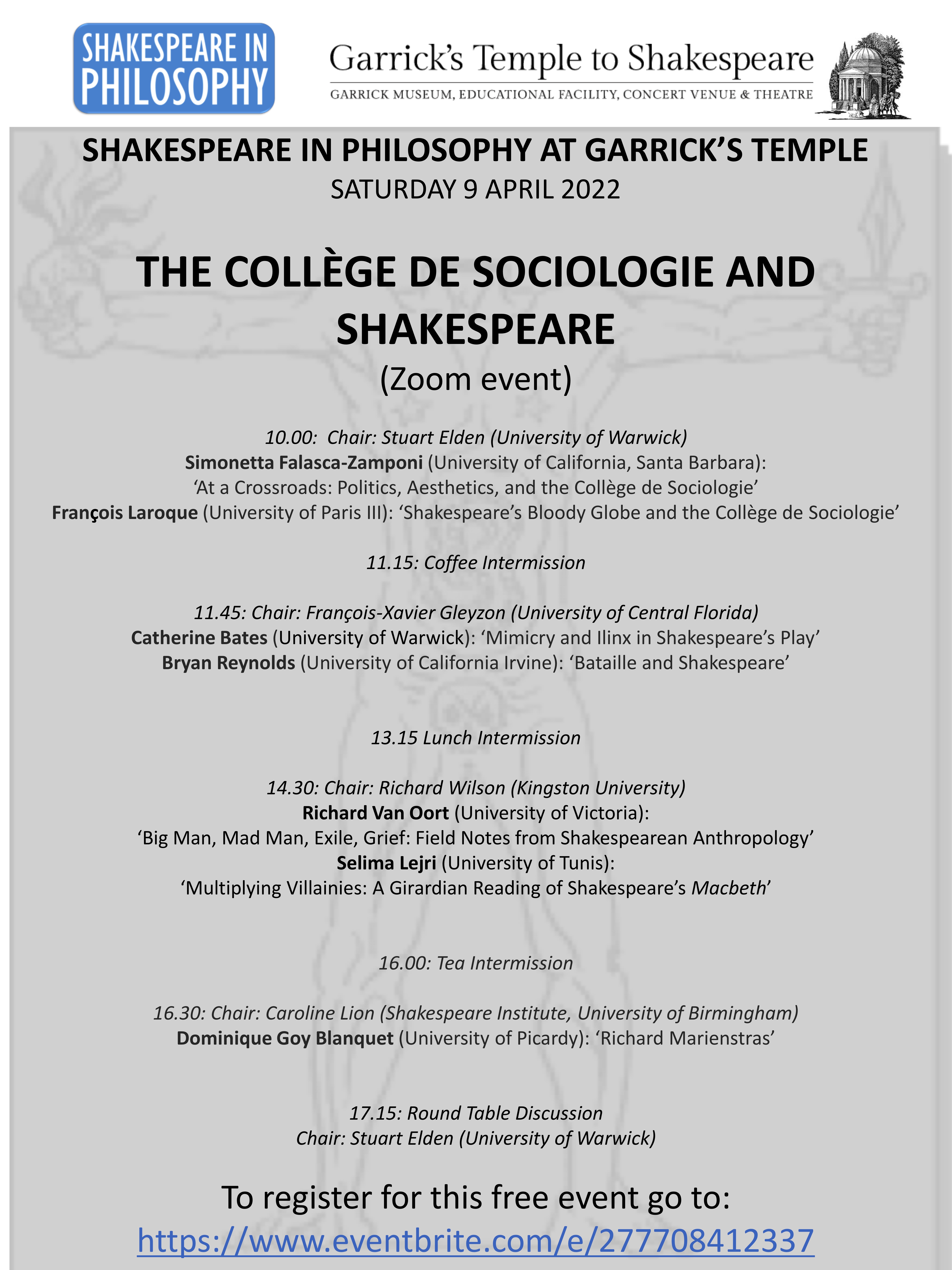
The Collège de Sociologie and Shakespeare, Garrick’s Temple to Shakespeare seminar, 9 April 2022 (online)

9 April 2022, 10am-6pm (UK) – The Collège de Sociologie and Shakespeare, Garrick’s Temple to Shakespeare, online event.

Pleased to share the details of this seminar, co-organised with Richard Wilson. The event is online, sadly, instead of at the lovely Garrick’s Temple to Shakespeare. The seminar is free, but registration required. Please go to https://www.eventbrite.com/e/277708412337

Posted in Georges Bataille, William Shakespeare | 1 Comment

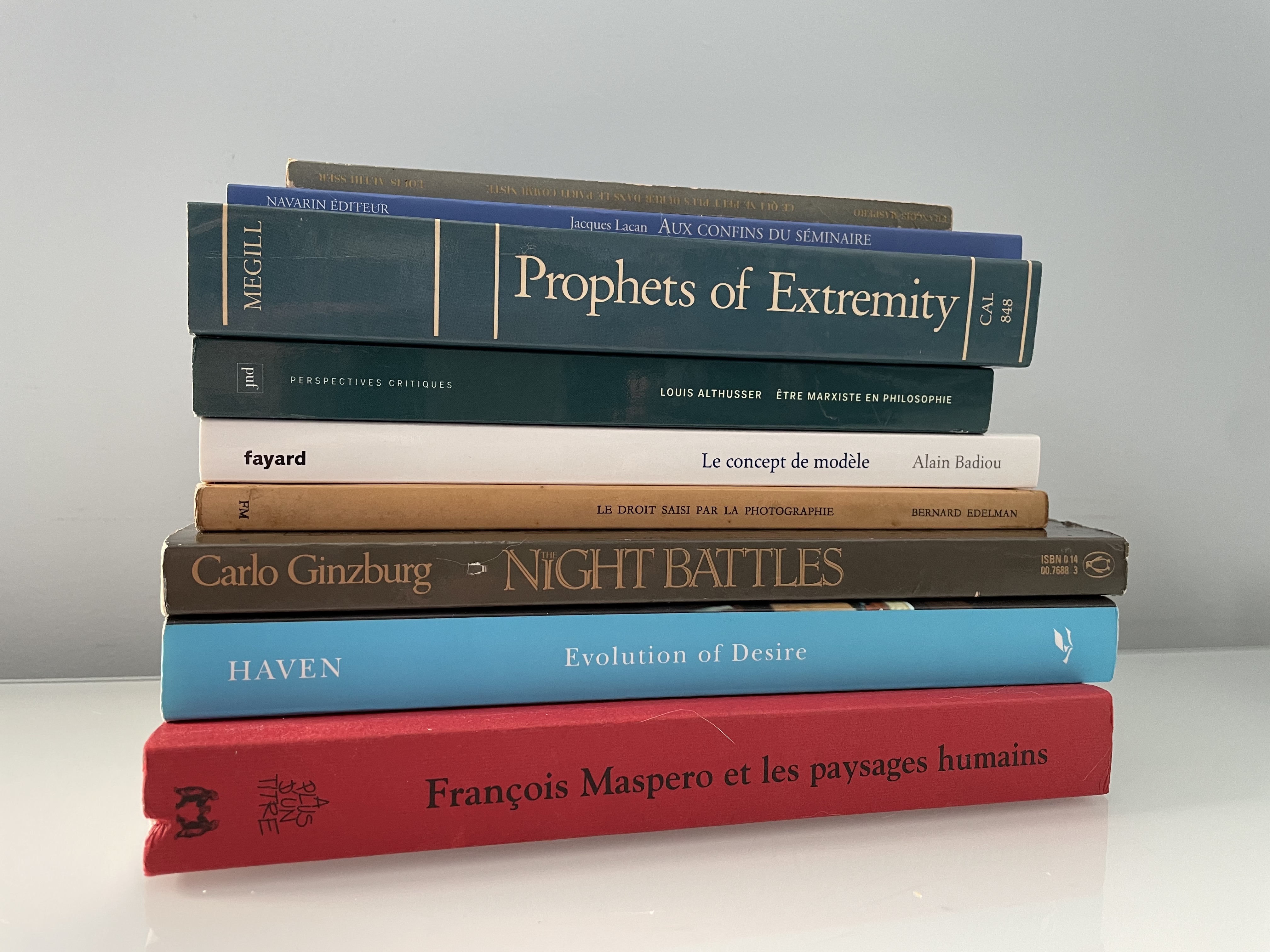
Books received – Althusser, Lacan, Megill, Badiou, Duménil, Ginzburg, Haven, Maspero

A lot of second-hand books bought recently, including Cynthia Haven’s Evolution of Desire: A Life of René Girard.

Posted in Uncategorized | 1 Comment