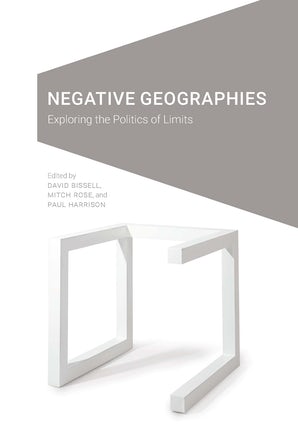
Negative Geographies is the first edited collection to chart the political, conceptual, and ethical consequences of how the underexplored problem of the negative might be posed for contemporary cultural geography. Using a variety of case studies and empirical investigations, these chapters consider how the negative, through annihilations, gaps, ruptures, and tears, can work within or against the terms of affirmationism. The collection opens up new avenues through which key problems of cultural geography might be differently posed and points to the ways that it might be possible and desirable to think, theorize, and exemplify negation.
Identity is widely acknowledged to be a felt experience, yet questions of atmosphere, mood and public sentiments are rarely made central to understanding the global politics of nationalism. This book asks what difference it makes when we address national identity as principally an affective force? National Affects traces how ideas about ‘us and them’ take form in ordinary spaces, in ways that are both deeply felt and hardly noticeable, in studies of global events that range from the London 2012 Olympic Games to responses to acts of terror, the European refugee crisis and ‘Brexit’.
In this timely intervention, Angharad Closs Stephens addresses the affective dimensions of being together to open new angles in the study of nationalism and global politics. She asks how the nation is felt in everyday life, as well as differently experienced, and investigates different forms of enacting being together to generate new insights in the study of national identity. National Affects draws on academic theories in the study of Politics, International Relations and Human Geography, as well as stories, performance works and novels, to establish a new tone of critical enquiry. Informed by longstanding critical interrogations of the politics of ‘us and them’, this book argues that these ideas are not as stable as they are often made to seem.
Drawing on a combination of artistic and academic interventions, this book offers a refreshing approach to conceptualising the politics of nationalism, identity and citizenship. In its focus on everyday atmospheres, it identifies new registers for intervening politically. Overall, National Affects outlines other ways of imagining and practising being political together, beyond the exclusionary politics of nationalism.
A guidebook to living in a world that’s destined to die, through a new reading of Lucretius’ De Rerum Natura
Presents a new theory of history based on movement, as opposed to time
Offers a unique theory of evolutionary materialism
Can be read separately or along with Lucretius I and Lucretius II
Puts Lucretius in conversation with contemporary physics and new materialism
For Lucretius, history means something surprisingly different than we ordinarily think. Instead of thinking of history in terms of time, he thought of it in terms of motion. This book unpacks the implications of this unique kinetic philosophy of history.
In the final volume of his trilogy on Lucretius, Thomas Nail argues that in books five and six of De Rerum Natura, Lucretius described a world born to die – long before humans theorised about thermodynamics or began to see the catastrophic consequences of man-made climate change. What does it mean to live in such a world; a world that is increasinly obviously our world? Nail shows us how De Rerum Natura provides a guidebook for us to answer this question.
Gunter Anders’ Philosophy of Technology is the first comprehensive exploration of the ground-breaking work of German thinker Gunter Anders. Anders’ philosophy has become increasingly prescient in our digitised, technological age as his work predicts the prevalence of social media, ubiquitous surveillance and the turn to big data. Anders’ ouevre also explored the technologies of nuclear power and the biotech concerns for the human and transhuman condition which have become so central to current theory.
Babette Babich argues that Anders offers important resources on streaming digital media through his writings on radio, television and film and is, unusually, both a comprehensive and profound thinker. Anders’ relationship with key philosophers like Hannah Arendt and Walter Benjamin and his thinking on Goethe, Nietzsche and Rilke is also explored with a focus on the deep impact he made on his peers. It reflects specifically on the intersection of Anders’ thought Heidegger and the Frankfurt school and how influential a figure he was on the landscape of 20th century philosophy. A compelling rehabilitation of a thinker with profound contemporary relevance.
International Workshop
Nietzsche, Genealogy, Foucault: History between between Life and Power
School of Arts and Humanities – University of Lisbon
14th June 2022
Event organized as part of the Praxis-CFUL
Keynote Speakers:
Keynote Speakers:
João Constâncio (NOVA University Lisbon)
Daniele Lorenzini (Warwick University)
Much has been written regarding genealogy, either as a new philosophical interpretation of History, a methodology or as a critical project. The number of published works on the issue is even more outstanding when compared to the scarcity of references to genealogy in primary literature, especially in Nietzsche, but in Foucault as well, when compared to the rest of his oeuvre. Despite the proliferation of books, chapters and articles regarding genealogy, the confusion surrounding this term and its application is far from being overcome and dissipated.
Given the recent 50th anniversary of the seminal article: “Nietzsche, Genealogy, History”, written by Michel Foucault and published…
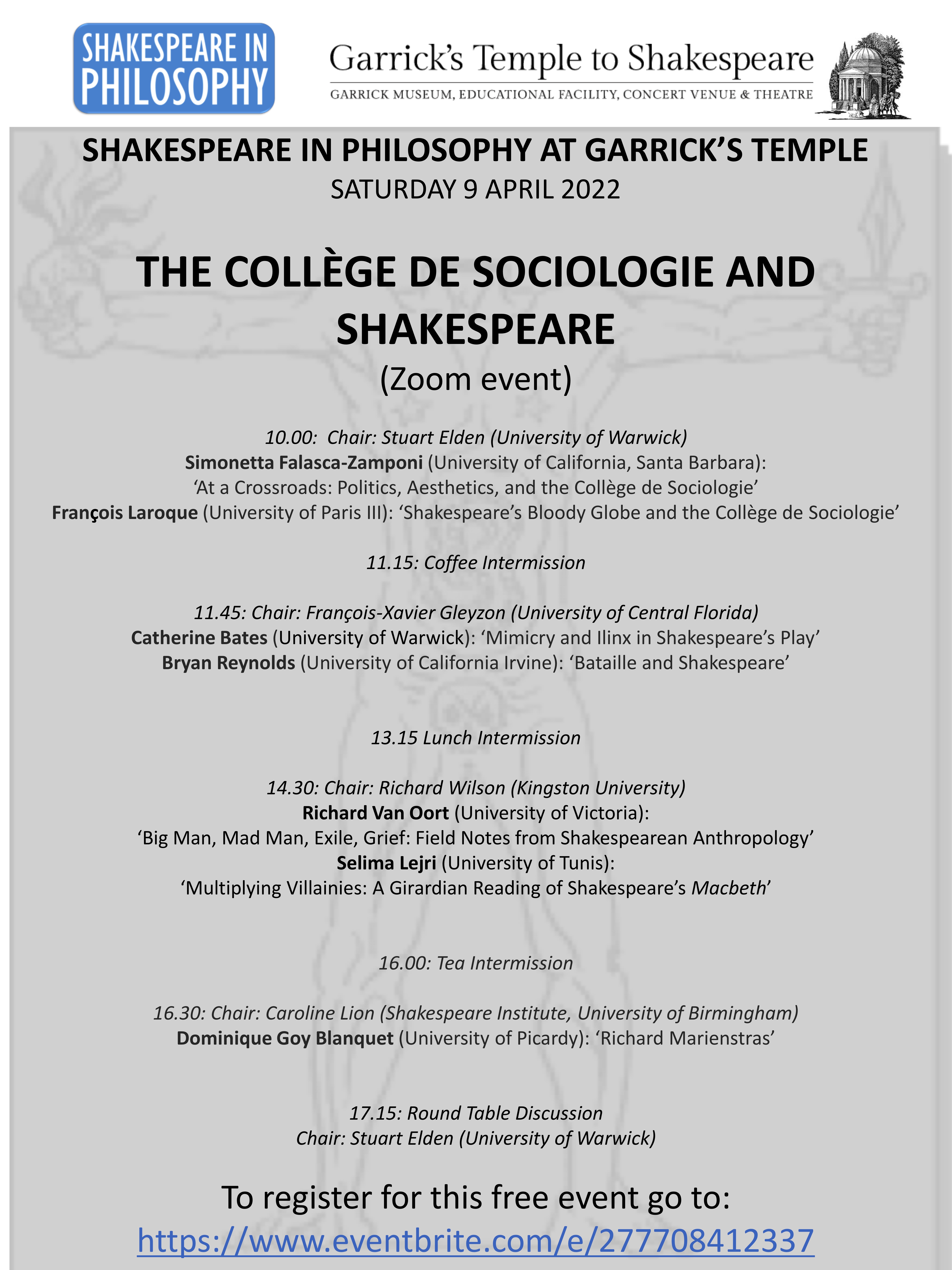
Pleased to share the details of this seminar, co-organised with Richard Wilson. The event is online, sadly, instead of at the lovely Garrick’s Temple to Shakespeare. The seminar is free, but registration required. Please go to https://www.eventbrite.com/e/277708412337
Update: the e-book can be accessed open access here.
Currently listed just as hardback, but a paperback and open access e-book will also be available. One of the chapters comes from the ICE-LAW project run by Phil Steinberg at Durham University.
Assembling scholars across multiple orientations – from legal studies, geography, anthropology, cultural and political theory, the environmental humanities, and ocean studies –this book connects law to the broader humanities in order to critically engage contemporary concerns with the fate of the ocean.
Although the United Nations’ monumental ‘Convention on the Law of the Sea’ imagines an all-encompassing constitutional framework for governing the ocean, this collection, Laws of the Sea, approaches law in plural ways, applying the insights that have emerged within various disciplines to consider the possibilities of a critical ocean approach in legal studies. The collection is comprised of twelve chapters that utilize a diverse set of methodological tools to explore a range of intersecting sites: from hydrothermal vents, through the continental shelf and marine genetic resources, to coastal communities in areas including France, Sweden, Florida, and Indonesia. Confronting the longstanding binary of land and sea, these chapters pose a fundamental challenge to law’s terracentrism, and its pervasive influence on juridical modes of knowing and making the world. Together, they ask: is contemporary Eurocentric law – and international law in particular – capable of moving away from its capitalist and colonial legacies, established through myriad oceanic abstractions and classifications, toward more amphibious legalities?
This collection will appeal to sociolegal, international, and environmental law scholars, as well as geographers and anthropologists, cultural and political theorists, and those working in environmental history, political ecology, and animal studies.
A complete guide for how small states can be strikingly successful and influential–if they assess their situations and adapt their strategies. Small states are crucial actors in world politics. Yet, they have been relegated to a second tier of International Relations scholarship. In A Small State’s Guide to Influence in World Politics, Tom Long shows how small states can identify opportunities and shape effective strategies to achieve their foreign policy goals. To do so, Long puts small states’ relationships at the center of his approach. Although small states are defined by their position as materially weaker actors vis-a-vis large states, Long argues that this condition does not condemn them to impotence or irrelevance. Drawing on typological theory, Long builds an explanation of when and how small states might achieve their goals. The book assesses a global range of cases-both successes and failures-and offers a set of tools for scholars and policymakers to understand how varying international conditions shape small states’ opportunities for influence.