100 YEARS IN FULL BLOOM

Andy Merrifield on Joyce’s Ulysses, for its centenary.

Andy Merrifield's avatarandy merrifield

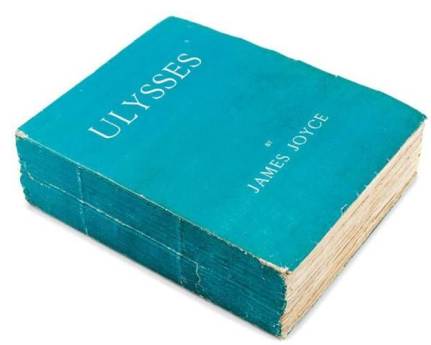
100 years ago, in Paris, February 2nd, James Joyce celebrated his fortieth birthday by raising a glass (or two…) to Ulysses, his great epic novel, launched into the world in all its full, if later revised, glory, that same day–this very day. Hats off here not only to author and book but also to the intrepid Sylvia Beach, whose Shakespeare & Company bore the moral and financial brunt of its initial publication.

FKkzw6HWYAEUHox

Between 1914 and 1921, Joyce worked on his modern, single-day interpretation of the Homeric tale as he embarked on his own personal Odyssey around Europe—in Trieste, Zurich, and Paris. After the thrill of its release, though, his book met with widespread prudery. Customs officials in New York orchestrated an Auto de Fe of hundreds of copies. Authorities at London’s Croydon Airport similarly seized the book. A boat load got pulped at Folkstone harbour.

img_38-8

“I can discover…

View original post 1,517 more words

Posted in Uncategorized | Leave a comment

‘Message ou bruit?’ Resituating a short text by Foucault on medicine

I’ve mentioned before how Dits et écrits, which is an excellent collection, can sometimes decontextualise a piece by Foucault, making it hard to see why it was written.

Tracking down the original publication of pieces can often be difficult but is usually worthwhile. I can only imagine how much work it was to find Foucault’s short pieces before the collection was published.

This decontextualization is well exemplified by ‘Message ou bruit?’, published as Dits et écrits text #44. In the original four-volume edition, this is in volume I, 557-60. I don’t think this piece has been translated – its title is “Message or Noise?” or perhaps “Signal or Noise?”

[Update August 2024: The piece has been translated by Chris O’Neill as “Message or noise?” , with a valuable accompanying commentary: Foucault and information theory: on “message or noise?” (1966)]

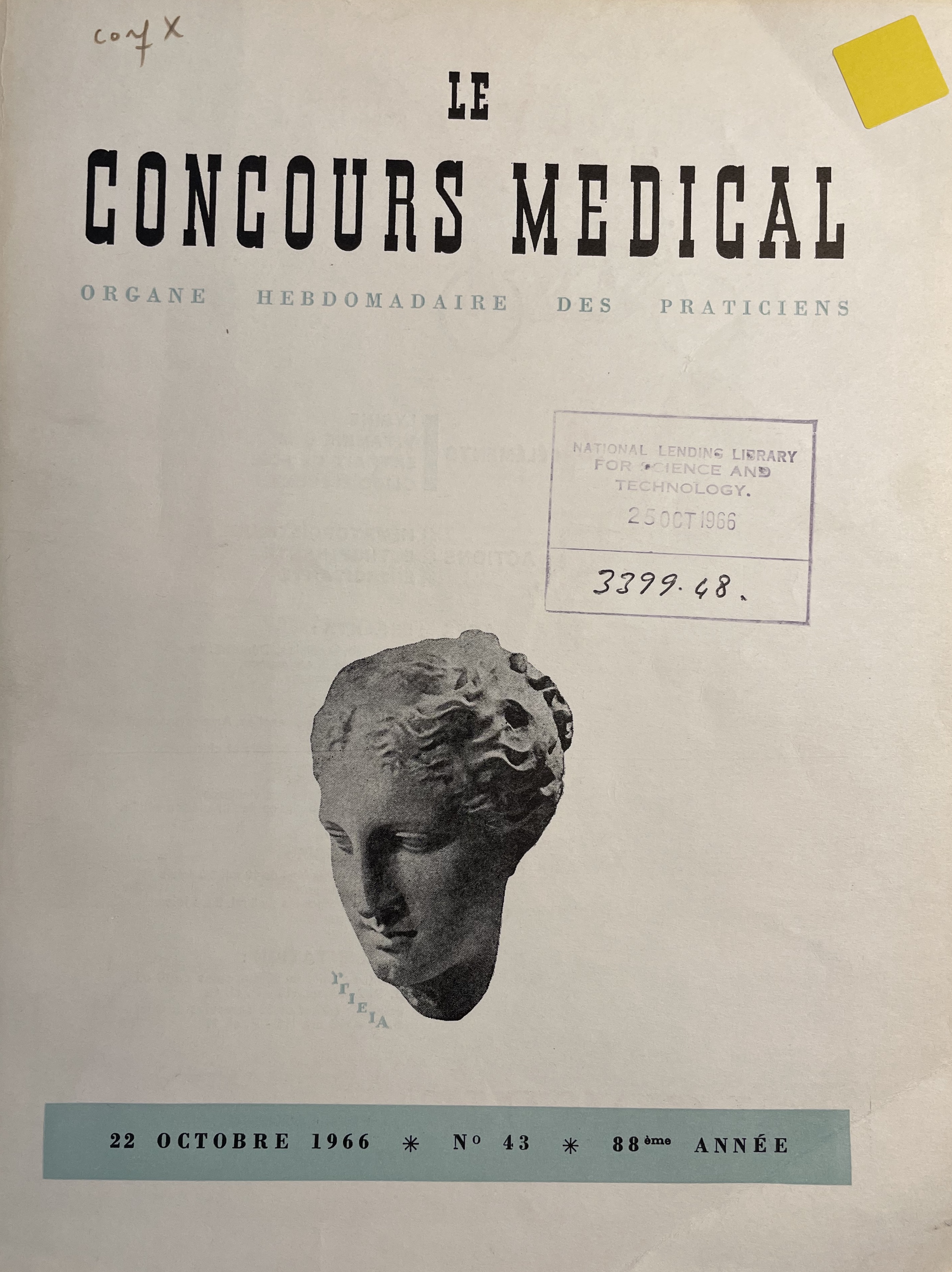
It is a short text on medicine, first published in Le Concours médical No 43, 15 Octobre 1966, pp. 6285-86. I was first alerted to the possibility there was something more interesting at stake by the entry in Foucault’s Titres et travaux where he refers to it as “Les problèmes des diagnostic”.

Looking at the original publication shows that Foucault’s text was partnered by one by François Dagognet (pp. 6281-85). Both are under the heading “Colloque sur… La nature de la pensée médicale (II)”. A short text introduces both:

L’échange d’opinions qui a paru dans le no 42 du 15 octobre a été communiqué à F. Dagognet et à Michel Foucault. Voici leurs réponses… [The exchange of views which appeared in No 42 of 15 October was shared with F. Dagognet and Michel Foucault. Here are their responses…]

The two pieces are entitled “Point de vue de F. Dagognet” and “Les réflexions de M. Foucault”. “Message ou bruit?” appears as the title of the first short section, rather than obviously of the piece as a whole.

Le Concours médicale is a professional medical journal, having the subtitle “Organe hebdomadaire des praticiens [weekly journal for practitioners]”. (It has recently been relaunched as Concours Pluripro) The previous issue mentioned has a collective piece entitled “Colloque sur… La nature de la pensée médicale (I)”, Le Concours médicale, No 42, 15 Octobre 1966, 6101-12.

Interestingly, Dagognet wrote a piece in the same issue of the journal as the original exchanges: “Michel Foucault ou l’archéologie de la médecine”, Le Concours médical 42, 1966, 6097-99. Dagognet had written a review of Naissance de la clinique the year before: “Archéologie ou histoire de la médecine?” Critique 216, 1965, 436-48. The Critique review I knew about – it is one of only two reviews I’ve found of this book around the time of its publication – but not this later piece. In Le Concours médical Dagognet situates Naissance de la clinique in relation to Histoire de la folie and Les mots et les choses, arguing that all the books contribute to a history of medicine, for their content and their method.

So, as well as giving a sense of the debate to which Foucault was responding, checking the original source of the piece also led me to an interesting piece about Foucault. Dagognet was a student of Georges Canguilhem, and like him, trained as both a philosopher and medical doctor. A French obituary is here and a brief note in English is at the Cahiers pour l’Analyse site. He and Foucault would debate Georges Cuvier in a conference Canguilhem organised a few years later. Foucault’s paper from that event has been translated twice (here and here), but the separate response to Dagognet from that event is another text which doesn’t make a lot of sense outside its original context.

“Message ou bruit?” remains a minor piece by Foucault, but it’s interesting to see how he was being discussed in medical journals. The other contemporary review of Naissance de la clinique was by the director of the Wellcome Institute for the History of Medicine, F.N.L. Poynter, in History of Science (Vol 3, 1964, 140-43). Foucault would go on to work with doctors in the Groupe Information Santé in the early 1970s, which I discuss in Foucault: The Birth of Power. A bibliography of their work is here.

Posted in Foucault: The Birth of Power, Georges Canguilhem, Michel Foucault, The Archaeology of Foucault | 5 Comments

Interviews about Intolerable. Writings from Michel Foucault and the Prisons Information Group (1970-1980)

image

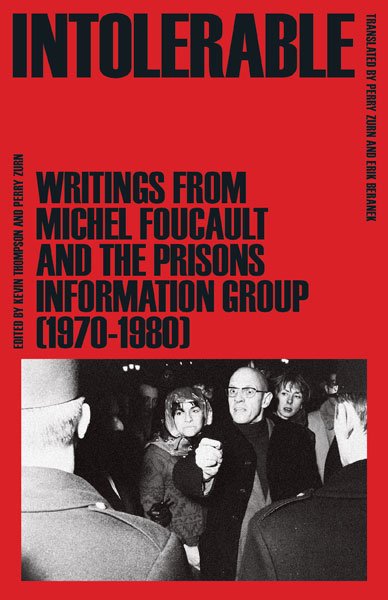
A number of interviews about the important collection Intolerable. Writings from Michel Foucault and the Prisons Information Group (1970-1980) – University of Minnesota Press, 2021

the collection was edited by Kevin Thompson and Perry Turn, and translated by Perry Turn and Erik Beranek.

Conversations in Atlantic Theory: (see episode 1)

Radical Philosophy Hour

New Books Network

Hopscotch Translation

And a symposium devoted to the collection published in the most recent edition of Foucault Studies 

Posted in Uncategorized | 1 Comment

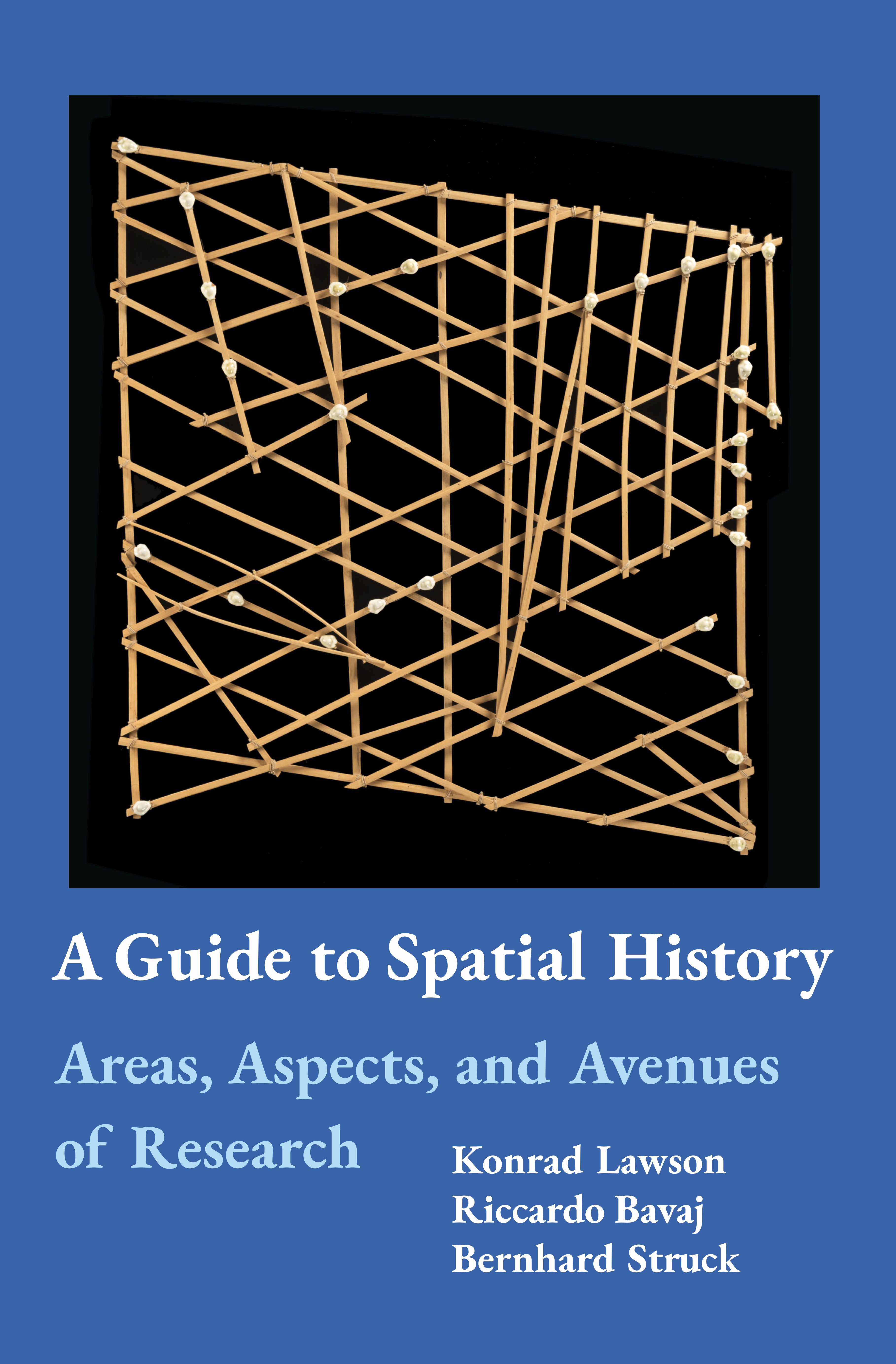
Konrad Lawson, Riccardo Bavaj and Bernhard Struck, A Guide to Spatial History: Areas, Aspects, and Avenues of Research, June 2021 (open access)

Konrad Lawson, Riccardo Bavaj and Bernhard Struck, A Guide to Spatial History: Areas, Aspects, and Avenues of Research, June 2021 (open access)

This guide provides an overview of the thematic areas, analytical aspects, and avenues of research which, together, form a broader conversation around doing spatial history.1 Spatial history is not a field with clearly delineated boundaries. For the most part, it lacks a distinct, unambiguous scholarly identity. It can only be thought of in relation to other, typically more established fields. Indeed, one of the most valuable utilities of spatial history is its capacity to facilitate conversations across those fields. Consequently, it must be discussed in relation to a variety of historiographical contexts. Each of these have their own intellectual genealogies, institutional settings, and conceptual path dependencies. Any attempt to approach spatial history in a hermetic way, as if it existed in a historiographical vacuum, would run counter to its very purpose. Spatial history is not merely one among many ‘hyphenated’ fields.2 It does not aim at further compartmentalization. At its very core lies a heightened sensitivity to the spatial dimensions of history in general. Historians may or may not choose to explicitly adopt the label ‘spatial history.’ Either way, there exists a sizeable body of spatially attuned historical scholarship that is eminently worthy of discussion.

The guide is available online or to download as pdf.

Posted in Uncategorized | Leave a comment

Le foucaldien relaunched as Genealogy + Critique (2022)

Le foucaldien relaunched as Genealogy + Critique (2022)

Clare O'Farrell's avatarFoucault News

Le foucaldien relaunched as Genealogy + Critique (2022)

From 2022, the peer-reviewed, open-access journal Le foucaldien, published by the London-based Open Library of Humanities (OLH), and the affiliated foucaultblog appear under the new title GENEALOGY+CRITIQUE at genealogy-critique.net. The relaunch broadens the scope of the journal and its blog by including various approaches of historical-genealogical research and critical theory formation.

GENEALOGY+CRITIQUE focuses on genealogical scholarship and a broad conception of critical theory. Combining historical and systematic forms of inquiry, the interdisciplinary journal fosters critical analyses of the present written in English, German, or French. It also aims at confronting historical-genealogical and critical theory approaches with concepts and methods in more recent fields of knowledge such as media studies, digital humanities, science and technology studies, as well as postcolonial, gender, and race studies.

The journal’s publisher, the Open Library of Humanities, is a nonprofit organization financed by an international consortium…

View original post 187 more words

Posted in Uncategorized | Leave a comment

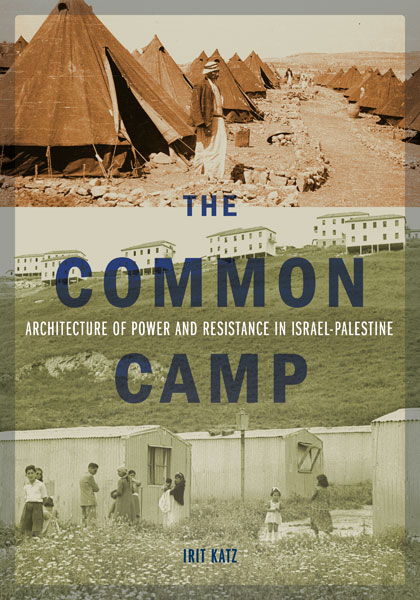
Irit Katz, The Common Camp: Architecture of Power and Resistance in Israel–Palestine – University of Minnesota Press, May 2022

Irit Katz, The Common Camp: Architecture of Power and Resistance in Israel–Palestine – University of Minnesota Press, May 2022

Seeing the camp as a persistent political instrument in Israel–Palestine and beyond

Focusing on the geopolitical complexity of Israel–Palestine and the dramatic changes it has experienced during the past century, The Common Camp explores the region’s extensive networks of camps and their existence as both a tool of colonial power and a makeshift space of resistance. Bringing together a broad range of historical and ethnographic materials within the context of this singular yet versatile entity, the book locates the camp at the core of modern societies and how they change and transform. 

Posted in Uncategorized | Leave a comment

Books received – Althusser, Pécheux and Fichant, Badiou, Terray, Balibar, Kristeva, Epstein, Danchev

Some books by Althusser and his then-students – some of which I talk about here – along with Etienne Balibar’s Violence and Civility, a couple by Julia Kristeva, Charlotte Epstein’s Birth of the State: The Place of the Body in Crafting Modern Politics, and the long-awaited Magritte: A Life by Alex Danchev and completed by Sarah Whitfield.

Posted in Alain Badiou, Etienne Balibar, Julia Kristeva, Louis Althusser | Leave a comment

CFP: Warwick Continental Philosophy Conference 2021/2022

Warwick Continental Philosophy conference – deadline for abstract 12 February 2022

Clare O'Farrell's avatarFoucault News

Warwick Continental Philosophy Conference 2021/2022
Continental Philosophy and Global Challenges
Historical perspectives through practical engagements

09-11 June 2022
University of Warwick (UK)
Conference Venue:
Department of Philosophy, University of Warwick
Coventry, United Kingdom

Keynote Speakers:
Prof. Bernard Harcourt (Columbia Law School)
Dr Elena Louisa Lange (University of Zurich)
TBA

Call for Abstracts
The aim of the fourth edition of the WCPC is to explore the ways in which continental philosophy has addressed and continues to address ‘global challenges’ – a term we use to indicate phenomena that can be described as problems affecting the entire globe and concerning the whole of humanity as well as non-human agents. More specifically, we aim to interrogate the kind of temporality that underlies the notion of global challenges both in philosophical reflection and in ensuing political practices.

In speaking of the temporality of such a concept, we are specifically thinking about the drive to…

View original post 789 more words

Posted in Uncategorized | Leave a comment

Nietzsche, Foucault et la généalogie (2022)

Series of seminars on Foucault, Nietzsche and genealogy

Clare O'Farrell's avatarFoucault News

PDF dépliant

Michèle COHEN-HALIMI et Orazio IRRERA 

Nietzsche, Foucault et la généalogie

Université Paris 8 | Semestre 2 | mardi 12h15-15h

(Les séances auront lieu sur Zoom et un lien sera transmis aux inscrits)

Inscriptions / contacts : orazio.irrera02@univ-paris8.fr | m.cohenhalimi@gmail.com

Séminaire organisé dans le cadre des activités pédagogiques et de recherche du Département de Philosophie de l’Université de Paris 8, du LLCP (EA, 4008), du GRAF (Groupe de Recherche sur les Archives Foucaldiennes), du Collège international de Philosophie, et du séminaire permanent « Foucault à Paris 8 ». Activité soutenue par le Centre Michel Foucault et la revue materiali foucaultiani.

La généalogie comprise comme méthode surgit tardivement dans le corpus nietzschéen, dans La Généalogie de la morale en 1887, et ne procède pas directement de l’élaboration du concept d’inactualité, ni de celui d’histoire, tels du moins qu’ils sont déployés dans la deuxième Considération inactuelle (1874). L’histoire de l’élaboration des…

View original post 287 more words

Posted in Uncategorized | Leave a comment

Claudia Aradau and Tobias Blanke, Algorithmic Reason: The New Government of Self and Other – May 2022 (print and open access)

Claudia Aradau and Tobias Blanke, Algorithmic Reason: The New Government of Self and Other – May 2022 (print and open access)

This is an open access title available under the terms of a CC BY-NC-ND 4.0 International licence. It is free to read at Oxford Scholarship Online and offered as a free PDF download from OUP and selected open access locations.

Are algorithms ruling the world today? Is artificial intelligence making life-and-death decisions? Are social media companies able to manipulate elections? As we are confronted with public and academic anxieties about unprecedented changes, this book offers a different analytical prism through which these transformations can be explored. Claudia Aradau and Tobias Blanke develop conceptual and methodological tools to understand how algorithmic operations shape the government of self and other. They explore the emergence of algorithmic reason through rationalities, materializations, and interventions, and trace how algorithmic rationalities of decomposition, recomposition, and partitioning are materialized in the construction of dangerous others, the power of platforms, and the production of economic value. The book provides a global trandisciplinary perspective on algorithmic operations, drawing on qualitative and digital methods to investigate controversies ranging from mass surveillance and the Cambridge Analytica scandal in the UK to predictive policing in the US, and from the use of facial recognition in China and drone targeting in Pakistan to the regulation of hate speech in Germany

Posted in Uncategorized | Leave a comment