Sylvère Lotringer (1938–2021)

Some of the tributes to Sylvère Lotringer

Clare O'Farrell's avatarFoucault News

Sylvère Lotringer (1938–2021)
Art Forum, November 10, 2021

Renowned French thinker Sylvère Lotringer, a lodestar in the twin galaxies of literary criticism and cultural theory, died on November 8 at the age of eighty-three following an illness. Beginning in the 1970s, Lotringer reshaped the American literary scene through the journal Semiotext(e), which he began publishing while teaching at Columbia University. The journal evolved into an independent publishing house of the same name, which through its English translations of their texts introduced American readers to such French giants of philosophy as Jean Baudrillard, Gilles Deleuze and Félix Guattari, Michel Foucault, Jean-François Lyotard, and Paul Virilio.
[…]

Los Angeles Times

[…]

In November of 1975, a French literary scholar at Columbia University by the name of Sylvère Lotringer, along with a student, John Rajchman, organized a four-day colloquium that was intended to bring together a wave of avant-garde French theorists with various…

View original post 353 more words
Posted in Uncategorized | Leave a comment

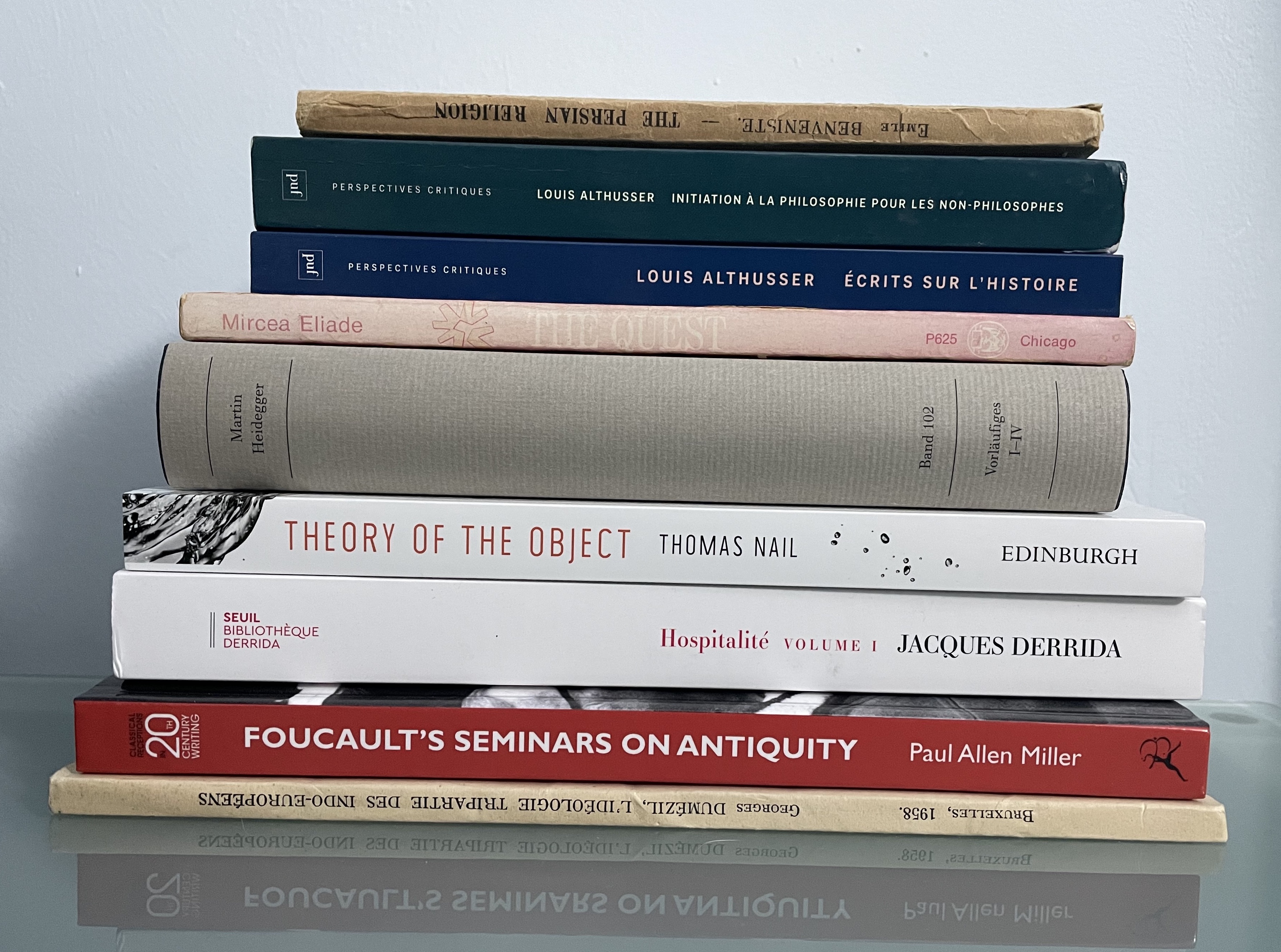
Books received – Benveniste, Althusser, Eliade, Heidegger, Nail, Derrida, Miller, Dumézil

Mostly bought second-hand, but also Thomas Nail, Theory of the Object and Paul Allen Miller, Foucault’s Seminars on Antiquity, both sent by the publishers, and the most recent of Derrida’s seminars and Heidegger’s notebooks.

Posted in Emile Benveniste, Georges Dumézil, Jacques Derrida, Louis Althusser, Martin Heidegger, Michel Foucault, Mircea Eliade | 1 Comment

Theory in Crisis Seminar – Engin Isin, ‘Planetary Movements: Willing, Knowing, Acting’, 10 December 2021

Theory in Crisis Seminar – Engin Isin, ‘Planetary Movements: Willing, Knowing, Acting’, 10 December 2021, 10 December 2021 , 4:00PM – 6:00PM (CEST) 

What is the role of critical theory today and who is it for? What kind of maps can theory provide in the context of entrenched capitalist crisis? These are some of the questions posed by this Theory in Crisis seminar series.   

In this session, Engin Isin will give a talk titled ‘Planetary Movements: Willing, Knowing, Acting’: 

Multiple but resonant social movements marked the beginning of the 21st century with several emergent qualities. There are far too many to mention here but even though the international congresses of working peoples, suffragette, anti-slavery, anti-colonial, anti-war, anti-racist, feminist, queer, trans, indigenous, and environmental movements, world social forums, migration movements, and sanctuary movements have all made indelible marks on the 19th and 20th centuries, the 21st century movements from No one is Illegal to Idle No More or from The Narmada Bachao Andolan resistance to Black Lives Matter, Rhodes Must Fall, and Extinction Rebellion signify qualities of a planetary politics. The naming of the present as the planetary either as a period or condition must proceed with an understanding of the emergent qualities of these movements.

Planetary movements intersect with each other: solidarity between oppressed, dispossessed, and displaced peoples and movements against sexual, racial, national and class domination. Planetary movements resist domination of peoples by peoples, species by species and planets by planets. Planetary movements are also not international, global, or transnational movements. The planetary is not a scale but a stage of politics. The planet earth, its peoples, its species, and its relation to other planets play out on a different stage.

This lecture is an invitation to interpret these movements as ‘planetary movements’ through twelve propositions organised into three parts: willing, knowing, and acting.  

Posted in Uncategorized | Leave a comment

William Walters, Charles Heller & Lorenzo Pezzani (eds.), Viapolitics: Borders, Migration, and the Power of Locomotion – Duke University Press, January 2022 (open access introduction)

William Walters, Charles Heller & Lorenzo Pezzani (eds.), Viapolitics: Borders, Migration, and the Power of Locomotion – Duke University Press, January 2022 (open access introduction)

Vehicles, their infrastructures, and the environments they traverse are fundamental to the movement of migrants and states’ attempts to govern them. This volume’s contributors use the concept of viapolitics to name and foreground this contested entanglement and examine the politics of migration and bordering across a range of sites. They show how these elements constitute a key site of knowledge and struggle in migratory processes and offer a privileged vantage point from which to interrogate practices of mobility and systems of control in their deeper histories and wider geographic connections. This transdisciplinary group of scholars explores a set of empirically rich and diverse cases: from the Spanish and European authorities’ attempts to control migrants’ entire trajectories to infrastructures of escort of Indonesian labor migrants; from deportation train cars in the 1920s United States to contemporary stowaways at sea; from illegalized migrants walking across treacherous Alpine mountain passes to aerial geographies of deportation. Throughout, Viapolitics interrogates anew the phenomenon called “migration,” questioning how different forms of contentious mobility are experienced, policed, and contested.

Contributors. Ethan Blue, Maribel Casas-Cortes, Julie Y. Chu, Sebastian Cobarrubias, Glenda Garelli, Charles Heller, Sabine Hess, Bernd Kasparek, Clara Lecadet, Johan Lindquist, Renisa Mawani, Lorenzo Pezzani, Ranabir Samaddar, Amaha Senu, Martina Tazzioli, William Walters

The Introduction is open access here.

Posted in Uncategorized | Leave a comment

Rhythmanalysis: Place, Mobility, Disruption and Performance, edited by Dawn Lyon, Research in Urban Society 17 (requires subscription)

Rhythmanalysis: Place, Mobility, Disruption and Performance, edited by Dawn Lyon, Research in Urban Society 17 (requires subscription) 

Posted in Henri Lefebvre, Uncategorized, urban/urbanisation | Leave a comment

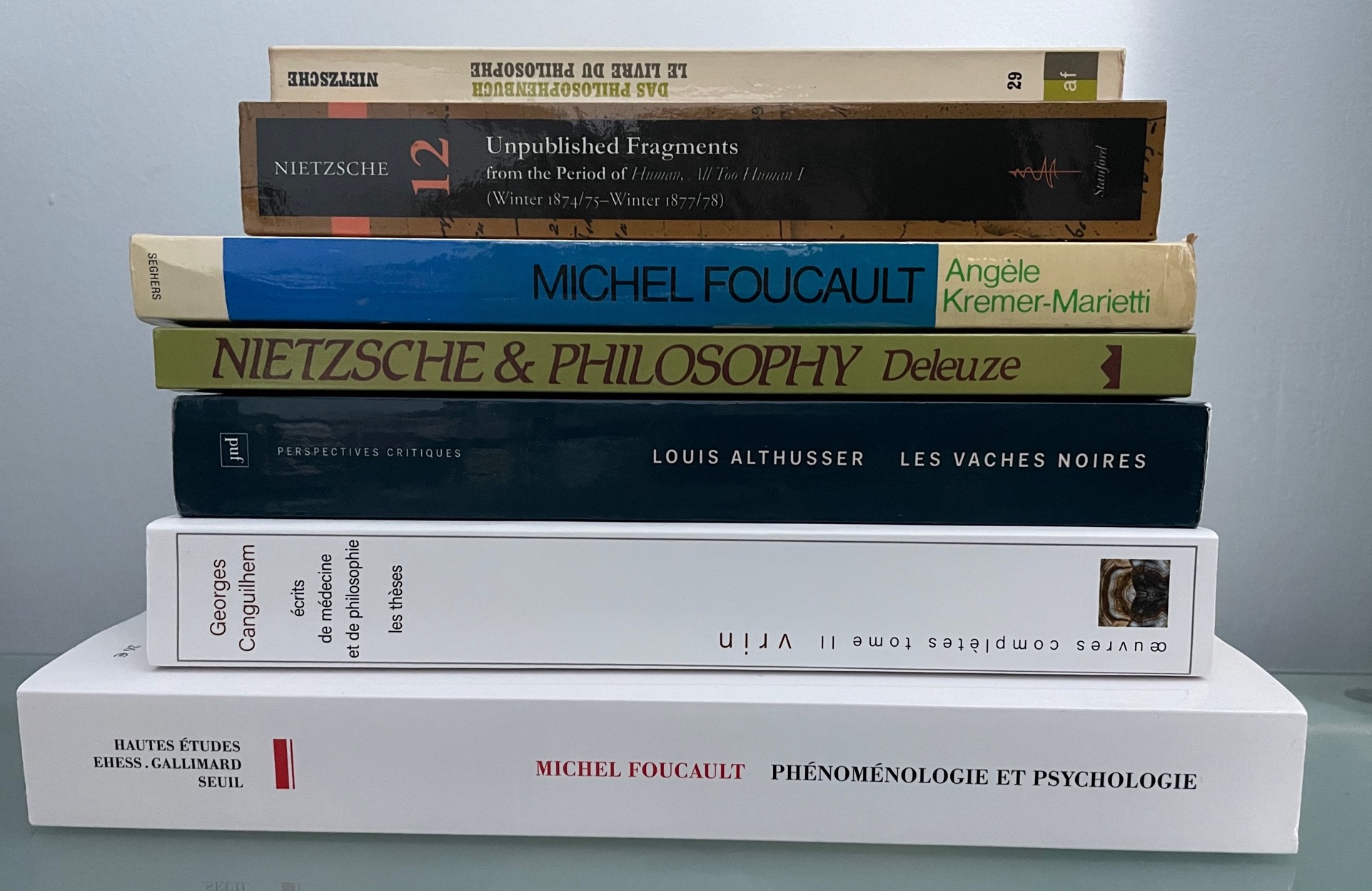
Books received – Nietzsche, Kremer-Marietti, Deleuze, Althusser, Canguilhem, Foucault

Mostly bought second-hand, but also the latest volume of Canguilhem’s Œuvres and Foucault’s Phénoménologie et psychologie, edited by Philippe Sabot, which I bought in Paris.

Posted in Friedrich Nietzsche, Georges Canguilhem, Louis Althusser, Michel Foucault, Uncategorized | 1 Comment

Vinciane Despret, Living as a Bird – translated by Helen Morrison, Polity, October 2021 and discussion at New Books Network

Vinciane Despret, Living as a Bird – translated by Helen Morrison, Polity, October 2021 and discussion at New Books Network

In the first days of spring, birds undergo a spectacular metamorphosis. After a long winter of migration and peaceful coexistence, they suddenly begin to sing with all their might, varying each series of notes as if it were an audiophonic novel. They cannot bear the presence of other birds and begin to threaten and attack them if they cross a border, which might be invisible to human eyes but seems perfectly tangible to birds. Is this display of bird aggression just a pretence, a game that all birds play? Or do birds suddenly become territorial – and, if so, why?

By attending carefully to the ways that birds construct their worlds and ornithologists have tried to understand them, Despret sheds fresh light on the activities of both and, at the same time, enables us to become more aware of the multiple worlds and modes of existence that characterize the planet we share in common with birds and other species.

There is a discussion of the book at the New Books Network with Carrie Figdor here.

https://megaphone.link/NBN3596086868

Birds sing to set up a territory, but the relationships between the bird, the song, the territory, and the bird’s community are highly complex and individually variable. InLiving as a Bird (English translation by Helen Morrison, Polity Press, 2021), Vinciane Despret explores the concept of territory from a perspective that situates philosophical work on human conceptions of other animals within historical and contemporary empirical research into bird song and territorial behavior. Following recent theorizing by ornithologists and ethologists, Despret – an associate professor of philosophy at the University of Liege in Belgium – critiques the popular view of territories as private property and birds as petit bourgeois who gain property rights, a conception grounded in European social upheavals starting in the 17th century. Instead, territories are zones of social interaction with one’s “dear enemies” at the peripheries, where male and female birds alike are active participants in the shaping, reshaping and sharing of neighborhoods bounded in song as well as space. This new translation makes Despret’s thoughtful analysis of songbird life accessible to an English-speaking audience.

Posted in Uncategorized | Leave a comment

Historical Materialism conference 2021 – videos on sessions on John Bellamy Foster, Gramsci and Althusser

Historical Materialism conference 2021 – videos of sessions on Althusser, Gramsci and John Bellamy Foster’s book. Lots more on the Haymarket channel.

Posted in Antonio Gramsci, Louis Althusser | Leave a comment

Philosophy today: Special section on Miguel De Beistegui, The Government Of Desire: A Genealogy Of The Liberal Subject (2021)

Special section: Miguel De Beistegui, The Government Of Desire: A Genealogy Of The Liberal Subject, Philosophy Today: Volume > 65 > Issue: 4, 2021

Clare O'Farrell's avatarFoucault News

Special section: Miguel De Beistegui, The Government Of Desire: A Genealogy Of The Liberal Subject, Philosophy Today: Volume > 65 > Issue: 4, 2021

Vilde Lid Aavitsland, The “Man of Desire” or the “Man of Labor”?: Comments on Miguel de Beistegui’s The Government of Desire

Kevin Thompson, Comments on Miguel De Beistegui’s The Government of Desire: A Genealogy of the Liberal Subject

Miguel de Beistegui, Desire in and Beyond Liberalism: From Normative to Algorithmic and Neuro-power

View original post

Posted in Uncategorized | Leave a comment

Marcelo Hoffman, ‘The FBI file on Foucault’, Viewpoint Magazine (open access), 2021

Marcelo Hoffman, ‘The FBI file on Foucault‘, Viewpoint Magazine, 2021

Nearly a decade ago, two Brazilian researchers, Heliana de Barros Conde Rodrigues and Maria Izabel Pitanga, made a remarkable discovery. They requested materials on the French philosopher Michel Foucault from the National Archive of the Ministry of Justice in Brasília and obtained a file on him compiled by an intelligence agency established by the Brazilian dictatorship, the National Intelligence Service (SNI). The file revealed that Foucault’s participation in a protest at a student assembly in São Paulo in 1975 had become the focal point of his surveillance by the SNI.1 Conde and Pitanga’s discovery left me with an elementary but irrepressible curiosity: did the Federal Bureau of Investigation (FBI) in the United States compile a file on Foucault? It did not seem outlandish to think that Foucault would have caught the attention of the FBI. He had visited the United States with great frequency in the 1970s and 1980s. Foucault had also established a reputation as a radical intellectual with a history of militant engagements at the time of his initial visits to the United States… [continues here]

Posted in Uncategorized | 1 Comment