updated 28 May 2021 with new description and table of contents
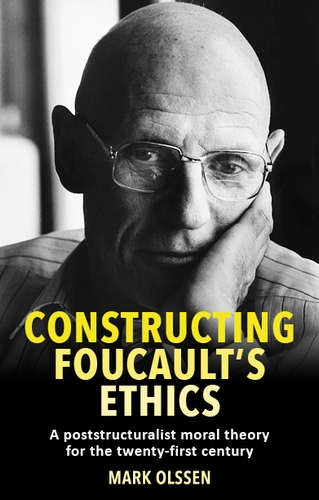
In popularizing the term ‘speaking truth to power’, now widely used throughout the world, Michel Foucault established the basis upon which a new ethics can be constructed. This is the thesis that Mark Olssen advances in Constructing Foucault’s ethics. Olssen not only ‘speaks truth’ to existing moral and ethical theories that have dominated western philosophy since Plato, but also shows how, by using Foucault’s insights, an alternative ethical and moral theory can be established that both avoids the pitfalls of postmodern relativism and simultaneously grounds ethical, moral, and political discourse for the present age.
Taking the late ‘ethical turn’ in the philosopher’s thought as its starting point, this ambitious study seeks to construct an ethics beyond anything Foucault ever attempted while remaining consistent with his core postulates. In doing so it advances the concept of ‘life continuance’, which expresses a normative orientation to the future in terms of the quest for survival and well-being, giving rise to irreducible normative values as part of the discursive order of events. This approach is explored in contrast with a range of other, established systems, from the Kantian to the Marxist to contract ethics and utilitarianism.
Introduction
1 Foucault and normativity
2 Life and error: Foucault, Canguilhem, Jacob
3 Nietzsche’s life philosophy: naturalism, will to power, normativity
Mark Olssen is one of the leading social scientists writing in the world today. Inspired by the writings of Michel Foucault, Olssen’s writings traverse philosophy, politics, education, and epistemology. This book comprises a selection of his papers published in academic journals and books over twenty-five years. Taken as a whole, the papers represent a redirection of the core axioms and directions of western ontology and philosophy in relation to how history, the subject, and education are theorised within the western philosophical tradition. Olssen’s writings not only contain a powerful critique and revision of western liberalism from a poststructuralist perspective, they both explicate and extend Michel Foucault’s challenge to the core axioms and assumptions underpinning western thought. As Stephen Ball suggests in his Foreword to this volume, “Olssen uses Foucault to explore issues… Olssen’s Foucault is not a lonely nihilist but a troubled provocateur who encourages in us toward the political project of self-formation – our relation to ourselves and always, to others.”
I missed this when it was published last year, but this looks a major undertaking. There is a review in the New York Review by Adam Kirsch here (opening part readable, rest requires subscription).
Ernst Cassirer occupies a unique space in twentieth-century philosophy. A great liberal humanist, his multi-faceted work spans the history of philosophy, the philosophy of science, intellectual history, aesthetics, epistemology, the study of language and myth, and more. Cassirer’s thought also anticipates the renewed interest in the origins of analytic and continental philosophy in the Twentieth Century and the divergent paths taken by the ‘logicist’ and existential traditions, epitomised by his now legendary debate in 1929 with the philosopher Martin Heidegger, over the question “What is the Human Being?”
The Philosophy of Symbolic Forms is Cassirer’s most important work. It was first published in German in 1923, the third and final volume appearing in 1929. In it Cassirer presents a radical new philosophical worldview – at once rich, creative and controversial – of human beings as fundamentally “symbolic animals”, placing signs and systems of expression between themselves and the world.
This major new translation of all three volumes, the first for over fifty years, brings Cassirer’s magnum opus to a new generation of students and scholars. Taken together, the three volumes of The Philosophy of Symbolic Forms are a vital treatise on human beings as symbolic animals and a monumental expression of neo-Kantian thought.
Correcting important errors in previous English editions, this translation reflects the contributions of significant advances in Cassirer scholarship over the last twenty to thirty years. Each volume includes a new introduction and translator’s notes by Steve G. Lofts, a foreword by Peter E. Gordon, a glossary of key terms, and a thorough index.
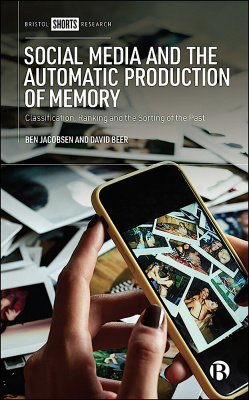
Social media platforms hold vast amounts of biographical data about our lives. They repackage our past content as ‘memories’ and deliver them back to us. But how does that change the way we remember?
Drawing on original qualitative research as well as industry documents and reports, this book critically explores the process behind this new form of memory making. In asking how social media are beginning to change the way we remember, it will be essential reading for scholars and students who are interested in understanding the algorithmically defined spaces of our lives.
“This book illuminates how our memories are formatted by the interfaces of social media. Jacobsen and Beer have written an insightful analysis of what ‘technologies of memory’ look like in data-driven societies.” José van Dijck, Utrecht University
“Jacobsen and Beer’s book is essential reading for anyone wanting to understand the automatic production of memory on social media. This book is one to be remembered and revisited time and again.” Taina Bucher, University of Oslo.
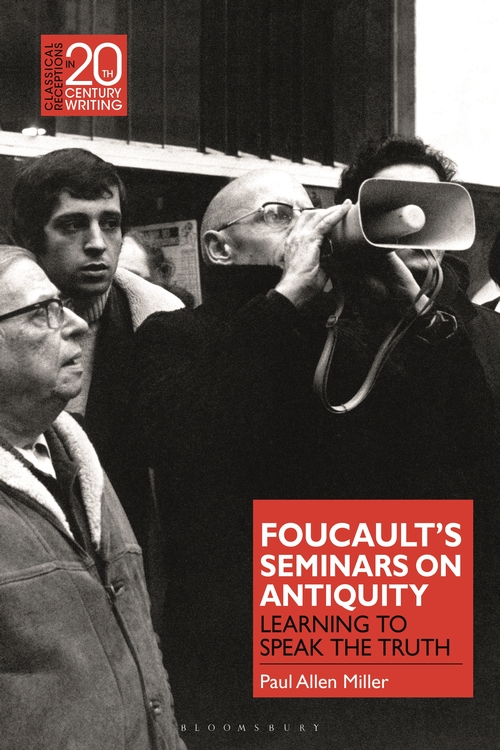
In 1980, Michel Foucault’s work makes two decisive turns. On the one hand, as announced at the start of his course at the Collège de France for that year, Le Gouvernement des vivants, his topic will be the modalities through which power constitutes itself in relation to truth. On the other hand, the texts on which he will concentrate will no longer be those of the early modern period. Rather, he begins with one by Dio Cassius on the emperor Septimius Severus and then proceeds to spend the next two sessions offering a reading of Oedipus Tyrannus. He will concentrate on works from antiquity for the rest of his life.
This book will offer the first detailed account of these lectures, examining both the development of their philosophical argument and the ancient texts on which that argument is based. This is the period during which Foucault also began work on Volumes 2 and 3 of the History of Sexuality. Yet, while there are clear overlaps between the work he was presenting in his course and the last books he published before his death, nonetheless the seminars are anything but rough drafts for the published work. Instead they offer a sustained encounter with the texts of the classical and early Christian era while seeking to trace a genealogy of the western subject as a speaker of truth.
Rana Mitter talks to Timothy Brennan and the writers Ahdaf Soueif, Pankaj Mishra and Marina Warner on BBC 3: Free Thinking
Drawing on extensive archival sources and hundreds of interviews, Timothy Brennan’s Places of Mind is the first comprehensive biography of Said, one of the most controversial and celebrated intellectuals of the 20th century. In Brennan’s masterful work, Said, the pioneer of post-colonial studies, a tireless champion for his native Palestine, and an erudite literary critic, emerges as a self-doubting, tender, and eloquent advocate of literature’s dramatic effects on politics and civic life.
Places of the Mind charts the intertwined routes of Said’s intellectual development, revealing him as a study in opposites: a cajoler and strategist, a New York intellectual with a foot in Beirut, an orchestra impresario in Weimar and Ramallah, a raconteur on national television, a Palestinian negotiator at the State Department, and an actor in films in which he played himself. Brennan traces the Arab influences of Said’s thinking along with his tutelage under Lebanese statesmen, off-beat modernist auteurs, and New York literati, as Said grew into a scholar whose influential writings changed the face of university life forever. With both intimidating brilliance and charm, Said turned these resources into a groundbreaking counter-tradition of radical humanism, set against the backdrop of techno-scientific dominance and religious war. With unparalleled clarity, Said gave the humanities a new authority in the age of Reaganism that continues today.
Drawing on the testimonies of family, friends, students, and antagonists alike, and aided by FBI files, unpublished writing, and Said’s drafts of novels and personal letters, Places of the Mind captures Said’s intellectual breadth and influence in an unprecedented, intimate, and compelling portrait of one of the great minds of the twentieth century.
Update: there is another discussion here. Thanks to dmf for this link.
Reclaiming migration critically assesses the EU’s migration policy by presenting the unheard voices of the so-called migrant crisis. It undertakes an extensive analysis of a counter-archive of migratory testimonies, co-produced with people on the move across the Mediterranean during 2015 and 2016, to document how EU policy developments create precarity on the part of those migrating under perilous conditions. The book draws attention to the flawed assumptions embedded within the policy agenda, while also exploring the claims and demands for justice that are advanced by people on the move. Written collectively by a team of esteemed scholars from across multiple disciplines, Reclaiming migration makes an important contribution to debates surrounding migration, borders, postcolonialism and the politics of knowledge production.