Some books in recompense for review for Polity, along with Achille Mbembe, Out of the Dark Nightfrom Columbia University Press, Jacques Martin’s L’individu chez Hegel, edited by Jean-Baptiste Vuillerod, the translation of Foucault’s Confessions of the Flesh and an old book by Emile Benveniste
On the day the final volume of The History of Sexuality is published in English, over 36 years after Foucault’s death in 1984, Shahidha Bari and her panel assess its influence.
Shahidha Bari is joined by Lisa Downing, Stuart Elden, and Stephen Shapiro to look volume 4 of Foucault’s History of Sexuality at, translated into English for the first time, which examines beliefs and practices among the early Christians in Medieval Europe. Although he had specified in his will that his works shouldn’t be published after he died (in 1984), the rights holders of Foucault decided that these ideas could now be made public. So what do they tell us and how influential has his approach to sexuality been?
Lisa Downing, Professor of Modern Languages at the University of Birmingham. She writes about gender and sexuality and she’s the editor of The Cambridge Introduction to Michel Foucault.
Stuart Elden’s books include The Early Foucault, which will be published in June 2021. This continues the work in his earlier books Foucault’s Last Decade and Foucault: The Birth of Power. He is Professor of Political Theory and Geography at the University of Warwick.
And Stephen Shapiro, Professor of English and Comparative Literature also at the University of Warwick. He is co-author of how to Read Foucault’s Discipline and Punish.
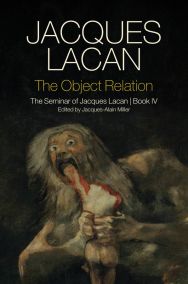
‘The unfulfilled and unsatisfied mother around whom the child ascends the upward slope of his narcissism is someone real. She is right there, and like all other unfulfilled creatures, she is in search of what she can devour, quaerens quem devoret. What the child once found as a means of quashing the symbolic unfulfilment is what he may possibly find across from him again as a wide-open maw […] To be devoured is a grave danger that our fantasies reveal to us. We find it at the origin, and we find it again at this turn in the path where it yields us the essential form in which phobia presents. We find it again when we look at the fears of Little Hans […] With the support of what I have shown you today, you will better see the relationships between phobia and perversion […] I shall go so far as to say that you will interpret the case better than did Freud himself […]’
Extract from Chapter XI
‘[…] it’s no accident that what has been perceived but dimly, yet perceived nevertheless, is that castration bears just as much relation to the mother as to the father. We can see in the description of the primordial situation how maternal castration implies for the child the possibility of devoration and biting. In relation to this anteriority of maternal castration, paternal castration is a substitute […]’
Extract from Chapter XXI
‘[In the case of little Hans] The initial transformation, which will prove decisive, is […] the transformation of the biting into the unscrewing of the bathtub, which is something utterly different, in particular for the relationship between the protagonists. Voraciously to bite the mother, as an act or an apprehension of her altogether natural signification, indeed to dread in return the notorious biting that is incarnated by the horse, is something quite different from unscrewing, from ousting, the mother, and mobilising her in this business, bringing her into the system as a whole, for this first time as a mobile element and, by like token, an element that is equivalent to all the rest.’
Extract from Chapter XXIII
As with their previous translations of Lacan, hardback initially (though relatively affordable), and paperback to follow.
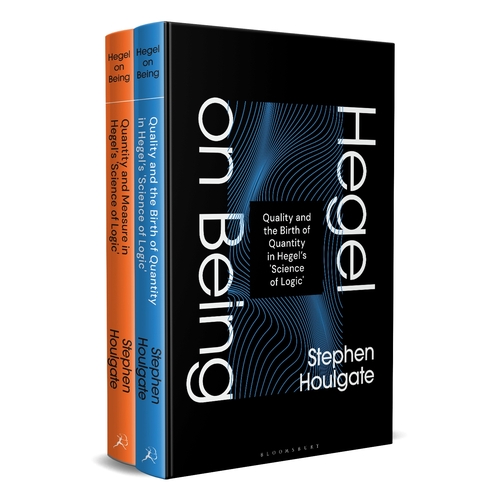
Stephen Houlgate, Hegel on Being – two volumes, Bloomsbury, October 2021
Very expensive hardback and e-book at present, but this looks a major work.
Hegel on Being provides an authoritative treatment of Hegel’s entire logic of being. Stephen Houlgate presents the Science of Logic as an important and neglected text within Hegel’s oeuvre that should hold a more significant place in the history of philosophy. In the Science of Logic, Hegel set forth a distinctive conception of the most fundamental forms of being through ideas on quality, quantity and measure. Exploring the full trajectory of Hegel’s logic of being from quality to quantity, this two-volume work by preeminent Hegel scholar, Houlgate situates Hegel’s text in relation to the work of Plato, Aristotle, Descartes, Spinoza, Kant, and Frege.
Volume I: Quality and the Birth of Quantity in Hegel’s ‘Science of Logic’ covers all material on the purpose and method of Hegel’s dialectical logic and charts the crucial transition from ideas of quality to quantity, as well as providing an original account of Hegel’s critique of Kant’s antinomies across several chapters. Volume II: Quantity and Measure in Hegel’s ‘Science of Logic’ continues the discussion of Hegel’s logic of being and considers all aspects of quantity in his logic, including his basic categories of being, writings on calculus, philosophy of mathematics, as well as a comparative study of Hegel and Frege’s approach to logic.
Lucidly written, with characteristic philosophical depth and analysis, Houlgate’s Hegel on Being explicates one of Hegel’s most complex works, providing a vital reference for a generation of Hegel scholars and a major contribution to the literature on 19th century German philosophy.
Arlette Farge, Instants de Vie, presented by Clémentine Vidal-Naquet, Éditions EHESS, February 2021
Le XVIIIesiècle d’Arlette Farge est sonore, odorant, tactile, à la fois familier et exotique, attachant. Elle a rencontré le peuple de Paris dans les archives, bavardes et hautes en couleur, de la police ; depuis, chacun de ses travaux redonne vie et laisse la parole à ces oubliés de l’histoire, à ce qui les occupe, les bouscule, leur tient à coeur.
Dans ces entretiens avec Perrine Kervran, Laure Adler et Patrick Boucheron, elle raconte sa formation, sa découverte des archives, son engagement féministe, les hasards et rencontres qui ont jalonné son parcours. Elle élabore également une réflexion sur la sensibilité, l’écriture de l’histoire, et le rôle de l’historien dans le présent.
Instants de viedessine ainsi le portrait d’une historienne pour qui réflexivité, émotion et recherche scientifique sont inséparables.
Remigiusz Ryziński. Foucault in Warsaw, Open Letter Books (Forthcoming, June 2021)
The previously untold story of the plot to kick Michel Foucault out of Poland in the 1950s
In 1958, Michel Foucault arrived in Poland to work on his thesis—a work that eventually came to be published as The History of Madness. While he was there, he became involved with a number of members of the gay community, including a certain “Jurek,” who eventually lead the secret police directly to Foucault’s hotel room, causing his subsequent exit from Poland. That boy’s motivations and true identity were hidden among secret police documents for decades, until Remigiusz Ryziński stumbled upon the right report and uncovered the truth about the whole situation.
Nominated for the Nike Literary Award, Foucault in Warsaw reconstructs a vibrant, engaging picture of gay life in Poland under communism—from the joys found in secret nightclubs, to the fears…
This is a book about how 21st-century capitalism really works. Modern economics strips away social, historical, and political context from analysis of ‘the economic’, but the economy is far too important to leave exclusively to the economists. Comparative Political Economy (CPE) is a much broader, richer intellectual undertaking which ‘re-embeds’ the analysis of the economic within the social and political realm. This is at the heart of how to think like a political economist. This text maps the terrain and evolution of CPE, providing the analytical tools to explore the many variants of capitalism, unearthing their roots in competing visions of the desirable distribution of the fruits of growth. Connecting CPE systematically to the subfield of International Political Economy (IPE), the book explains how these visions generate ongoing political struggles over how to regulate and manage capitalism. This is the perfect introduction to the field for all students of CPE and IPE.
On 13 April 2021, 6pm Melbourne/9am UK, I’ll be taking part in an online discussion on ‘Michel Foucault and the Social Contract‘ with Mark Kelly and Christopher Watkin, as part of a series looking at the social contract today. Full details of the Social Contract Network are here.
Perhaps surprisingly, Foucault does not talk about social contract theory very often. In this talk I will briefly survey his discussions of the term and the tradition of political thought, especially in his Collège de France lecture courses – his discussion of civil war and the contract in The Punitive Society; the challenge to the tradition in ‘Society Must Be Defended’; and his indication of a shift from the implicit contract of security in territory to population security in his work on governmentality. The main focus, however, will be on a remark Foucault makes in ‘Society Must Be Defended’ about the dual nature of sovereignty, of the relation between political, juridical power and magical, supernatural power. These two faces or aspects are the power to bind and command, and the power to dazzle and petrify. He calls this the “yoke of law and the lustre of glory”. I will explore the links between this understanding of contracts and Georges Dumézil’s work on Indo-European mythology.
While Foucault’s own direct engagements with the social contract are few and far between, I want to offer a Foucauldian critique of social contract theory qua normative political theory. Contractarianism is notoriously premised on a profound ontological individualism, on the idea that individuals are prior to society, and can therefore either (on a strong reading) constitute civil society based on their free contracting to bring it into existence or (on a weak reading) change the form of society in accordance with their wishes. Against this, Foucault argues that the individual (and thus discourses of individualism like social contract theory) is an invention of disciplinary modernity. I will seek to progress this line of critique by combining it with Foucault’s critique of utopianism to suggest that social contract theory represents an incipient normalisation of society itself, indeed one that precedes and provides the background for the intense normalisation of individuals in late modernity.
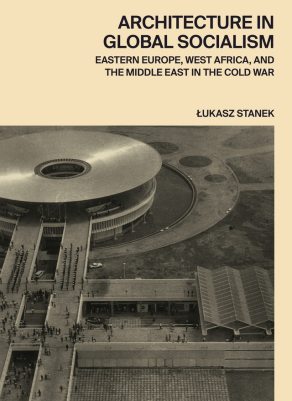
In the course of the Cold War, architects, planners, and construction companies from socialist Eastern Europe engaged in a vibrant collaboration with those in West Africa and the Middle East in order to bring modernization to the developing world. Architecture in Global Socialism: Eastern Europe, West Africa, and the Middle East in the Cold War(Princeton UP, 2020) shows how their collaboration reshaped five cities in the Global South: Accra, Lagos, Baghdad, Abu Dhabi, and Kuwait City.
Łukasz Stanek describes how local authorities and professionals in these cities drew on Soviet prefabrication systems, Hungarian and Polish planning methods, Yugoslav and Bulgarian construction materials, Romanian and East German standard designs, and manual laborers from across Eastern Europe. He explores how the socialist development path was adapted to tropical conditions in Ghana in the 1960s, and how Eastern European architectural traditions were given new life in 1970s Nigeria. He looks at how the differences between socialist foreign trade and the emerging global construction market were exploited in the Middle East in the closing decades of the Cold War. Stanek demonstrates how these and other practices of global cooperation by socialist countries—what he calls socialist worldmaking—left their enduring mark on urban landscapes in the postcolonial world.
Featuring an extensive collection of previously unpublished images, Architecture in Global Socialismdraws on original archival research on four continents and a wealth of in-depth interviews. This incisive book presents a new understanding of global urbanization and its architecture through the lens of socialist internationalism, challenging long-held notions about modernization and development in the Global South.
If you are curious to see some of the architectural projects discussed in Stanek’s award-winning book, please review some images here.
Sharika Crawford is an associate professor of history at the United States Naval Academy in Annapolis and the author of The Last Turtlemen of the Caribbean: Waterscapes of Labor, Conservation, and Boundary Making (University of North Carolina Press, 2020).