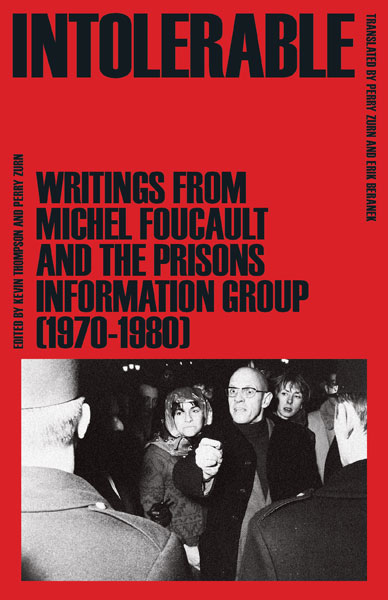
Intolerable: Writings from Michel Foucault and the Prisons Information Group (1970–1980), edited by Kevin Thompson and Perry Zurn, University of Minnesota Press, April 2021

Publication date for this important collection has slipped to April 2021 – it is worth the wait.

stuartelden's avatarProgressive Geographies

imageIntolerable: Writings from Michel Foucault and the Prisons Information Group (1970–1980), edited by Kevin Thompson and Perry Zurn, University of Minnesota Press, December 2020 [updated: April 2021]

Founded by Michel Foucault and others in 1970–71, the Prisons Information Group (GIP) circulated information about the inhumane conditions within the French prison system. Intolerable makes available for the first time in English a fully annotated compilation of materials produced by the GIP during its brief but influential existence, including an exclusive new interview with GIP member Hélène Cixous and writings by Gilles Deleuze and Jean Genet.

These archival documents—public announcements, manifestos, reports, pamphlets, interventions, press conference statements, interviews, and round table discussions—trace the GIP’s establishment in post-1968 political turmoil, the new models of social activism it pioneered, the prison revolts it supported across France, and the retrospective assessments that followed its denouement. At the same time, Intolerable offers a rich, concrete…

View original post 254 more words

Posted in Uncategorized | 2 Comments

Nigel Thrift, Killer Cities – Sage, February 2021

Nigel Thrift, Killer Cities – Sage, February 2021

Killer Cities uses a combination of social theory, polemic and close attention to empirical detail to tell the story of how and why cities cause mass animal death and, in the process, hasten the destruction of the planet. This book is not just a lament, however. It is  an attempt to navigate out of this mess of planned and unplanned violence towards a world in which cities no longer act as killers but become aligned with the lives of other beings. It offers pragmatic ways of diminishing the death toll and changing mindsets without ever minimizing the dilemmas that inevitably will have to be faced. Killer cities can be rehabilitated so that they offer brighter paths towards the future – for animals, for human beings, and for the planet. A new urban geography could be within our grasp. Indeed, it has to be, for all of our sakes.

You can’t change the world without first seeing it through new lenses. Killer Cities shines a light on the ecocidal underbelly of urban life in a capitalist world. Using animals as a focus, Nigel Thrift advances concepts, arguments and evidence that might inspire us to make a very different urban future. The book is creative and hopeful in the face of formidable forces of mental and practical inertia.
Noel Castree
University of Manchester (England) and University of Wollongong (Australia)


This epic compendium on the ravages of planetary urbanism from one of geography’s most generative thinkers is above all, as the title suggests, a provocation. Whether it inspires or infuriates, it cannot fail to force thought.
Sarah Whatmore
Professor of Environment and Public Policy, University of Oxford


People love cities. New York, Paris, Barcelona, London: These are the places where modern life has thrived. So much so that, by 2050, the United Nations predicts that almost 70 percent of the global population will live in cities. In the process, cities have become selfish places for humans to think only of themselves. In Killer Cities, Nigel Thrift invites us to include a broader menagerie into cities—many of which are already there anyway, but pinned under the boot of humanity. The result is liberatory—for people and creatures of all kinds, but also for cities themselves.
Ian Bogost
Georgia Institute of Technology


Killer Cities documents the long histories of violence done by cities, the killings, displacements and neglect. It also holds out the hope that cities can be reimagined as unfolding sites of experimental cohabitation. Thrift draws from a vast range of sources, celebrating those who recognize the multiple knots of obligation that human beings have to each other, to other-than-human beings and to the planet itself.  It is a book for our time, as pandemics, climate change and the anthropocene increasingly unsettle the category of the human.
Penny Harvey
Professor Social Anthropology, University of Manchester


The breath-taking thesis of this book is that the re-cognition of cities and the future of humanity requires not only thinking about but with animals. To use a term the book itself employs, this is social theory as enjambment. In Killer Cities, thinking runs on and over – from species to species – without terminal punctuation.
Celia Lury
Director, Centre for Interdisciplinary Methodologies, University of Warwick


Posted in Nigel Thrift, urban/urbanisation | Leave a comment

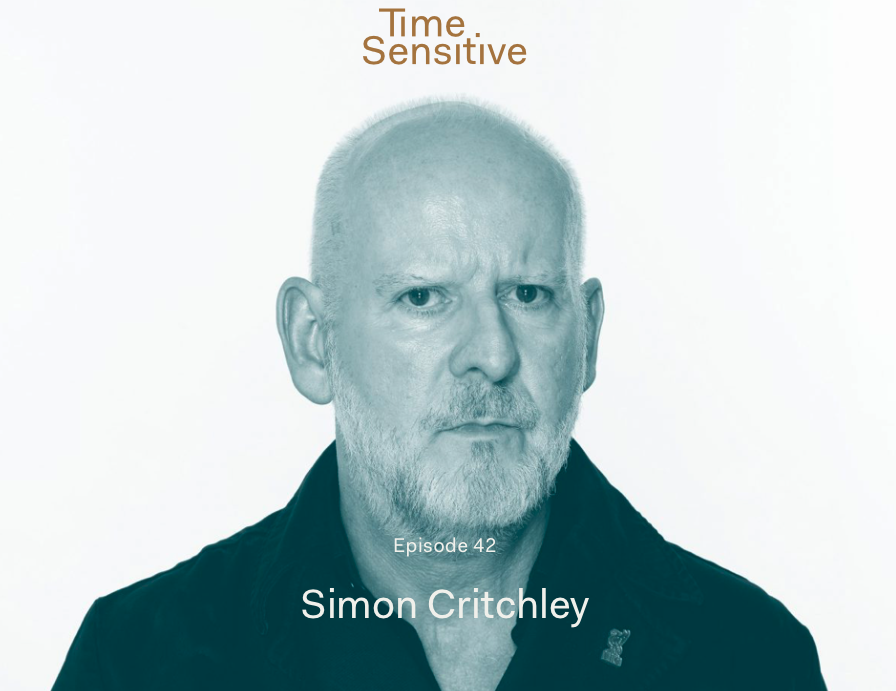
Simon Critchley on Finding Clarity in Philosophy and Comedy, interview by Andrew Zuckerman

Simon Critchley on Finding Clarity in Philosophy and Comedy, interview by Andrew Zuckerman

Simon Critchley has seen his share of accidents. In his younger years, he damaged his hands while working in manufacturing plants, and ruined his hearing by rehearsing with a punk band in spaces with subpar acoustics. At 18, he suffered significant memory loss, and most recollections from his childhood in rural England temporarily disappeared. The experience of forgetting, Critchley realized, was something he could make useful: It gave him a clean slate, and the freedom to fill in the blanks however he wanted. 

So when he entered the University of Essex 1982, Critchley threw himself into his studies, and eventually discovered teaching philosophy as a means to light a fire under people, helping them strip away distractions so that they can really think, and develop a voice and structure to express what comes up in the process. It’s an approach that informs how the philosopher currently works with his students at the New School for Social Research in New York, and how he tackles his own output, nearly four decades in the making. 

This slow, purposeful manner also allows Critchley, now 60 and living in Brooklyn, to continually explore the possibilities of what he is becoming, resulting in highly personal musings on subjects as varied as life itself. His first book, The Ethics of Deconstruction (1992), took a controversial stance on the forces driving the work of one of his favorite philosophers, Emmanuel Levinas. His writing on humor, devoted to its darkest and lesser-understood aspects, stems from his passion for stand-up comedy. He’s also written about the power of the shape-shifting musician David Bowie, whom he has revered since first glimpsing the artist on the British TV show Top of the Pops at age 12, and continues to dabble in song-making himself: Critchley spent part of the pandemic working on a new single, “Eat Your Funky Dasein”—a riff on a saying by the French philosopher Jacques Lacan—with his long-time collaborator John Simmons, and released it at the end of the summer. Each project is about a commitment to form. “You have to be bold and take risks,” Critchley says. “As you get older and you’ve done more of it, you can begin to let that go where it goes.” For him, finding a clarity of space from which to work is a lifelong endeavor. 

On this episode, Critchley’s constant re-centering of himself to look at the world through a philosophical lens shines through. He discusses with Andrew how disappointment can serve as a source of creativity, why humor is an act of philosophical reflection, and writing as a form of improvisation.

Posted in Simon Critchley | 1 Comment

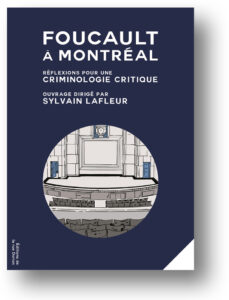
Sylvie Lafleur (ed.), Foucault à Montréal: Réflexions pour une criminologie critique – Éditions de la rue Dorion, January 2021

Sylvie Lafleur (ed.), Foucault à Montréal: Réflexions pour une criminologie critique – Éditions de la rue Dorion, January 2021

En 1976, Michel Foucault participe à une conférence organisée par l’Office des droits des détenus de concert avec l’École de criminologie de l’Université de Montréal. Il y présente ses réflexions sur l’usage des peines de substitution à l’incarcération qui, pour plusieurs, témoignent d’une tendance à l’adoucissement des punitions et présagent la disparition de la prison. Doutant que les sociétés qui y ont recours soient plus tolérantes, Foucault croit, au contraire, que l’utilisation des peines alternatives est symptomatique de l’extension d’une « société policière » qui ne ménage pas les efforts pour fabriquer des délinquant·s et punir les personnes faisant l’objet d’un ressentiment politique et populiste, qu’elles soient pauvres, migrant·es ou marginales.

Dans « Alternatives » à la prison : diffusion ou décroissance du contrôle social – allocution méconnue et longtemps oubliée enfin restituée ici –, Foucault s’interroge sur la logique soutenant la surveillance accrue des personnes et annonce la transformation de la société en prison ouverte. L’auteur de de Surveiller et punir doute que l’imposition de sanctions non carcérales témoigne qu’une rupture avec l’emprisonnement est survenue et suppose que le recours aux mesures probatoires et à la surveillance policière s’intensifiera avec le temps.

Près d’un demi-siècle plus tard, qu’en est-il des perceptions de Foucault ? L’imposition de peines de substitution participe-t-elle à dématérialiser l’architecture pénale ? Vivons-nous dans une société moins tolérante aux « inconduites » ? Quelle raison pénale marque notre contemporanéité ? Comment fabrique-t-on des délinquant·es aujourd’hui ?

Constitué d’entretiens avec les organisateurs de la conférence de Michel Foucault, Jean-Claude Bernheim et André Normandeau, et de spécialistes du contrôle social et de la criminalité, Jade Bourdages, Tony Ferri et Anthony Amicelle, Foucault à Montréal répond à ces interrogations et porte un regard critique sur la judiciarisation croissante des rapports sociaux.

A shorter version has been published by Éditions Divergences as ‘Alternatives’ à la prison. Foucault’s Montréal talk has been published in different forms; there was an English translation by Couze Venn in Theory, Culture & Society in 2009 (requires subscription).

Posted in Uncategorized | 1 Comment

Arlette Farge, Instants de Vie, with Clémentine Vidal-Naquet, Éditions EHESS, February 2021 (and discussion with Luc Darieaux)

Arlette Farge, Instants de Vie, presented by Clémentine Vidal-Naquet, Éditions EHESS, February 2021

Le XVIIIe siècle d’Arlette Farge est sonore, odorant, tactile, à la fois familier et exotique, attachant. Elle a rencontré le peuple de Paris dans les archives, bavardes et hautes en couleur, de la police ; depuis, chacun de ses travaux redonne vie et laisse la parole à ces oubliés de l’histoire, à ce qui les occupe, les bouscule, leur tient à coeur.

Dans ces entretiens avec Perrine Kervran, Laure Adler et Patrick Boucheron, elle raconte sa formation, sa découverte des archives, son engagement féministe, les hasards et rencontres qui ont jalonné son parcours. Elle élabore également une réflexion sur la sensibilité, l’écriture de l’histoire, et le rôle de l’historien dans le présent.

Instants de vie dessine ainsi le portrait d’une historienne pour qui réflexivité, émotion et recherche scientifique sont inséparables.

Update: There is a discussion of the book with Luc Darieaux here.

Posted in Arlette Farge | 1 Comment

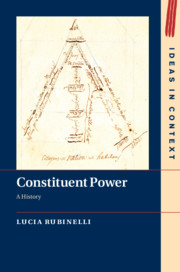
Lucia Rubinelli, Constituent Power: A History – Cambridge University Press, April 2020 (and roundtable March 9 2021)

Lucia Rubinelli, Constituent Power: A History – Cambridge University Press, April 2020

From the French Revolution onwards, constituent power has been a key concept for thinking about the principle of popular power, and how it should be realised through the state and its institutions. Tracing the history of constituent power across five key moments – the French Revolution, nineteenth-century French politics, the Weimar Republic, post-WWII constitutionalism, and political philosophy in the 1960s – Lucia Rubinelli reconstructs and examines the history of the principle. She argues that, at any given time, constituent power offered an alternative understanding of the power of the people to those offered by ideas of sovereignty. Constituent Power: A History also examines how, in turn, these competing understandings of popular power resulted in different institutional structures and reflects on why contemporary political thought is so prone to conflating constituent power with sovereignty.

The first in-depth treatment of the history of the language of constituent power

Offers a clear analysis of the difference between constituent power and ideas of sovereignty

Will appeal equally to historians, who tend to confuse constituent power with notions of sovereignty, political theorists, who often disregard its history, and to scholars in public and constitutional law

There will be a roundtable discussion of the book on March 9 2021 (details here).

Posted in Uncategorized | Leave a comment

Robert von Friedeburg, Luther’s Legacy: The Thirty Years War and the Modern Notion of ‘State’ in the Empire, 1530s to 1790s – Cambridge University Press, 2016

Robert von Friedeburg, Luther’s Legacy: The Thirty Years War and the Modern Notion of ‘State’ in the Empire, 1530s to 1790s – Cambridge University Press, 2016

In this new account of the emergence of a distinctive territorial state in early modern Germany, Robert von Friedeburg examines how the modern notion of state does not rest on the experience of a bureaucratic state-apparatus. It emerged to stabilize monarchy from dynastic insecurity and constrain it to protect the rule of law, subjects, and their lives and property. Against this background, Lutheran and neo-Aristotelian notions on the spiritual and material welfare of subjects dominating German debate interacted with Western European arguments against ‘despotism’ to protect the lives and property of subjects. The combined result of this interaction under the impact of the Thirty Years War was Seckendorff’s Der Deutsche Fürstenstaat (1656), constraining the evil machinations of princes and organizing the detailed administration of life in the tradition of German Policey, and which founded a specifically German notion of the modern state as comprehensive provision of services to its subjects.

‘This book offers an original and striking argument about the emergence of the German concept of the State from conflict and dialogue among princes and their subjects amidst the catastrophic circumstances of the Thirty Years War and its immediate aftermath. Friedeburg breaks new ground by shifting the discussion away from the unsteady development of German liberalism and the supposed uncritical and even enthusiastic embrace of monarchism, which allegedly pushed Germany along a deviant ‘special path’ away from western democracy and towards Nazism.’ Peter H. Wilson, University of Hull

I missed this when it came out a few years ago, but looks a very interesting contribution to debates about 17th century political theory and history.

Posted in Uncategorized | Leave a comment

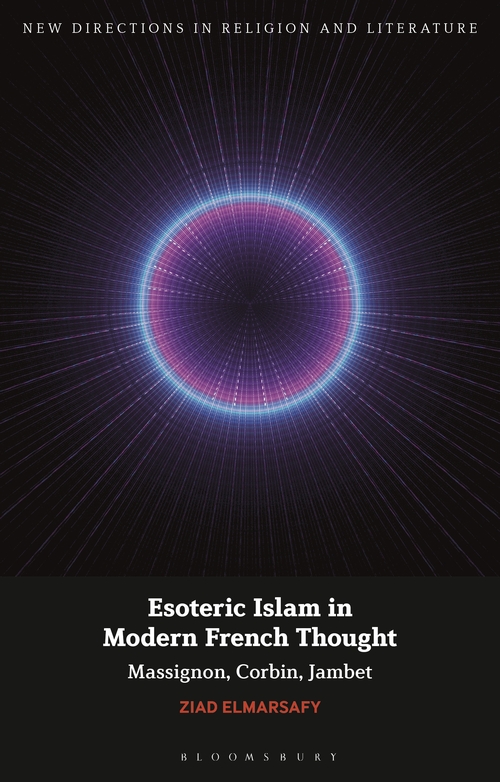
Ziad Elmarsafy, Esoteric Islam in Modern French Thought: Massignon, Corbin, Jambet – Bloomsbury, January 2021

Ziad Elmarsafy, Esoteric Islam in Modern French Thought: Massignon, Corbin, Jambet – Bloomsbury, January 2021

Why would a devout Catholic, a committed Protestant, and a Maoist atheist devote their lives and work to the study of esoteric aspects of Islam? How are these aspects ‘good to think with’? What are the theoretical and intellectual problems to which they provide solutions? These are the questions at the heart of Esoteric Islam in Modern French Thought. The three French specialists of Islam described above form an intellectual and personal genealogy that structures the core of the text: Massignon taught Corbin, who taught Jambet in his turn. Each of them found in the esoteric a solution to otherwise insurmountable problems: desire for Massignon, certainty for Corbin, and resurrection/immortality for Jambet. Over the course of three long chapters focused on the life and work of each writer, the book maps the central place of esoteric Islam in the intellectual life of twentieth and twenty-first century France.

“In this remarkable work, Ziad Elmarsafy re-opens the esoteric archive of modern French Islam. It requires a scholar of exceptional cultural, philosophical and linguistic range to even begin to do justice to Massignon, Corbin and Jambet’s work and Elmarsafy is that scholar. As he reconstructs the intellectual history of French engagements with esoteric Islam, Elmarsafy not only tells a story that has never properly been told before, but creates an entirely new genealogy of the evolution of modern French thought that forces us to re-pose classic questions about truth, subjectivity and freedom we thought we had already answered. Finally, and most importantly, however, this book beautifully exemplifies its own central argument about French esoteric Islam: Elmarsafy’s deeply affirmative readings of Massignon, Corbin and Jambet are distinguished throughout by the very intellectual hospitality or openness to the other that characterises their own engagements with the Islamic tradition. This is a major intellectual achievement by one of the most important scholars of comparative literature and thought working today and we are all in his debt.” –  Arthur Bradley, Professor of Comparative Literature, Lancaster University, UK, 

Posted in Uncategorized | Leave a comment

Stuart Elden, The Early Foucault, Polity, June 2021 – three endorsements

Stuart Elden, The Early Foucault – Polity, June 2021

Three really generous endorsements for the book, from people whose own work I really admire.

‘Elden’s compendious coverage of Foucault’s intellectual career constitutes the contemporary apogee of scholarship on Foucault.’
Mark G. E. Kelly, Western Sydney University

‘This is a work of immense scholarship. Stuart Elden provides a wealth of contextual information on Foucault’s less familiar early career.’
Clare O’Farrell, Queensland University of Technology

‘Stuart Elden’s comprehensive, finely crafted investigation of the early Foucault is much more than a contribution to Foucault studies. It’s an exemplary guide to writing intellectual history.’
Michael J. Shapiro, University of Hawai’i, Manoa

The proofs and index for the book are complete, so just waiting to see the finished thing. Here’s the back cover description:

It was not until 1961 that Foucault published his first major book,  History of Madness. He had been working as an academic for a decade, publishing a few works including a short book, teaching in Lille and Paris, organizing cultural programmes and lecturing in Uppsala, Warsaw and Hamburg. Although he published little in this period, Foucault wrote much more, some of which has been preserved and only recently become available to researchers.

Drawing on archives in France, Germany, Switzerland, Sweden and the USA, this is the most detailed study yet of Foucault’s early career. It recounts his debt to teachers including Louis Althusser, Jean Hyppolite, Maurice Merleau-Ponty and Jean Wahl; his diploma thesis on Hegel; and his early teaching career. It explores his initial encounters with Georges Canguilhem, Jacques Lacan, and Georges Dumézil, and analyses his sustained reading of Friedrich Nietzsche, Edmund Husserl and Martin Heidegger. Also included are detailed discussions of his translations of Ludwig Binswanger, Victor von Weizsäcker, and Immanuel Kant; his clinical work with Georges and Jacqueline Verdeaux; and his cultural work outside of France.

Investigating how Foucault came to write  History of Madness, Stuart Elden shows this great thinker’s deep engagement with phenomenology, anthropology and psychology. An outstanding, meticulous work of intellectual history,  The Early Foucault sheds new light on the formation of a major twentieth-century figure.

This book is the third of four major intellectual histories of Michel Foucault, exploring newly released archival material and covering the French thinker’s entire academic career.  Foucault’s Last Decade was published by Polity in 2016;  Foucault: The Birth of Power followed in 2017; and  The Archaeology of Foucault will publish in the early 2020s.

Posted in Michel Foucault, The Early Foucault | 2 Comments

Books received – Martinet, Lévi-Strauss, Althusser, Saussure, Faustino & Ferraro

Mainly second-hand books for the Foucault work, and related projects, but also a copy of the new collection The Late Foucault, edited by Martin Faustino and Gianfranco Ferraro, sent by the publisher.

Posted in Claude Lévi-Strauss, Louis Althusser, Michel Foucault | Leave a comment