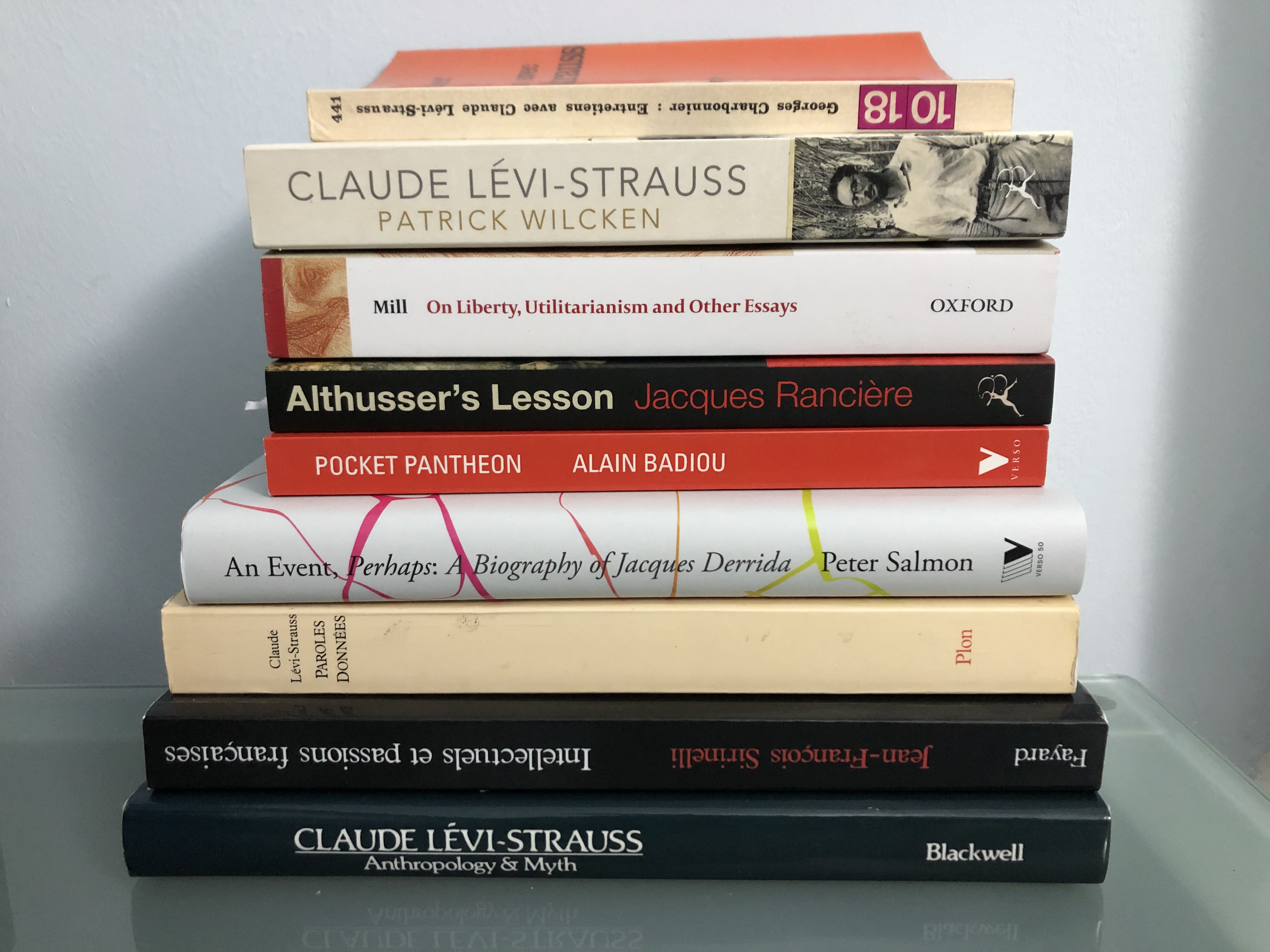
Some books bought recently for the Foucault work, related projects and J.S. Mill for teaching. I’m teaching the history of political thought again this year, and while I have most of the texts we’re using, didn’t have Mill’s Considerations on Representative Government which is in this collection, edited by Mark Philp of Warwick’s History department and Frederick Rosen of UCL.
On 2 December 1970, Michel Foucault delivered his inaugural lecture at the Collège de France. He was 44 years old. My thanks to Marcelo Hoffman for alerting me to this anniversary. Had this not been such a crazy term, it would have been nice to commemorate this event a bit more, but I did at least want to mark the date.
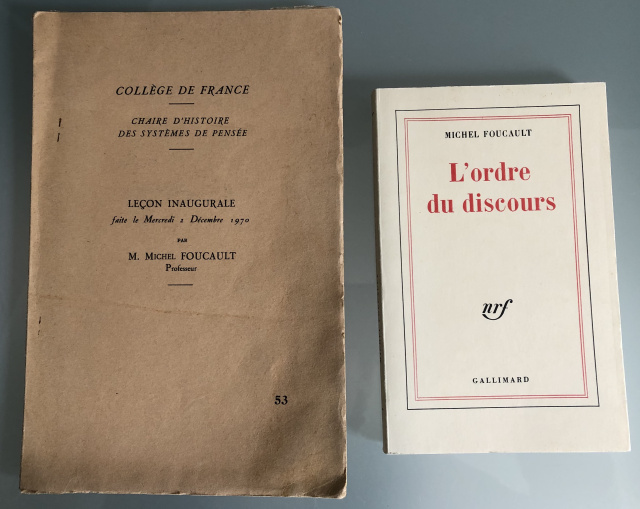
The text was first published in the series of inaugural lectures by the Collège itself as Leçon inaugurale faite le Mercredi 2 Décembre 1970. It was then published as a short book by Gallimard in February 1971 as L’ordre du discours: Leçon inaugurale au Collège de France prononcée le 2 décembre 1970. Although Foucault notes in the Gallimard edition that it is not quite the same as the spoken text, I didn’t know about the Collège de France publication. When the lecture was reprinted in the Pléiade Œuvres the Gallimard version was the one used – a critical edition would have been useful.
I was first alerted to the differences by an anonymous informant, ‘Ambulo Ergosum’, who provided me with notes on the differences. I bought a copy of the original text, and also compared it to the later published (and reprinted) version. The results of this analysis are here.
The lecture has been translated into English three times – first by Rupert Swyer as a journal article which was reprinted as an appendix to some editions of The Archaeology of Knowledge, and then again in Robert Young (ed.), Untying the Text: A Poststructuralist Reader (open access here). A third – and to my mind, the best – translation by Thomas Scott-Railton is in Nancy Luxon (ed.), Archives of Infamy (University of Minnesota Press, 2019). All these translations are of the later, Gallimard version.
One week after the lecture, Foucault gave the first lecture of the Leçons sur la volonté de savoircourse, which has been translated as Lectures on the Will to Know. The inaugural lecture might have been usefully included in that volume when it was published. It works as a standalone text, and initiates his series of courses, but is also very directly linked to that first course.
As far as I am aware there is no recording of the inaugural lecture. This is the case for all Foucault’s lectures from the first few courses, which is why they were published on the basis of his manuscript notes (or, with the third, on a transcription of tapes which seem no longer to exist). There was a re-recording of the lecture made a few years ago, by France Culture, but the audio is no longer available (the page it was hosted on is here).
I discuss ‘The Order of Discourse’ in the Introduction to Foucault: The Birth of Power, seeing the lecture as a kind of hinge between the work of the 1960s and the 1970s work to come. The lecture certainly has links back to The Archaeology of Knowledge, but also hints of questions of power and a project on sexuality. However, when I wrote that book I wasn’t aware of the earlier published version, and so I might discuss it a little again in the final pages of my study of Foucault in the 1960s. Work for that is ongoing, albeit very slowly at the moment. I’ll hopefully write an update on that research soon.
But for today I did want to mark this anniversary of one of Foucault’s most interesting and important lectures, at a crucial point in his career. I previously posted about a recent Brazilian collection commemorating the lecture – Rosimeri de Oliveira Dias and Heliana de Barros Conde Rodrigues (eds.), Ordens do discurso: comentários marginais à aula de Michel Foucault.
How do we live well? The first sentence of Grace and Gravity raises the fundamental question that constantly occupies our minds-and of all those who lived before us. Paradoxically, the impossibility of answering this question opens up the very room needed to find ways of living well. It is the gap where all disciplines fall short, where architecture does not fit its inhabitants, where economy is not based on shortage, where religion cannot be explained by its followers, and where technology works far beyond its own principles.
According to Lars Spuybroek, the prize-winning former architect, this marks the point where the “paradoxical machine” of grace reveals its powers, a point where we “cannot say if we are moving or being moved”. Following the trail of grace leads him to a new form of analysis that transcends the age-old opposition between appearances and technology. Linking up a dazzling and often delightful variety of sources-monkeys, paintings, lamp posts, octopuses, tattoos, bleeding fingers, rose windows, robots, smart phones, spirits, saints, and fossils-with profound meditations on living, death, consciousness, and existence, Grace and Gravity offers an eye-opening provocation to a wide range of art historians, architects, theologians, anthropologists, artists, media theorists and philosophers.
“Lars Spuybroek is one of the freshest and most original voices in our contemporary intellectual world. Grace and Gravity is a truly exceptional and quite extraordinary book. The reader comes away from encountering it with their minds instructed and their lives enriched. It is so much more than a merely ‘academic’ book and it can be appreciated on many levels. It is a book to savour and one can only be grateful for such a work.” – Keith Ansell-Pearson, University of Warwick, UK
“Natura semper facit saltus, nature always makes leaps. In this impressively erudite book, Lars Spuybroek shows that these leaps are not across sheer void, but a ‘thin, ghostlike film’ that does not quite belong either to the parts or wholes of things. Against the recent dogmas of continuity and immanence, he invites us to a new understanding of his key term, grace.” – Graham Harman, SCI-Arc, USA
I don’t have absolutely everything I’ve published in pdf, but I’m happy to share the articles and chapters I do have. If you can’t find it on this site, please contact me.
Coils of the Serpent is a scholarly journal dedicated to the investigation of contemporary manifestations of power. It is intended as an open-access platform where diverse theories and analyses of power shall be developed, brought into dialogue with each other, discussed, criticized, illustrated and popularized. The journal was launched in 2016.
Lacan: A Genealogy provides a genealogical account of Lacan’s work as a whole, from his early writings on paranoid psychosis to his later work on the real and surplus enjoyment.
Beistegui argues that Lacan’s work requires an in-depth genealogy to chart and interpret the his key concept of desire. The genealogy is both a historical and critical approach, inspired by Foucault, which consists in asking how – that is, by what theoretical and practical transformations, by the emergence of which discourses of truth, which institutions, and which power relations – our current subjectivity was shaped. Desire is a crucial thread throughout because it lies at the heart not only of liberal political economy, psychiatry and psychopathology, and the various discourses of recognition (from philosophy to psychology and the law) that shape our current politics of identity, but also, and more importantly, of the manner in which we understand, experience and indeed govern ourselves, ethically and politically.
A novel reading of Lacan that foregrounds the radicality and urgency of his concepts and the relationship between desire, norm and the law.
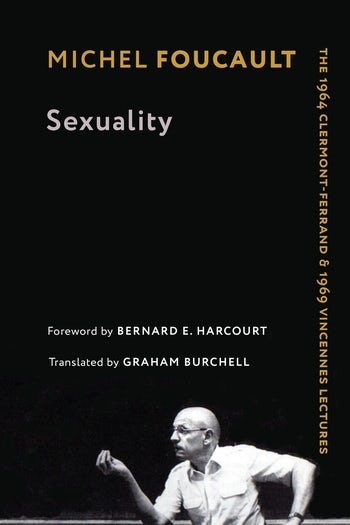
Edited by Claude-Olivier Doron, foreword by Bernard E. Harcourt, translated by Graham Burchell.
Michel Foucault’s The History of Sexuality—the first volume of which was published in 1976—exerts a vast influence across the humanities and social sciences. However, Foucault’s interest in the history of sexuality began as early as the 1960s, when he taught two courses on the subject. These lectures offer crucial insight into the development of Foucault’s thought yet have remained unpublished until recently.
This book presents Foucault’s lectures on sexuality for the first time in English. In the first series, held at the University of Clermont-Ferrand in 1964, Foucault asks how sexuality comes to be constituted as a scientific body of knowledge within Western culture and why it derived from the analysis of “perversions”—morbidity, homosexuality, fetishism. The subsequent course, held at the experimental university at Vincennes in 1969, shows how Foucault’s theories were reoriented by the events of May 1968; he refocuses on the regulatory nature of the discourse of sexuality and how it serves economic, social, and political ends. Examining creators of political and literary utopias in the nineteenth and twentieth centuries, from Sade to Fourier to Marcuse, who attempted to integrate “natural” sexualities, including transgressive forms, into social and economic life, Foucault elaborates a double critique of the naturalization and the liberation of sexuality. Together, the lectures span a range of interests, from abnormality to heterotopias to ideology, and they offer an unprecedented glimpse into the evolution of Foucault’s transformative thinking on sexuality.
These lectures offer a really important insight into Foucault’s work in the 1960s on the question of sexuality—a topic on which his more famous works come from the 1970s and 1980s. This volume shows how he proposed a study of scientific knowledge about sexuality from biology to psychology, with some explicit engagement with figures who are only discussed obliquely elsewhere. Graham Burchell is the most important translator of Foucault’s work into English, and Anglophone readers remain much in his debt.
A new Brazilian collection commemorating the 50th anniversary of Foucault’s inaugural lecture at the Collège de France, delivered on 2nd December 1970
Em quinze capítulos, este livro funciona como um caleidoscópio: discute, desde múltiplas facetas, a aula inaugural que Michel Foucault ministrou, há 50 anos, no Collège de France – “A ordem do discurso”. Cada capítulo aborda distintos aspectos não só daquela aula como, ainda, discute suas conexões com outras obras do filósofo. Sendo assim, tem-se aqui um interessante transbordamento para além daquela importante aula.
Resultado dos esforços inteligentes empreendidos por vinte especialistas, esses comentários marginais nos trazem contribuições valiosas que abordam desde as relações entre Foucault e o ambiente acadêmico francês, até as muitas ressonâncias entre “A ordem do discurso” e as nossas “realidades” de hoje. Talvez se possa mesmo dizer que este livro trabalha no sentido de promover uma múltipla “desrarefação”: dos ditos, daqueles que se autorizam a dizer e das condições em que acontecem os ditos. Os autores e autoras de cada capítulo, ao fazerem da escrita uma prática política, entram em sintonia com o éthos foucaultiano. Mas tal postura não significa uma suposta obediência ao filósofo, nem algum compromisso prévio com qualquer vinculação partidária e, nem mesmo, alguma adesão a priori a quaisquer princípios fundamentais. O que se tem não é militância, mas sim ativismo; são textos ativos, reativos, provocativos, combativos, conspirativos, alternativos, adversativos etc.
A feliz ideia das organizadoras deste livro – duas reconhecidas especialistas no campo dos estudos foucaultianos – nos chega num momento da maior importância. No Brasil, a crise pandêmica que assombra o mundo desdobra-se em várias outras crises, cujos efeitos sociais, políticos, econômicos e éticos estão sendo devastadores. As combinações entre tais efeitos se potencializam, tornando mais tóxico o ar que respiramos. Por isso, muitos estão usando o neologismo “sindemia” para designar tais combinações e potencializações. Assim, neste contexto mais “sindêmico” do que pandêmico, o caleidoscópio que temos em mãos servirá para compreendermos melhor as ordens dos discursos que estão contribuindo para instaurar e aprofundar as dificuldades do tempo presente. Como sabemos, a compreensão é, mesmo que insuficiente, condição necessária para nos municiarmos e enfrentarmos os combates contra o status quo vigente.
Thanks to Marcelo Hoffman, one of the collection’s contributors, for the news.
This volume in The Complete Works presents the first English translations of Nietzsche’s unpublished notebooks from Winter 1874/1875 through 1878, the period in which he developed the mixed aphoristic-essayistic mode that continued across the rest of his career. These notebooks comprise a range of different materials, including early drafts and near-final versions of aphorisms that would appear in both volumes of Human, All Too Human. Additionally, there are extensive notes for a never-completed Unfashionable Observation that was to be titled “We Philologists,” early drafts for the final sections of “Richard Wagner in Bayreuth,” plans for other possible publications, and detailed reading notes on philologists, philosophers, and historians of his era, including Friedrich August Wolf, Eugen Dühring, and Jacob Burckhardt.
Through this volume, readers gain insight into Nietzsche’s emerging sense of himself as a composer of complexly orchestrated, stylistically innovative philosophical meditations—influenced by, but moving well beyond, the modes used by aphoristic precursors such as Goethe, La Rochefoucauld, Vauvenargues, and Schopenhauer. Further, these notebooks allow readers to trace more closely Nietzsche’s development of ideas that remain central to his mature philosophy, such as the contrast between free and constrained spirits, the interplay of national, supra-national, and personal identities, and the cultural centrality of the process of Bildung as formation, education, and cultivation.
With this latest book in the series, Stanford continues its English-language publication of the famed Colli-Montinari edition of Nietzsche’s complete works, which include the philosopher’s notebooks and early unpublished writings. Scrupulously edited so as to establish a new standard for the field, each volume includes an Afterword that presents and contextualizes the material it contains.
About the authors
Gary Handwerk is the Bruce J. Leven Endowed Chair for Environmental Studies and Professor of Comparative Literature and Comparative History of Ideas at the University of Washington.
When are borders justified? Who has a right to control them? Where should they be drawn?
Today people think of borders as an island’s shores. Just as beaches delimit a castaway’s realm, so borders define the edges of a territory, occupied by a unified people, to whom the land legitimately belongs. Hence a territory is legitimate only if it belongs to a people unified by a civic identity. Sadly, this Desert Island Model of territorial politics forces us to choose. If we want territories, then we can either have democratic legitimacy, or inclusion of different civic identities—but not both. The resulting politics creates mass xenophobia, migrant-bashing, hoarding of natural resources, and border walls.
To escape all this, On Borders presents an alternative model. Drawing on an intellectual tradition concerned with how land and…




 Paulina Ochoa Espejo,
