Abstract
An interview with Michel Foucault in 1979 that was never published during his lifetime and was recently rediscovered in the archives. The interview, appearing for the first time in English and in its complete form, marks one of Foucault’s final public discussions of the contentious topic of the Iranian Revolution. In particular, Foucault clarifies what he means by “political spirituality” and addresses the respective relations between religion, revolution, and self-transformation.
The term mantle has inspired philosophers, geographers, and theologians and shaped artists’ and mapmakers’ visual vocabularies for thousands of years. According to Veronica della Dora, mantle is the “metaphor par excellence, for it unfolds between the seen and the unseen as a threshold and as a point of tension.” Featuring numerous illustrations, The Mantle of the Earth: Genealogies of a Geographical Metaphor is an intellectual history of the term mantle and its metaphorical representation in art and literature, geography and cartography. Through the history of this metaphor from antiquity to the modern day, we learn about shifting perceptions and representations of global space, about our planetary condition, and about the nature of geography itself.
Robert J. Mayhew, School of Geographical Sciences, University of Bristol
“Probing the constellation of meanings that the earth’s mantle has thrown up in European and North American history from antiquity to the present day, della Dora offers nothing less than a genealogy of our attitudes to the earth and its environments. Polyglot, profound, and at times poetic, The Mantle of the Earthis an astonishing intellectual history with vital resonances to our present planetary condition.”
Stuart Elden, University of Warwick, author of “The Birth of Territory,” “Shakespearean Territories,” and “Canguilhem”
“The Mantle of the Earth is an exceptional book. Thoroughly researched, endlessly interesting, and beautifully written, it takes a notion that seems straightforward and explores it in multiple insightful and productive ways. Its breadth is quite extraordinary. Della Dora also wears her learning lightly, until you start looking at the notes, which are staggeringly erudite. Fabulous.”
Charles W. J. Withers, Geographer Royal for Scotland, professor emeritus, University of Edinburg
“An ambitious, wide-ranging, and detailed inquiry into a compellingly evident (yet underexamined) topic, namely, the metaphor of the earth’s mantle (or veil) and the intellectual genealogy and representational geography of this term. Notions of fabrication—in weaving; in the textures of surfaces; and in maps, as veils and as substantive forms of earthly representation—are employed with ease and insight. Clear, with hardly a word of jargon and numerous well-chosen illustrations that help illuminate the text, The Mantle of the Earth is impressive in its scholarly depth and range.”
The Hans Blumenberg Seminars (Convener: Audrey Borowski) mark the centenary of Hans Blumenberg’s (1920–1996) birth and provide an occasion to revisit some aspects of his life and thought.
Univ’s Nicholas Halmi, Margaret Candfield Tutorial Fellow in English; Professor of English and Comparative Literature, will be taking part in the first event on 5 October, when he will be in conversation with Rüdiger Zill, author of Der absolute Leser – Hans Blumenberg. Eine intellektuelle Biographie(2020).
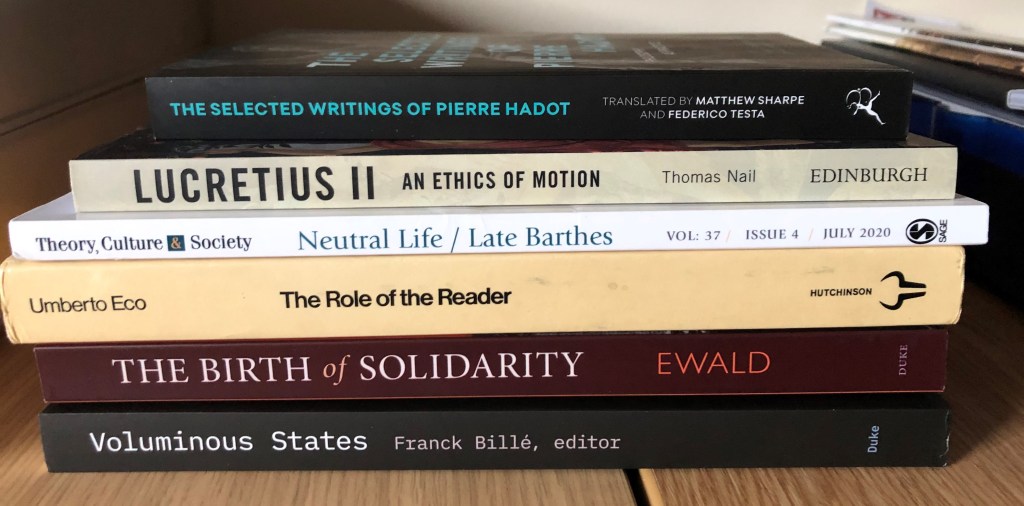
I endorsed Voluminous States, and the Ewald and Nail books were kindly sent by the publishers. The long-awaited Hadot collection was recompense for review work.
A lot of the time recently has been spent revising The Early Foucault, but that is now done, and in the run-up to term I spent a bit of time on this manuscript. Ordinarily I’d have had to spend this time preparing teaching, but this coming academic year is very different and so I’ve not been able to do this. It was only a few days before term started that I was definitively told what I’d be teaching, which is mainly to run seminars on one of our big undergraduate modules on the history of political thought. Some seminars are in person, and some online. I’ve taught on this module before, but not for almost twenty years… My own module on European Political Theory is being ‘rested’ as part of a rationalisation of the teaching programme. The MA seminar series I run on Geopolitics attempts to be very contemporary, and so I only finalise the material in the hours before it runs.
So, in the last couple of weeks of the summer I headed deep into the Welsh countryside to a little farm I stayed at for a few days last year. It has no internet and it’s hard even to get a mobile phone signal. It’s great for cycling – not far from Penrhiw-Wen and the glorious Elan valley, Pennau Hill, and the infamous Devil’s Staircase. Simon Warren’s Cycling Climbs of Wales was one of the non-work books I packed. So, my days were spent on a mix of reading, writing and cycling. I found the lack of internet helped enormously with the concentration, and just watching the TV news at fixed times, rather than the constant availability of live feeds or social media, was much better for keeping a sense of perspective.
While I’ve done some of the initial work for the discussions of Foucault’s major texts in this period – Birth of the Clinic, The Order of Things and The Archaeology of Knowledge – I’ve yet to begin the drafting of the discussions of those books. Instead I’ve been doing some more of the preparatory work, and writing some bits on other texts from this period. In a sense the writing I’ve been doing is creating the framework into which the discussion of the more famous works can fit. It seems to work well as a means of not allowing the familiar to structure the story, but let the archives and other less obvious traces set the familiar in a fresh context. With both Foucault: The Birth of Power and Foucault’s Last Decade, there was the sequence of the Collège de France courses alongside the books Foucault published in the 1970s and 1980s, and so I could try to trace how ideas emerged and developed in their light. With The Early Foucault, although a large part of the purpose was to trace how Foucault came to write the History of Madness, much of the book is actually about things he disowned, didn’t publish or otherwise obscured. With this book, there are relatively few courses which have been preserved, and as yet relatively few things from this decade have been published beyond what Foucault did himself. But I think there are traces that can be explored to set the familiar in a new light.
In the 1960s, Foucault published some parts of his books before the books themselves. He didn’t do that so much later in his career, with the exception of parts of the second and third volumes of the History of Sexuality. With Les mots et les choses/The Order of Things, for example, both the chapter on Velasquez and ‘La prose du monde/The Prose of the World’ were published independently, and one chapter of Raymond Roussel also appeared beforehand. But none of these texts are exactly the same, so as part of the preparatory work for this study I’ve been comparing and annotating the original versions to those in the books. He also anticipated themes of The Archaeology of Knowledge in a couple of pieces written in response to questions.
“Dire et voir chez Raymond Roussel/Saying and Saying in Raymond Roussel” (text 10 in Dits et écrits, and translated in Essential Works Volume II) threw up a puzzle. Despite both French and English editors saying this is a variant of the first chapter of the book Raymond Roussel/Death and the Labyrinth, that is only partly true. The article begins with material that was used for the book certainly, with some changes there is then an extensive passage in the book which is not the article; some more material which appears in the book, again with variations, and then some material which does not appear in the book. But the English translation of the article, in Essential Works, volume II, does not print the text in the order it appears in the French: it puts the material which is not in the book before the final section which is. Essentially, the English reader who wants to see what is in the French should read Essential Works II pages in this sequence: 21-25 [From start up to “the light it sheds on the other works”], then 30-31 [“All these perspectives… but a third or more”], and finally 25-30 [“Every esoteric interpretation… procession of masks”]. I imagine they worked with separate files, editing the existing book translation and the other material which had to be freshly translated, and then put them in the wrong order.
As well as ‘What is an Author?’, which I’ve discussed before, there is also at least one other shorter piece from this period that exists in two versions – Foucault’s Introduction to the Port Royal Grammar. In 1967, in the journal Langages, Foucault published a short text entitled “La ‘Grammaire générale’ de Port-Royal”. While this is noted in Dits et écrits, and allocated text number 49, it is not actually printed in the collection. The editors note that “Une variante plus developée de ce texte servie en 1969 de preface pour une réédition de la Grammaire générale de Port-Royal”. That second version appears in its chronological place as text number 60 – in the four-volume edition the note is on Vol I, p. 600; the second text on Vol I, pp. 732-52. That text is a critical version which shows the variants between the two texts.
The authors of the grammar – a companion to the Port-Royal Logic – were Antoine Arnauld and Claude Lancelot, and the text was first published in 1680. There is an English translation of the text from 1754 (easily available as print-on-demand), and an expensive modern translation (General and Rational Grammar: The Port-Royal Grammar, translated by Jacques Rieux and Bernard E. Rollin, The Hague: Mouton, 1975). However, as far as I am aware, neither version of Foucault’s text has been translated into English. Of course, Foucault also discusses the Grammar in Les mots et les choses/The Order of Things.
Although the version in Dits et écrits was probably sufficient, I wanted to find a copy of the original text. At the moment, it’s available open access on Jstor, though I also found a cheap copy of the journal issue from a second-hand bookshop. The article itself notes that “Cet article est extrait d’une Préface préparée par M. Foucault pour une réédition de la Grammaire Générale de Port-Royal. (Note des éd.)” (p. 15). This suggests that the longer text predates the shorter one, rather than the preface being an expanded version of the earlier article. The editors of Dits et écrits did nearly all the work comparing the two versions, but there are a few little things they missed.
I mentioned in the last update that I’d been writing a little on Foucault’s links to the Tel Quel journal, and I’ve developed this a bit, along with some wider discussion of his literary work in the 1960s. There will be a discussion of the book on Raymond Roussel, but also of the wide range of texts he published, and several he did not, on literature in the 1960s. The posthumous collection Language, Madness, Desire was translated very quickly, and Folie, langage, littérature will also appear in English, but we still don’t have translations of several of the essays and reviews Foucault actually published in this period. Several of these essays were translated in Language, Counter-Memory, Practice in 1977, and most of those were reprinted, and some more added, in volume II of the Essential Works. But there is probably a book’s worth of material not in English. It’s a slightly silly situation that we have almost all the posthumous material in English or forthcoming, but several essays Foucault authorised for publication are untranslated.
I also wrote a section on Foucault’s engagement with Bataille in the 1960s, which discusses the “Preface to Transgression” in the tribute issue of Critique in 1963, as well as Foucault’s “Présentation” to the first volume of Bataille’s Œuvres complètes which appeared in 1970. There are pages of the prospectus of the Œuvres in Foucault’s archives, used as scrap paper. There is no complete version, but between different boxes and folders at least one copy of each page. Although this wasn’t written by Foucault, but by Jean Bruno, it gives an indication of the way the project was planned. I’ve had some correspondence with one of the other editors of the Œuvres about Foucault’s role, so have written a bit about this work.
There are various sources for the history of the journal Critique, which Bataille founded and whose Conseil de Rédaction Foucault joined after Bataille’s death. These sources include the correspondence between Bataille and Eric Weil, one of the co-editors, the memoir of Jean Piel, the other co-editor, and the excellent Critique 1946-1998 by Sylvie Patron. Roland Barthes was also on the Conseil, as was Jacques Derrida a bit later. Some other sources, notably the collection of Barthes’s letters in Album helped to fill in detail about this story. One thing I discovered was Foucault’s role in editing an issue on Merleau-Ponty; another was a link in the story of Foucault and Derrida’s falling out. There are some good studies of Barthes, including the biography by Tiphanie Samayoult and the earlier book by Marie Gil, both of which are very interesting and provide some useful details.
Elsewhere in the book I try to discuss Foucault’s role in editing the French translation of Nietzsche’s works. Over a couple of the more productive days I had in Wales, I wrote a long section on “Nietzsche, Freud, Marx”, the preface written with Deleuze for the edition of Le Gai savoir, and the two published interviews about the editorial work. One of those interviews was conducted with Deleuze, but the text in Dits et écrits does not indicate who is speaking in response to the interviewer’s questions. For one question, on Les mots et les choses, it is obviously Foucault, but there is at least one other response where a turn of phrase suggests Foucault. I’m going to try to find a copy of the original interview, even though I doubt that will mark things differently. There are also some interviews with Deleuze on this work. The other part of this chapter on Nietzsche will discuss his 1969-70 course at Vincennes, on the basis of the manuscript in Paris and some student notes.
Finally, together with Alison Downham Moore, I wrote a review of Foucault’s two 1960s courses on sexuality, published in 2018 (and forthcoming in translation by Graham Burchell with Columbia University Press). Being away from internet and most of my books meant I have a long list of things to check, articles to download or scan, books to locate or buy, libraries to visit, things to read and so on. In some ways this is quite useful as I move into term. Having a long list of small tasks is quite helpful, as I’ve said before, for keeping a sense of slow, steady progress around other things. The rationale of this is that even if substantial blocks of writing time are going to be harder to come by, a little bit a few times a week still keeps the book moving forward. But this term is going to be like no other.
The previous updates on this book are here, and those for The Early Foucaulthere. The Early Foucault should be out in 2021. A list of the resources on this site relating to Foucault – bibliographies, audio and video files, some textual comparisons, some short translations, etc. – can be found here. The earlier books Foucault: The Birth of Powerand Foucault’s Last Decade are both available from Polity.
Some of the book is available to view at the above link; some other photos at his website and the Robert Morat gallery.
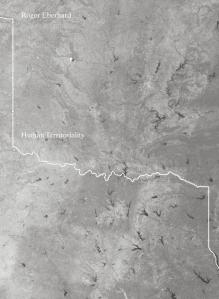
Borders are a means of separation. They separate two sides, defining a here and a there. But they also delineate what lies within the boundaries, instilling a sense of safety and security. Although they implicitly stake a claim to permanence, nothing is as changeable as boundary lines. So it is ironic that people and entire nations should develop so much pride and protectionism on the basis of existing borders, while knowing full well that these are artificial constructs that are constantly changing and sometimes disappearing altogether. – Roger Eberhard
Human Territoriality is a selection of Roger Eberhard’s photographs of former border regions around the globe and down through the course of human history. Some of these borders have shifted over time, by only a few hundred meters or much more, due to climate change or manmade changes in the landscape, others have vanished with the fall of mighty empires on either side. Eberhard’s photographs, supplemented by in-depth captions, help us to grasp the protean puzzle of the world’s cartography. In a time of mass migration, border walls and spreading nationalism, they reveal the inherent instability of these man-made demarcations.
Who is Jacques Derrida? For some, he is the originator of a relativist philosophy responsible for the contemporary crisis of truth. For the far right, he is one of the architects of Cultural Marxism. To his academic critics, he reduced French philosophy to “little more than an object of ridicule.” For his fans, he is an intellectual rock star who ranged across literature, politics, and linguistics. In An Event, Perhaps, Peter Salmon presents this misunderstood and misappropriated figure as a deeply humane and urgent thinker for our times.
Born in Algiers, the young Jackie was always an outsider. Despite his best efforts, he found it difficult to establish himself among the Paris intellectual milieu of the 1960s. However, in 1967, he changed the whole course of philosophy: outlining the central concepts of deconstruction. Immediately, his reputation as a complex and confounding thinker was established. Feted by some, abhorred by others, Derrida had an exhaustive breadth of interests but, as Salmon shows, was moved by a profound desire to understand how we engage with each other. It is a theme explored through Derrida’s intimate relationships with writers sucheven as Althusser, Genet, Lacan, Foucault, Cixous, and Kristeva.
Accessible, provocative and beautifully written, An Event, Perhaps will introduce a new readership to the life and work of a philosopher whose influence over the way we think will continue long into the twenty-first century.
The editors of Foucault Studies are pleased to publish this issue containing a review symposium of Verena Erlenbusch-Anderson’s “Genealogies of Terrorism” as well as four original articles and three book reviews.
Editorial
Sverre Raffnsøe et al.
Review Symposium
Preface to Symposium on Verena Erlenbusch-Anderson’s “Genealogies of Terrorism”
Colin Koopman
Examining Genealogy as Engaged Critique
Samir Haddad
Genealogy, Terrorism, and the “Relays” of Thought
Sarah K. Hansen
Situating Genealogies of Terrorism
Cressida J. Heyes
Genealogy as Multiplicity, Contestation, and Relay: Response to Samir Haddad, Sarah Hansen, and Cressida Heyes
Verena Erlenbusch-Anderson
Articles
The carceral existence of social work academics: a Foucauldian analysis of social work education in English universities
Diane Simpson, Sarah Amsler
On the Ways of Writing the History of the State
Eli B. Lichtenstein
Foucault On Psychoanalysis: Missed Encounter or Gordian Knot?
Mark G. E. Kelly
Rejecting claims that migration is a crisis for Europe, this book instead suggests that the ‘migration crisis’ reflects a more fundamental breakdown of a modern European tradition of humanism. Squire provides a detailed and broad-ranging analysis of the EU’s response to the ‘crisis’, highlighting the centrality of practices of governing migration through death and precarity. Furthermore, she unpacks a series of pro-migration activist interventions that emerge from the lived experiences of those regularly confronting the consequences of the EU’s response. By showing how these advance alternative horizons of solidarity and hope, Squire draws attention to a renewed humanism that is grounded both in a deepened respect for the lives and dignity of people on the move, and an appreciation of longer histories of violence and dispossession. This book will be of interest to scholars and researchers working on migration in political science, international relations, European studies, law and sociology.
‘This book masterfully documents how the barbarians appearing at the frontiers of Europe are none other than the European governments themselves and how the European licence to dictate the measure of a human is being revoked by acts of hope and solidarity.’
Engin Isin – Professor of International Politics, Queen Mary University of London