Correcting the misunderstood role of maxims at the intersection of early science and literature
Eighteenth-century novels are full of maxims—pithy statements of received wisdom such as “necessity is the mother of invention” or “neither a borrower nor a lender be.” Maxims are ancient rhetorical forms, celebrated by no less an influential figure than Aristotle as powerful tools of persuasion. Critics have generally explained away their ubiquitous presence in eighteenth-century novels as a vestige of a premodern form. As Kelly Swartz explains, however, their presence illustrates an important yet often overlooked aspect of the novel’s relationship with the early empirical sciences.
Applying insights from Francis Bacon’s account of aphorizing as a method of scientific writing to works by Aphra Behn, Jonathan Swift, Samuel Richardson, and Jane Austen, Swartz shows how maxims functioned in a critical role that she calls “unknowing.” Such expressions, she argues, represented the not yet known as a way to inspire in readers a desire for ongoing, collective inquiry. Maxims also allowed these authors to invent unknowing fictional minds, at once attractive and vexing, ranging from the incoherent and banal to the unintelligibly rich. Maxims and the Mind thus offers new insight into the nature of the relationship between science and the early novel, emphasizing their shared interest in the representation of knowledge still awaiting discovery.
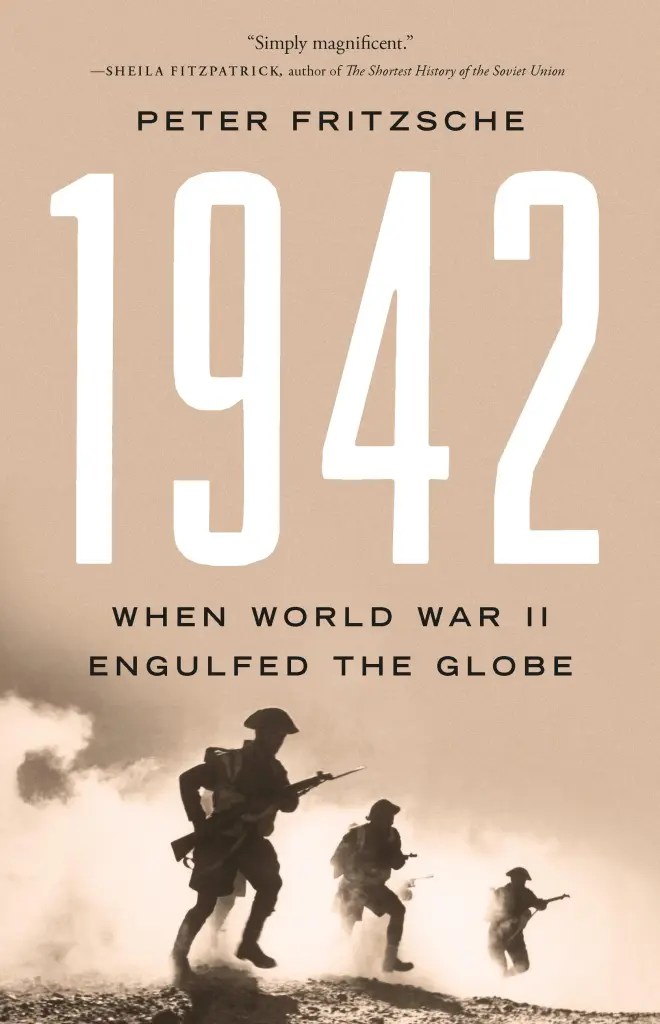
A penetrating history of the year World War II became a global conflict and humankind confronted both destruction and deliverance on a planetary scale, “offering an intriguing perspective on a world at war” (Richard Overy, New York Times–bestselling author of Blood and Ruins)
By the end of the Second World War, more than seventy million people across the globe had been killed, most of them civilians. Cities from Warsaw to Tokyo lay in ruins, and fully half of the world’s two billion people had been mobilized, enslaved, or displaced.
In 1942, historian Peter Fritzsche offers a gripping, ground-level portrait of the decisive year when World War II escalated to global catastrophe. With the United States joining the fight following Japan’s attack on Pearl Harbor, all the world’s great powers were at war. The debris of ships sunk by Nazi submarines littered US beaches, Germans marauded in North Africa, and the Japanese swept through the Pacific. Military battles from Singapore to Stalingrad riveted the world. But so, too, did dramas on the war’s home fronts: battles against colonial overlords, assaults on internal “enemies,” massive labor migrations, endless columns of refugees.
With an eye for detail and an eye on the big story, Fritzsche takes us from shipyards on San Francisco Bay to townships in Johannesburg to street corners in Calcutta to reveal the moral and existential drama of a people’s war filled with promise and terror.
Edward Baring is an intellectual historian of twentieth-century Europe and the Associate Professor of History and Human Values at Princeton University. He is the author of The Young Derrida and French Philosophy, 1945–1968 (Cambridge University Press, 2011) and Converts to the Real: Catholicism and the Making of Continental Philosophy (Harvard University Press, 2019). His new book, Vulgar Marxism: Revolutionary Politics and the Dilemmas of Worker Education, 1891–1931 (University of Chicago Press, forthcoming December 2025), explores the history of twentieth-century Marxist thought through the lens of worker education. The first part of the book describes the educational infrastructure built by the German Social Democratic Party from 1880 to 1914. Baring then shows how prominent intellectuals of the interwar period—Georg Lukács, Karl Korsch, Hendrik de Man, Antonio Gramsci, and José Carlos Mariátegui—situated their work in relation to worker education and the failure of European revolutions in 1918. Baring discussed his forthcoming book with Sam Franz and Véronique Mickisch for the JHI Blog.
The success of new far-right movements cannot be explained by fear or rage alone – the pleasures of aggression and violence are just as essential. As such, racism is particularly intense when it is erotically charged, migration presenting as a sexual threat to white women being one of many examples. Germany’s strikingly successful right-wing political party Alternative für Deutschland is, according to the historian Dagmar Herzog, characterized by this “sexy racism,” with its second main feature being that of an obsessive antidisability hostility – both elements resonating strongly with Nazism. In The New Fascist Body, Herzog connects her analysis of fascism’s libidinous energy with its animus against bodies perceived as imperfect. Only by studying the emotional and intellectual worlds of past fascisms can we understand and combat their current manifestations.
The book features an afterword by Alberto Toscano, author of Late Fascism: Race, Capitalism and the Politics of Crisis(Verso 2023).
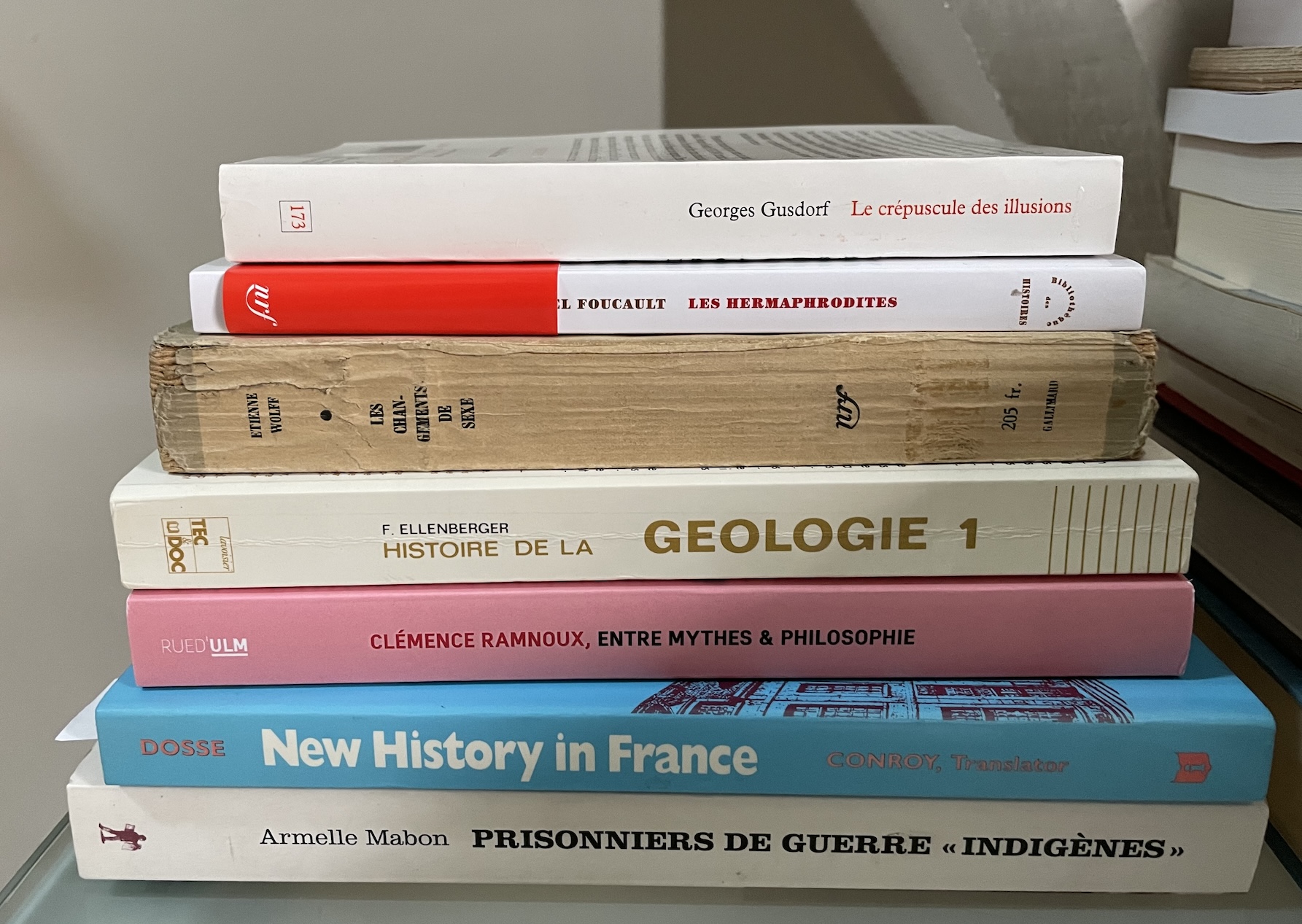
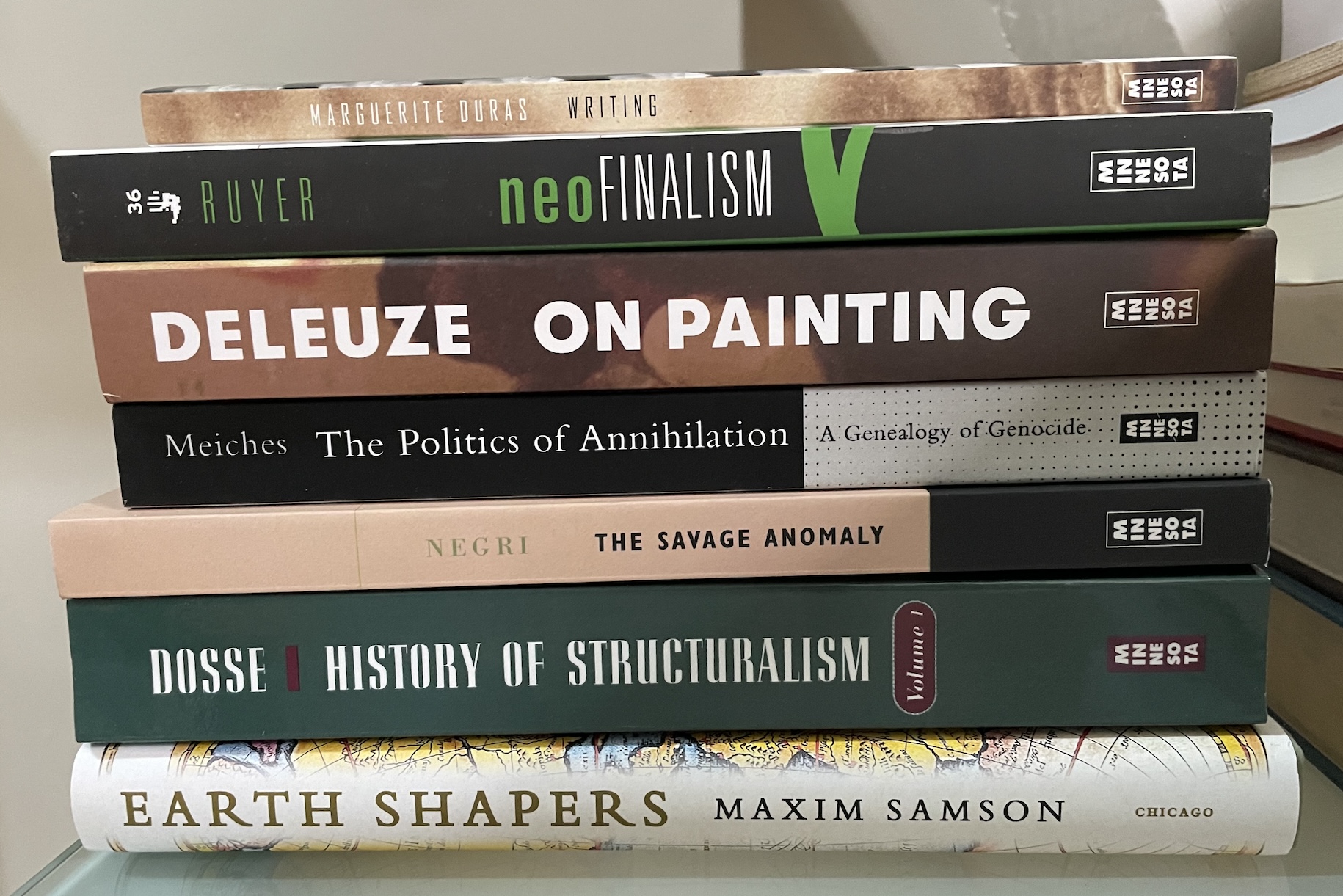
Most of these relate to the developing interest in French professors who were prisoners of war – which includes Gusdorf, Ellenberger, and Wolff – and Raymond Ruyer in the previous pile. I write about Wolff here, and will post about Foucault’s Les Hermaphrodites manuscript on Sunday. Ramnoux will likely be the subject of a future ‘Sunday History‘.
Both the journal and the book are available open access. Here’s a passage from the review about my editorial work:
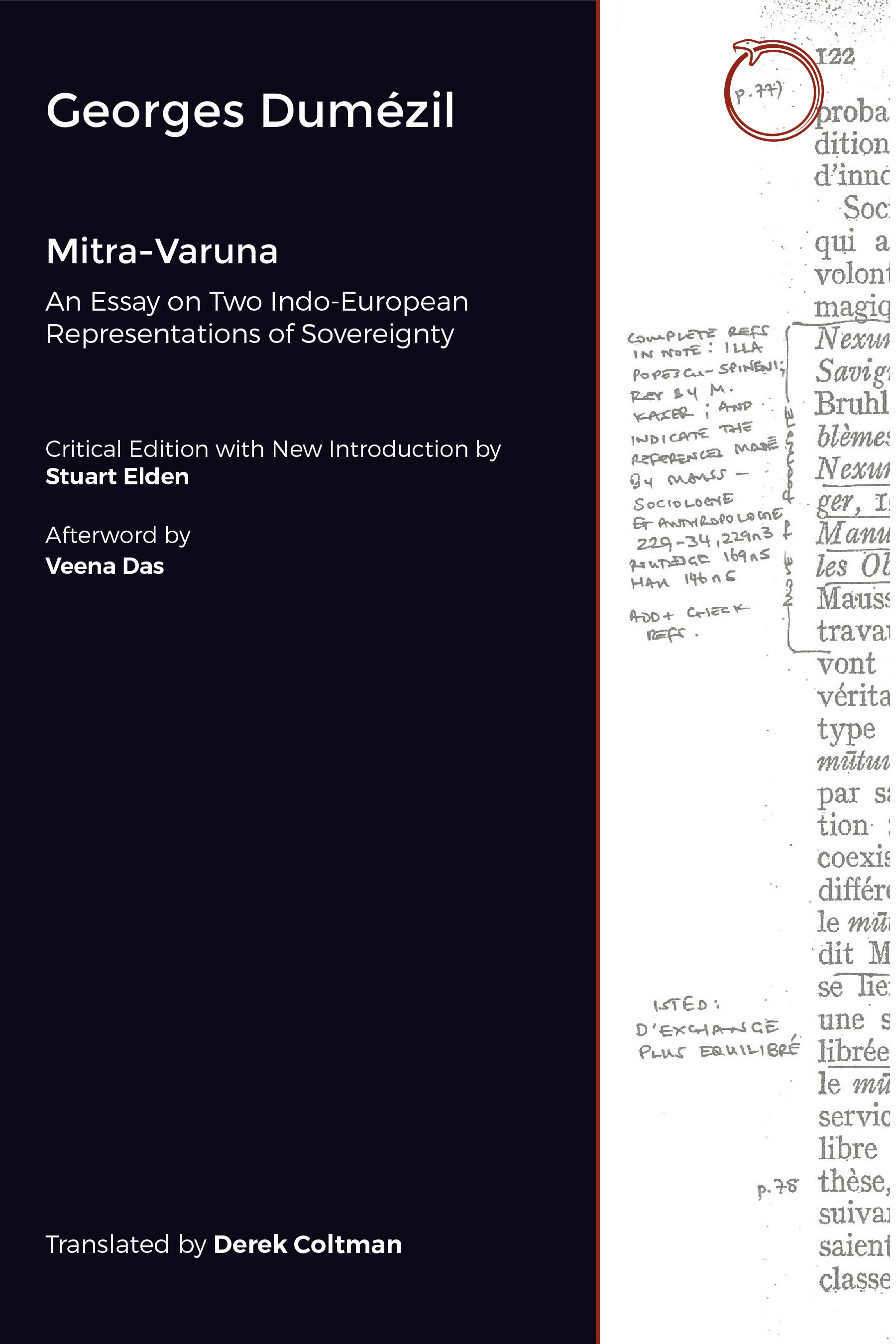
Even an owner of the second edition of Mitra-Varuna in French, or of the 1988 Zone Books edition of the translation by Derek Coltman, which forms the basis of the present book, would find much of additional value in the publication under review. (Stuart Elden, responsible for this slightly revised version of Coltman’s translation, points out that the Zone Books publication, like virtually all of the English translations of Dumézil’s work published over the past several decades, is out of print [p. xxiv].) As the cover of this book, brought out by Hau Books of Chicago, vividly shows, much of Dumézil’s revision of Mitra-Varuna evolved in the tiny notes he entered by hand into the margins of the printed first edition. Elden’s editorial work makes it possible for the reader to find the major changes between the two French editions, and to consult the more important original passages, mostly presented in both French and English translation, that have undergone substantial change. Helpfully, Elden has also clarified or corrected Dumézil’s sometimes telegraphic bibliographical references.
Adding substantially to the value of this publication is Elden’s introductory essay, not just a preparation of the reader for Mitra-Varuna but more generally, as he titles it, a “Re-Introduction to Georges Dumézil”: a much-needed reminder to the modern scholarly world of the numerous contributions that Dumézil made to the fields of comparative mythology, particularly in regard to the Indo-European world, and to the study of the languages and the oral traditions of the peoples of the Caucasus. (It is in the last of these fields, perhaps the closest to Dumézil’s heart, that his folkloristic instincts were most evident.) Elden’s outline of Dumézil’s life, scholarly career, and achievements includes an account of the major influences on his work, emanating from other great scholars of the last century, such as the historian Granet and the sociologist Mauss. There is also a very judicious account of the controversial accusation that Nazi or fascist sympathies underlay Dumézil’s scholarship published in the period leading up to the Second World War, in particular his Mythes et dieux des Germains (1939). Dumézil’s reputation and posterity were damaged by this controversy in his later years and after his death in 1986. But was this an instance of guilt by association, which had less to do with anything Dumézil said or did, and more with the affiliations of some predecessors and colleagues whose work Dumézil utilized, or with epigones gone astray, who in later times took the very concept of “Indo-European” (a fundamentally linguistic and definitely not an ethnic or racial category) and even some of Dumézil’s own ideas, in nefarious directions? Elden grapples with this question fairly and insightfully.
But I should note that the cover image is a page of my marked up photocopy of the first edition, comparing the two French editions, not Dumézil’s own annotations.
Explores how Hollywood’s superhero genre has shaped US foreign policy and security discourses
One of the first book-length, inter-disciplinary studies on the intertwined development of ‘9/11’ as an event, the ‘War on Terror’ and superheroes
Provides a new and innovative path to theorise and conceptualise International Relations, security and foreign policy
Presents a unique window to understand contemporary political issues such as security, terrorism and war through film and popular culture
Combines and contributes to a range of different disciplines such as International Relations, Critical Security Studies, Foreign Policy Analysis, Critical Terrorism Studies and Critical Geopolitics
Addresses and reformulates concepts such as security, crisis, heroism, national identity and their relationship to power, agency and the everyday
This book considers how the long-standing superhero genre has been reinvigorated in the twenty-first century as an interlocutor of security and surveillance discourses following the events of ‘9/11’. While superheroes have a long cultural history, Schmid argues that their contemporary representations in Hollywood films and TV shows create and deepen specific discourses on security, terrorism and violence. He shows how the Marvel Cinematic Universe and the DC Extended Universe, in particular, are important artefacts that can help us to understand how these discourses are popularised and ultimately normalised.
The book offers a rich account of the emergence of superheroes against the backdrop of America’s history since its founding in 1776 and their rise to popularity through comic books since the 1930s. Analysing the connections between superheroes, foreign policy and security from ‘9/11’ to the present, it demonstrates the significance of superheroes for the construction of heroism and security in contemporary times.
In an earlier piece in the ‘Sunday Histories’ series, I discussed the work Roman Jakobson did for Franz Boas on the Paleo-Siberian and Aleutian material at the New York Public Library. In his initial time in the United States, as a refugee from Western Europe, he was piecing together a living by undertaking research projects making use of his prodigious range of languages. I reported that he indicates in one of his letters to Boas that:
… he was also doing research on the relatively unknown Yiddish-Czech language spoken by medieval Czech Jews, for the Yiddish Scientific Institute (YIVO), also in New York (Jakobson to Boas, 11 September 1941). He had met YIVO co-founder Max Weinrich in Copenhagen at the Fourth Congress of Linguistics in August 1936 (Jakobson to YIVO, 27 February 1969, Rachel Erlich papers, box 5). Some of Jakobson’s work for YIVO was published in “The City of Learning: The Flourishing Period of Jewish Culture in Medieval Prague” in The American Hebrew in December 1941. Jakobson there says he is “preparing a special detailed study about the ‘Canaan language’ in Jewish medieval culture” (p. 373). In a later piece he describes this as a book entitled Czech in Medieval Hebrew Sources (Selected Writings, Vol VI.2, 886). That study was never completed, though Jakobson did work on Canaanic (see Dittmann, “Roman Jakobson’s Research into Judeo-Czech”; Bláha et. al. “Roman Jakobson’s Unpublished Study on the Language of Canaanite Glosses”). He would also occasionally publish on Yiddish, writing a preface to Uriel Weinreich’s College Yiddish in 1949 (pp. 9-10). Uriel was the son of Max, with whom Jakobson would occasionally work. Jakobson and Morris Halle contributed to Max Weinreich’s Festschrift on “The Term ‘Canaan’ in Medieval Hebrew”. Although not published until 1964, this text was drafted in New York in 1942-44, before being completed in 1962 (see Selected Writings, Vol VI.2, 886).
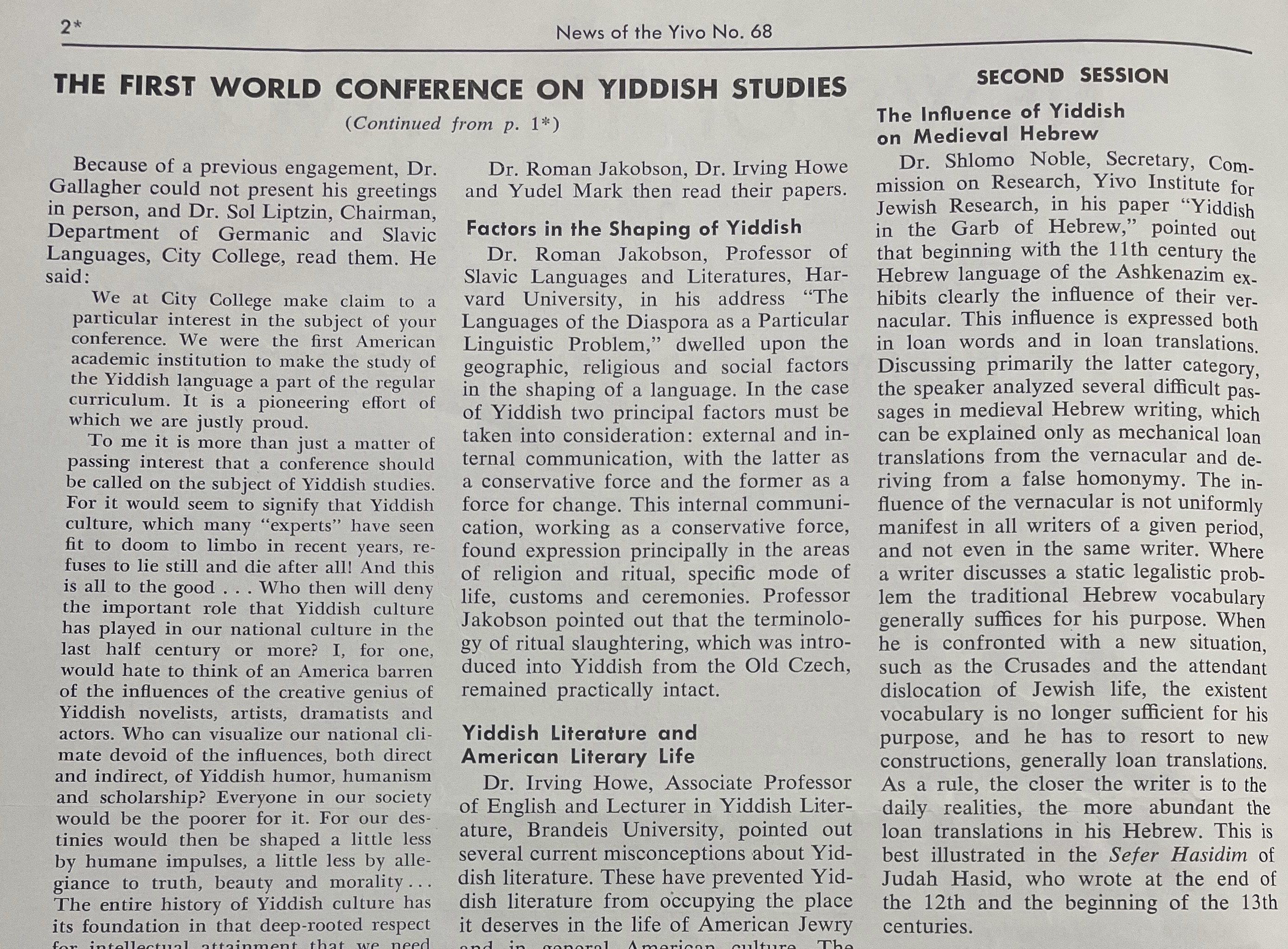
William Pimlott has now shared with me another source for Jakobson’s work on Yiddish, a report of a paper Jakobson gave to The First World Conference on Yiddish Studies, held in New York City from 7-10 April 1958, and sponsored by YIVO. Max Weinrech chaired the event, which opened in the Earl Hall auditorium of Columbia University, where Jakobson had previously taught. Jakobson appears to have been the first speaker in the first session. From the report of the conference in the News of the Yivo newsletter:
News of the YIVO report on Jakobson’s paper ‘Factors in the Shaping of Yiddish’
Factors in the Shaping of Yiddish
Dr. Roman Jakobson, Professor of Slavic Languages and Literatures, Harvard University, in his address “The Languages of the Diaspora as a Particular Linguistic Problem,” dwelled upon the geographic, religious and social factors in the shaping of a language. In the case of Yiddish two principal factors must be taken into consideration: external and internal communication, with the latter as a conservative force and the former as a force for change. This internal communication, working as a conservative force, found expression principally in the areas of religion and ritual, specific mode of life, customs and ceremonies. Professor Jakobson pointed out that the terminology of ritual slaughtering, which was introduced into Yiddish from the Old Czech, remained practically intact (News of the Yivo 68, p. 2).
As might be expected, this lecture has not gone unnoticed by specialists. Ondřej Bláha, Robert Dittmann, Karel Komárek, Daniel Polakovič and Lenka Uličná say this:
Jakobson returned to the topic of Judeo-Czech also in his lecture The Languages of the Diaspora as a Particular Linguistic Problem, presented at the opening session of the Conference on Yiddish Studies on 7th April 1958. Its 13-page long transcript has also been preserved in the MIT Archives (RJP 34/44) and will be edited by the present authors for publication. Even though Jakobson apologizes in the opening words for entering the field of Yiddish, he does admit a long-term interest in the language and refers among other things also to Judeo-Czech and its expansion to Poland where some formerly Czech words like butcher terms or proper nouns were kept for internal communication within the Jewish community evidencing “enormous conservativism” (“Roman Jakobson’s Unpublished Study on the Language of Canaanite Glosses”, p. 287).
The archival code they give of “RJP 34/44” means the Roman Jakobson papers, held in the Department of Distinctive Collections at the Massachusetts Institute of Technology, MC 0072, box 34, folder 44. That folder contains an English typed transcript, with handwritten corrections and additions for some gaps in the transcription, usually when Jakobson was giving words or phrases in other languages, including German, Czech, Russian, Hebrew and Yiddish. This is the text Bláha and his colleagues published in a Czech volume, Kenaanské glosy ve středověkých hebrejských rukopisech s vazbou na české země. In that volume it appears both as a Russian text with Czech apparatus and the original English version. In a companion volume of essays first presented at a conference in Prague, Knaanic Language: Structure and Historical Background, a number of papers engage with Jakobson’s work on this language.
According to Robert Dittmann’s discussion of Jakobson’s work on this topic, the language used by Czech Jews in Poland “remained unchanged because it was not necessary to adapt these terms to the non-Jewish population, because the whole problem of butchers was an internal Jewish problem” (Dittmann, “Roman Jakobson’s Research into Judeo-Czech”, p. 278). Jakobson’s point is that vocabulary around money-lending, when Jewish people engaged with other peoples in the area, picked up elements of the local languages.
He also focuses a lot on the notion of diaspora, indicating that it is a term initially used to describe the Jewish linguistic experience. He gives the example of Vladimir the Great who converted to Christianity and converted the people of Russia. Apparently, the Grand Prince said to a Jewish representative, “Well, you recommend me your religion, but what is your territory?” Jakobson says “And the Jews answered, ‘We have no territory… We have only a pale of settlement’. And this is probably the best definition of the diaspora, and also of the linguistic implications of this question” (p. 797). At the end of his lecture, Jakobson returns to this relation of language to territory in his present moment, that is April 1958:
Then, all the events of our time, with the creation of certain facts which even, to a certain degree, eliminate the notion of an absolute Diaspora, because there is a group Hebrew not more only a hieratic language, but also as a cultural language; and which are not more only a pale, a čerta osedlosti, but a territory. And this creates completely new situations as also all the tragic events of the last decades in Eastern Europe, especially in Poland. But here, I would, if I would discuss this question, it would be a new problem, and not more the problem of the linguistic aspects of the Diaspora (p. 813, following the transcription, and checked to the typescript, which has some awkward expressions).
The same issue of News of the Yivo indicates a Russian-language piece Jakobson published in 1953, first in the Yivo journal Yidishe Shprakh, and then translated in a book honouring the Yiddish philologist Judah A. Joffe in 1958:
Roman Jakobson points out what happened to “The Yiddish Sound Structure in its Slavic Environment”. The difference in vowel length was obliterated and the accent in Hebrew words tended to shift away from the ultima. Ukrainian Yiddish approximated the vocalic system of its environment, and under its influence developed palatalized consonants (News of the Yivo 68, p. 8).
That piece is reprinted in Selected Writings, but only in its original language.These indications, and the essay with Halle, demonstrate Jakobson’s enduring interest in a topic he seems to have begun researching in his early years in exile as a source of income, drawing on the nearly two decades he had spent in Czechoslovakia between the world wars. The News of the Yivo therefore provides some useful English summaries of evidence for the broader story of Jakobson’s work in the United States.
“The First World Conference on Yiddish Studies”, News of the Yivo 68, 1958, 1-7.
“The Judah A. Joffe Book”, News of the Yivo 68, 1958, 8.
Ondřej Bláha, Robert Dittmann, Karel Komárek, Daniel Polakovič and Lenka Uličná, “Roman Jakobson’s Unpublished Study on the Language of Canaanite Glosses”, Jews and Slavs 24, 2012, 282-318.
Ondřej Bláha, Robert Dittmann, and Lenka Uličná eds., Knaanic Language: Structure and Historical Background. Proceedings of a Conference Held in Prague on October 25-26, 2012, Prague: Academia, 2013.
Ondřej Bláha, Robert Dittmann, Karel Komárek, Daniel Polakovič and Lenka Uličná eds., Kenaanské glosy ve středověkých hebrejských rukopisech s vazbou na české země, Prague: Academia, 2015.
Robert Dittmann, “Roman Jakobson’s Research into Judeo-Czech”, in Tomáš Kubíček and Andrew Lass eds. Roman O. Jakobson: A Work in Progress, Olomouc: Palacký University, 2014, 145-53.
Roman Jakobson, “The City of Learning: The Flourishing Period of Jewish Culture in Medieval Prague” [1941], reprinted in Selected Writings, Vol IX.2, 371-79.
Roman Jakobson, “Zvukovye osobennosti, svjazyvajuscie idis s ego slavjanskim okruzeniem [The Yiddish Sound Pattern and Its Slavic Environment]”, Yidishe Shprakh 13, 1953, 70-83; translated in Judah A. Joffe Book, New York: Yivo Institute for Jewish Research, 1958, 207-220; and reprinted in Selected Writings, Vol I, 402-12.
Roman Jakobson, “The Language of the Diaspora as a Particular Linguistic Problem (Paper given at the opening session of the Conference on Yiddish Studies, April 7, 1958)”, in Ondřej Bláha, Robert Dittmann, Karel Komárek, Daniel Polakovič and Lenka Uličná eds., Kenaanské glosy ve středověkých hebrejských rukopisech s vazbou na české země, Prague: Academia, 2015, 794-813.
Roman Jakobson, Selected Writings, The Hague: Mouton & Co, nine volumes, 1962-
Roman Jakobson and Morris Halle, “The Term ‘Canaan’ in Medieval Hebrew” [1964], reprinted in Jakobson, Selected Writings, Vol VI.2, 858-86.
Uriel Weinreich, College Yiddish, New York: YIVO Institute for Jewish Research, 1974 [1949].
“Report on the Extra-Curricular Activities of Roman Jakobson during the Academic Year of 1957-1958”, box 1, folder 28
“The Languages of the Diaspora as a Particular Linguistic Problem, lecture transcript and notes, 1958”, unpublished lecture, 7 April1958, box 34, folder 44.
This is the 43rd post of a weekly series, where I post short essays with some indications of further reading and sources, but which are not as formal as something I’d try to publish more conventionally. They are usually tangential to my main writing focus, a home for spare ideas, asides, dead-ends and possible futures. I hope there is some interest in them. They are provisional and suggestions are welcome. A few shorter pieces in a similar style have been posted mid-week.
The full chronological list of ‘Sunday histories’ is here, with a thematic ordering here.