Arjen Kleinherenbrink, Against Continuity: Gilles Deleuze’s Speculative Realism – Edinburgh UP, Jan 2019

9781474447782_1Arjen Kleinherenbrink, Against Continuity: Gilles Deleuze’s Speculative Realism – Edinburgh UP, Jan 2019

Against Continuity is the first book to demonstrate that the beating heart of Gilles Deleuze’s philosophy is a systematic ontology of irreducible, singular entities. This requires a radical break with decades of Deleuzian orthodoxy, according to which Deleuze’s metaphysics revolves around the dissolution of discrete entities into a continuous world of flows and events.

With reference to all of Deleuze’s work, including published and untranslated seminars, as well as the recently published Lettres et autres textes, Arjen Kleinherenbrink critically compares Deleuze’s ontology to seven related contemporary thinkers: Levi Bryant, Maurizio Ferraris, Markus Gabriel, Manuel DeLanda, Graham Harman, Tristan Garcia and Bruno Latour. These comparisons establish Deleuze as an important precursor to object-oriented speculative realism and open up exciting new avenues of thought for critics and supporters of Deleuze alike.
Posted in Bruno Latour, Gilles Deleuze, Graham Harman, Manuel deLanda, Uncategorized | 1 Comment

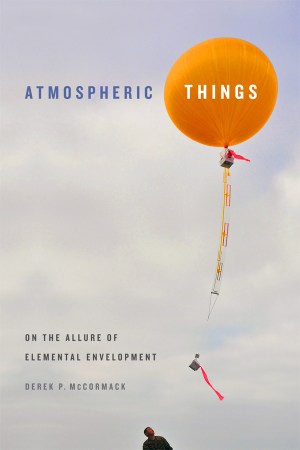
Derek P. McCormack, Atmospheric Things: On the Allure of Elemental Envelopment – OUP, July 2018 (open access intro)

978-0-8223-7123-6_pr.jpgDerek P. McCormack, Atmospheric Things: On the Allure of Elemental Envelopment – OUP, July 2018

Introduction available here

In Atmospheric Things Derek P. McCormack explores how atmospheres are imagined, understood, and experienced through experiments with a deceptively simple object: the balloon. Since the invention of balloon flight in the late eighteenth century, balloons have drawn crowds at fairs and expositions, inspired the visions of artists and writers, and driven technological development from meteorology to military surveillance. By foregrounding the distinctive properties of the balloon, McCormack reveals its remarkable capacity to disclose the affective and meteorological dimensions of atmospheres. Drawing together different senses of the object, the elements, and experience, McCormack uses the balloon to show how practices and technologies of envelopment allow atmospheres to be generated, made meaningful, and modified. He traces the alluring entanglement of envelopment in artistic, political, and technological projects, from the 2009 Pixar movie Up and Andy Warhol’s 1966 installation Silver Clouds to the use of propaganda balloons during the Cold War and Google’s experiments with delivering internet access with stratospheric balloons. In so doing, McCormack offers new ways to conceive of, sense, and value the atmospheres in which life is immersed.

Posted in Uncategorized | Leave a comment

Bill Bunge’s Nuclear War Atlas (poster)

Jeremy Crampton shares Bill Bunge’s Nuclear War Atlas poster – and appeals for someone/a library to make a higher-resolution scan.

Jeremy's avatarOpen Geography

william-bunge-sheraton-hotel-boston-2008 Bill Bunge, 2008 AAG (Boston). Source.

Bill Bunge’s Nuclear War Atlas was published in two formats, a book from Basil Blackwell published in 1988, and a poster published in June 1982, with 28 maps on one side, and extensive text on the other,

just one week too late for the great United Nations demonstration in New York City. The first edition of the atlas was designed for field use among the unemployed of Detroit’s black slum ghetto (who hold my loyalty but who were vulnerable to the false slogan ‘war means work’ when today it clearly means death), but my work proved far too technical. So I surrendered to the fact that the market for the atlas, the potential readership, would be intellectuals, and put in the earlier and continuing abstract work mentioned, especially in chapter 2.

The original edition was in the tradition of Lobeck’s Physiographic Diagram of…

View original post 268 more words

Posted in Uncategorized | 2 Comments

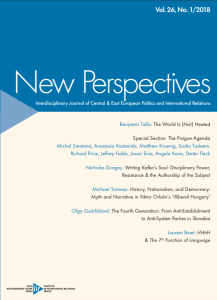
New Perspectives Issue 1/2018 (open access) – includes excerpts from Laurent Binet’s novels and a Foucauldian reading of Kafka

12018-740x1024New Perspectives Issue 1/2018

Editorial

  1. The World Is (Not) Heated

Benjamin Tallis

Special Section

  1. The Prague Agenda

Michal Smetana, Anastasia Kazteridis, Matthew Kroenig, Sadia Tasleem, Richard Price, Jeffrey Fields, Jason Enia, Angela Kane, Dieter Fleck

Research articles

  1. Writing Kafka’s Soul: Disciplinary Power, Resistance & the Authorship of the Subject

Nicholas Dungey

  1. History, Nationalism, and Democracy: Myth and Narrative in Viktor Orbán’s ‘Illiberal Hungary’

Michael Toomey

  1. The Fourth Generation: From Anti-Establishment to Anti-Systém Parties in Slovakia

Oľga Gyárfášová

Cultural Cut

  1. HHhH & The 7th Function of Language

Laurent Binet

Posted in Uncategorized | 1 Comment

Spaces of Crisis and Critique: Heterotopias Beyond Foucault, edited by Anthony Faramelli, David Hancock, Robert G. White – Bloomsbury September 2018

9781350021112Spaces of Crisis and Critique: Heterotopias Beyond Foucault, edited by Anthony Faramelli, David Hancock, Robert G. White – Bloomsbury 2018. Unfortunately only hardback and expensive e-book.

In Of Other Spaces Foucault coined the term “heterotopias” to signify “all the other real sites that can be found within the culture” which “are simultaneously represented, contested, and inverted.” For Foucault, heterotopic spaces were first of all spaces of crisis, or transformative spaces, however these have given way to heterotopias of deviation and spaces of discipline, such as psychiatric hospitals or prisons.

Foucault’s essay provokes us to think through how spaces of crisis and critique function to open up disruptive, subversive or minoritarian fields within philosophical, political, cultural or aesthetic discourses. This book takes this interdisciplinary and international approach to the spatial, challenging existing borders, boundaries, and horizons; from Claire Colebrook’s chapter unpacking the heterotopic spaces of America and Mexico that lie beyond reductive ideological spaces of light and darkness, to a Foucauldian reading of the Zapatista resistance.

With essays on politics, philosophy, literature, post-colonial studies, and aesthetics from established and emerging academics, this book answers Foucault’s call to give us a better understanding of our present cultural epoch.

Posted in Michel Foucault, Uncategorized | 2 Comments

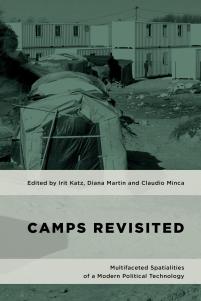
Camps Revisited: Multifaceted Spatialities of a Modern Political Technology, edited by Irit Katz, Diana Martin, and Claudio Minca – Rowman International, December 2018

5b3c62a5f5ba7414c0eeaeefCamps Revisited: Multifaceted Spatialities of a Modern Political Technology, edited by Irit Katz, Diana Martin, and Claudio Minca – Rowman International, December 2018

Facing the current growing global archipelago of encampments, this book project intends to develop a geographical reflection on ‘the camp’, as a modern institution and as a spatial bio-political technology.

This book focuses on past and present camp geographies and on the dispositifs that make them an ever-present spatial formation in the management of unwanted populations characterizing many authoritarian regimes as well as many contemporary democracies. It also offers and investigates possible ways to resist the present-day proliferating manifestations of camps and ‘camp thinking’, by calling for the incorporation of ‘camp studies’ into the broader field of political geography and to consider the geographies of the camp as constitutive of much broader modern geo-political economies.

By linking spatial theory to the geopolitical and biopolitical workings and practices of contemporary camps, the contributions in this collection argue that the camps seem to be here-to-stay, like a permanent/temporary presence giving shape to improvised, semi-structured and hyper-orderly structured spatialities in our cities and our countryside. Camps are also a specific response, for example, to the changing conditions of European borders due to the ‘refugee crisis’ and the rise of nationalism in many countries affected by such crisis.

Posted in Uncategorized | Leave a comment

CFP: Marx and the City, London, 2 November 2018

Marx & the City

Friday, 2 November 2018
A one-day symposium at Arcadia University, The College of Global Studies,
London Center, 16-17 Southampton Place, London, W1A 2AJ

Confirmed speakers: Professor Ursula Huws; Professor Donald Sassoon; Dr
Lindsey German

Deadline for abstracts: 3 September 2018

There are three interlocking aims behind Marx and the City, the first
symposium to be held at Arcadia University’s London study abroad centre in
Holborn. The first point is to mark the life and work of Karl Marx: we do so
both in the two hundredth year since his birth and in a building a mere
ten-minute walk from his first proper London home. Second, we wish to stress
‘the city’ as an object of study that makes a mock of and does away with
rigid disciplinary boundaries. As such, we encourage abstracts from anyone
and everyone, most certainly including those outside the academy. Finally,
this symposium will seek to involve Arcadia students at all levels of
decision-making. All too rarely do students get to see their teachers’ ideas
challenged publicly: by contrast, Marx and the City will invite some of
Arcadia’s fall 2018 intake to actively participate through chairing and
attending panels, reviewing abstract submissions, and so on.
Karl Marx found in the industrialising cities of the nineteenth century both
the epitome of modern capitalist exploitation and the revolutionary agents of
capitalism’s demise.  Marx himself has extensive contact with the city; he
spent most of his life living as a revolutionary exile in London, the city at
the heart of the British Empire.  This symposium examines Marx’s approach to
the city, how he envisaged its revolutionary transformation as well as the
relevance and resonances of his approach.

We welcome abstracts for papers or contributions in other media. A
non-proscriptive list of potential subjects follows:
– Marx’s cities (Paris, London, Berlin, Brussels etc.)
– Marxist approaches to the city
– Utopia and reimaginings of the city
– Engels’ ‘great towns’
– ‘Beneath the pavement . . .’: the city and revolution
– Marxist feminist approaches to the city
– The revolutionary exile in the foreign city
– Marx and urban culture
– Marx and the urban underworld
– Marx and the city in film
– Marx, sex, and sexuality in the city
– Marxist conceptions of suburbia
– Social class and revolution in the city
– The neoliberal city

Please send proposals for 20-minute contributions to connellyk@arcadia..edu & danielsm@arcadia.edu.  Abstracts should be no more than 250
words.

Posted in Uncategorized | Leave a comment

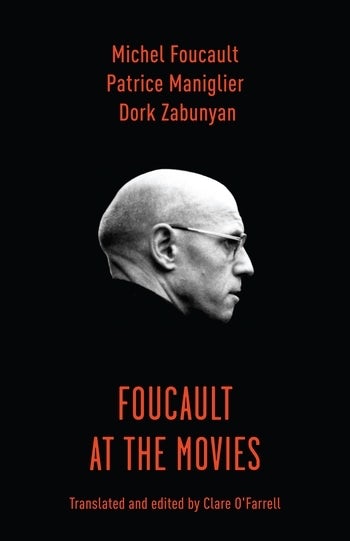
Foucault at the movies (2018)

Great to hear that this collection is imminent – Columbia UP site says 23 August.

Clare O'Farrell's avatarFoucault News

Editor: I am delighted to have just received a first copy of the new book.

Foucault at the Movies
Michel Foucault, Patrice Maniglier, Dork Zabunyan. Translated and edited by Clare O’Farrell, Columbia University Press, 2018

Michel Foucault’s work on film, although not extensive, compellingly illustrates the power of bringing his unique vision to bear on the subject and offers valuable insights into other aspects of his thought. Foucault at the Movies brings together all of Foucault’s commentary on film, some of it available for the first time in English, along with important contemporary analysis and further extensions of this work.

Patrice Maniglier and Dork Zabunyan situate Foucault’s writings on film in the context of the rest of his work as well as within a broad historical and philosophical framework. They detail how Foucault’s work directly or indirectly inspired both film critics and directors in surprising ways and discuss his ideas…

View original post 503 more words

Posted in Uncategorized | Leave a comment

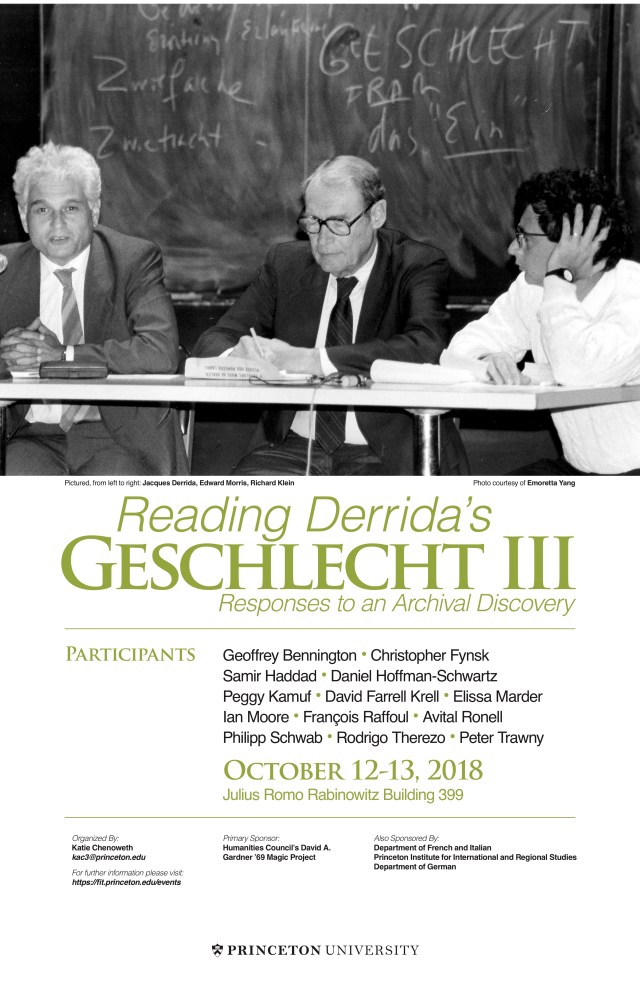
Reading Derrida’s Geschlecht III: Responses to an Archival Discovery, Princeton, Oct 12-13 2018

Reading Derrida’s Geschlecht III: Responses to an Archival Discovery, Princeton, Oct 12-13 2018.

Derrida wrote four papers on the theme of ‘Geschlecht’ – race, lineage, sex, and multiple other meanings – in Heidegger, publishing I, II and IV. The third was presented at a conference and a written version circulated to participants but not published. David Farrell Krell, Phantoms of the Other: Four Generations of Derrida’s Geschlecht (Albany: State University of New York, 2015) is an excellent study of this work (my review is here). This conference looks great, with some terrific speakers including Krell.

GELSCHLECHT CONF POSTER V5.jpg

Posted in Jacques Derrida, Martin Heidegger, Uncategorized | Leave a comment

Foucault fever in contemporary China (2017)

Interesting account of Foucault’s status in China – good to know there is this interest when both my recent Foucault books are being translated into Chinese.

Clare O'Farrell's avatarFoucault News

Opinion: Foucault fever in contemporary China – CGTNBy Zhao Hong. CGTN, 2017-02-24
Guest commentary by Zheng Yiran

On September 11, 2016, at the Central Academy of Fine Arts (CAFA) Art Museum, a thousand people squeezed into an auditorium that can accommodate only four hundred audience. It was the Beijing Premiere of Wang Min’an’s documentary, “Michel Foucault”. Hundreds of people were standing on the aisle to watch this 83-minute film, considered to be the epitome of the “Foucault Fever” in contemporary China.
[…]
In Douban, a very popular Chinese SNS website allowing people to share comments related to books, films and other cultural products and activities, the reading group of Foucault has gathered 12,000 people. The number of Foucault fans beats that of Immanuel Kant, Martin Heidegger, G. W. F. Hegel. Interestingly, Foucault’s group is also bigger than other groups tagged “French culture,” “French literature” and “Sophie Marceau,” who is…

View original post 50 more words

Posted in Uncategorized | Leave a comment