Announcement in French and English – thanks to Foucault News for the information
Description Michel Foucault moved in with Daniel Defert at 285 rue de Vaugirard (Paris 15th arrondissement) at the beginning of 1971, and he remained there until his death in 1984.
The inventory of the library preserved in this apartment is the result of a collective effort carried out from May to July 2024, made possible through the kind hospitality of Antoine Jabre, Daniel Defert’s husband. Henri-Paul Fruchaud and Philippe Chevallier were assisted in their work by two interns from the Bibliothèque nationale de France, Cecilia Drago and Annabelle de Traversay, as well as by François Ewald, Laurence Le Bras, and Niki Kasumi Clements. The project received support from the Bibliothèque nationale de France and the Centre Michel Foucault.
The file produced in 2024 was then fully revised and edited as a Heurist database by Carolina Verlengia (Triangle – UMR 5206) in June and July 2025, with the support of the Centre Michel Foucault and the Centre d’archives en philosophie, histoire et édition des sciences (CAPHÉS, UAR 3610).
This inventory should not be regarded as complete. First, because approximately 1,430 books dedicated to Michel Foucault had already left 285 rue de Vaugirard in the 2010s to join the Beinecke Rare Book & Manuscript Library at Yale University. Second, because certain choices had to be made due to time constraints. Thus, the following were not included in the inventory:
works published after Michel Foucault’s death;
a few minor reference or ephemeral items (dictionaries, travel guides, advertising brochures, etc.);
the numerous offprints, except for those directly related to Michel Foucault’s work and circle of friends;
books kept outside the living room and the former study (fewer in number than those described here and mostly paperbacks).
Finally, even though the core of this collection is clearly Michel Foucault’s working and “scholarly sociability” library, as reflected in the range of disciplines and themes it covers, as well as in the many reading marks and inscriptions, it is impossible to separate Michel Foucault’s use of the library from Daniel Defert’s. This is partly due to their shared life together (the presence of duplicates, particularly of certain classics of ancient thought, reminds us that Daniel Defert followed an academic path that was relatively similar to Michel Foucault’s), but also because Daniel Defert continued to live in the apartment from 1984 until his death in 2023 and frequently made use of this working library (especially for his editorial projects, from Dits et Écrits to Leçons sur la volonté de savoir). We have therefore attributed certain volumes, with due caution, to an owner who can at most be regarded as their first.
Michel Foucault s’est installé avec Daniel Defert au 285 rue de Vaugirard (Paris 15e) début 1971 ; il y resta jusqu’à sa mort en 1984.
L’inventaire de la bibliothèque conservée dans cet appartement est le fruit d’un travail collectif réalisé de mai à juillet 2024 grâce à l’accueil bienveillant d’Antoine Jabre, mari de Daniel Defert. Henri-Paul Fruchaud et Philippe Chevallier ont été aidés dans leur tâche par deux stagiaires de la Bibliothèque nationale de France, Cecilia Drago et Annabelle de Traversay, ainsi que par François Ewald, Laurence Le Bras et Niki Kasumi Clements. L’opération a reçu le soutien de la Bibliothèque nationale de France et du Centre Michel Foucault.
Le fichier produit en 2024 a ensuite été intégralement corrigé et édité sous la forme d’une base de données Heurist par Carolina Verlengia (Triangle – UMR 5206), en juin et juillet 2025, avec le soutien du Centre Michel Foucault et du Centre d’archives en philosophie, histoire et édition des sciences (CAPHÉS, UAR 3610).
Cet inventaire ne saurait être considéré comme complet. Tout d’abord, parce qu’environ 1 430 ouvrages dédicacés à Michel Foucault avaient déjà quitté le 285 rue de Vaugirard dans les années 2010 pour rejoindre la Beinecke Rare Book & Manuscript Library de l’université de Yale. Ensuite, parce qu’il nous fallut faire des choix, en raison de contraintes de temps. Ainsi, n’ont pas été inventoriés :
les ouvrages publiés après le décès de Michel Foucault ;
quelques usuels ou éphémères peu significatifs (dictionnaires, guides touristiques, brochures publicitaires, etc.) ;
les très nombreux tirés à part, à l’exception de ceux directement reliés au travail et aux cercles d’amitié de Michel Foucault ;
les ouvrages conservés en dehors du salon et de l’ancien bureau (moins nombreux que l’ensemble ici décrit, dont une majorité de livres de poche)
Enfin, même si le cœur de cet ensemble est de toute évidence la bibliothèque de travail et de « sociabilité savante » de Michel Foucault, comme le montrent les disciplines et les thèmes couverts, mais aussi les nombreuses marques de lecture et d’envoi, il est désormais impossible d’isoler son usage de celui qu’en fit Daniel Defert : à la fois du fait de leur vie commune (la présence de doublons, en particulier pour certains classiques de la pensée antique, nous rappellent que Daniel Defert a suivi un parcours de formation relativement similaire à celui de Michel Foucault), mais aussi parce que Daniel Defert demeura dans l’appartement de 1984 à son décès en 2023 et eut fréquemment recours à cette bibliothèque de travail (en particulier pour ses travaux d’édition, des Dits et Écrits aux Leçons sur la volonté de savoir). C’est donc avec prudence que nous avons attribué certains ouvrages à un propriétaire qui n’est tout au plus que le premier.
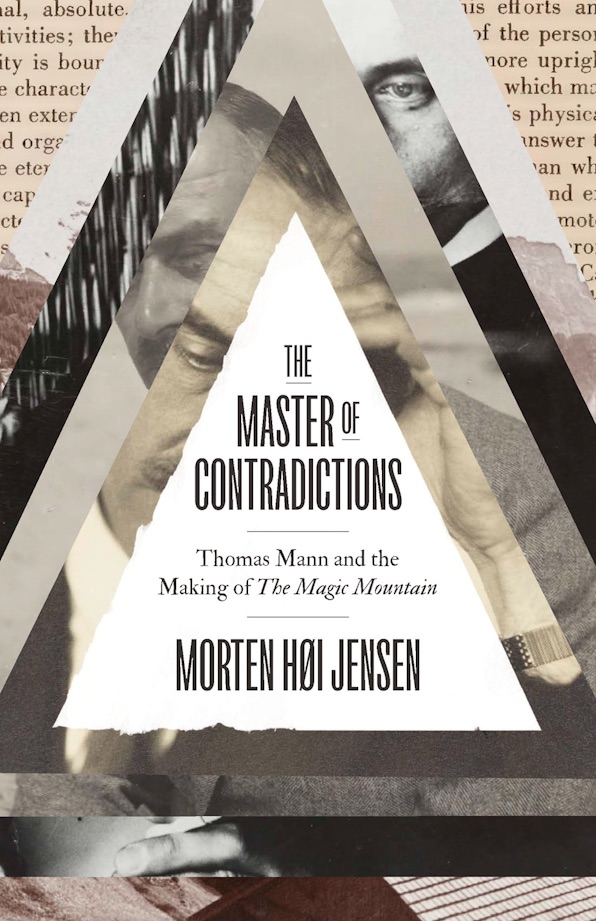
The arresting story of how Thomas Mann wrote The Magic Mountain as a defeated Germany descended into political chaos
Like many writers of his generation, Thomas Mann (1875–1955) welcomed the outbreak of the First World War. He viewed it as a spiritual necessity, a chance to reassert German cultural dominance over Western ideas of democracy and enlightenment. Then, in 1924, he published The Magic Mountain, a massive novel that culminates in the slaughter of war and foreshadows the Nazi terror to come. One of the central achievements of modernism, The Magic Mountain bears testimony to its author’s dramatic political reorientation as a defender of democracy.
This poignant book is a biography of Mann’s great novel—its evolution from a short story into a two-volume masterpiece and one of the bestselling novels of the Weimar era. Deftly weaving together elements of biography, history, and literary criticism, Morten Høi Jensen reveals how writing The Magic Mountain against a backdrop of world war, revolution, hyperinflation, and rising right-wing terror moved Mann to embrace the democratic and humanistic ideas he once scorned.
One hundred years after The Magic Mountain was first published, at a time when democratic ideas are again under threat, Jensen reveals the universality and timeliness of Mann’s great novel—its still-resonant debates over democracy and tyranny, time and place, illness and death.
Comment s’est constituée, à travers le temps, la conception de la vérité qui est aujourd’hui celle de la civilisation occidentale? Tel est le thème de ce cours inédit prononcé par Foucault au printemps 1972 à l’Université d’État de New York à Buffalo. En prolongeant ses deux premiers cours au Collège de France, il étudie dans deux périodes, l’Antiquité grecque et le Moyen Âge occidental, l’histoire de la façon dont s’est opéré, à travers l’évolution des pratiques judiciaires et des relations de pouvoir qui les sous-tendent, le partage du vrai et du faux qui est à l’origine du discours scientifique occidental. Ainsi, l’Histoire de la vérité est l’un des tout premiers travaux où Foucault met en oeuvre l’approche généalogique qui caractérise sa pensée à partir du début des années 1970. Ce cours est aussi l’occasion, pour Foucault, de préciser sa propre démarche, dans laquelle la relation entre pouvoir et savoir occupe une place centrale, en la distinguant soigneusement de celle d’un certain marxisme, notamment par la critique des notions d’idéologie et de conception du monde.
The next issue of Foucault Studies has an essay on this course by Leonhard Riep, alongside my discussion of what else the Buffalo archives reveal about Foucault’s two visiting posts there in 1970 and 1972. A much shorter version of my piece is here.
Update November 2025: my article in Foucault Studies is now available here, Leonhard’s essay here – both open access.
Russia’s invasion of Ukraine in February 2022 shocked the world and overturned assumptions that large-scale conventional war was inconceivable in the 21st century. On the other side of the planet, democratic Taiwan faces the rising threat of a military takeover by China – a conflict whose impact on the international community would be catastrophic.
Renowned Taiwan expert and former intelligence officer J. Michael Cole explains how this Pacific nation has become a tinderbox that could ignite a full-scale global conflict. Drawing on unparalleled access to Taiwanese government sources and two decades of on-the-ground observation, he explores the root causes of the conflict between Taiwan and China – from the identity politics that make “peaceful unification” inconceivable, to the rise of Xi Jinping, the most powerful and authoritarian Chinese leader since Mao Zedong. With in-depth analysis of how the war in Europe is influencing preparations by Beijing, Taipei, and Washington for a potential cross-strait confrontation, The Taiwan Tinderbox is an impassioned plea for the defense of Taiwan as a priority for the international community and the future of democracy.
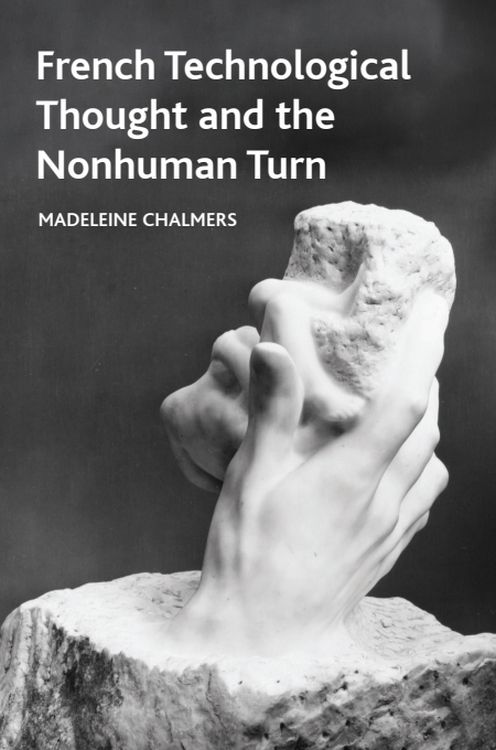
Uncovers the nonhuman turn’s unexpected roots in the avant-gardes and mysticisms of nineteenth-century France
Builds a new genealogy which highlights the unacknowledged expression of Catholic mysticism and avant-garde French literature in the nonhuman turn
Brings into play both canonical and non-canonical authors, from Symbolism to Surrealism and beyond
Mines unexplored elements of major thinkers, including Gilbert Simondon and Gilles Deleuze
Tackles the porous boundaries between literature, philosophy, science, politics, and theology in French thought
French Technological Thought and the Nonhuman Turn traces a genealogy of thinking and writing about technology, which takes us from the French avant-gardes to the contemporary ‘nonhuman turn’ in Anglo-American theory via the Surrealists, Gilbert Simondon, and Gilles Deleuze.
Tracking the unruly transition from Catholic vocabularies of grace, potentiality, and actuality to the modern and contemporary secular lexicon of agency, virtuality, and affect, this book explores technology as a source of subject matter and conceptual metaphors, but also probes how ideas and words are modes of technicity through which we shape and reshape the world. Fusing literature, philosophy, and theology, it offers readers new contexts – and questions – for the egalitarian ontological commitments of contemporary post- and nonhuman thinking.
Sorry to report that the price is prohibitively expensive.
This book focuses on the geographical and geopolitical sources for Carl Schmitt’s multilayered political thinking in order to uncover the relation between the political and the geographical aspects of his concept of space from 1939 to 1950. The aim is therefore to open up a field of enquiry, specifically to investigate Schmitt’s sources in the geographical and geopolitical literature inside and outside Germany in order to reconstruct the genealogy of his idea of space, territory and international order. In doing so, the contributors aim both to distinguish concepts that have generally been only vaguely defined in the literature on Schmitt, namely his idea of space, political territory and land, and to define more precisely the relationship between Schmitt’s Großraum and the National Socialist Lebensraum.
This book refers to, complements and goes beyond three different approaches – International Relations, geography and philology: First, in that it explores the genealogy of Schmitt’s concept of space by adopting a twofold methodology of intellectual history and philology; second, in that it considers the relevance of language in Schmitt’s discourse on power and space; third, in that it relates Schmitt’s thinking to the transnational literature on geopolitics and political geography.
Geo – Political Spaces will appeal to academics and the well-informed public at large. It is also suitable for academic teaching, especially when it comes to historical theory, the concept of space or the history of political thought.
A crucial intervention at the intersection of ecotheology and trauma theology
We are in the midst of a global ecological crisis. At times, the scale of the suffering involved can be hard to fully comprehend. The whole planetary ecosystem feels out of kilter. Meanwhile, trauma theorists, and society at large, have become increasingly aware of the incidence of trauma in a growing variety of contexts. In Witnessing a Wounded World, Timothy Middleton asks what might be gained by viewing ecological suffering through the lens of trauma.
By bringing concepts and methodologies from trauma theology to bear on questions that arise within ecotheology, Middleton engages a series of pressing questions. What kind of traumas are being precipitated by anthropogenic climate change and accelerating biodiversity loss? What would it mean to envisage the Earth itself as traumatized? And how might a Christian theologian respond?
From large-scale deforestation and opencast mining to rampaging wildfires and fracturing ice sheets, the Earth itself is subject to intense devastation. Witnessing a Wounded World analyzes such phenomena in terms of three traumatic ruptures—to communication, to flesh, and to time. Drawing on practices of witnessing and the insights of deep incarnation Christologies, Middleton proceeds to offer a theological account of this ecological trauma. For Christians, a model of Christic witnessing can bring the Earth’s suffering to light.
As the first sustained treatment of ecological trauma to address the trauma of the Earth itself, Witnessing a Wounded World makes a profound contribution to discussions of suffering, faith, and the present ecological emergency.
The world’s leading Marxist geographer and economist takes us by the hand to guide us through Marx’s masterwork
For decades, David Harvey has been teaching Marx’s work, particularly Capital, to great acclaim. He has analysed chapter by chapter – sometimes line-by-line – Marx’s three volumes and the Grundrisse. This new book opens up the mental universe of that work for a general reader.
In The Story of Capital, Harvey takes a synoptic approach to the conceptual architecture as a whole and guides us through the key moments, from labour and technology to the state and geopolitics, via the profit rate, social reproduction, the relationship to nature, fictitious capital and the return of the rentiers. In doing so, Harvey has produced a work which will become a key reference for all those trying to grasp the nature of contemporary capitalism.
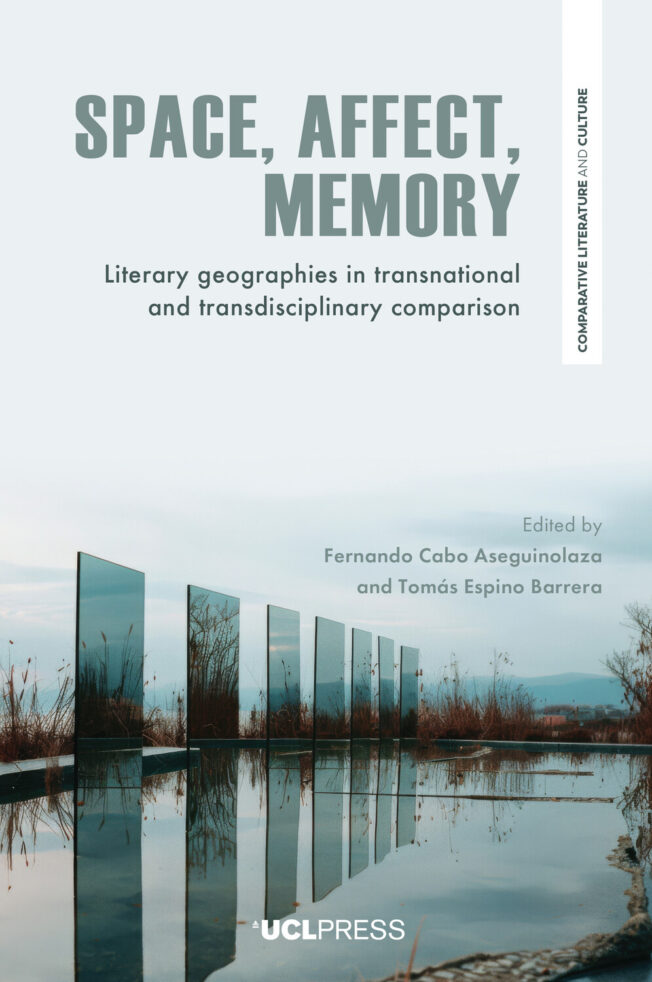
Space, Affect, Memory highlights the centrality of space in modern and contemporary culture, both as an object of study and as a concept that underpins research and creative practice. In so doing, this book argues for the necessity of a new approach to space which integrates its affective and memorial dimension.
Contributors from different fields explore and advance debates in literary geography from diverse transnational perspectives through close readings of canonical and less familiar cultural and literary productions in English, Spanish, Portuguese, French, Italian and Japanese, in locales spanning Africa, the Americas, Asia and Europe. In this way, Space, Affect, Memory decentres the anglophone bias of established scholarly approaches in literary geography, probing terminologies and methodologies from different national traditions.
Finally, Space, Affect, Memory interweaves the visual arts by engaging with photography, performance and architecture. As a result, the volume offers a fresh, comparative perspective on the intermingling of space, affect and memory that lies at the heart of literary geography and comparative literature. These efforts converge in a shared attempt to pluralize the field (geographies) and to showcase the numerous possibilities of creative, transdisciplinary interaction between media, performance and representation, across cultures.
Jacques Derrida was certainly a careful reader of Émile Benveniste. He wrote a critique of Benveniste in “Le supplément de copule. La philosophie devant la linguistique” which appeared in 1971, in a special issue of Langages, “Épistémologie de la linguistique” edited by Julia Kristeva in tribute to Benveniste. The essay was collected in Marges de la philosophie and translated as “The Supplement of Copula: Philosophy before Linguistics” in Margins of Philosophy. Derrida often makes use of Benveniste’s Vocabulaire des institutions indo-européennes, the Dictionary of Indo-European Concepts and Society, in his later work, of which the discussion of the gift in Given Time, or of hospitality in his lectures are the best-known examples. A marked up copy of the original English translation is in Derrida’s library now held by Princeton University. There are lots more references, as the posthumous seminars make clear. In these seminars he often voices criticisms, while nonetheless often building on Benveniste’s analyses. This side of the relation is well attested and Étienne Balibar, in particular, has written about it. Much more could be said of the seminars and Derrida’s reading of Benveniste but that is not my concern here.
But was Benveniste a reader of Derrida? There is a tragic terminus ante quem – Benveniste’s incapacitating stroke of December 1969, after which he spent nearly seven years in hospitals and care homes before his death, suffering from aphasia and partial paralysis. So, he would not have been able to respond to “Le supplément de copule”, or know of the use Derrida made of his Vocabulaire, which was published shortly before his stroke.
Benveniste certainly knew people who knew Derrida – Kristeva and Roland Barthes, or Tzvetan Todorov. There were undoubtedly opportunities for Benveniste to be aware of Derrida’s work, even from quite early. Any reading of Derrida would have happened at the beginning of Derrida’s career, before or around the time of his miraculous year of 1967, when the books Of Grammatology, Writing and Difference and Speech and Phenomena all appeared. Although Derrida had published before then, notably his long introduction to his translation of Husserl’s The Origin of Geometry in 1962, and these three books all make use of previously published material, 1967 is when he really burst onto the scene. Or we could push the date back a little to the 18-21 October 1966 Baltimore conference on structuralism at which he gave the closing talk, “Structure, Sign, and Play in the Discourse of the Human Sciences” (reprinted in Writing and Difference). I write about that event, and share a link to its recently rediscovered recordings, here.
In his “Translator’s Introduction” to Benveniste’s Last Lectures, delivered in 1968-69, John E. Joseph says this of the part of the course on writing:
He might have talked about how his approach did or did not articulate with Derrida’s, whose Of Grammatology we know that he read, since his manuscripts include notes taken during his reading of it. Irène Fenoglio explains his silence by Benveniste’s desire to treat the subject as a linguist, hence ignoring someone he regarded as a philosopher – which is entirely plausible, and in line with what we know about the operation of disciplinary boundaries at the time. Derrida always spoke of how much Benveniste’s etymological enquiries enriched his thinking, and his writings show that it is so. Here was a lost opportunity to repay the debt (p. 48).
Joseph repeats this claim in a chapter, stressing that “Benveniste’s reading notes mention specific passages of the book” (“L’hostipalité des linguistes”, p. 320 n. 4). Irène Fenoglio is one of the editors of Benveniste’s course, and Joseph’s reference is to her chapter “L’écriture au fondement d’une ‘civilisation ‘laïque’”, published in Autour d’Émile Benveniste, pp. 168-69, and in particular the discussion on pp. 231-32.
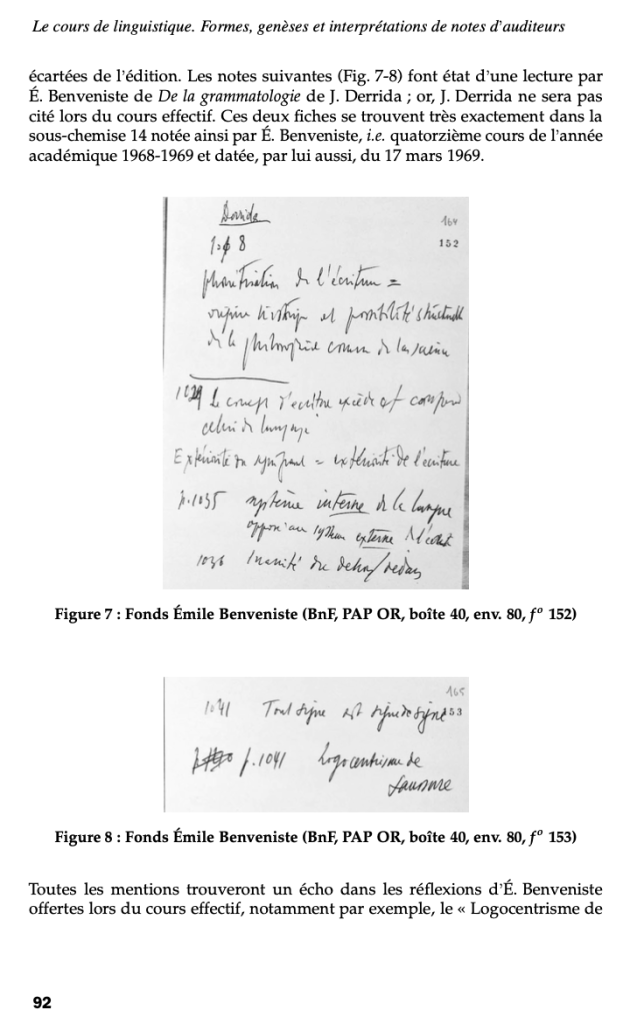
p. 92 of Irène Fenoglio, “Éditer un cours de linguistique générale à partir d’archives manuscrites: Essai de méthodologie critique”, Langages 209, 2018, 77-96. Clicking on image takes you to the online version, where figures 7 and 8 can be seen.
In another one of her articles, “Éditer un cours de linguistique générale à partir d’archives manuscrites”, Fenoglio says these notes “refer to E. Benveniste’s reading of Derrida’s De la grammatologie” (p. 92) The notes which prove this, she claims, are found in the subfolder of the 14th lecture of the course, dated to 17 March 1969. She indicates that this is important even if “Derrida is not cited in the actual lecture” (p. 92). Fenoglio reproduces those pages in her chapter, p. 169, and her article, p. 92. I have learned a great deal from Fenoglio and Joseph’s work – he is the author of a magisterial biography of Saussure, for example, and Fenoglio has edited and interpreted various texts from Benveniste’s archives (see also her “Le fonds Émile Benveniste de la BnF est-il prototypique?”). But on this point about Benveniste reading Derrida’s book, I’m not sure.
The materials relating to the 1968-69 course are in box 40 of the Papiers d’orientalistes at the Bibliothèque nationale de France. I’ve seen the notes mentioned by Joseph and Fenoglio in the original, folios 152 and 153, rather than just Fenoglio’s reproduction, and they are certainly about Derrida and logocentrism. There is unfortunately not much to see. There are nine lines of writing on one page and two lines at the top of the second. The reproduction Fenoglio provides – which can be seen above, and in more detail online, figures 7 and 8 – is complete, though the blank bottom of the second page is not shown.
These notes are not however about Derrida’s De la grammatologie, the book published in 1967. They are about an earlier version of one small part of that book, an article previously published in Critique in 1965, “De la grammatologie”, not De la grammatologie. The notes are not completely clear, but in the left margin there are a series of numbers – 1018, 1029, 1035, 1036, 1041, 1041. Only two of these have a ‘p.’ before them; two are written over to correct an earlier mistake, one is crossed out and rewritten. But they are page numbers, and they accord well to the content of the first part of the article, published on pages 1016-42 of issue 223 of the journal in 1965. This is not the complete piece, which was split across two issues, presumably because of its length: part I in 1965; part II in 1966, pages 23-53 of the issue 224. All the page references in Benveniste’s notes are to the first part, from 1965.
So, Benveniste quotes Derrida’s “la phonétisation de l’écriture – origine historique et possibilité structurelle de le philosophie comme de la science” from p. 1018; notes the distinction between the internal system of language and the external, which Derrida is relating to Saussure (p. 1035), and the complication of the inside and outside (p. 1036). He also indicates Derrida’s claim about the “logocentrism” of Saussure (p. 1041).
But both Joseph and Fenoglio say that these notes prove Benveniste read De la grammatologie, the book. It matters, because that text accomplishes much more than just what is said in the article, especially if Benveniste only read its first part.
Derrida’s two-part article discusses three works – Madeleine V. David, Le débat sur les écritures et l’hiéroglyphe aux XVIIe et XVIIIe siècles, published in 1965; André Leroi-Gourhan, Le Geste et la parole, published in two volumes in 1964 and 1965, with the first volume subtitled Technique et Langage; and a proceedings, L’écriture et la psychologie des peuples, published in 1963 from a conference organised by the Centre International de Synthèse in May 1960.
The books indicate a wide network of ideas. David’s book was initially a thesis at the École Pratique des Hautes Études under the supervision of Ignace Meyerson, with Alexis Rygaloff and Jean-Pierre Vernant the rapporteurs and Fernand Braudel, director of the sixth section of the EPHE, thanked for his support of its publication (pp. 9-10). Leroi-Gourhan was a former student of Marcel Mauss, his workwas important to writings by Gilles Deleuze and Félix Guattari and Bernard Stiegler among others, and he was appointed to the Collège de France in 1969 in a chair of prehistory made possible by Georges Dumézil’s retirement the previous year. The participants in L’écriture et la psychologie des peuples connect in multiple ways to Benveniste’s career – the ancient Greek philologist Pierre Chantraine had been a student of Antoine Meillet alongside Benveniste, and like the sociologist of Islam Maxime Rodinson was a colleague of Benveniste at the École Pratique des Hautes Études. The Hittite scholar Emmanuel Laroche taught at the EPHE too, and was effectively Benveniste’s successor at the Collège de France, appointed in 1972; Marcel Cohen was a colleague at the EPHE, and the Assyriologist René Labat and the Tibetan scholar Jean Filliozat were colleagues at the Collège. Alexandre Koyré took part in some of the discussions of papers. Less surprising than Benveniste’s interest in a review of this collection was that he was not involved in the conference himself.
Derrida’s two-part article provides material which is developed into part one of De la grammatologie, “L’écriture avant la lettre”, “Writing before the Letter”. Of course, even in the first part of the article Derrida goes beyond the books under discussion, and anticipates many themes of his wider work, including Heidegger, the metaphysics of presence, Saussure, and the relation between speech and writing.
A further page of notes by Benveniste, folio 171 in the same box of the Papiers d’orientalistes, are notes on “Grammatologie”. Derrida is not mentioned by name, and while some of its vocabulary is similar, it’s worth noting that ‘grammatology’ is not exclusive to Derrida. As far as I’m aware, its first use is in Ignace Gelb’s A Study of Writing: The Foundations of Grammatology, the first edition of which appeared in 1952. Later editions remove the word ‘grammatology’ from the subtitle. Derrida’s interpretation arguably makes the term his own. The same can be said of the term ‘logocentrism’, coined by Ludwig Klages but usually associated with Derrida. The last note by Benveniste on this article reproduced by Fenoglio mentions “logocentrisme de Saussure”, referencing p. 1041 of Derrida’s article.
All the discussion of Claude Lévi-Strauss in De la grammatologie comes in the second part of the book, almost twice the length of the first. Rousseau in mentioned in the article in a few places (pp. 1017, 1030, 1037-38, 1039 n. 19), but the more substantial discussion also comes in the second part of the book. In an interview with Dawn McCance, the philosopher and literary theorist Rodolphe Gasché recalls that:
On one occasion at least, and with some amusement, Derrida pointed out to me that the book, Of Grammatology, that made him famous was… a work patched together of two unrelated pieces: on the one hand, a reworked review article on several important books on writing that had just been published, and which appeared in Critique in 1965 and 1966 under the title “De la Grammatologie”; and, on the other hand, his lectures during this same academic year at the École normale supérieure (ENS) on Rousseau, that is, on a subject that was not one of his own choice, but which was determined by the fact that Rousseau, that very year, was on the program of the “aggregation,” and which it was thus his duty to teach in order to prepare the normaliens for this competitive examination for the recruitment of high school teachers and university professors (“Crossings: An Interview with Rodolphe Gasché”, p. 202).
None of this means that Benveniste did not read the second part of the article, or the 1967 book De la grammatologie. As Fenoglio notes, his library was sold after his death to the Linguistics Institute at the University of Bern, where his literary executor Georges Redard taught. Fenoglio says that she has seen a copy in that library which comes from the Benveniste collection (Fenoglio, “L’écriture au fondement d’une ‘civilisation ‘laïque’”, p. 159 n. 1). That copy was not there when I visited the Bibliothek Sprachwissenschaft – the book with the shelfmark she gives was the 1974 printing of the text, not the 1967 original (LA 042). There is unfortunately not a comprehensive list of the original deposit available. There may be other notes by Benveniste on Derrida elsewhere in his papers, though I have looked at everything at least once. Of course, absence of evidence is not evidence of absence.
However, the surviving notes taken by Benveniste on Derrida do not prove he read the book De la grammatologie. He certainly read the earlier article “De la grammatologie”, but seemingly only part one of that two-part piece. As a review of work on writing, Derrida’s essay was something which would have undoubtedly interested Benveniste for the course he was teaching. Several themes of his wider work are previewed here, but Derrida’s essay is not the major work of which it would become a part. I think it’s more likely that Benveniste simply took this as a review essay about writing which was quite interesting for his research and teaching, not as a text by a philosopher which he, as a linguist, could chose to engage with or to ignore. At other times he was certainly willing to engage with philosophy or other material outside of linguistics.
If it was a “lost opportunity” for Benveniste not to have lectured or written about Derrida, I think it was even more of a missed prospect that he had seemingly read so little of his work.
References
L’écriture et la psychologie des peuples:XXIIe semaine de synthèse, Paris: Librarie Armand Colin, 1963.
Étienne Balibar, “De la certitude sensible à la loi du genre”, Citoyen sujet et autres essais d’anthropologie philosophique, Paris: PUF, 2011, 183-206; “From Sense Certainty to the Law of Genre: Hegel, Benveniste, Derrida”, Citizen Subject: Foundations for Philosophical Anthropology, trans. Stephen Miller, New York: Fordham University Press, 2016, 106-20.
Émile Benveniste, Dernières Leçons: Collège de France 1968 et 1969, eds. Jean-Claude Coquet and Irène Fenoglio, Paris: EHESS/Gallimard/Seuil, 2012; Last Lectures: Collège de France 1968 and 1969, trans. John E. Joseph, Edinburgh: Edinburgh University Press, 2019.
Madeleine V. David, Le Débat sur les écritures et l’hiéroglyphe aux XVIIe et XVIIIe siècles et l’application de la notion de déchiffrement aux écritures mortes, Paris: SEVPEN, 1965.
Jacques Derrida, “De la grammatologie”, Critique 223, 1965, 1016-42, and Critique 224, 1966, 23-53.
Jacques Derrida, De la grammatologie, Paris: Éditions de Minuit, 1967; Of Grammatology,trans. Gayatri Spivak, Baltimore: Johns Hopkins University Press, 1976.
Jacques Derrida, “Le supplément de copule: La philosophie devant la linguistique”, Langages 24, 1971, 14-39; reprinted in Marges – de la philosophie, Paris: Minuit, 1972, 209-46; “The Supplement of Copula: Philosophy before Linguistics”, Margins of Philosophy, trans. Alan Bass, Brighton: Harvester Press, 1982, 175-205.
Irène Fenoglio, “Le fonds Émile Benveniste de la BnF est-il prototypique? Réflexions théoriques et méthodologiques sur les potentialités d’exploitation d’archives linguistiques” in Valentina Chepiga and Estanislao Sofia eds. Archives et manuscrits de linguistes, Louvain-la-neuve: Academia-L’Harmattan, 2014, 11-46.
Irène Fenoglio, “L’écriture au fondement d’une ‘civilisation ‘laïque’”, in Autour d’Émile Benveniste, Paris: Seuil, 2016, 153–236.
Irène Fenoglio, “Éditer un cours de linguistique générale à partir d’archives manuscrites: Essai de méthodologie critique”, Langages 209, 2018, 77-96.
I.J. Gelb, A Study of Writing: The Foundations of Grammatology, Chicago: University of Chicago Press/London: Routledge & Kegan Paul, 1952.
John E. Joseph, Saussure, Oxford: Oxford University Press, 2012.
John E. Joseph, “Translator’s Introduction” in Émile Benveniste, Last Lectures: Collège de France 1968 and 1969, eds. Jean-Claude Coquet and Irène Fenoglio, trans. John E. Joseph, Edinburgh: Edinburgh University Press, 2019, 31-60.
John E. Joseph, “L’hostipalité des linguistes: Puech coincé entre Benveniste et Derrida”, in Valentina Bisconti, Anamaria Curea and Rossana de Angelis eds. Héritages, receptions, écoles en sciences du langage: avant et après Saussure, Paris: Presses Sorbonne Nouvelle, 2019, 315-23.
André Leroi-Gourhan, Le Geste et la parole, Paris: Albin Michel, two volumes, 1964-65; Gesture and Speech, trans. Anna Bostock Berger, Cambridge, MA: MIT Press, 1993.
Dawn McCance, “Crossings: An Interview with Rodolphe Gasché”, Mosaic 50 (1), 2017, 201-26.
The Library of Jacques Derrida, Firestone Library, Princeton University
Émile Benveniste library, Bibliothek Sprachwissenschaft, Universität Bern
This is the 41st post of a weekly series, where I post short essays with some indications of further reading and sources, but which are not as formal as something I’d try to publish more conventionally. They are usually tangential to my main writing focus, a home for spare ideas, asides, dead-ends and possible futures. I hope there is some interest in them. They are provisional and suggestions are welcome. A few shorter pieces in a similar style have been posted mid-week.
The full chronological list of ‘Sunday histories’ is here, with a thematic ordering here.