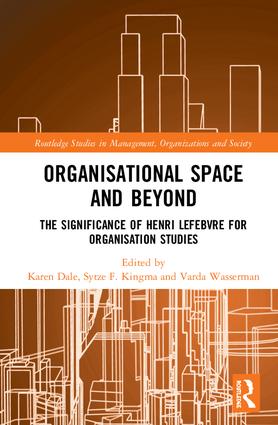
Organisational Space and Beyond: The Significance of Henri Lefebvre for Organisation Studies – new edited collection

9781138236400Organisational Space and Beyond: The Significance of Henri Lefebvre for Organisation Studies, edited by Karen Dale, Sytze F. Kingma, Varda Wasserman

Through the focus on organizational space, using the reception and significance of the seminal work on the subject by sociologist Henri Lefebvre, this book demonstrates why and how Lefebvre’s work can be used to inform and elaborate organisational studies, especially in view of the current interest in the “socio-material” dimension of organisations.

As the “spatial turn” in organisational research exposed the importance of spatial design in inducing power and cultural relations, Lefebvre’s perspective has become an inspiring, theoretical framework. However, Organisational Space and Beyond explores how Lefebvre’s work could be of a much wider relevance, especially given his profound theoretical engagement with diverse schools of philosophical and sociological thought, including Nietzsche, Marx, Sartre and Foucault.

This book brings together a range of authors that collectively develop a broader understanding of Lefebvre’s relevance to organizational studies, including areas of management concern such as strategy and diversity studies, and ultimately draw on Lefebvre’s work to rethink, reimagine and reshape scholarship in organisational studies. It will be of relevance to researchers, academics, students and organizational professionals in the fields of organisation studies, management studies, cultural studies, architecture and sociology.

Currently only an expensive hardback and much cheaper e-book, but with a good amount available as a preview.

I’ve added this book to my list of reading suggestions on Lefebvre.
Posted in Henri Lefebvre, Uncategorized | Leave a comment

Interview with Dylan Trigg at Figure/Ground

Interview with Dylan Trigg at Figure/Ground Here’s the first question and answer:

How did you decide to become a university professor? Was it a conscious choice?

Like many people working in academia, accidents and errors have become more valuable than conscious choices. My introduction to philosophy came via psychotherapy, which itself came via criminal psychology. Before philosophy, I was studying existential psychoanalysis in London. This style of therapy is rooted in phenomenology, and the grand themes of death, freedom, anxiety, and meaning inspired an interest in Kierkegaard, Nietzsche, Schopenhauer, Sartre, Heidegger, Levinas and so forth. I was introduced to this through Irvin Yalom’s textbook, “Existential Psychotherapy,” which I read as a teenager and still hold in great regard, though perhaps with some uncritical nostalgia now. Later on, works by R.D. Laing, Karl Jaspers, and Ludwig Binswanger drew me closer to the phenomenological tradition more broadly.  Because of this background, the Wittgensteinian idea of philosophy as therapy retains a relevance for me both academically and personally, as Wittgenstein would have it: “The work of the philosopher consists in assembling reminders for a particular purpose.”  So, academia for me is not a conscious choice, as such. I did not harbour childhood fantasies of becoming a professor. It was instead an expression of something that began in the context of studying psychotherapy, which I then became seduced by.


Posted in Uncategorized | Leave a comment

James D. Boys, Clinton’s War on Terror: Redefining US Security Strategy, 1993-2001 – now out and Introduction

layoutJames D. Boys, Clinton’s War on Terror: Redefining US Security Strategy, 1993-2001 – now out with Lynne Rienner. The Introduction is available open access

In the aftermath of the catastrophic attacks of September 11, 2001, President Bill Clinton’s time in office was portrayed as one in which vital opportunities to confront growing threats to US security were missed. Firmly challenging this characterization, James Boys explores the long-misunderstood approach adopted by the Clinton administration as it sought to define an effective response to acts of political violence.

Boys argues that only by understanding the efforts of Clinton and his team to address international terrorism can we make sense of the reasoning behind the actions of George W. Bush, Barack Obama, and Donald Trump, all of whom inherited, continued, and expanded on Clinton-era policies and practices. Drawing on official documents and on interviews with key players, he reveals the evolution of counterterrorism strategy throughout the Clinton administration, as well as the ramifications that it has today.

Posted in Uncategorized | Leave a comment

Foucault, La Sexualité – 1964 course from Clermont-Ferrand scheduled for October 2018

The publication of Foucault’s courses from the 1950s and 1960s has been planned for some time, and now his 1964 course from Clermont-Ferrand La sexualité is listed as forthcoming in October 2018. Limited details at the moment, but here are the listings on Amazon, Cultura, Decitre and Fnac. It’s coming out with Gallimard/Seuil in the Hautes Etudes series, but is not yet on their website. I‘d previously heard this would be paired with a 1969 course from Vincennes on a related topic, but it is now listed as followed by ‘Le discours de la sexualité’. I’ll share more details if and when I hear them, or please add any other information in comments.

Update: Thanks to Daniele Lorenzini for confirming that there are two courses in this volume – the 1964 Clermont-Ferrand one, and the 1969 course from Vincennes Le discours de la sexualité. Claude-Oliver Doran, who was involved in the Théories et institutions penales course, is the editor.

Update 2: A few more details here.

Update 3: the Seuil website is here.

Posted in Michel Foucault, Uncategorized | 7 Comments

Shakespearean Territories (forthcoming Oct 2018, University of Chicago Press) – endorsements and description

Shakespearean Territories cover - CopyThree very generous endorsements of Shakespearean Territories – from a philosopher, geographer and literary theorist. The book is forthcoming in October 2018 from University of Chicago Press and is available to preorder from usual outlets.

Shakespearean Territories is a truly groundbreaking volume that enriches our reading of Shakespeare at the same time as it illuminates our understanding of the nature and history of territory. An insightful and engrossing work, Shakespearean Territories demonstrates Elden’s unquestionable position as the most significant thinker of territory and the geographic working today—and in relation to the literary and dramatic no less than the political.”—Jeff Malpas, University of Tasmania

“A work of meticulous scholarship, Shakespearean Territories teases out and explains a wide range of geographical themes present in Shakespeare’s plays with finesse and profound interpretation. Beyond the specific insights he offers on territory and geography as refracted through Shakespeare’s plays, Elden displays the substantial value of bridging literary and historical-geographical analysis.”—Alexander Murphy, University of Oregon

Shakespearean Territories offers illuminating analyses of Shakespeare’s works that are immersed in relevant scholarship on the colonial, geophysical, and corporeal aspects of territory. This is a fascinating textual analysis that builds upon the concept of territory with Elden’s characteristic nuance and depth.”—Garrett Sullivan, Penn State University

My thanks to Jeff, Alec and Garrett for such kind words. Here’s the back cover description of the book:

Shakespeare was an astute observer of contemporary life, culture, and politics. The emerging practice of territory as a political concept and technology did not elude his attention. In Shakespearean Territories, Stuart Elden reveals just how much Shakespeare’s unique historical position and political understanding can teach us about territory. Shakespeare dramatized a world of technological advances in measuring, navigation, cartography, and surveying, and his plays open up important ways of thinking about strategy, economy, the law, and colonialism, providing critical insight into a significant juncture in history. Shakespeare’s plays explore many territorial themes: from the division of the kingdom in King Lear,to the relations among Denmark, Norway, and Poland in Hamlet,  to questions of disputed land and the politics of banishment in Richard II. Elden traces how Shakespeare developed a nuanced understanding of the complicated concept and practice of territory and, more broadly, the political-geographical relations between people, power, and place. A meticulously researched study of over a dozen classic plays, Shakespearean Territories will provide new insights for geographers, political theorists, and Shakespearean scholars alike.

Posted in Shakespearean Territories, Uncategorized, William Shakespeare | Leave a comment

Verso Radical Thinkers set 16 – Therborn, Bloch, Benner, Heller

Verso_Radical_Thinkers-f_feature-4da38439321e4d75aa21280cfa4af668Verso Radical Thinkers set 16

Göran Therborn, From Marxism to Post-Marxism?

Ernst Bloch, On Karl Marx

Erica Benner, Really Existing Nationalisms

Agnes Heller, The Theory of Need in Marx 

Posted in Karl Marx, Uncategorized | 1 Comment

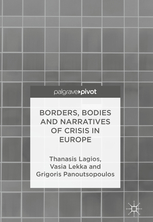
Thanasis Lagios, Vasia Lekka and Grigoris Panoutsopoulos, Borders, Bodies and Narratives of Crisis in Europe,

9783319755854.jpgThanasis Lagios, Vasia Lekka and Grigoris Panoutsopoulos, Borders, Bodies and Narratives of Crisis in Europe, now published with Palgrave Pivot.

This book addresses two interrelated discourses of crisis in contemporary Europe: the migrant crisis vs. the economic crisis. The chapters shed light on the thread that links these two issues by first examining immigration and the transformations regarding its control and administration via border technologies, as well as on the centrality of the body as a means and carrier of border within contemporary biopolitical societies. In a second step, the authors proceed  to a genealogy of the current discourses regarding the financial and political crisis through a Foucauldian and Lacanian perspective, focusing on the co-articulation of scientific knowledge and biopolitical power in Western societies.

Thanks to Marcelo Hofman for the link. A shame about the price though.

Posted in Uncategorized | 3 Comments

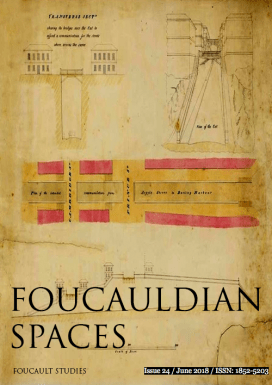
Foucault Studies 24 published – with new Foucault translation, feature on Foucaudian Spaces, and review of Subjectivity and Truth (open access)

cover_issue_740_en_US.pngFoucault Studies 24 published – with new Foucault translation, feature on Foucaudian Spaces, and my review of the Subjectivity and Truth lecture course.

Editorial

Editorial – Special Issue, Foucauldian Spaces

Sverre Raffnsøe

PDF

1-5

Section in collaboration with Foucault Circle

Introductory Essay: Foucauldian Spaces

Dianna Taylor, Joanna Crosby

PDF

6-11

Articles

South Africa as postcolonial heterotopia: The racialized experience of place and space

Charles Villet

PDF

12-33

The 2015 Baltimore Protests: Human Capital and the War on Drugs

Joanna Crosby

PDF

34-57

Foucault’s functional justice and its relationship to legislators and popular illegalism

Sylvain Lafleur

PDF

58-76

Round Table Discussion with Lynne Huffer, Steven Ogden, Paul Patton, and Jana Sawicki

Lynne Huffer, Steven Ogden, Paul Patton, Jana Sawicki

PDF

77-101

Monsters of Sex: Michel Foucault and the Problem of Life

Sarah K. Hansen

PDF

102-124

From the End of Man to the Art of Life: Rereading Foucault’s Changing Aesthetics

Kenneth Berger

PDF

125-150

Governing the Voice: A Critical History of Speech-Language Pathology

Joshua St. Pierre, Charis St. Pierre

PDF

151-184

Translations

Introduction: The Analytic Philosophy of Politics

Giovanni Mascaretti

PDF

185-187

The Analytic Philosophy of Politics

Giovanni Mascaretti, Michel Foucault

PDF

188-200

Book Reviews

Subjectivity and Truth review

Stuart Elden

PDF

201-205

The multiple Foucault and the Modern/Colonial International

Victor Coutinho Lage

PDF

206-210

Mariana Valverde, Michel Foucault

Christian Hammermann

PDF

211-212

Richard A. Lynch: Foucault’s Critical Ethics

Oscar Larsson

PDF

213-216


Posted in Michel Foucault, Uncategorized | Leave a comment

Radical Philosophy 2.02 published – open access

rp_202_front_coverRadical Philosophy 2.02 published – open access

Five theses on sabotage in the shadow of fossil capital
Jeff Diamanti and Mark Simpson

Powerless companions or fellow travellers?
Human rights and the neoliberal assault on postcolonial economic justice

Jessica Whyte

What are popular economies? Some reflections from Argentina
Verónica Gago

Between subject and citizen:
On Etienne Balibar’s foundations for philosophical anthropology

Warren Montag

The methodological is political: What’s the matter with ‘analytic feminism’
Alice Crary

The becoming-black of the world? On Achille Mbembe’s Critique of Black Reason
David Marriott

Beyond failure and success: Revolutions and the politics of endurance
Walid el Houri

Left-wing populism
Interview with Éric Fassin

Reviews

Posted in Uncategorized | Leave a comment

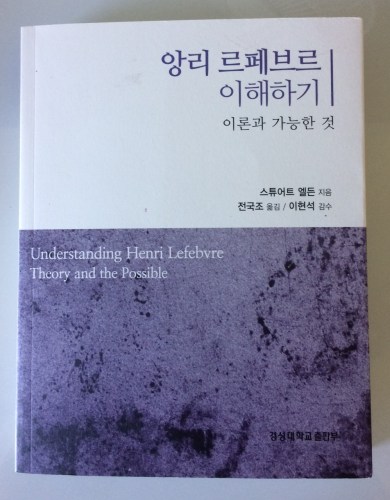
Understanding Henri Lefebvre published in Korean translation (with text of English version of new preface)

IMG_3404.JPGMy 2004 book Understanding Henri Lefebvre: Theory and the Possible has been published in Korean translation by Kyungsung University Press. My two recent Foucault books are also forthcoming in Korean with Nanjing Publishing House.

(If anyone has a link to the Korean webpage for the book, please add in comments.) [Update: this is a link to the Korean edition]

The text is the same as the original edition, except for a brief new preface. Since that text isn’t available anywhere else, I’ve put the English version below:


Preface to the Korean edition

I began reading Henri Lefebvre almost twenty-five years ago, as I began my PhD thesis at Brunel University. My supervisor, Mark Neocleous, suggested I should read Lefebvre’s The Production of Space, recently translated into English, alongside the work I was doing on Michel Foucault. I remember a lecture I attended by Edward Soja in which he discussed Lefebvre, and that was also a great inspiration, even though I disagreed with much of what he said. I wrote initial pieces on Lefebvre at the time, though the submitted PhD only discussed Nietzsche, Heidegger and Foucault. The book which came from that thesis, Mapping the Present, focused just on Heidegger and Foucault.

My first conference presentation, in 1997, was on Lefebvre, at the University of Manchester. I remember being asked by the chair afterwards if my PhD thesis was on this topic. When I replied that it was not, he said this was good to hear, “because Lefebvre won’t get you anywhere”. While Lefebvre is certainly not the only thing I’ve worked on, this was not the case. Working on Lefebvre has led to several projects, speaking invitations and many friendships and collaborations. The most important of these initially was another conference encounter, where I met Eleonore Kofman. We began a conversation and she invited me to join her and Elizabeth Lebas on their next collection of Lefebvre’s writings. They had edited and translated Writings on Cities a couple of years before, and were planning a more general collection of his work.  Eleonore and Elizabeth thought it would be helpful to have a political theorist join them, especially to work on the section on Marxism and philosophy. This was the book that became Key Writings, eventually published in 2003. In parallel with that book I produced my study of Lefebvre, the book translated here, Understanding Henri Lefebvre.

Since then most of my work on Lefebvre has been editing his work in English translation. I worked with Gerald Moore on the translation of his last book, published posthumously, Rhythmanalysis. Neil Brenner and I then brought together a selection of his political writings in the collection State, Space, World, for which Gerald worked as a translator. The long introduction to that book, and a standalone essay on Lefebvre’s thoughts on state, space and territory, both co-authored with Neil, are the last substantial pieces I have written on Lefebvre. The essay, in particular, was crucial in working through Lefebvre’s ideas on territory in dialogue with Neil, a topic which has been the focus of much of my own work. Since then, I have been working with Verso for some of Lefebvre’s philosophical writings, editing the translation of his Metaphilosophy and writing an introduction, and advising on future books, of which the next will be Hegel, Marx, Nietzsche. I also wrote a brief preface to the translation of Marxist Thought and the City. My current project is working with Adam David Morton on a collection of Lefebvre’s writings on rural questions.

Unlike other thinkers I have worked on, the written traces of Lefebvre has remained much the same. Heidegger’s collected edition, the Gesamtausgabe will stretch to over 100 volumes, only a small fraction of which were published in his lifetime. Foucault’s lecture courses, individual lectures and papers and, most recently, the fourth volume of his History of Sexuality mean that there is more and more material to take into account. With Lefebvre, this is not the case. He published much more in his lifetime than either Heidegger or Foucault, but very little has appeared since his death. Rhythmanalysis appeared very soon after he died, and in 2002 Méthodologie des sciences. Both of these were discussed in Understanding Henri Lefebvre. The research of Łukasz Stanek unearthed the manuscript Towards an Architecture of Enjoyment, as well as many shorter pieces of which I was unaware, and Lefebvre’s doctoral thesis on peasant communities in the Pyrenees has now been published. But there is not the range of material published posthumously there has been for many other thinkers. Whatever material still exists remain largely unknown. There is no archive of Lefebvre’s work accessible, save for the few traces found in the Columbia University library papers of his long-term collaborator Norbert Guterman. His lecture courses, drafts, and whatever other riches there might be remain in private hands.

As such, if I was to write this book again today I would not change a great deal. I would do more to integrate the rural research of his doctoral thesis into the account in Chapter 4. In that same chapter I would likely say more about his engagement with spatial practitioners – architects and planners – in the light of Stanek’s pioneering work. When I wrote the book the only other book length studies of Lefebvre were Rémi Hess’s biography and the English-language study by Rob Shields. There are now books by Sue Middleton, Benjamin Fraser, Chris Butler, Andy Merrifield, Nathaniel Coleman, Laurence Costes and Hugues Lethierry, along with several edited collections, as well as wide range of articles. I would do more to take into account these different interpretations and appropriations. Many more translations of Lefebvre are now available in a wide range of global languages, testament to his enduring appeal and use.

Lefebvre was a thinker of specific place and time, though his work has proved influential in a range of other contexts and disciplines far beyond his own practice in philosophy and sociology. I very much hope that this guide proves useful to his readers in Korea.

Posted in Henri Lefebvre, Uncategorized, Understanding Henri Lefebvre | 1 Comment