Examines how four intellectuals with ties to the French social sciences articulated a new primitivist sensibility between 1945 and 1975.
We tend to associate primitivism with the nostalgic idealization of origins, often aimed at parts of the world that are viewed as closer to that idealized past than modern post-industrial society. Primitivist impulses still exist in popular culture, whether in paleo diets or returns to foraging, and they can also be seen in intellectual and political circles in debates around the possibility of degrowth. In this book, historian Ryan L. Allen examines primitivism anew through four fascinating figures: Georges Bataille, Henri Lefebvre, Georges Devereux, and Mircea Eliade.
In the postwar period, Allen shows, the French social sciences reappraised the primitive and archaic from anthropological, sociological, psychiatric, or religious angles. These thinkers sought past alternatives to midcentury hyper-modernization and capitalist excess. They put forth trenchant critiques of contemporary society and sought in the archaic past a way to imagine a more sustainable future. Adventures in the Archaic rehabilitates these thinkers, showing how their critique of growth and consumerism was nourished by an engagement with primitive cultures as potential sources of cultural and ecological wisdom. As we confront ecological crisis, Allen suggests that there is still something to learn from these iconoclastic approaches.
“Models of Ideological Analysis” by Fredric Jameson, Opening Lecture of 1977 Institute on Culture & Society (audio recording)
Remastered audio of Fredric Jamesons opening lecture at the 1977 Institute On Culture & Society sponsored by the Marxist Literary Group and hosted by St. Cloud State University.
The second lecture is “Ideology: Marx and Lukacs“ and is contextualised in “The Jameson Tapes, Side B”. The contributors to the Jameson Tapes include Anna Kornbluh, Isabel Bartholomew, Caleb Smith and Robert T. Tally, Jr.
Wolff will be the subject of one of my ‘Sunday Histories’ posts – he was administrator of the Collège de France and a biologist with interesting links to philosophy. The Bataille essays translated in this volume have been added to my list of translations of his work.
Very expensive hardback only, unfortunately, but e-book also available.
This multidisciplinary book provides a diverse overview of social science approaches to geopolitical borders, social boundaries and cultural frontiers. It discusses the multiplicity of borders with a view to addressing the question: how far have we come?
Chapters present narratives on statecraft, law and violence relating to geopolitical borders, adopting cultural and historical perspectives. An array of esteemed specialists examine political imaginaries of border security and identify methodological innovations that will enhance future scholarly work in the field. They highlight regional and global problems tied to borders, looking at issues such as sovereignty, citizenship, security, migration and social justice. Ultimately, it illustrates that metaphorical borders delineating identity and culture are as real as any political, economic or social boundary.
Border Studies: A Multidisciplinary Approach draws on perspectives from geography, political science, international relations, history, social anthropology, law and economics, making this an invigorating read for scholars in these fields. Practitioners in politics, government, international relations and law will also greatly benefit from its unique insights.
In the 1949-50 academic year, Claude Lévi-Strauss gave the Fondation Loubat lectures at the Collège de France. He was hoping to get elected to a chair there at this time, and behind the scenes various people were lobbying for this to happen. Giving a guest series of lectures could be a prelude to election, but these attempts were unsuccessful. Émile Benveniste and the psychologist Henri Piéron were among those trying to get Lévi-Strauss elected, and the idea of a chair in Comparative Sociology with him in mind was discussed at the Assemblée des Professeurs on 27 November 1949. The decision was to go for a chair in the history of Paris and the Seine département instead. No formal proposal for a chair in Comparative Sociology, much less an application by Lévi-Strauss to fill it, seems to have been produced.
Lévi-Strauss’s Loubat lectures are generally given the title of “L’expression mythique de la structure sociale”, “The Mythic Expression of Social Structure”. This is how a notice in the Annuaire de Collège de France describes them. Lévi-Strauss had given the Collège administrator Édmond Faral the slightly longer title “L’expression mythique de la structure sociale chez les populations indigènes de l’Amérique [… among the Indigeneous Populations of America]”. Oliver Jacquot‘s brief history of the Loubat lectures gives that title too. Lévi-Strauss’s EPHE page gives a more specific focus in a description: “Analyse structurale du thème du Glouton dans la mythologie de l’Amérique du Nord [Structural Analysis of the theme of the Wolverine in North American mythology]”.
The focus on North America makes sense given the remit of the Fondation, with a concentration on a specific myth as Lévi-Strauss developed the work. However, the retrospective Annuaire de Collège de France notice reverts to the original title. The lectures were held on 5, 12, 19, and 26 January, and 2 and 9 February 1950. André Breton, the painter Max Ernst, Georges Dumézil, and Merleau-Ponty were among the audience, and it’s likely Benveniste and Piéron also attended. Lévi-Strauss was paid 30,000 francs for the course.
The more specific focus of the lectures is supported by the fullest published discussion of the lectures of which I am aware – a letter to Roman Jakobson dated 27 January 1950. The letter has only been published in French, but is part-quoted and translated in Emmanuelle Loyer’s excellent biography of Lévi-Strauss. The longer relevant passage reads:
For I am deep into mythology as well! I am currently giving the lectures of the Loubat Foundation for American Antiquities at the Collège de France, and I have chosen to focus on the theme of the wolverine [glouton] in North America, of which I am trying to provide a structural analysis. This entails studying the connections between 1) the traits of the figure (gluttony [gloutonnerie], clownishness, obscenity, scatology, cannibalism, beggary, etc.); 2) the sociological level at which it is expressed in each culture (collective behaviour, individual vocation, ritual personification, folkloric theme, mythical theme, etc.), 3) the relation between the ‘territory’ defined by these two axes and the rest of the social structure. This has yielded rather striking results, which were totally unexpected and caught me off-guard; for I am almost brought back to Engels, the Origins of the Family, etc. […] Anyway, this will be the next book I write next summer.The Arthurian cycle is part of this affair, for I am almost sure that the character of Percival developed from a figure analogous to that of the wolverine found in American rituals.
Lévi-Strauss did not develop the lectures into the book he mentions. In the 1950s, he published his long introduction to Marcel Mauss, Tristes Tropiques, and the first volume of Structural Anthropology, as well as shorter pieces and lectures. But these particular lectures were not published. There is a discussion of the animal called the wolverine in La pensée sauvage in 1962, but nothing like as developed an argument as suggested here. That book was first translated as The Savage Mind and more recently retranslated as Wild Thought. The analysis there is in just two passages, noting that there is an uncertainty about which animal is referred to in a particular myth, indicating some aspects of its character and its regional distribution (La pensée sauvage, 67-68, 70-71; Wild Thought, 56-59, 61-62). There are also mentions of the wolverine in the Mythologiques series.
The online inventory of the fonds Claude Lévi-Strauss at the Bibliothèque nationale de France does not indicate a place where the lectures might be – the listing of Collège de France courses begins with the commencement of his chair there, while other teaching records or conferences seem to be dated and placed elsewhere. I’ve asked a couple of people who work on Lévi-Strauss and know these archives, and they have said there is no trace of the lectures. As this is almost a decade before he was elected to a chair at the Collège de France, there is also no record in the otherwise very useful Paroles données/Anthropology and Myth collection of his course summaries from the Collège and the École Pratique des Hautes Études.
There is however a file of correspondence relating to the lectures, and a brief summary, a typewritten text of about 1000 words by Lévi-Strauss, in the Collège de France archives. It expands on the points in the letter to Jakobson, and is the fullest description of the lectures that seems to exist. Two aspects of the summary are especially interesting.
One is the geographical dimension of the analysis, ranging from the Pueblo people of the south-west United States to the north-west Pacific coast, and the Plains. The particular forms the wolverine takes in the mythologies he analyses are characterised as the Fool, Clown and Cannibal, with intermediate forms between the three types. Another interesting aspect is the importance of situating mythical thought in relation to other aspects of social life, including ritual, law, customs and psychological behaviour, stressing that myth is not an autonomous category and that different mythical tales cannot be compared without taking sociological context into account. Here the geographical aspects become significant again, as minute variations in a relatively limited area allow a more systematic comparison.
Lévi-Strauss indicates that 110-125 people attended the lectures, beyond the normal capacity of the lecture hall. It seems this summary was written for the Collège de France Annuaire, but it was not used. Instead, the Annuaire published just this very brief notice – which even manages to misspell Lévi-Strauss’s name.
excerpt from the Annuaire du Collège de France, 50, p. 246 – (with misspelling of Lévi-Strauss’s name)
The summary Lévi-Strauss wrote was never published. At the end of 1950 Lévi-Strauss was again discussed for a possible chair in Comparative Sociology, with Benveniste taking the lead, but this too was unsuccessful. These failed bids for a chair perhaps helps to explain why he never wrote up the lectures and – at least as far as we can tell – did not even keep the manuscripts. In 1959, Lévi-Strauss was finally elected to a chair in Social Anthropology at the Collège, when Maurice Merleau-Ponty led the process for his election. He taught there for over twenty years.
Claude Lévi-Strauss, “Introduction à l’oeuvre de Marcel Mauss”, in Marcel Mauss, Sociologie et anthropologie, Paris: PUF, 2013 [1950], ix-lii; Introduction to the work of Marcel Mauss, trans. Felicity Baker, London: Routledge, 1987.
Claude Lévi-Strauss, Tristes Tropiques, Paris: Plon, 1955; Tristes Tropiques, trans. John Weightman and Doreen Weightman, London: Penguin, 1992.
Claude Lévi-Strauss, Anthropologie structurale, Paris: Plon, 1958; Structural Anthropology, trans. Claire Jacobson and Broke Grundfest Schoepf, New York: Basic Books, 1963.
Claude Lévi-Strauss, La Pensée sauvage, Paris: Plon, 1962; The Savage Mind, London: Wiedenfeld and Nicolson, 1966; Wild Thought,trans. Jeffrey Mehlman and John Leavitt, Chicago: University of Chicago Press, 2021.
Claude Lévi-Strauss, Paroles données, Paris: Plon, 1984; Anthropology and Myth: Lectures 1951-1982, trans. Roy Willis, Oxford: 1987.
Claude Lévi-Strauss and Didier Eribon, De près et de loin suivi de «Deux ans après», Paris: Odile Jacob, 1990; Conversations with Claude Lévi-Strauss, trans. Paula Wissing, Chicago: University of Chicago Press, 1991.
Roman Jakobson and Claude Lévi-Strauss, Correspondance 1942-1982, eds. Emmanuelle Loyer and Patrice Maniglier, Paris: Seuil, 2018.
Emmanuelle Loyer, Lévi-Strauss, Paris: Flammarion, 2015; Lévi-Strauss: A Biography, trans. Ninon Vinsonneau and Jonathan Magidoff, Cambridge: Polity, 2018.
Patrick Wilcken, Claude Lévi-Strauss: The Poet in the Laboratory, London: Bloomsbury, 2010.
Archives
Bibliothèque nationale de France, NAF 28150, Fonds Claude Lévi-Strauss
Collège de France, 24 CDF 2/3-b, 1949-50 Fondation Loubat
Collège de France, CDF 2 AP 14, Assemblée des Professeurs
This is a revised and expanded version of a post from May 2023. It is the 32nd post of a weekly series, where I post short essays with some indications of further reading and sources, but which are not as formal as something I’d try to publish more conventionally. They are usually tangential to my main writing focus, a home for spare ideas, asides, dead-ends and possible futures. I hope there is some interest in them. They are provisional and suggestions are welcome. A few shorter pieces in a similar style have been posted mid-week.
Independence for Children presents an alternative conception of parenting to those that have dominated our thinking about children and the family to date. It offers an elaboration and defence of anti-perfectionist parenting. The central argument of this book is that, as they develop, children become entitled to adopt and pursue their own conceptions of religion and human well-being. As young children, they are entitled to an upbringing that is informed by ideals and reasons they can later accept in the light of the religious or ethical values they go on to hold as adults. In short, parents and others owe children an upbringing from which they are not alienated later in life.
Parental anti-perfectionism suggests that parents should introduce their children to the various and sometimes competing views concerning our place in the universe and human flourishing and raise them to be respectful of the diversity of lifestyles within society. But Matthew Clayton argues that parents have no right to steer their children towards particular religious doctrines or conceptions of human flourishing, and that religious schools ought to be phased out.
This book addresses several questions in the philosophy of upbringing, such as how we ought to understand the interests of children, the moral claims of parents, and what constitutes a valuable family life. Clayton finishes by briefly exploring the implications of anti-perfectionist morality for how parents ought to approach issues concerning work, consumption, gender, and food.
The globetrotting story of how humans have harnessed the geographical landscape and written ourselves onto our surroundings.
Mountains, meridians, rivers, and borders—these are some of the features that divide the world on our maps and in our minds. But geography is far less set in stone than we might believe, and, as Maxim Samson’s Earth Shapers contends, in our relatively short time on this planet, humans have become experts at fundamentally reshaping our surroundings.
From the Qhapaq Ñan, the Inca’s “great road,” and Mozambique’s colonial railways to a Saudi Arabian smart city, and from Korea’s sacred Baekdu-daegan mountain range and the Great Green Wall in Africa to the streets of Chicago, Samson explores how we mold the world around us. And how, as we etch our needs onto the natural landscape, we alter the course of history. These fascinating stories of connectivity show that in our desire to make geographical connections, humans have broken through boundaries of all kinds, conquered treacherous terrain, and carved up landscapes. We crave linkages, and though we do not always pay attention to the in-between, these pathways—these ways of “earth shaping,” in Samson’s words—are key to understanding our relationship with the planet we call home.
An immense work of cultural geography touching on ecology, sociology, history, and politics, Earth Shapersargues that, far from being constrained by geography, we are instead its creators.
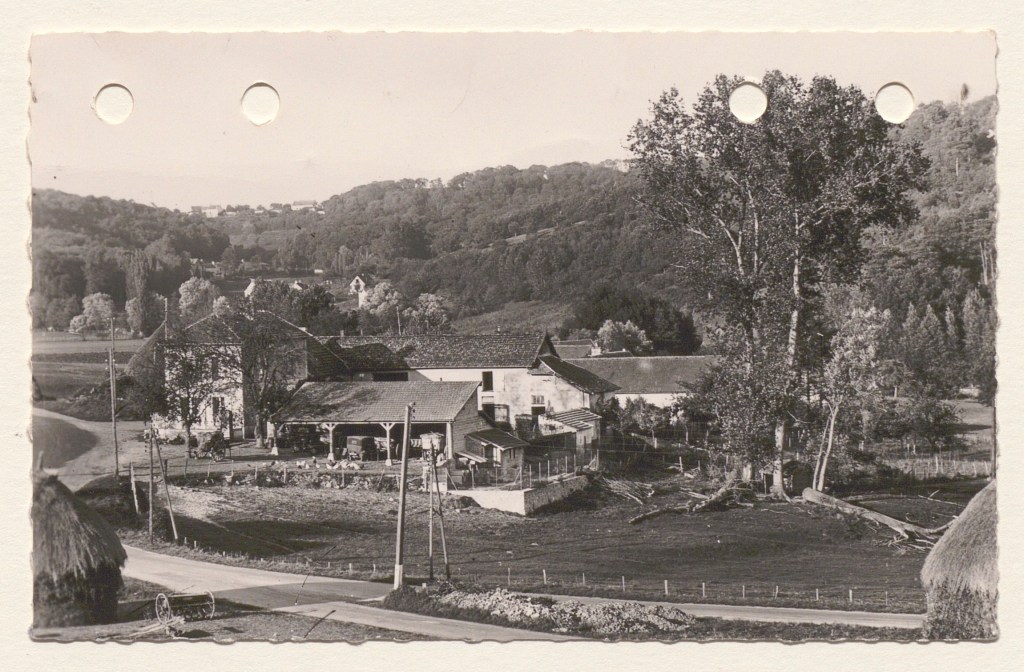
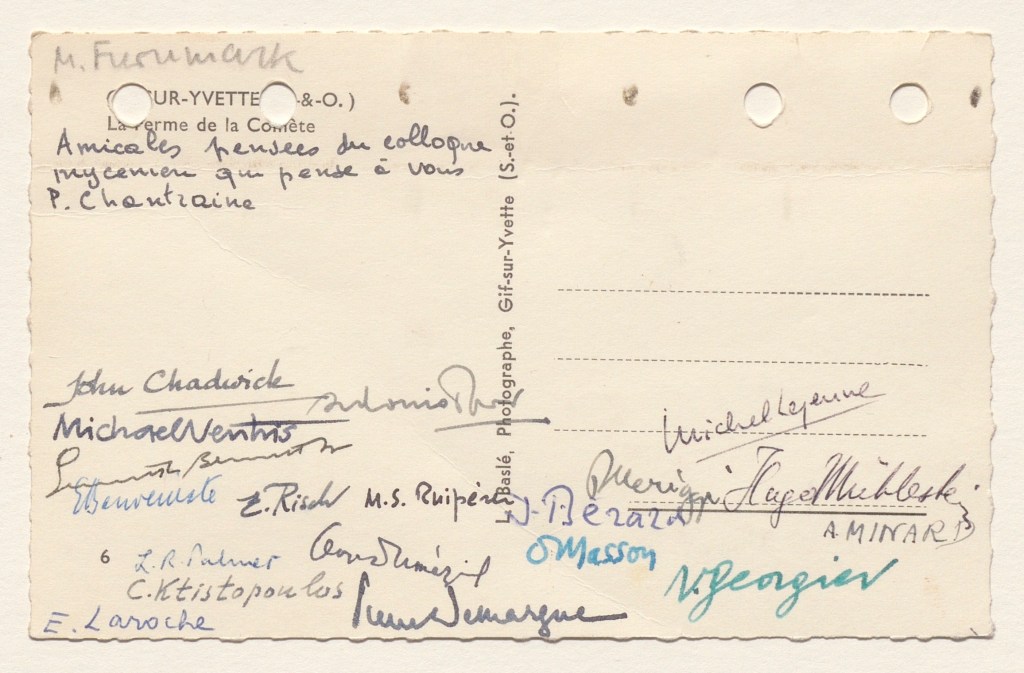
Looking for something else, I chanced upon a postcard to Arne Furumark, available online, signed by the participants at the 1956 Mycenaean Studies conference outside of Paris, which I talk about here. Among the names are the decipherers of Linear B, John Chadwick and Michael Ventris, as well as Georges Dumézil and Émile Benveniste, and several other participants, including Leonard Palmer, who I talk about here.
Furumark was a Swedish archaeologist, with a specialism in Mycenaean Greek pottery. He would have been an obvious participant in the event, and was clearly missed by those who did attend. At the top left of the postcard, Pierre Chantraine has written “Amicales pensées du colloque mycénien qui pense à vous”. The view is of a farm in Gif-sur-Yvette (La Ferme de la Comète), near where the conference was held.
The other signatures are almost all of other participants in the photo I shared in the post about the conference. The postcard is in Furumark’s archives at the University of Uppsala, where he taught for twenty years. Michel Lejeune’s 25 September 1955 circular about the event is also available online.
References
Michel Lejeune (ed.), Études mycéniennes: Actes du Colloque international sur les textes mycéniens (Gif-sur-Yvette, 3-7 avril 1956), Paris: Centre national de la recherche scientifique, 1956.
This note is in the same style as the ‘Sunday histories‘ posts, though its minor status means I’ve posted it mid-week.
update September 2025: Apparently the sending of a postcard is a tradition that endures at this conference, as is invoking the spirit of the Gif event, in Mycenological conference bingo. Thanks to Dimitri Nakassis for linking to this post.
Two-part television interview with Georges Dumézil, 1984, Rencontres, CBC with Marcel Brisebois
Entrevue avec Georges Dumézil (1898-1986), membre de l’Académie française et professeur au Collège de France. Sujets abordés : – La signification du terme «indo-européen» et de «peuples indo-européens» -La notion de peuples apparentés. – La comparaison des langues et la comparaison du vocabulaire. -Lui-même précurseur du structuralisme. -Sa définition d’un mythe et sa fonction. -La transmission des mythes par les générations. -Le rôle des rythmes à l’égard des mythes. -Les considérations historiques et mythiques des événements. -Sa théorie des trois fonctions de l’homme et de l’humanité et l’équilibre entre celles-ci.
The critique of twentieth-century American anthropology often portrays anthropologists of the past as servants of colonialism who “extracted” information from indigenous peoples and published works causing them harm. Herbert S. Lewis recovers the reality of the first century of American anthropology as a vital scholarly discipline that rejected established ideas of race, insisted on the value of very different ways of life, and delivered irreplaceable ethnographic studies. This volume presents powerful refutations of the accumulated damaging myths about anthropology’s history.