Maxim Samson, Earth Shapers: How We Mapped and Mastered the World, from the Panama Canal to the Baltic Way – Profile Books, August 2025; University of Chicago Press, October 2025

Maxim Samson, Earth Shapers: How We Mapped and Mastered the World, from the Panama Canal to the Baltic WayProfile Books, August 2025; University of Chicago Press, October 2025

The globetrotting story of how humans have harnessed the geographical landscape and written ourselves onto our surroundings.

Mountains, meridians, rivers, and borders—these are some of the features that divide the world on our maps and in our minds. But geography is far less set in stone than we might believe, and, as Maxim Samson’s Earth Shaperscontends, in our relatively short time on this planet, humans have become experts at fundamentally reshaping our surroundings.

From the Qhapaq Ñan, the Inca’s “great road,” and Mozambique’s colonial railways to a Saudi Arabian smart city, and from Korea’s sacred Baekdu-daegan mountain range and the Great Green Wall in Africa to the streets of Chicago, Samson explores how we mold the world around us. And how, as we etch our needs onto the natural landscape, we alter the course of history. These fascinating stories of connectivity show that in our desire to make geographical connections, humans have broken through boundaries of all kinds, conquered treacherous terrain, and carved up landscapes. We crave linkages, and though we do not always pay attention to the in-between, these pathways—these ways of “earth shaping,” in Samson’s words—are key to understanding our relationship with the planet we call home.

An immense work of cultural geography touching on ecology, sociology, history, and politics, Earth Shapers argues that, far from being constrained by geography, we are instead its creators.

Posted in Uncategorized | Leave a comment

André Laks, Plato’s Second Republic: An Essay on the Laws – Princeton University Press, paperback September 2025

André Laks, Plato’s Second Republic: An Essay on the Laws – Princeton University Press, paperback September 2025

In Plato’s Second Republic, André Laks argues that the Laws, Plato’s last and longest dialogue, is also his most important political work, surpassing the Republic in historical relevance. Laks offers a thorough reappraisal of this less renowned text, and examines how it provides a critical foundation for the principles of lawmaking. In doing so, he makes clear the tremendous impact the Laws had not only on political philosophy, but also on modern political history.

Laks shows how the four central ideas in the Laws—the corruptibility of unchecked power, the rule of law, a “middle” constitution, and the political necessity of legislative preambles—are articulated within an intricate and masterful literary architecture. He reveals how the work develops a theological conception of law anchored in political ideas about a god, divine reason, that is the measure of political order. Laks’s reading opens a complex analysis of the relationships between rulers and citizens; their roles in a political system; the power of reason and persuasion, as opposed to force, in commanding obedience; and the place of freedom.

Plato’s Second Republic presents a sophisticated reevaluation of a philosophical work that has exerted an enormous if often hidden influence even into the present day.

Posted in Uncategorized | Leave a comment

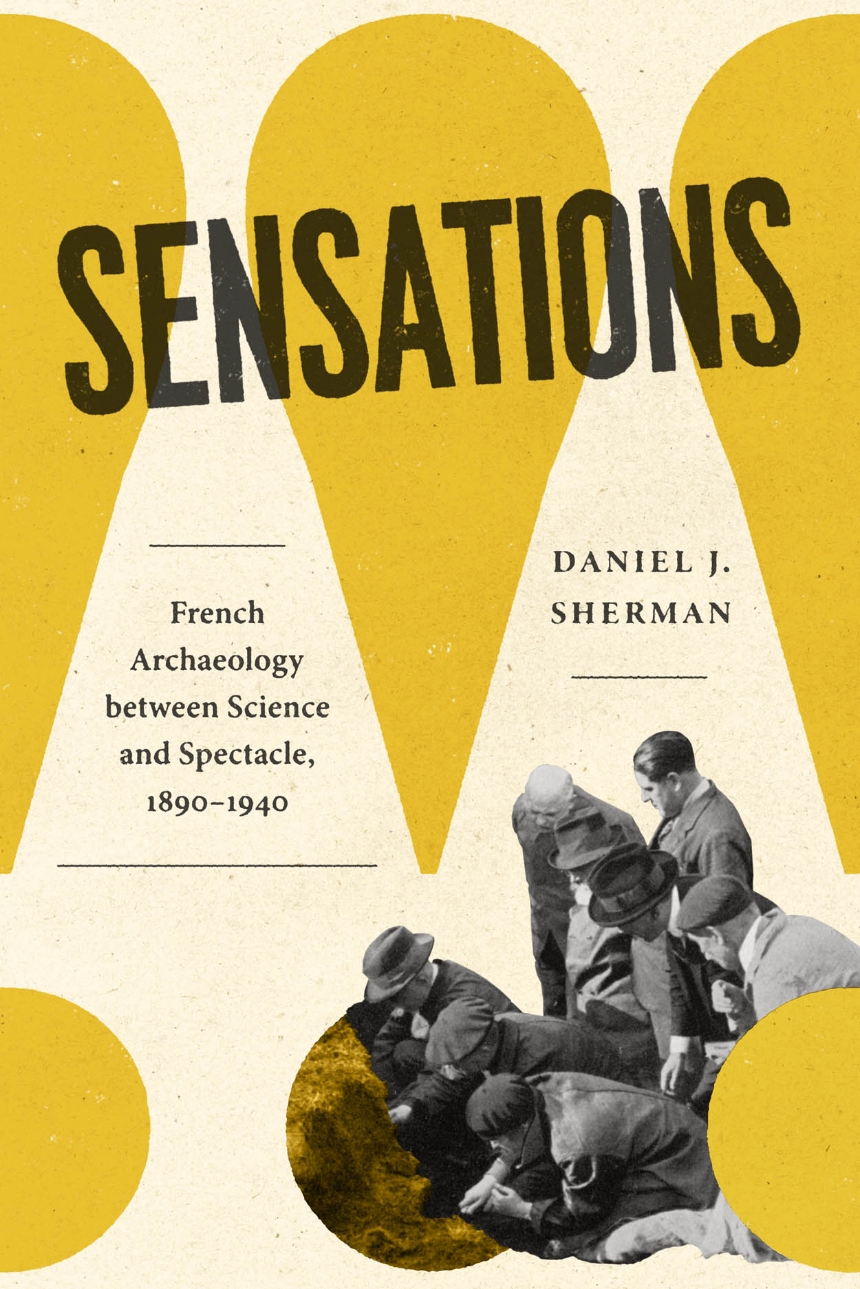
Daniel J. Sherman, Sensations: French Archaeology between Science and Spectacle, 1890–1940 – University of Chicago Press, May 2025 and New Books discussion with Sarah Miles

Daniel J. Sherman, Sensations: French Archaeology between Science and Spectacle, 1890–1940 – University of Chicago Press, May 2025

New Books discussion with Sarah Mills. Thanks to dmf for the link.

Delves into two controversies from the French archaeological world to illuminate the tension between the discipline’s scientific ambitions and its hunger for media attention.
 
For well over a century, from Heinrich Schliemann’s sensational discoveries at Troy in the 1880s, through the Tutankhamun excavations of the 1920s, to the recent LIDAR-aided uncovering of lost Maya cities, archaeology has made headlines. In this new history of archaeology and its archival traces, Daniel J. Sherman treats the friction between science and spectacle as constitutive of the field. By exploring two long-running controversies that roiled the French archaeological world and its wider public in the first third of the twentieth century, he gives the science/media relationship a unique place in the history of archaeology—and its present.
 
The first controversy involves a dispute over the conduct of excavations at Carthage in Tunisia, then under French colonial rule. In the second, accusations of forgery clouded what seemed to be a stunning Neolithic find at a hamlet called Glozel, in the Auvergne region in central France. The affair divided the scholarly community and attracted enormous media attention across Europe and North America. Both controversies occurred at a transitional moment between what has been called the heroic age of archaeology, dominated by explorers and adventurers with little specialized training, and the beginnings of its professionalization. As Sherman shows, the two affairs put the methods, procedures, and networks of archaeology in the spotlight and profoundly shaped its history.

Posted in Uncategorized | Leave a comment

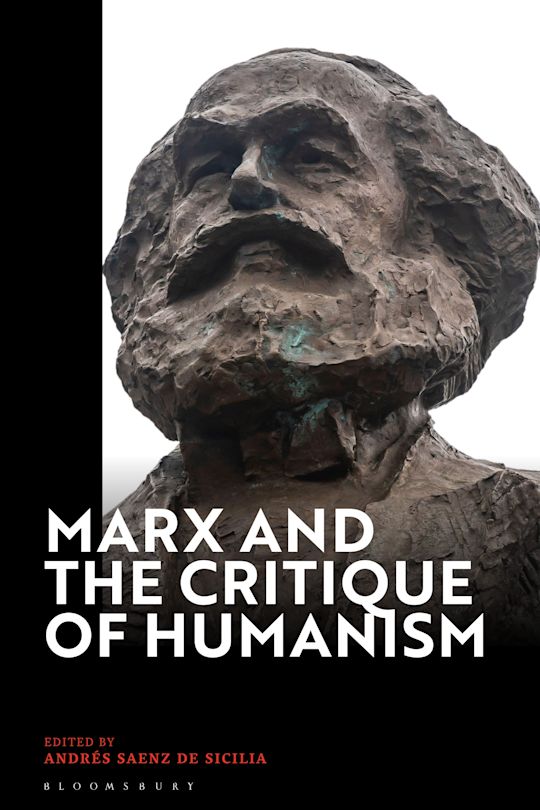
Andres Saenz de Sicilia ed. Marx and the Critique of Humanism – Bloomsbury, February 2026

Andres Saenz de Sicilia ed. Marx and the Critique of Humanism – Bloomsbury, February 2026

What is the status of ‘the human’ and ‘humanism’ in Marx’s thought? Does Marx’s critical project rest upon ‘humanist’ commitments? If so, what are these and how do they shift across his writings and inform his critical theory of capitalist society? Marx and the Critique of Humanism addresses these questions through a diverse collection of critical interventions from leading Marxist scholars. These contributions offer both a renewed appraisal and contextualisation of the notion of ‘the human’ across Marx’s oeuvre, as well as a range of critical perspectives on the status of humanism within critical social theory today.

The book revaluates Marx’s relation to humanism by examining the intellectual context, influences and interlocutors which shaped his theoretical commitments and critical methodology; the concept of ‘Gattungswesen‘ in Marx’s early writings; the ways in which ‘the human’ informs and is transformed by Marx’s critique of political economy; the ecological dimensions of Marx’s thought; the reception of Marx’s humanism by anti-colonial thinkers; and the relation of Marx’s thought to post-structuralist and post-humanist critiques of enlightenment humanism. Moving beyond the simplistic picture of a ‘humanistic’ early Marx and a ‘scientific’ late Marx, this volume shows instead how a sustained concern with the human evolves in tandem with Marx’s broader intellectual development.

Posted in Karl Marx | Leave a comment

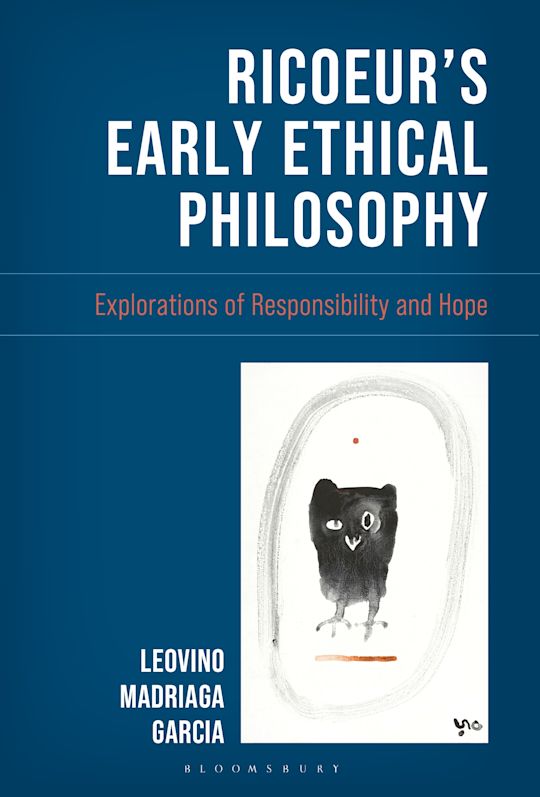
Leovino Madriaga Garcia, Ricoeur’s Early Ethical Philosophy: Explorations of Responsibility and Hope – Bloomsbury, September 2025

Leovino Madriaga Garcia, Ricoeur’s Early Ethical Philosophy: Explorations of Responsibility and Hope – Bloomsbury, September 2025

Using the themes of responsibility and hope, this introduction to the thought of Paul Ricoeur addresses both the beginner and the specialist.

By focusing on the early essays and early mature works-including the Philosophy of the Will volumes: Freedom and Nature, Fallible Man, and The Symbolism of Evil-Leovino Garcia shows that Ricoeur’s entire orientation is primarily ethical in that it awakens in us the power to exist creatively. Ricoeur brings the Joy of the Yes to the sadness of the finite, the passion for the possible to the resignation to necessity, and the vehemence of the primary affirmation to the radical negation.

Posted in Uncategorized | 2 Comments

Janae Sholtz, The Invention of a People: Heidegger and Deleuze on Art and the Political – Edinburgh University Press, paperback 2025

Janae Sholtz, The Invention of a People: Heidegger and Deleuze on Art and the Political – Edinburgh University Press, paperback 2025

Ten years after its initial publication, this book is finally available in paperback.

A multi-layered reading of the intersections between two of the most influential figures in contemporary philosophy
The Invention of a People explores the residual relation between Heidegger’s thought and Deleuze’s novelty, focusing on the parallels between their emphasis on the connection of earth, art and a people-to-come.
Contextualising the problematic of a people-to-come within a larger political and philosophical context of post-war thinkers of community such as Bataille, Blanchot and Nancy, Sholtz offers a creative approach to the work of these two thinkers. Deleuze’s project is therefore cast as both an extension and radicalisation of the Heideggerian themes of immanence, ontological difference and the transformative potential of art.
Presenting interstitial readings of Paul Klee, Kostos Axelos, Arthur Rimbaud, the 1960’s art collective Fluxus and artist Brian Fridge, she invents creative encounters which act as provocations from the outside, opening new lines of flight and previously unthought terrain. Ultimately, she develops a diagrammatic image of a people-to-come that is constantly in flux and can answer the demands of the untimely future.

Posted in Uncategorized | 2 Comments

Rossella Saetta Cottone ed. Clémence Ramnoux, entre mythes et philosophie: Dumézil, Freud, Bachelard (avec des inédits de Clémence Ramnoux) – Éditions Rue d’Ulm, October 2025

Rossella Saetta Cottone ed. Clémence Ramnoux, entre mythes et philosophie: Dumézil, Freud, Bachelard (avec des inédits de Clémence Ramnoux) – Éditions Rue d’Ulm, October 2025

Some excerpts available here; parts available online with subscription.

Ramnoux’s Œuvres were published a few years ago, in a lovely two-volume edition, with an introduction by Rossella Saetta Cottone.

Philosophe, spécialiste des mythes, Clémence RAMNOUX (1905-1997) a récemment fait l’objet d’un regain d’intérêt : ses œuvres ont été rééditées, ses archives redécouvertes et léguées à la bibliothèque de l’École normale supérieure.

Admise rue d’Ulm en 1927 dans la première promotion à accueillir des femmes, Ramnoux fut aussi la première femme à être invitée à l’Institute for Advanced Study de Princeton sur la recommandation du célèbre philologue Harold Cherniss. Elle y acheva la rédaction de sa thèse sur Héraclite, qui demeure une étude de référence. Arrivée à la philosophie archaïque au terme d’un parcours très original (l’étude comparée des mythes nordiques sous la direction de Georges Dumézil, l’expérience d’une psychanalyse didactique, et la fréquentation assidue de Gaston Bachelard qui nourrit son intérêt pour la rêverie poétique), elle voulut percer le secret du passage des mythes cosmogoniques aux premières ontologies présocratiques en se fondant sur l’analyse sémantique. Elle envisagea ainsi l’évolution entre mythes et philosophie comme la transformation d’une pensée structurée par généalogies en une pensée polaire.

Passionnée de langue et de culture anglaises, gaulliste convaincue, elle partit enseigner à l’université d’Alger en pleine guerre d’Indépendance, puis contribua à la création du département de philosophie de l’université de Nanterre en compagnie de Paul Ricœur. Ce volume multidisciplinaire rend compte de la vie et de l’œuvre complexes de cette pionnière des humanités injustement oubliée.

Posted in Clémence Ramnoux, Gaston Bachelard, Georges Dumézil, Sigmund Freud, Uncategorized | 1 Comment

Andrew Alexander Davis and Sebastian Rand eds., New Perspectives on Hegel’s Philosophy of Right – Bloomsbury, August 2025

Andrew Alexander Davis and Sebastian Rand eds., New Perspectives on Hegel’s Philosophy of Right – Bloomsbury, August 2025

This collection of new perspectives on Hegel’s Philosophy of Right breaks down some of the most stubborn barriers between the book and its readers. From its polemical preface to its closing ruminations on the state and world history, Hegel’s seminal text can appear antiquated and conservative to even the most motivated reader. These essays remove those obstacles by demonstrating how radical many of his reflections on politics and ethics remain some 200 years after its publication. 

New Perspectives on Hegel’s Philosophy of Right works through Hegel’s ideas in two distinct stages. Its first half explains how a close reading of contested sections can reveal new possibilities for the interpretation of key issues like private property, family, conscience, patriotism and the executive branch – covering important topics from each of the three major sections of Hegel’s text. The book’s second half then considers Hegel’s work in dialogue with contemporary political thought, legal studies, critical theory, economic theory and queer studies.

These essays show the rich interplay of Hegelian concepts and insights with pressing contemporary concerns, proving their continued relevance. Maintaining focus on how Hegel’s work speaks to us today, this book offers readers an invaluable set of launchpoints to explore his lasting contribution to both the new and perennial concerns of philosophy.

Posted in Georg Wilhelm Friedrich Hegel, Uncategorized | Leave a comment

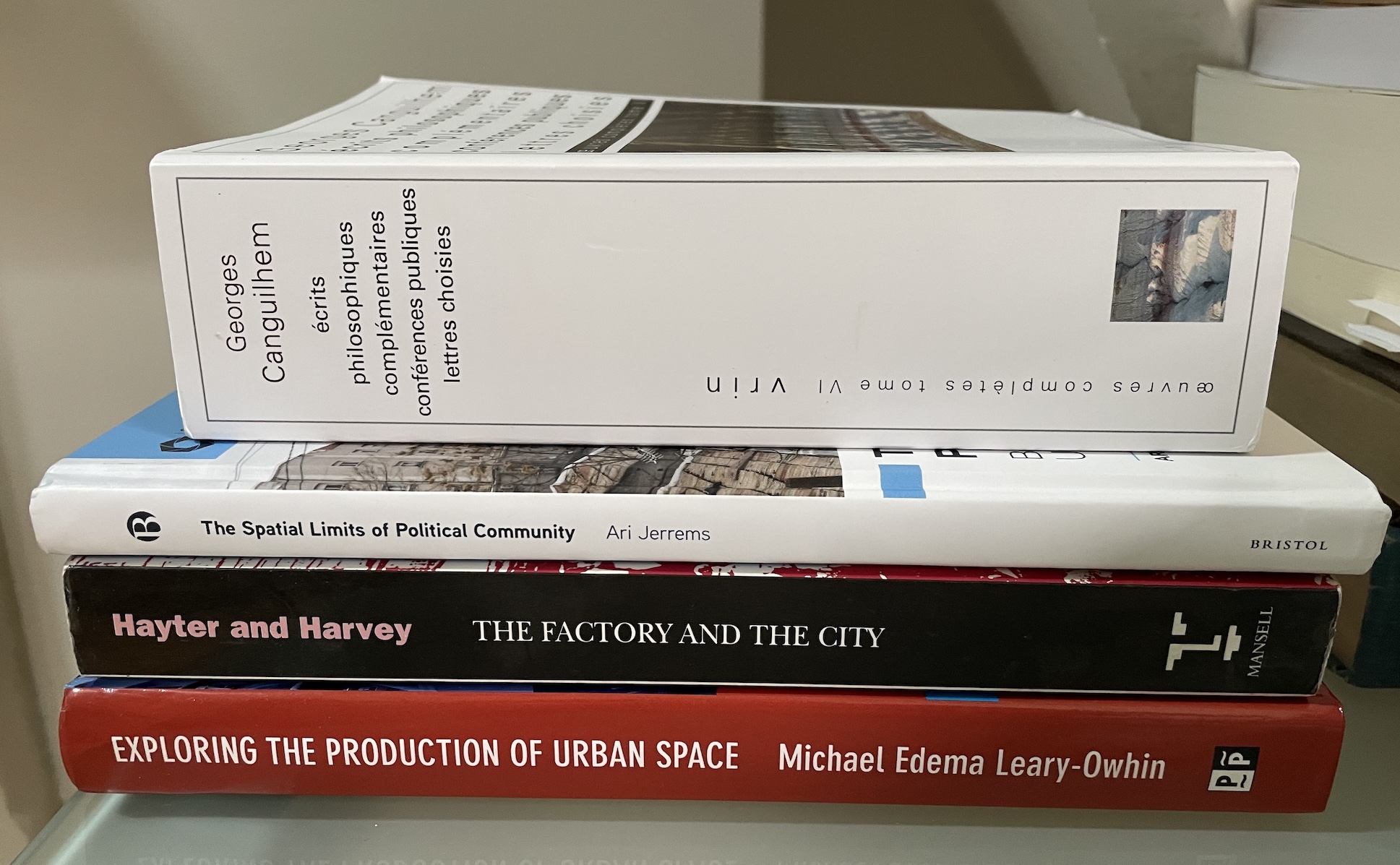
Books received – Canguilhem, Jerrems, Hayter and Harvey, Leary-Owhin

The final volume of Georges Canguilhem, Oeuvres complètes, Ari Jerrems, The Spatial Limits of Political Community, Teresa Hayter and David Harvey, The Factory and the City: The Story of the Cowley Automobile Workers in Oxford and Michael Edema Leary-Ohwin, Exploring the Production of Urban Space.

Ari kindly sent me a copy of his book, based on his PhD thesis which I co-supervised, and Michael’s book was in recompense for review work.

Posted in David Harvey, Georges Canguilhem, Uncategorized | Leave a comment

Books received – Levinas, de Menasce, Braudel, Bloch and Febvre

Books relating to the new interest in stories of French academics who spent time in German prisoner of war camps, a book about Émile Benveniste’s former student Jean de Menasce (see here), and a few relating to the Annales school – two volumes of Braudel’s Écrits and the third volume of the Marc Bloch-Lucien Febvre correspondence.

Posted in Emile Benveniste, Emmanuel Levinas, Fernand Braudel, Uncategorized | Leave a comment