The History of Political Thought in the Age of Ideologies, 1789-1989 – Queen Mary, 31 May-1 June 2018

The History of Political Thought in the Age of Ideologies, 1789-1989 – Queen Mary, 31 May-1 June 2018. Free but registration required.

Historians of political ideas since the late 1960s have advocated focussing on authorial intentions instead of tracing the progress of “unit ideas” or the transmission of disembodied concepts. Yet historical practice has not always followed methodological injunctions. Nowhere is this more the case than in the period following the French Revolution. Capacious political movements are assumed to dominate the nineteenth and twentieth centuries, giving rise to a procession of abstract ideologies. Yet is it plausible to think of the era as inhabited by such continuous “discourses”, let alone as being characterised in terms of a clash between them? This conference is intended to probe the durability of ideas that are standardly assumed to traverse the ages while sustaining the integrity of their meaning.

The conference also aims to examine how the epoch is generally presented. In what sense can the period be described as an “age of ideologies” if its constitutive doctrines are disassembled into a succession of speech-acts? In 1982 Karl Dietrich Bracher described the twentieth century as a “Zeit der Ideologien”. Yet this conception already had interesting precedents by the time he wrote, having been applied to the nineteenth century by Reinhart Koselleck in 1959. Koselleck’s depiction has a longer pedigree still, looking back to nineteenth century accounts of the legacy of the enlightenment. Thus, in the wake of the French Revolution, the idea emerged that an era of hostile ideologies had succeeded an older age of religious strife. In exploring how we might best write the history of political thought after 1789, this conference will examine common depictions of the period as living in the shadow of revolutionary upheaval that unleashed an enduring contest between opposing principles.

The speakers at the conference include Peter Ghosh (Oxford), Niklas Olsen (Copenhagen), Greg Conti (Cambridge), Gareth Stedman Jones (QMUL), Emily Jones (Cambridge), Jennifer Pitts (Chicago), William Selinger (Harvard), Maurizio Isabella (QMUL), Stuart Jones (Manchester), Andrew Sartori (NYU), Eva Hausteiner (Bonn), Leslie Butler (Dartmouth), Georgios Varouxakis (QMUL), Duncan Kelly (Cambridge), Anne-Sophie Chambost (Université Jean Monnet Saint-Etienne), Rachel Hoffman (Cambridge), Quentin Skinner (QMUL), Udi Greenberg (Dartmouth), Julia Nicholls (KCL), and Richard Bourke (QMUL).

Posted in Uncategorized | Leave a comment

Jeff Malpas, Place and Experience A Philosophical Topography, second edition now published

9781138291430Jeff Malpas, Place and Experience A Philosophical Topography, second edition now published.

The first edition of Place and Experience established Jeff Malpas as one of the leading philosophers and thinkers of place and space and provided a creative and refreshing alternative to prevailing post-structuralist and postmodern theories of place. It is a foundational and ground-breaking book in its attempt to lay out a sustained and rigorous account of place and its significance.

The main argument of Place and Experience has three strands: first, that human being is inextricably bound to place; second, that place encompasses subjectivity and objectivity, being reducible to neither but foundational to both; and third that place, which is distinct from, but also related to space and time, is methodologically and ontologically fundamental. The development of this argument involves considerations concerning the nature of place and its relation to space and time; the character of that mode of philosophical investigation that is oriented to place and that is referred to as ‘philosophical topography’; the nature of subjectivity and objectivity as inter-related concepts that also connect with intersubjectivity; and the way place is tied to memory, identity, and the self. Malpas draws on a rich array of writers and philosophers, including Wordsworth, Kant, Proust, Heidegger and Donald Davidson.

This second edition is revised throughout, including a new chapter on the consequences of the human embeddedness in place, especially as this relates to the ethical and politics, and a new foreword by Edward Casey. It also includes a new set of additional features, such as chapter summaries, illustrations, annotated further reading, and a glossary, which make this second edition more useful to teachers and students alike.

“The new edition of this pioneering book remains at the forefront of philosophical engagements with place and space. Profound and challenging, as well as engagingly written, it moves seamlessly across registers – from Proust and Wordsworth to taxi driver knowledge, from Heidegger to analytic philosophy. This is a fundamental work for philosophers, geographers and all those concerned with the question of human experience.” – Stuart Elden, University of Warwick, UK and Monash University, Australia

“This expanded and revised edition of Place and Experience signifies the enduring importance of Malpas’s path-breaking contributions to place and space studies. Eminently readable, full of compelling and illustrative examples, and authoritatively argued, the book masterfully articulates the deep integration of place to human experience.” – Janet Donohoe, University of West Georgia, USA

“This important and now classic book is a crucial contribution to our understanding of the deep connections between place and all things human. Transcending disciplinary boundaries, Place and Experience offers valuable lessons for architects, urban and environmental designers, and all those willing to challenge the seeming inevitability of homogeneous space and placelessness brought about by our technological civilization.” – Alberto Pérez-Gómez, McGill University, Canada

“Ever since Plato, an abiding methodological conceit of philosophy has been to separate conceptual questions from empirical conceptions. Jeff Malpas challenges this conceit. In drawing on literature, anthropology, psychology, and the history of science, as well as philosophy, he opens up new paths and possibilities for thinking seriously about embodied human being in the world and its prospects in difficult times.” – Richard Eldridge, Swarthmore College, USA

“This is a book filled with provocative ideas about agency, locality, self, spatiality, past and person. It also established Jeff Malpas as a pre-eminent philosopher of place. If you want to understand the complex unity of place, there is no better book with which to begin.” – Edward Relph, University of Toronto, Canada

“Jeff Malpas’s beautiful work about place has fed the architecture of my own creative work for many years now. This splendid new edition of his classic text spans from the past of our memories to the future we already live in – thanks to globalization and that thing we call “connectedness” – urging us to more properly locate our thoughts, our actions and our experiences so that we might locate, more entirely, ourselves. A nourishing, inspiring and important book.” – Ashley Hay, author of A Hundred Small Lessons

Posted in Immanuel Kant, Jeff Malpas, Martin Heidegger, Uncategorized | Leave a comment

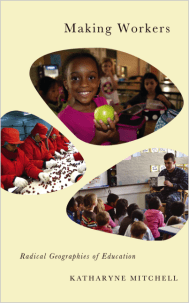
Katharyne Mitchell, Making Workers: Radical Geographies of Education – now out with Pluto

9780745399850.jpeKatharyne Mitchell, Making Workers: Radical Geographies of Education – now out with Pluto books.

As globalisation transforms the organisation of society, so too is its impact felt in the classroom. Katharyne Mitchell argues that schools are spaces in which neoliberal practices are brought to bear on the lives of children. Education’s narratives, actors and institutions play a pivotal role in the social and political formation of youth as workers in a capitalist economy.

Mitchell looks at the formation of student identity and allegiance –as well as spaces of resistance. She investigates the transition to educational narratives emphasising flexibility and strategic global entrepreneurialism and examines the role of education in a broader political project of producing new generations of economically insecure but compliant workers.

Scrutinising the impact of an influx of new actors, practices and policies, Mitchell argues that public education is the latest institution to embrace the neoliberal logic of ‘choice’ – pertaining to schools, faculty, and curricula – that, if unchallenged, will lead to further incursions of the market and increased socioeconomic inequality.

‘Katharyne Mitchell’s Making Workers is an exemplary analysis of the structural forces, networks, discourses, and practices shaping educational systems from compulsory education through to higher education, including life-long learning. Given the importance of education systems to the production of citizens as well as the work-force, Mitchell’s book is a must-read for all interested in the future of economy and society’ – Kris Olds, Professor, Department of Geography, University of Wisconsin-Madison

‘A beautifully written and highly engaging account of neoliberalism and its still unfolding capture of our public educational institutions, teachers and students… This book should be at the top of the reading list for all who wish to understand the impacts of the last forty years of transformation in education as well as those who wish to join the struggle to save our schools and our children’ – Sallie A. Marston, Professor, School of Geography and Development and Director, Community and School Garden Program, University of Arizona

Good to see that Pluto now provide a free e-book with the hardcopy – Verso have done this for some time, but still puzzled more publishers don’t do this.

Posted in Uncategorized | Leave a comment

Books received – Delaporte, Lecourt, Ginestier, Eribon, Lichnerowicz, Perroux and Gadoffre

Some second-hand books for the Canguilhem and Foucault work

IMG_3211.JPG

Posted in Canguilhem (book), Gaston Bachelard, Georges Canguilhem, Michel Foucault, The Early Foucault, Uncategorized | Leave a comment

Three really interesting looking books from Routledge – but three completely obscene prices

Three really interesting looking books from Routledge – but three completely obscene prices.

MorinKaren Morin, Carceral Space, Prisoners and Animals – £105 or £76.50 e-book

Carceral Space, Prisoners and Animals explores resonances across human and nonhuman carceral geographies. The work proposes an analysis of the carceral from a broader vantage point than has yet been done, developing a ‘trans-species carceral geography’ that includes spaces of nonhuman captivity, confinement, and enclosure alongside that of the human. The linkages across prisoner and animal carcerality that are placed into conversation draw from a number of institutional domains, based on their form, operation, and effect. These include: the prison death row/ execution chamber and the animal slaughterhouse; sites of laboratory testing of pharmaceutical and other products on incarcerated humans and captive animals; sites of exploited prisoner and animal labor; and the prison solitary confinement cell and the zoo cage. The relationships to which I draw attention across these sites are at once structural, operational, technological, legal, and experiential / embodied. The forms of violence that span species boundaries at these sites are all a part of ordinary, everyday, industrialized violence in the United States and elsewhere, and thus this ‘carceral comparison’ amongst them is appropriate and timely.

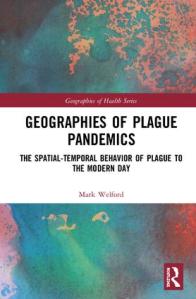
WelfordMark Welford, Geographies of Plague Pandemics – £105 or £35.99 e-book

Geographies of Plague Pandemics synthesizes our current understanding of the spatial and temporal dynamics of plague, Yersinia pestis. The environmental, political, economic, and social impacts of the plague from Ancient Greece to the modern day are examined. Chapters explore the identity of plague DNA, its human mortality, and the source of ancient and modern plagues. This book also discusses the role plague has played in shifting power from Mediterranean Europe to north-western Europe during the 500 years that plague has raged across the continent. The book demonstrates how recent colonial structures influenced the spread and mortality of plague while changing colonial histories. In addition, this book provides critical insight into how plague has shaped modern medicine, public health, and disease monitoring, and what role, if any, it might play as a terror weapon.

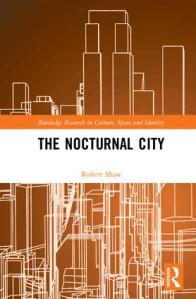
ShawRobert Shaw, The Nocturnal City – £105 (no e-book listed)

Night is a foundational element of human and animal life on earth, but its interaction with the social world has undergone significant transformations during the era of globalization. As the economic activity of the ‘daytime’ city has advanced into the night, other uses of the night as a time for play, for sleep or for escaping oppression have come increasingly under threat.

This book looks at the relationship between night and society in contemporary cities. It identifies that while theories of ‘planetary urbanization’ have traced the spatial spread of urban forms, the temporal expansion of urban capitalism has been less well mapped. It argues that, as a key part of planetary being, understanding what goes on at night in cities can add nuance to debates on planetary urbanization.

A series of practices and spaces that we encounter in the night-time city are explored. These include: the maintenance and repair of infrastructure; the aesthetics of the urban night; nightlife and the night-time economy; the home at night; and the ecologies of the urban night. Taking these forward the book will ask whether the night can reveal some of the boundaries to what we call ‘the urban’ in a world of cities, and will call for a revitalized and enhanced ‘nightology’ to study these limits.

Now I don’t want to just single out Routledge, since there are other offenders, but these prices are just ridiculous. The books are short too – 176, 156 and 126 pages. What a terrible shame for these authors to have worked so hard on these books, each of which deserves a much wider audience than these prices will allow.

Posted in Publishing, Uncategorized | 7 Comments

Louis Althusser, Écrits sur l’histoire – now out with PUF

1519093812_9782130792949_v100Louis Althusser, Écrits sur l’histoire (1963-1985) – now out with PUF

Quatrième volume de l’entreprise de publication systématique des livres et textes inédits de Louis Althusser, établie par G. M. Goshgarian sur la base des manuscrits du fonds Althusser recueilli à l’IMEC, Écrits sur l’histoire rassemble un florilège d’inter­ventions et de méditations du philosophe, s’étendant de 1963 à 1986. Interrogeant sans relâche la place de l’histoire dans la théorie marxiste, et donc ce qu’Althusser voyait comme le danger historiciste au cœur de la lecture révolutionnaire du présent, ils témoignent d’un dialogue continu avec la discipline historique de son temps – dont plusieurs représentants ont échangé avec le philosophe. Soucieux de l’histoire, mais désireux d’éviter toute explication qui l’érigerait en une force déterministe, Althusser n’a en effet jamais cessé de méditer la manière dont histoire et concept s’équilibraient dans la théorie marxiste – équilibre qu’il chercha à réinventer pour son époque. Ce sont les traces de cette entreprise, toujours commentée dans le monde entier, qui se trouvent réunies dans ce volume.

Note d’édition, par Michael Goshgarian

I. Une conversation sur l’histoire littéraire (1963)

II. Note supplémentaire sur l’histoire (1965-1966?)

III. Sur la genèse (1966)

IV. Comment quelque chose de substantiel peut-il changer ? (1970)

V. À Gretzky (1973)

VI. Projet de réponse à Pierre Vilar (1973?)

VII. Livre sur l’impérialisme (1973)

VIII. À propos de Marx et l’histoire (1975)

IX. Sur l’histoire (1986)

Posted in Louis Althusser, Uncategorized | Leave a comment

The Meaning of Light: Seeing and Being on the Battlefield

Pip Thornton shares her 2015 paper on battlefield terrain – strong connections to my work on terrain and the Gordillo paper I shared earlier this week.

Pip Thornton's avatarpip thornton art & research

I haven’t always written about algorithms and digital capitalism, but I have previously used poetry as a lens through which to expose the politics and asymmetries of technology and space. The Meaning of Light: Seeing and Being on the Battlefield (cultural geographies Vol: 22 issue: 4) is a paper I published in 2015 based on my experiences as a reservist soldier in Iraq in 2003. It’s about vision, affect, bodies, materiality and the (often imperial) politics of terrain on the battlefield. It all started with a poem I wrote about watching illuminating shells lighting up Basra before an artillery attack.

Light Discipline (2013)

In a blackout we adjust our sights

by touch and cup our smoke against

the desert, waiting for the light.

At long last the barrel scrapes

into place and the night is instantly

exposed. I cover my ears and watch.

In the distance a fitful city crouches,

View original post 76 more words

Posted in Uncategorized | Leave a comment

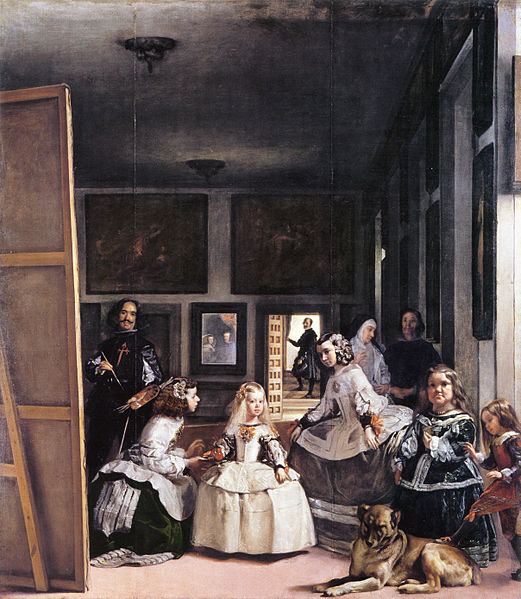
Interactive visualization of Diego Velázquez, Las Meninas (1656)

521px-Las_Meninas_by_Diego_Velázquez

Interactive visualization of Diego Velázquez, Las Meninas (1656)

The painting is in the Prado in Madrid – I was there just last week. The Prado website has some more information.

Thanks to Melissa Pawelski for the link.


Posted in Uncategorized | 1 Comment

Chris Barrett, Early Modern English Literature and the Poetics of Cartographic Anxiety – OUP

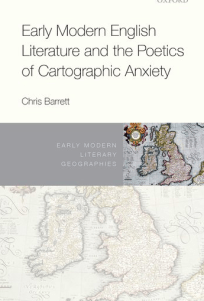
Screenshot 2018-03-17 11.06.55.pngChris Barrett, Early Modern English Literature and the Poetics of Cartographic Anxiety – now published by Oxford University Press in their Early Modern Literary Geographies series.

The Cartographic Revolution in the Renaissance made maps newly precise, newly affordable, and newly ubiquitous. In sixteenth-century Britain, cartographic materials went from rarity to household décor within a single lifetime, and they delighted, inspired, and fascinated people across the socioeconomic spectrum. At the same time, they also unsettled, upset, disturbed, and sometimes angered their early modern readers. Early Modern English Literature and the Poetics of Cartographic Anxiety is the first monograph dedicated to recovering the shadow history of the many anxieties provoked by early modern maps and mapping in the sixteenth and seventeenth centuries.

A product of a military arms race, often deployed for security and surveillance purposes, and fundamentally distortive of their subjects, maps provoked suspicion, unease, and even hostility in early modern Britain (in ways not dissimilar from the anxieties provoked by global positioning-enabled digital mapping in the twenty-first century). At the same time, writers saw in the resistance to cartographic logics and strategies the opportunity to rethink the way literature represents space—and everything else. This volume explores three major poems of the period—Edmund Spenser’s The Faerie Queene (1590, 1596), Michael Drayton’s Poly-Olbion (1612, 1622), and John Milton’s Paradise Lost (1667, 1674)—in terms of their vexed and vexing relationships with cartographic materials, and shows how the productive protest staged by these texts redefined concepts of allegory, description, personification, bibliographic materiality, narrative, temporality, analogy, and other elemental components of literary representations.

Posted in Uncategorized | Leave a comment

David Bissell, Transit Life: How Commuting Is Transforming Our Cities – now out with MIT Press

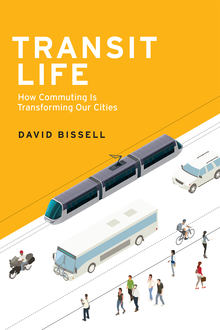
9780262534963David Bissell, Transit Life: How Commuting Is Transforming Our Cities – now out with MIT Press

We spend much of our lives in transit to and from work. Although we might dismiss our daily commute as a wearying slog, we rarely stop to think about the significance of these daily journeys. In Transit Life, David Bissell explores how everyday life in cities is increasingly defined by commuting. Examining the overlooked events and encounters of the commute, Bissell shows that the material experiences of our daily journeys are transforming life in our cities. The commute is a time where some of the most pressing tensions of contemporary life play out, striking at the heart of such issues as our work-life balance; our relationships with others; our sense of place; and our understanding of who we are.

Drawing on in-depth fieldwork with commuters, journalists, transit advocates, policymakers, and others in Sydney, Australia, Transit Life takes a holistic perspective to change how we think about commuting. Rather than arguing that transport infrastructure investment alone can solve our commuting problems, Bissell explores the more subtle but powerful forms of social change that commuting creates. He examines the complex politics of urban mobility through multiple dimensions, including the competencies that commuters develop over time; commuting dispositions and the social life of the commute; the multiple temporalities of commuting; the experience of commuting spaces, from footpath to on-ramp, both physical and digital; the voices of commuting, from private rants to drive-time radio; and the interplay of materialities, ideas, advocates, and organizations in commuting infrastructures.

“I read Transit Life, fittingly, while commuting in and out of a new city for the first time. The book is a guide to these taken-for-granted journeys, the infrastructures that make them possible, and the people that live them. It crackles and pops with insights of stories and encounters that will help us see commuting anew. It places practical reflection on the brushes, glances, gestures, and skills we experience and develop in our routes and routines in and out of cities. Accessible, perceptive, passionate, and often revelatory; it is a book about life on the move like no other.”
Peter Adey, Professor of Human Geography, Royal Holloway University of London; author of Mobility, 2nd edition
“Like John Urry’s Mobilities a decade ago, Transit Life convinces the reader that transport is fascinating and at the core of debates in the social sciences and humanities.”
Robyn Dowling, Professor of Urbanism, The University of Sydney
“David Bissell’s Transit Life offers a deep dive into the experiences of daily commuters and the rhythmic patterns of movement that make up our cities. Immersing himself in the troubled traffic that courses through Sydney, Australia, Bissell finds vibrant, diverse, intense human feelings about the commute, far richer and more surprising than statistics can provide. Despite its endless frustrations and disappointments, commuting emerges as a skilled practice that also brings moments of connection, camaraderie, and occasional enjoyment. He shows how commuting subtly transforms us and how we transform the places through which we pass. Transit Life exemplifies a new kind of mobility thinking, commuting us toward more rewarding forms of social inquiry.”
Mimi Sheller, Director, Center for Mobilities Research and Policy; Professor of Sociology, Drexel University; author of Aluminum Dreams
Posted in Uncategorized | Leave a comment