
As ever, a useful roundup from critical theory
I’ve linked to some of these before, but the LSE has now put together a page of links to their advice posts – Writing for Research.
There are lots more links and some discussions archived here.
Figure/Ground interview with Leonard Lawlor
Leonard Lawlor is Edwin Erle Sparks Professor of Philosophy at Pennsylvania State University. He specializes in nineteenth- and twentieth-century Continental philosophy. He received his doctorate from SUNY Stony Brook in 1988 and taught at the University of Memphis from 1989–2008, where he held the position of Faudree-Hardin University Professor of Philosophy from 2004 to 2008 before joining the faculty at Penn State, as Sparks Professor of Philosophy. He is known for his writings on phenomenology and on the figures Jacques Derrida, Gilles Deleuze, Michel Foucault, Henri Bergson, Maurice Merleau-Ponty, Edmund Husserl, and Jean Hippolyte. Lawlor’s most recent work concerns transcendental violence and possible responses to it. His recent From Violence to Speaking Out takes up the question of responses to violence. Although From Violence to Speaking Out contains precise expositions of important ideas in Derrida, Deleuze, and Foucault, it is an original work of philosophy, extending ideas found in his 2007 This is not Sufficient. Somewhat disguised by the expositions, From Violence to Speaking Out is primarily a work in ethics.
This the 16th in a series of dialogues with artists, writers, and critical thinkers on the question of violence. This conversation is with the acclaimed American writer Elaine Scarry, who is the Walter M. Cabot Professor of Aesthetics and the General Theory of Value at Harvard University. The author of many books, Elaine’s work has been pioneering in rethinking the relationship between violence, the body, and trauma as a political and social category.
Robert Cottrell talks to Will Davies about blogging, writing, sociology and social media on The Browser – podcast.
 Edward S. Casey, The World on Edge is reviewed at NDPR by Fred Evans. I’d missed this book when it came out earlier this year, but looks like another important study by Casey. Here’s the press description of the book:
From one of continental philosophy’s most distinctive voices comes a creative contribution to spatial studies, environmental philosophy, and phenomenology. Edward S. Casey identifies how important edges are to us, not only in terms of how we perceive our world, but in our cognitive, artistic, and sociopolitical attentions to it. We live in a world that is constantly on edge, yet edges as such are rarely explored. Casey systematically describes the major and minor edges that configure the human and other-than-human realms, including our everyday experience. He also explores edges in high- stakes situations, such as those that emerge in natural disasters, moments of political and economic upheaval, and encroaching climate change. Casey’s work enables a more lucid understanding of the edge-world that is a necessary part of living in a shared global environment.
Update: thanks to dmf for the link to an open-access related piece by Casey: Edges and the in-Between
Recent reviews at the Antipode Foundation site.
The end of 2017 is nigh, so it’s time to look back at the book reviews we’ve published in the last quarter…
 There are some timely essays in this latest batch, which starts with Jim Glassman on Perry Anderson’s The H-Word: The Peripeteia of Hegemony; far from an exercise in Marxology (Gramsciology?!), “if you want to see how hegemony has been transformed from a critical term in the lexicon of leftist scholars and activists to a less critical but increasingly pervasive term in the lexicon of those interrogating late US imperialism […] then The H-Word is a book well worth reading.”
 Next we have Maribel Casas-Cortes on Kelly Oliver’s Carceral Humanitarianism: Logics of Refugee Detention; after another year of Mediterranean movements this is another pressing book, “a necessary and provocative philosophical appraisal of humanitarianism, focused on the treatment of refugees and the realities of migrant detention centres in the…
View original post 340 more words
 Caren Kaplan, Aerial Aftermaths: Wartime from Above – forthcoming in January from Duke University Press.
You can read the introduction here.
From the first vistas provided by flight in balloons in the eighteenth century to the most recent sensing operations performed by military drones, the history of aerial imagery has marked the transformation of how people perceived their world, better understood their past, and imagined their future. In Aerial Aftermaths Caren Kaplan traces this cultural history, showing how aerial views operate as a form of world-making tied to the times and places of war. Kaplan’s investigation of the aerial arts of war—painting, photography, and digital imaging—range from England’s surveys of Scotland following the defeat of the 1746 Jacobite rebellion and early twentieth-century photographic mapping of Iraq to images taken in the immediate aftermath of 9/11. Throughout, Kaplan foregrounds aerial imagery’s importance to modern visual culture and its ability to enforce colonial power, demonstrating both the destructive force and the potential for political connection that come with viewing from above.
 Todd Mei – Exploring an economic turn in phenomenology: Land as hypokeimenon (audio) – Kingston University, 23 November 2017
In this lecture Todd Mei will expand upon an argument in his recent (2017) book, Land and the Given Economy: The Hermeneutics and Phenomenology of Dwelling, regarding the existential basis of economies in our relation to the environment.
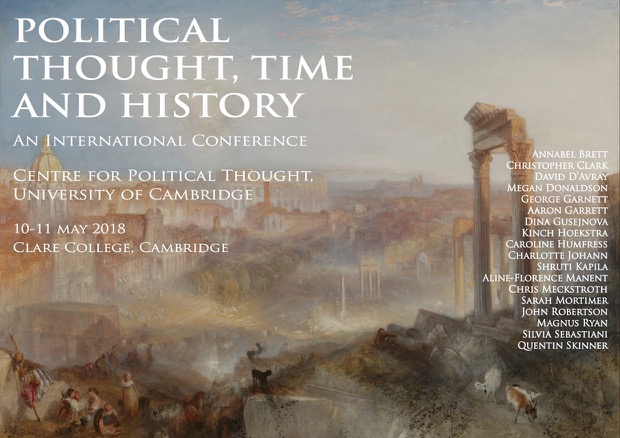
Full details and programme heherere.
It is easy to assume that political thought is bound up with time and history. To most historians, time and history are obvious dimensions of politics; politics occur in contexts which are temporal and historical, and must be studied by reference to the evidence provided by those contexts. Periodically historians have questioned whether temporality should be regarded as uniform; recently, there has been much interest in the thesis that ‘modernity’ entailed a new understanding of time. But whether that understanding, and the understandings of time in pre-modern eras, are thought of as belonging to contemporaries and shared by all those who thought about politics, or are conceived rather as heuristic models, is often unclear. The debate hovers uncertainly between intellectual history and historical methodology.
Political philosophers, however, have never taken time and history for granted. Whether temporality is a necessary or normative foundation for the concept of the civitas, the state, whether political concepts require to be inserted into a historical narrative to be effective are questions to which they have returned very different answers. A Machiavelli might hold politics governed by an inherently temporal ‘necessity’, and insist that political agency be assessed in its specific historical outcomes. But a Hobbes or a Rousseau would create a foundation for the state which deliberately limited the scope for time to make a difference, and which would be valid independent of historical circumstance. A similar division may be found among the jurists. Exponents of customary law argued from prescription, while Roman jurists explored the adaptability of concepts codified for the inhabitants of the Roman Empire to the post-Roman world of multiple kingdoms and city-states. But other jurists set aside time by preferring first principles to prescription, or by making historical examples support accounts of natural law as the universal, supratemporal embodiment of civilised sociability. Viewed as the study of ‘languages’, the history of political thought has found itself studying many languages to which time and history are essential – but many too which diminish or exclude them.
The aim of this conference will be to explore the variety of engagements with time and history found in political thinkers, the better to understand (and, perhaps, to explain) why political philosophy has been unable to take these concepts for granted. Themes of individual sessions will include Time and the State, the temporal and historical perspectives available to political thinkers following the fall of the Roman Empire, time in customary and Roman legal traditions, the temporalities of civil and sacred history in the early modern period, the conceptual status of Enlightenment ‘stadial history’ and what it contributed to the understanding of society and government, the time of ‘modern’ politics, in the nineteenth and again in the twentieth centuries, and whether a political thought ‘global’ in time and history is conceivable. It will end with a reassessment of time in the history of political thought itself: what understandings of time should govern our engagement with the political and legal thought of the past, whether remote or still close at hand? Must they be adapted if the history of political thought is, as many of its foremost practitioners have hoped, to enhance political philosophy itself? The conference is organised under the aegis of the Cambridge Centre for Political Thought and the University’s Faculty of History.


