
How I write and why I write – series of posts by historians at A Trumpet of Sedition. Posts by Simone Hanebaum, John Rees, Marcus Rediker, Alison Stuart, Gaby Mahlberg, etc.
There are lots more posts about writing and publishing archived here.
How I write and why I write – series of posts by historians at A Trumpet of Sedition. Posts by Simone Hanebaum, John Rees, Marcus Rediker, Alison Stuart, Gaby Mahlberg, etc.
There are lots more posts about writing and publishing archived here.
New collection on Foucault and political thought
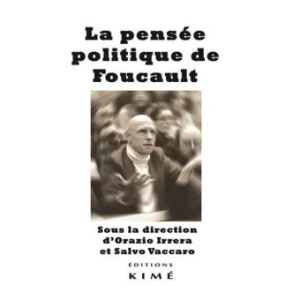 La pensée politique de Foucault
sous la direction d’Orazio IRRERA et Salvo VACCARO
Paris, Editions Kimé (coll. “Philosophie en cours”), 2017, p. 248.
Loin d’être considérée comme une simple notion appartenant au vocabulaire de la théorie politique, l’idée foucaldienne de la politique renvoie plutôt à une attitude généalogique fournissant un diagnostic du présent et restituant des relations complexes et contingentes qui nouent des domaines de savoir, des types de normativité et des formes de subjectivité. Par ce biais cette idée touche tout un ensemble de questions qui ont été cruciales pour l’itinéraire intellectuel de Foucault. En premier lieu celles de la gouvernementalité et de la biopolitique, des savoirs et des pouvoirs qui les constituent, des pressions normalisantes avec leurs effets spécifiques d’assujettissement, mais aussi des résistances et des contre-conduites que la gouvernementalité et la biopolitique rencontrent et produisent dans leur exercice. Au cœur de l’idée foucaldienne de la politique on…
View original post 443 more words
Simon Springer et al (2017). Say ‘Yes!’ to peer review: Open Access publishing and the
need for mutual aid in academia. Fennia 195: 2, pp. xx–xx. ISSN 1798-5617 [pdf, or scroll down list of forthcoming papers]
Scholars are increasingly declining to offer their services in the peer review process. There are myriad reasons for this refusal, most notably the ever-increasing pressure placed on academics to publish within the neoliberal university. Yet if you are publishing yourself then you necessarily expect someone else to review your work, which begs the question as to why this service is not being reciprocated. There is something to be said about withholding one’s labour when journals are under corporate control, but when it comes to Open Access journals such denial is effectively unacceptable. Make time for it, as others have made time for you. As editors of the independent, Open Access, non-corporate journal ACME: An International Journal for Critical Geographies, we reflect on the struggles facing our daily operations, where scholars declining to participate in peer review is the biggest obstacle we face. We argue that peer review should be considered as a form of mutual aid, which is rooted in an ethics of cooperation. The system only works if you say ‘Yes’!
I made similar arguments – though for a (then) not-for-much-profit journal, rather than an open access one – a decade ago: The Exchange Economy of Peer Review, Environment and Planning D: Society and Space, 2008, 26.6, 911-3.
Navigating Marx in the Age of Trump: An Interview With David Harvey in The Observer

This fall marks the 150th anniversary since the publication of Karl Marx’s Capital. In his groundbreaking series, Marx famously defined capital as value in motion, architecting an entire field of study for understanding economics, social relations, and the institutions structuring massive inequality. Set against the backdrop of Europe’s factory system and the relationship between capitalist and laborer, Marx’s ideas spawned revolution and tyrannical regime alike. In writing Capital, the theorist forever altered our perception toward the system’s volatile nature.
Though factories have mostly been replaced by markets, banking systems and credit, capital rules the world over. Following the rise of the international monetary system in the 1970s, interest-bearing capital was cemented as the driving force behind governments, markets, and industries. As capital has grown more powerful and unstable, expanding and plunging into crises when its inherent contradictions are realized, Marx’s theories are even more relevant today.
Navigating Marx in the age of Trump is social theorist David Harvey. A professor of anthropology at the Graduate Center of the City University of New York, Harvey pioneered modern geography as a discipline while putting Marx’s theories into contemporary context. His newest book, Marx, Capital, and the Madness of Economic Reason, examines Capital alongside recent advancements in technology and credit systems. To get an in-depth analysis on the state of global capitalism, we spoke with Harvey about populism, Goldman-Sachs, and Silicon Valley’s elite.
Economist and former Finance Minister of Greece, Yanis Varoufakis connects the Western establishment’s authoritarian, incompetent financial policies to the rise of the far right and the splintering of Europe, and sees a much larger crisis – of capitalism’s contradictions and the political class’s ideological bankruptcy – on the horizon, drawing closer.
An interesting discussion of Ethan Kleinberg’s new book, Haunting History: For a Deconstructive Approach to the Past, with a link to a panel discussion of the book with Kleinberg, Joan Wallach Scott, Carol Gluck and Stefanos Geroulanos.
 Nigel Thrift reviews David Willetts, A University Education in The Times Higher Education.
Thanks to G.M. Goshgarian for bringing this to my attention – Books come under suspicion in post-coup Turkey. This obviously needs to be seen in the wider context of Turkish politics, but seems indicative of what is being reported about academics and journalists more generally.
Ever since Turkey’s attempted 2016 coup, a growing number of books have been outlawed and confiscated, with some even being considered evidence for certain crimes. Publishers, authors and readers are deeply concerned.
“Early in the morning, when we wanted to deliver the manuscript to the publishing house, we were arrested. All our notes that had something to do with the book, as well as all computers — in other words basically everything — was confiscated. We then decided to write the book anew in jail. As we were not allowed to use a computer or a typewriter, we wrote it all down with a pencil. As we were in different cells, we sent each other our texts.”…
… Following the coup attempt, a state of emergency was declared in Turkey. According to Turkish publishers, a total of 30 publishing houses have since been closed by decree, while more than 670 books have been confiscated for allegedly serving as “propaganda of a terror organization.”
Another 135,000 books have been banned from public libraries on the same or similar grounds. Some works by Louis Althusser, Server Tanilli and Nazım Hikmet have even been considered as evidence for criminal actions. Baruch Spinoza, one of the most renowned philosophers of the 17th century, as well as 20th century French writer and philosopher Albert Camus, have been accused of having been members of terror organizations. A farmer was arrested for owning their works, even though he himself is illiterate. [more here]
Peter Linebaugh’s address to the House of Commons on the 800th anniversary of the Charter of the Forest on the Verso blog
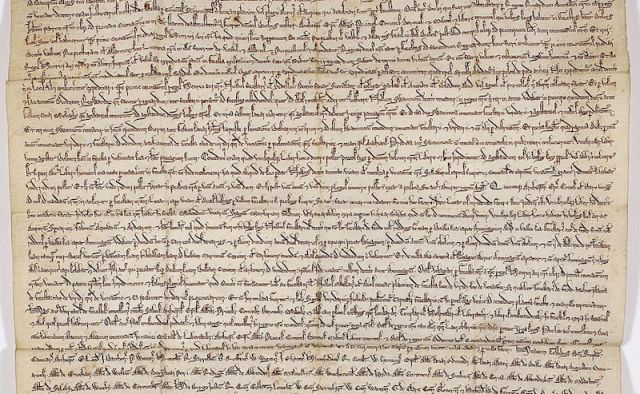
This text, delivered in the State Rooms at the House of Commons on 7 November 2017, was first published in Counterpunch.
Two winds have propelled me here to you, to this House of Commons.
One wind, a hurricane and diabalo, brought flood and fire threatening the destruction of petrochemial civilization, call it capitalism. Homelessness or prison accompany the wind from, Detroit, Michigan, to Houston, Texas, from Puerto Rico in the Caribbean to northern California at the Pacific edge.
A second gentler, softer wind, a zephyr, has renewed my spirit from the Lacandón jungle in Chiapas where the Zapatistas have vowed to protect the forest and reclaim the land, or from the Great Plains of the American continent where pipe lines of oil and gas endanger the pollution of land and the rivers. Encampments of indigenous people and their allies by prayer and by protest have become, in their words, “water protectors.”
Then, day before yesterday on Guy Fawkes Day, with some merry companions of the indigenous people of these islands, I visited Sherwood Forest and Laxton parish in Nottinghamshire. [continues here]
 Jens Bartelson, War in International Thought – now out from Cambridge University Press
As scholars and citizens, we are predisposed to think of war as a profoundly destructive activity that ideally should be abolished altogether. Yet before the twentieth century, war was widely understood as a productive force in human affairs that should be harnessed for the purposes of creating peace and order. Analyzing how the concept of war has been used in different contexts from the seventeenth to the late nineteenth century, Jens Bartelson addresses this transition by inquiring into the underlying and often unspoken assumptions about the nature of war, and how these have shaped our understanding of the modern political world and the role of war within it. He explores its functions in the process of state making and in the creation of the modern international system to bring the argument up to date to the present day, where war is now on the centre stage of world politics.


