Sawyer & Steinmetz-Jenkins (eds.), Foucault, Neoliberalism and Beyond – forthcoming in 2018

59b383cef5ba740228e84989Stephen W. Sawyer & Daniel Steinmetz-Jenkins (eds.), Foucault, Neoliberalism and Beyond – forthcoming in 2018 from Rowman & Littlefield International.

Few philosophers have garnered as much attention globally as Michel Foucault. But even within this wide reception, the consideration given to his relationship to neoliberalism has been noteworthy. However, the debate over this relationship has given rise to a great deal of polemics and confusion.

This volume brings together leading figures in the field to provide a reliable guide to one of the most controversial subjects in recent continental thought. It puts across the case for Foucault’s importance for post-colonial, race, queer and feminist studies, among other areas, and opens up his relationship to neoliberalism to offer a broader picture of tensions brewing within the Left more generally.

Posted in Michel Foucault, Uncategorized | 1 Comment

CFP Modern-Colonial Geographies in Latin America: The Mirage of The Civilizing City and The Archaic Countryside

Call for papers for an interesting conference organised by Mara Duer and Simone Vegliò.

moderncolonialgeographies's avatarModern-colonial Geographies in Latin America

London (King’s College London) 5-6 April 2018

Wanting to be modern seems crazy: we are condemned to be so, given that the future and the past are prohibited’ (Octavio Paz, 1966: 5)

View original post 1,332 more words

Posted in Uncategorized | Leave a comment

Investigating Infrastructures Forum at Society and Space open site

Society and Space open site forum on Investigating Infrastructures

Peter Gratton's avatarPHILOSOPHY IN A TIME OF ERROR

Some really interesting pieces. Below are the links to individual pieces and this is from the introduction by Deborah Cowen:

In the sample of work below, you will find creative engagement with infrastructure in its seemingly banal and innocuous forms, like the jersey barrier, or the airport washroom. Some authors focus instead on the affective, intimate, and aspirational dimensions of infrastructure in engagements with im/mobility and undocumented youth, Palestinian homes, and anti-colonial artistic practice. One author challenges popular and professional conceptions of transit efficiency by engaging infrastructure from their perspective and experience of dis-ability. A number of pieces address questions of force and violence through engagements with the infrastructures of petroleum extraction, the construction of national borders, colonial scientific observatories, and the internment of racialized peoples. Together, the essays examine infrastructure in the making and begin to rethink how intimacy, law, family, territory, able bodiedness, and race produce and require…

View original post 148 more words

Posted in Uncategorized | Leave a comment

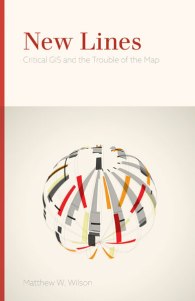
Matthew W. Wilson, New Lines: Critical GIS and the Trouble of the Map – now out with UMP

imageMatthew W. Wilson, New Lines: Critical GIS and the Trouble of the Map – now out with University of Minnesota Press.

A provocative critique of Geographic Information Science

New Lines considers a society increasingly drawn to the power of the digital map, examining the conceptual and technical developments of the field of geographic information science as this work is refracted through a pervasive digital culture. This book draws together archival research on the birth of the digital map with a reconsideration of the critical turn in mapping and cartographic thought.

“With rapidly shifting digital technologies, geo-surveillance, everyday cartography, privatized georeferenced data, and neoliberalization, New Lines offers a reflexive reassessment of the scholarly praxis of critical GIS, an increasingly anachronistic term. Attentive also to contemporary philosophical debates, Matthew W. Wilson’s lively and ambitious manifesto pushes the reader to re-examine everything they thought they knew about the topic”.

Eric Sheppard, author of Limits to Globalization: The Disruptive Geographies of Capitalist Development

Posted in Uncategorized | Leave a comment

Peter Brown reviews Sarah Ruden’s new translation of Augustine’s Confessions

Peter Brown reviews Sarah Ruden’s new translation of Augustine’s Confessions in the NYRB.

Posted in Uncategorized | Leave a comment

David Beer, Three types of reading: ideas, targets & explorations

David Beer, ‘Three types of reading: ideas, targets & explorations’

I’ve been asked to give a short talk on the topic of ‘active reading’ to our students. The request got me thinking about my reading practices . I realised that, very broadly speaking, I do three types of reading. What varies is how focused the reading is and how closely it is tied to particular writing plans.

Posted in Uncategorized | Leave a comment

‘Legal terrain—the political materiality of territory’ – LRIL lecture now published

m_lril_5_1cover‘Legal terrain—the political materiality of territory’ – my London Review of International Law lecture is now published. The journal requires subscription, but if you’d like a copy and can’t access through an institution, please email me.

This lecture sketches the contours of a political -legal theory of terrain. It argues that terrain is a useful concept to think the materiality of territory. Terrain is where the geopolitical and the geophysical meet, and it is therefore a helpful concept to make political -legal understandings of territory better account for the complexities of the geophysical.

The video of the lecture is also available online.

Posted in My Publications, terrain, Territory, Uncategorized | 2 Comments

Martin Dodge and Rob Kitchin, Mapping Cyberspace (free book download)

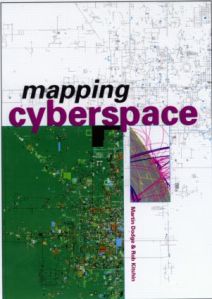
9780415198844Martin Dodge and Rob Kitchin’s 2001 book Mapping Cyberspace is now available as a free download. There is also a website about the book here.
Mapping Cyberspace is a ground-breaking geographic exploration and critical reading of cyberspace, and information and communication technologies. The book:

* provides an understanding of what cyberspace looks like and the social interactions that occur there

* explores the impacts of cyberspace, and information and communication technologies, on cultural, political and economic relations

* charts the spatial forms of virutal spaces

* details empirical research and examines a wide variety of maps and spatialisations of cyberspace and the information society

* has a related website at http://www.MappingCyberspace.com.

This book will be a valuable addition to the growing body of literature on cyberspace and what it means for the future.

Posted in Uncategorized | 2 Comments

Reflections on the Posthuman in International Relations – E-IR edited collection (free download)

RPIR-coverReflections on the Posthuman in International Relations. An E-IR Edited Collection

Available now on Amazon (UK, USA, Ca, Ger, Fra), in all good book stores, and via a free PDF download.
Find out more about E-IR’s range of open access books here.

This book exposes a much needed discussion on the interconnectedness between objects, organisms, machines and elemental forces. It seeks to disturb dogmatic ontologies that privilege human life and successfully questions the separation between the natural and human worlds. By doing so, the collection confronts, challenges, and energises discussion beyond International Relations’ traditional territorial lines. By revealing the fragility of mainstream narratives of the ‘human,’ each author in this collection contributes to an unsettling vision of a posthuman world. Questions of what the future beyond the Anthropocene looks like pervasively infiltrate the collection and move away from a system that all too often relies on binary relationships. In contrast to this binary view of the world, the book (re)entagles the innate complexities found within the world and brings forward a plurality of views on posthumanism.

Posted in Uncategorized | Leave a comment

Derrida’s Margins

Peter Gratton's avatarPHILOSOPHY IN A TIME OF ERROR

A project of The Center for Digital Humanities at Princeton, it aims to present Derrida’s own notes, etc., in references found in his works, starting from Of Grammatology. Here is the description of the endeavor:

Our online research tool will enable scholars to study the development of [Derrida’s] philosophy in an unprecedented way by providing comprehensive digital access to the annotations, marginalia, bookmarks, tipped-in pages, and notes from Derrida’s library that correspond to the roughly one thousand citations found in the pages Of Grammatology. We begin by identifying all quotations and references in Of Grammatology; we then locate these references in Derrida’s personal copies of each work, transcribing all relevant marginal annotations and other markings. Digital images and transcriptions of these annotated pages will form the basis of the website, allowing users to track and search Derrida’s reading practices. This corpus will also serve as a pilot…

View original post 29 more words

Posted in Uncategorized | Leave a comment