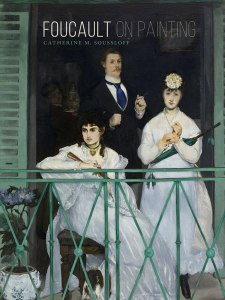
Catherine M. Soussloff, Foucault on Painting – forthcoming in November 2017 with University of Minnesota Press

imageCatherine M. Soussloff, Foucault on Painting – forthcoming in November 2017 with University of Minnesota Press.

A timely exploration of Foucault’s art historical and philosophical engagement with painting as knowledge

Catherine M. Soussloff argues that Michel Foucault’s sustained engagement with European art history critically addresses present concerns about the mediated nature of the image in the digital age. She explores the meaning of painting for Foucault’s philosophy, and for contemporary art theory, proposing a new relevance for a Foucauldian view of ethics and the pleasures and predicaments of contemporary existence.

Catherine Soussloff is certainly one of the most intellectually intelligent and reflective art historians I can think of. Foucault on Painting is a clear, deeply thoughtful, and perfectly written contribution to the important field of intersect between art and philosophy.

—James Rubin, Stony Brook University


Posted in Michel Foucault, Uncategorized | 3 Comments

Shannon Mattern, Mapping’s Intelligent Agents

A very interesting piece in Places journal – Shannon Mattern, “Mapping’s Intelligent Agents“. Thanks to Jenny Edkins for the link.

Self-driving cars have sparked a “billion dollar war over maps,” but the cars are the most boring thing about it. How do machine intelligences read and write the world? And what Other intelligences deserve our attention?

Posted in Uncategorized | 1 Comment

Bernard Harcourt’s legal work – ‘The Long Defense of the Alabama Death-Row Prisoner Doyle Lee Hamm’

Most readers of this blog will, I guess, know Bernard Harcourt for his work editing Michel Foucault’s early Collège de France lectures or the 1981 course in Louvain, and his own writings. He also edits the Carceral Notebooks which I have mentioned a couple of times recently. But this piece in The New Yorker from last year is a very interesting discussion of his legal work – The Long Defense of the Alabama Death-Row Prisoner Doyle Lee Hamm, by Jennifer Gonnermann.

Posted in Uncategorized | Leave a comment

Hannah and Martin – play on the Arendt/Heidegger relation, 27-29 Nov, London

Hannah and Martin – play on the Arendt/Heidegger relation, 27-29 Nov, London

by Joan Nederlof, Lineke Rijxman and Willem de Wolf

27 – 29 November, 7.30pm
£20 / £15

Based on the true story of the secret love affair between a Jewish philosopher and her National Socialist professor, Hannah and Martin is a fascinating exploration of the separation of private and public life.

The play portrays the ethical, political and romantic complexities of the relationship between two of the 20th Century’s most influential thinkers: Hannah Arendt and Martin Heidegger.

Willem de Wolf reprises his role as Martin Heidegger alongside Lineke Rijxman, winner of the Theo d’Or Award for her performance as Hannah.

Intelligent theatre of a rare order.” (NRC)

Hannah and Martin was created by Dutch theatre company Mugmetdegoudentand. The play will be performed with English subtitles.

book tickets here

Posted in Uncategorized | Leave a comment

Carceral Notebooks 13 – Foucault and the Politics of Resistance in Brazil

book-vol13.jpgCarceral Notebooks 13 – Foucault and the Politics of Resistance in Brazil – forthcoming in 2018

Edited by Marcelo Hoffman, this looks fascinating. Foucault made several visits to Brazil and gave some important lectures there. This issue looks to provide some important historical and political background to those visits.

Posted in Michel Foucault, Uncategorized | Leave a comment

The Early Foucault Update 12: A writing/cycling retreat and some time in London’s libraries

As I said at the end of the last update on this book project, after the week in the Paris archives I took a week away on a kind of writing/cycling retreat. It started as the idea of a holiday, but became more of a working break with some hilly rides in the Peak District and quite a bit of writing. For the most part the weather was awful with high winds and heavy downpours. I did clock up some miles, but not as many as I’d hoped.

The writing was good, though for reasons that are not entirely clear to me, I don’t seem to be able to make substantial progress on one particular chapter, which is on the things Foucault actually published in the 1950s. I keep messing around with bits of it, but really need to sit down with the texts and put something down. In some ways, this ought to be the most straight-forward chapter to write – almost all the others are dependent on archive material, more arcane sources, reports and so on. Perhaps it’s the ease with which I should be able to write it that is the barrier. Perhaps it’s because it’s the chapter that retreads reasonably well-known ground, and so is less interesting to write, though there is limited work on these pieces.

In any case, there is plenty of other work to do. Simply for my own reference, I put together a timeline of Foucault’s early career. It relies heavily on the ‘Chronology’ Defert wrote for Dits et écrits, but also draws on the biographies and other sources, and includes all the detail I know of the early courses at Lille and the ENS. I did the same for his later career when I was researching Foucault: The Birth of Power and Foucault’s Last Decade, and it was an invaluable source for me. We know so much more about Foucault in the 1970s and 1980s than the 1950s, but with all these periods there are discrepancies in dates, and lining things up – with marked up uncertainties and disagreements – is helpful to me. As with the one I did for the later period, I imagine I’ll continue to add to it over the writing of this book.

In terms of the book itself, I wrote a little about Foucault’s short book notice from 1954 (rediscovered in 2011 and omitted from Dits et écrits); sketched out a small section on Foucault’s first encounter with Raymond Roussel’s work in 1957; and one on the dispute with Presses Universitaires de France about Maladie mentale et personnalité being reissued. I did a bit more work on the discussion of Jean Barraqué, mainly through discussions of his work and Hermann Broch. Although I’ve not yet really written about the 1950s publications, I do have a discussion of the dates they were written and their publication history. This question is discussed in all the biographies, and the order is not at all clear. I don’t think I’ve fully resolved it, but I’ve done a fairly thorough search of material, and have found a couple of other bits of evidence. My checking of original sources wherever possible also paid off in finding a discrepancy between the first version and the one reprinted in Dits et écrits. I also found a fascinating source about Foucault’s father quite by chance.

Yet generally one thing I’m finding with much of this work is how limited the sources are. For Foucault’s work in a psychiatric hospital and a prison in the early 1950s, for example, the biographies already cover the key material, informed by Foucault’s few recollections in interviews. They also had the benefit of being able to talk to Georges and Jacqueline Verdeaux. But there is not much to go on. With this, and other things, I’m searching for the tiniest bits of evidence.

I then had a week in London, where I ordered a range of things in the British Library. I also made short trips to Senate House, UCL and the Wellcome Library to check some things not at the BL. Among other things this involved some pieces about Barraqué in old music newspapers, early translations of Ludwig Binswanger in French and English, news reports after Foucault’s death in which friends and colleagues reminisced about his early years, and more extensive memoirs from Jean-Paul Aron and Maurice Pinguet. Of course, checking one thing often throws up something else to check; reading one thing gives a list of other things to look at. And while I can resolve many of these things in London or at Warwick, many more are added to a list of things to do when next in Paris. Some might need to be done further afield. This reference checking and extra reading will likely continue right until I finish this book, but it’s always good to chip away at it as I go.

Term begins on Monday, and I have a couple of short pieces I need to work on in the first week or two. But I’m determined to keep writing for this book and the Canguilhem one during term, even though that’s going to mean a shift to writing in the fairly early mornings before I go into work. It’s great to have the Shakespeare book in production, as I reported last week, as that is one of the multiple book projects off my desk. But I’m still writing two books and co-editing another.


The previous updates on this project are here; and Foucault’s Last Decade and Foucault: The Birth of Power are now both available from Polity. Several Foucault research resources such as bibliographies, short translations, textual comparisons and so on are available here. On the related Canguilhem project, see this page.

Posted in Canguilhem (book), Michel Foucault, Shakespearean Territories, The Early Foucault, Uncategorized | 2 Comments

Books received – Lacan, Aron, Carceral Notebooks, Iyer, Colombel

A few recently received books received – Sibylle Lacan’s book about her father, Jean-Paul Aron, Les modernes, Carceral Notebooks #12, Arun Iyer, Towards an Epistemology of Ruptures, and Jeannette Colombel’s book on Foucault. The Iyer was sent in recompense for review work, and the Carceral Notebooks was kindly sent by the editors, Andrew Dilts and Perry Zurn. It looks at the work of the GIP and Foucault, but brings the themes uptodate in the concluding section. The individual papers are available open access here. The other books were picked up second-hand.IMG_2853

Posted in Uncategorized | Leave a comment

Dan Webb, Critical Urban Theory, Common Property, and “the Political”

9781138735972Dan Webb, Critical Urban Theory, Common Property, and “the Political”: Desire and Drive in the City

Dan Webb explores an undervalued topic in the formal discipline of Political Theory (and political science, more broadly): the urban as a level of political analysis and political struggles in urban space. Because the city and urban space is so prominent in other critical disciplines, most notably, geography and sociology, a driving question of the book is: what kind of distinct contribution can political theory make to the already existing critical urban literature? The answer is to be found in what Webb calls the “properly political” approach to understanding political conflict as developed in the work of thinkers like Chantal Mouffe, Jodi Dean, and Slavoj Žižek. This “properly political” analysis is contrasted with and a curative to the predominant “ethical” or “post-political” understanding of the urban found in so much of the geographical and sociological critical urban theory literature. In order to illustrate this primary theoretical argument of the book, Webb suggests that “common property” is the most useful category for conceiving the city as a site of the “properly political.” When the city and urban space are framed within this theoretical framework, critical urbanists are provided a powerful tool for understanding urban political struggles, in particular, anti-gentrification movements in the inner city.
Posted in Uncategorized | 2 Comments

Preparing for academic interviews – a few resources

A very useful roundup of resources for applying for jobs and being interviewed by Charlotte Mathieson.

Charlotte Mathieson's avatarDr Charlotte Mathieson

This post is a follow-up of resources for those who attended The Voice of the Academic: Vocal Training for Academic Success at the University of Surrey on 22nd September, although the links may also be helpful to others preparing for academic interviews.

View original post 16 more words

Posted in Uncategorized | 1 Comment

Sloterdijk reviewed (critically) in NYRB: Some thoughts

Peter Gratton links to John Gray’s critical review of Sloterdijk in the NYRB, and offers a few thoughts in response.

Peter Gratton's avatarPHILOSOPHY IN A TIME OF ERROR

Alas, behind a paywall, but John Gray goes through a tremendous number of his works—if he’s read all listed, he might be one of the few to get through all of those pages. He hits scathing points others have made before: Sloterdijk makes claims that seem thunderous but are on second thought vacuous; his erudition means you get a blizzard of examples that hide relatively simple arguments (e.g., cultures have an interior cohesion–a bubble if you will), if any are to be found; he is a political reactionary whose ideas are both horrible (his views on European refugees) and often silly (we should replace taxes with philanthropy), which then within a few pages turn quite dangerous (liberal democracies are under-raged—an idea that has not aged well). Sloterdijk often just offers warmed over thinking from others: Nietzsche’s ressentiment plays a prominent role in his thinking and his considerations of rage reads…

View original post 353 more words

Posted in Uncategorized | 1 Comment