Novels and biographies read in 2016

Not all novels, and many more biographies in here then previous years, but these were the (mainly) non-work books I read in 2016.

  1. John Fowles, Daniel Martin 
  2. Mason Currey, Daily Rituals: How Artists Work (non-fiction)
  3. Helga Schneider, Let Me Go: My Mother and the SS (memoir)
  4. Kate Grenville, The Idea of Perfection
  5. Joseph Conrad, An Outcast of the Islands
  6. Walter Benjamin, Radio Benjamin (non fiction – radio broadcasts)
  7. George Eliot, Adam Bede (again – first time since A-level)
  8. Christian Meier, Caesar (biography)
  9. David Graeber, Debt: The First 5000 Years (non-fiction)
  10. Ian Rankin, The Beat Goes On: The Complete Rebus Short Stories
  11. Keri Hulme, The Bone People
  12. Thomas Pynchon, Bleeding Edge
  13. Reinhard Mehring, Carl Schmitt: A Biography
  14. William Golding, Rites of Passage
  15. José Saramago, The Notebook (diaries)
  16. Barry Unsworth, Sacred Hunger
  17. Stephen Greenblatt, The Swerve: How the Renaissance Began
  18. Henrik Ibsen, Four Major Plays
  19. Patrick Baert, The Existentialist Moment: The Rise of Sartre as a Public Intellectual
  20. Simon Jenkins, A Short History of England
  21. A.S. Byatt, The Virgin in the Garden
  22. Iris Murdoch, The Sea, the Sea
  23. Ellis Peters, One Corpse Too Many
  24. Edmund de Waal, The Hare with Amber Eyes
  25. Edmund White, Genet (biography)
  26. Robin Sloan, Mr Penumbra’s 24-hour Bookstore
  27. Aaron Swartz, The Boy Who Could Change the World (non-fiction)
  28. Martin Amis, The Zone of Interest
  29. Philippa Langley and Michael Jones, The King’s Grave: The Search for Richard III (non-fiction)
  30. Sebastian Barry, The Secret Scripture
  31. Kazuo Ishiguro, The Unconsoled
  32. Vilém Flusser and Louis Bec, Vampyroteuthis Infernalis: A Treatise
  33. John Banville, The Untouchable
  34. Kingsley Amis, Lucky Jim
  35. Iris Murdoch, The Philosopher’s Pupil
  36. Ellis Peters, Monk’s Hood
  37. Benedict Anderson, A Life Beyond Boundaries (memoir)
  38. James Shapiro, 1606: The Year of Lear (biography)
  39. Robert Macfarlane, The Old Ways: A Journey on Foot (memoir)
  40. Iain Sinclair, London Orbital (non fiction)
  41. Umberto Eco, Numero Zero
  42. Robert Harris, Dictator
  43. Diana Fuss, The Sense of an Interior: Four Writers and the Rooms that Shaped Them (non-fiction)
  44. John Berger and Jean Mohr, A Fortunate Man: The Story of a Country Doctor (non-fiction)
  45. Sebastian Faulks, Where my Heart used to Beat
  46. Han Kang, The Vegetarian
  47. Tendai Huchu, The Maestro, The Magistrate and the Mathematician
  48. George Monbiot, How did we get into this mess? (non-fiction)
  49. Jonathan Frantzen, Purity
  50. China Mieville, King Rat
  51. Emile Zola, Germinal
  52. Tiphaine Samoyault, Barthes: A Biography
  53. J.G. Ballard, High Rise
  54. Walter Benjamin, The Storyteller: Tales out of Loneliness
  55. John Rees and Lindsey German, A People’s History of London (non-fiction)
  56. Gustav Flaubert, The Temptation of Saint Anthony (again)
  57. David Farrell Krell, Son of Spirit: A Novel
  58. Ian Rankin, Standing in Another Man’s Grave
  59. Alex Scarrow, A Thousand Suns
  60. Stanley Weintraub, Silent Night: The Remarkable Christmas Truce of 1914 (non-fiction)
  61. Haruki Murakami, Hear the Wind Sing
Posted in Novels read, Uncategorized | 1 Comment

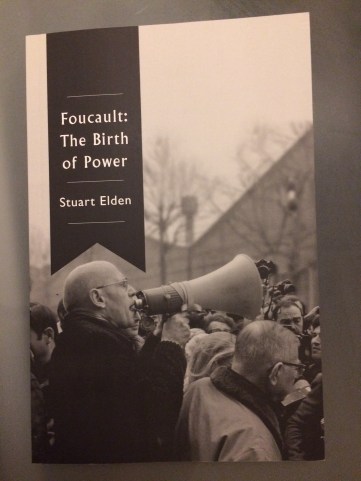
An early Christmas present – an advance copy of Foucault: The Birth of Power

Birth of Power.JPG

Just before I head off on holiday, an advance copy of Foucault: The Birth of Power. The book will be available in the UK in January and a little later worldwide. There is a short post about it on the Polity blog, lots more info about my Foucault work here; and the endorsements, description and contents follow:

Foucault: The Birth of Power opens an illuminating window into the process of political awakening and philosophical transformation as intellectual history. Drawing on lectures, talks and unpublished as well as published material, Stuart Elden has marshalled the contents of a massive archive to substantiate this pivotal period in the development of one of the most influential thinkers of the twentieth century.’
Caren Kaplan, University of California, Davis

‘This is a brilliant prequel to Elden’s masterful book, Foucault’s Last Decade. Here, Elden offers a meticulous, erudite reading of the thinker’s early years at the Collège de France – a critical time in the arc of his research, which included seminars and conferences on disciplinary power, with deep political engagement and activism on behalf of prisoners. With his unmatched knowledge of Foucault, Elden unearths key intellectual moments and carefully traces Foucault’s intellectual journey to the mid-1970s, the publication of Discipline and Punish and the lectures on psychiatric power. Foucault: The Birth of Power is the perfect reading companion to Foucault’s “power-knowledge” period.’
Bernard Harcourt, Columbia University

Michel Foucault’s The Archaeology of Knowledge was published in March 1969; Discipline and Punish in February 1975. Although only six years apart, the difference in tone is stark: the former is a methodological treatise, the latter a call to arms. What accounts for the radical shift in Foucault’s approach?

Foucault’s time in Tunisia had been a political awakening for him, and he returned to a France much changed by the turmoil of 1968. He taught at the experimental University of Vincennes and then moved to a prestigious position at the Collège de France. He quickly became involved in activist work concerning prisons and health issues such as abortion rights, and in his seminars he built research teams to conduct collaborative work, often around issues related to his lectures and activism.

Foucault: The Birth of Power makes use of a range of archival material, including newly available documents at the Bibliothèque nationale de France, to provide a detailed intellectual history of Foucault as writer, researcher, lecturer and activist. Through a careful reconstruction of Foucault’s work and preoccupations, Elden shows that, while Discipline and Punish may be the major published output of this period, it rests on a much wider range of concerns and projects.

Acknowledgements

Abbreviations

Introduction: Out of the 1960s

1. Measure: Greece, Nietzsche, Oedipus

2. Inquiry: Revolt, Ordeal, Proof

3. Examination: Punishment, War, Economy

4. Madness: Power, Psychiatry and the Asylum

5. Discipline: Surveillance, Punishment and the Prison

6. Illness: Medicine, Disease and Health

Conclusion: Towards Foucault’s Last Decade

Notes

Index

Posted in Foucault: The Birth of Power, Michel Foucault, Uncategorized | 1 Comment

Academic Books of 2016 – my personal list

Many of the academic books I read this year were for the Foucault and Shakespeare work, and few were published this year. This alphabetical list is of the twenty books published this year which I read and liked the most.

  1. Louis Althusser, Etienne Balibar, Roger Establet, Pierre Macherey and Jacques Rancière, Reading Capital: The Complete Edition (Verso) – short blog piece on this here
  2. Judith Butler, Notes Toward a Performative Theory of Assembly (Harvard University Press)
  3. Patrick Cockburn, The Rise of Islamic State (Verso)
  4. Claire Colebrook and Jason Maxwell, Agamben (Polity)
  5. Klaus Dodds and Mark Nuttall, The Scramble for the Poles: The Geopolitics of the Arctic and Antarctic (Polity)
  6. Eugen Fink, Play as Symbol of the World (Indiana University Press) – my review here
  7. Jennifer Gabrys, Program Earth: Environmental Sensing Technology and the Making of a Computational Planet (University of Minnesota Press)
  8. Stephen Graham, Vertical: The City from Satellites to Bunkers (Verso)
  9. Harriet Hawkins, Creativity (Routledge)
  10. Bob Jessop, The State: Past, Present, Future (Polity)
  11. Razmig Keucheyan, Nature is a Battlefield: Towards a Political Ecology (Polity)
  12. Jesse Lecavalier, The Rule of Logistics: Walmart and the Architecture of Fulfillment (University of Minnesota Press)
  13. Dotan Leshem, The Origins of Neoliberalism: Modeling the Economy from Jesus to Foucault (Columbia University Press)
  14. Debbie Lisle, Holidays in the Danger Zone: Entanglements of War and Tourism (University of Minnesota Press)
  15. William Rankin, After the Map: Cartography, Navigation, and the Transformation of Territory in the Twentieth Century (University of Chicago Press)
  16. Sverre Raffnsøe, Morten S. Thaning, and Marius Gudmand-Hoyer, Michel Foucault: A Research Companion (Palgrave) – which I endorsed
  17. Tiphanie Samayoult, Barthes: A Biography (Polity)
  18. Mark Neocleous, The Universal Adversary: Security, Capital and the ‘Enemies of All Mankind’ (Routledge) – see my brief thoughts here
  19. Alexander Vasudevan, Metropolitan Preoccupations: The Spatial Politics of Squatting in Berlin (Wiley-Blackwell)
  20. Aoileann Ní Mhurchú and Reiko Shindo (eds.) Critical Imaginations in International Relations (Routledge)

In addition there are a few other books I’d like to mention in which I had some involvement:

Posted in Bob Jessop, Etienne Balibar, Eugen Fink, Henri Lefebvre, Jacques Rancière, Judith Butler, Louis Althusser, Mark Neocleous, Michel Foucault, Pierre Macherey, Stephen Graham, Uncategorized, William Shakespeare | 12 Comments

My favourite music of 2016

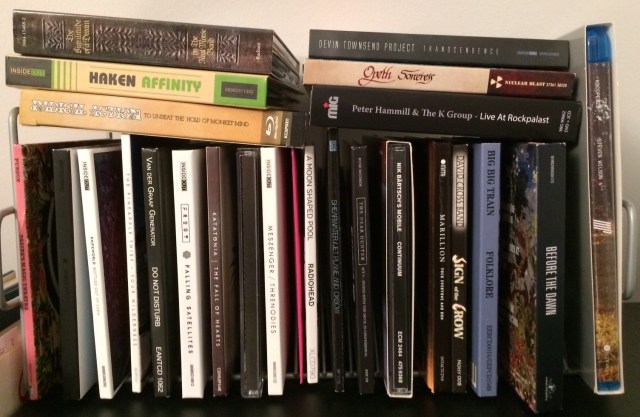
IMG_2007.JPGA very good year for music, I thought. These are the albums I liked the most…

1. Airbag, Disconnected
2. Nik Bärtsch’s Mobile Extended, Continuum
3. Big Big Train, Folklore
4. David Bowie, Blackstar
5. Kate Bush/The K Fellowship, Before the Dawn
6. David Cross Band, Sign of the Crow
7. Devin Townsend Project, Transcendence
8. The Dear Hunter, Act V: Hymns with the Devil in Confessional
9. Frost*, Falling Satellites
10. Haken, Affinity
11. Peter Hammill and K Group, Live at Rockpalast – Hamburg 1981
12. Katatonia, The Fall of Hearts
13. King Crimson, Radical Action
14. Knifeworld, Bottled out of Eden
15. Marillion, FEAR
16. Messenger, Threnodies
17. The Neal Morse Band, The Similitude of a Dream
18. Opeth, Sorceress
19. The Pineapple Thief, Your Wilderness
20. Purson, Desire’s Magic Theatre
21. Radiohead, A Moon Shaped Pool
22. Sha’s Feckel, Feckel for Lovers
23. Shearwater, Jet Plane and Oxbow
24. Steven Wilson,
25. Van der Graaf Generator, Do not Disturb

Live the gigs by Nik Bärtsch, Steven Wilson, Haken, Frost*, The David Cross Band and King Crimson were especially good. But this was a tough year for deaths of great musicians… David Bowie, Prince, Leonard Cohen, Greg Lake…

Posted in Music, Uncategorized | 11 Comments

Danger, Crime and Rights: A 1983 Conversation between Michel Foucault and Jonathan Simon (open access)

Berkeley seminar group 2 (colour).jpgAlthough it was available online earlier this year, “Danger, Crime and Rights: A Conversation between Michel Foucault and Jonathan Simon” is formally published in Theory, Culture & Society , Vol 34 No 1, pp. 3-27. It is currently available open access. The transcribed discussion was edited and introduced by me and there is an afterword by Jonathan Simon.

This article is a transcript of a conversation between Michel Foucault and Jonathan Simon in San Francisco in October 1983. It has never previously been published and is transcribed on the basis of a tape recording made at the time. Foucault and Simon begin with a discussion of Foucault’s 1977 lecture ‘About the Concept of the “Dangerous Individual” in 19th-Century Legal Psychiatry’, and move to a discussion of notions of danger, psychiatric expertise in the prosecution cases, crime, responsibility and rights in the US and French legal systems. The transcription is accompanied by a brief contextualizing introduction and a retrospective comment by Simon.

Posted in Jonathan Simon, Michel Foucault, Uncategorized | 1 Comment

Network of Concerned Geographers – petition to the Association of American Geographers

Please consider joining many Geographers and signing the following petition to the Association of American Geographers. It calls for the AAG to study and take action on the growing entanglements between the US military and the discipline of geography. We would like to have 500+ signatures by mid-January.

https://actionnetwork.org/petitions/network-of-concerned-geographers

The NCG is coordinated through the Action Network, a not-for-profit progressive platform that does not steal and sell your data.

Posted in Uncategorized | Leave a comment

Where to start with reading Peter Sloterdijk? – reading guide updated

9780745699875Where to start with reading Peter Sloterdijk? – my reading guide has been updated, with links to recent translations and the forthcoming The Aesthetic Imperative: Writings on Art.

Posted in Uncategorized | 1 Comment

Books received – Shakespeare, Lefebvre, Tel Quel, Sloterdijk, Lacan

IMG_2013.JPG

The new Lefebvre translation Marxist Thought and the City, Sloterdijk’s Not Saved: Essays After Heidegger, the Arden third series edition of The Comedy of Errors, Lacan’s second seminar, and a copy of the Tel Quel collection Théorie d’ensemble.

Posted in Uncategorized | 2 Comments

Letzlove-Portrait(s) Foucault – a play on the Foucault/Voetzel encounter

Thanks to Felix de Montety for the link to this – Letzlove-Portrait(s) Foucault. This is a play based on the Foucault/Voetzel encounter, which led to the book Vingt ans et après.

Été 1975. Un jeune homme fait du stop sur l’autoroute en direction de Caen. Le conducteur qui s’arrête a un look inhabituel : un homme chauve, avec des lunettes cerclées d’acier, un polo ras du cou et une curiosité constante pour son jeune passager. Ils échangent leurs coordonnées avant de se dire au revoir… Trois ans plus tard paraîtra un livre d’entretiens entre cet inconnu de vingt ans, Thierry Voeltzel, et ce célèbre philosophe, Michel Foucault, qui avait alors tenu à garder l’anonymat. Au cours de la conversation qui se noue entre eux, sont abordées les mutations existentielles de la jeunesse dans son rapport avec la sexualité, les drogues, la famille, le travail, la religion, la musique, les lectures…et la révolution. Quarante ans après, l’intérêt de ce document réside autant dans les expériences vécues de Thierry que dans le portrait en creux de son interviewer.

Posted in Uncategorized | Leave a comment

Derek Gregory’s Geographical Imaginations blog guide

Derek Gregory’s ever-interesting Geographical Imaginations blog now has a guide to past posts, grouped by theme.

p022yr4r

I’ve been pleased to see how often old posts are consulted by readers: I never intended this to be a fleet of ships passing in the digital night.

But as the blog has grown, I realise it’s become increasingly difficult to navigate through the different themes and so I’ve added a GUIDE to the tabs at the head of the page.

This lists some of the key posts which will, I hope, supplement a judicious use of the search box (and the word clouds to the right) plus the publications available under the DOWNLOADS tabs.

It’s still under construction, but let me know if you think I’ve missed anything important.

Posted in Derek Gregory, Uncategorized | Leave a comment