Maxim Samson, Earth Shapers: How Humans Mastered Geography and Remade the World, from the Panama Canal to the Baltic Way – University of Chicago Press, October 2025 and New Books discussion

Maxim Samson, Earth Shapers: How Humans Mastered Geography and Remade the World, from the Panama Canal to the Baltic Way – University of Chicago Press, October 2025

The globetrotting story of how humans have harnessed the geographical landscape and written ourselves onto our surroundings.

Mountains, meridians, rivers, and borders—these are some of the features that divide the world on our maps and in our minds. But geography is far less set in stone than we might believe, and, as Maxim Samson’s Earth Shapers contends, in our relatively short time on this planet, humans have become experts at fundamentally reshaping our surroundings.

From the Qhapaq Ñan, the Inca’s “great road,” and Mozambique’s colonial railways to a Saudi Arabian smart city, and from Korea’s sacred Baekdu-daegan mountain range and the Great Green Wall in Africa to the streets of Chicago, Samson explores how we mold the world around us. And how, as we etch our needs onto the natural landscape, we alter the course of history. These fascinating stories of connectivity show that in our desire to make geographical connections, humans have broken through boundaries of all kinds, conquered treacherous terrain, and carved up landscapes. We crave linkages, and though we do not always pay attention to the in-between, these pathways—these ways of “earth shaping,” in Samson’s words—are key to understanding our relationship with the planet we call home.

An immense work of cultural geography touching on ecology, sociology, history, and politics, Earth Shapersargues that, far from being constrained by geography, we are instead its creators.

New Books discussion with Miranda Melcher – thanks to dmf for the link
Posted in Uncategorized | Leave a comment

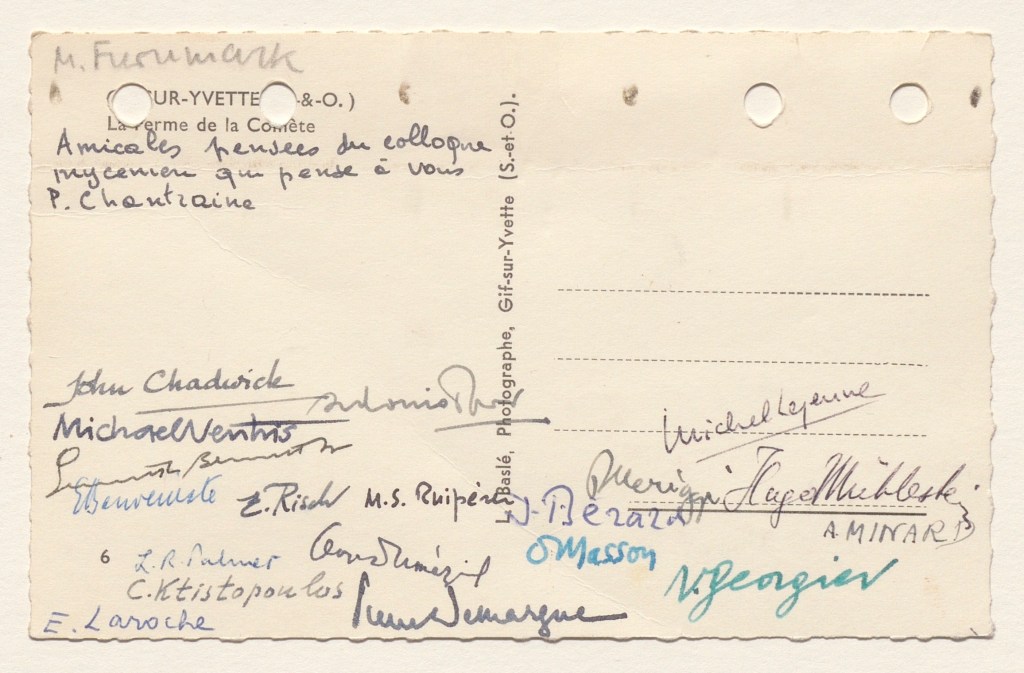
A postcard to Arne Furumark from the 1956 Mycenaean Studies conference

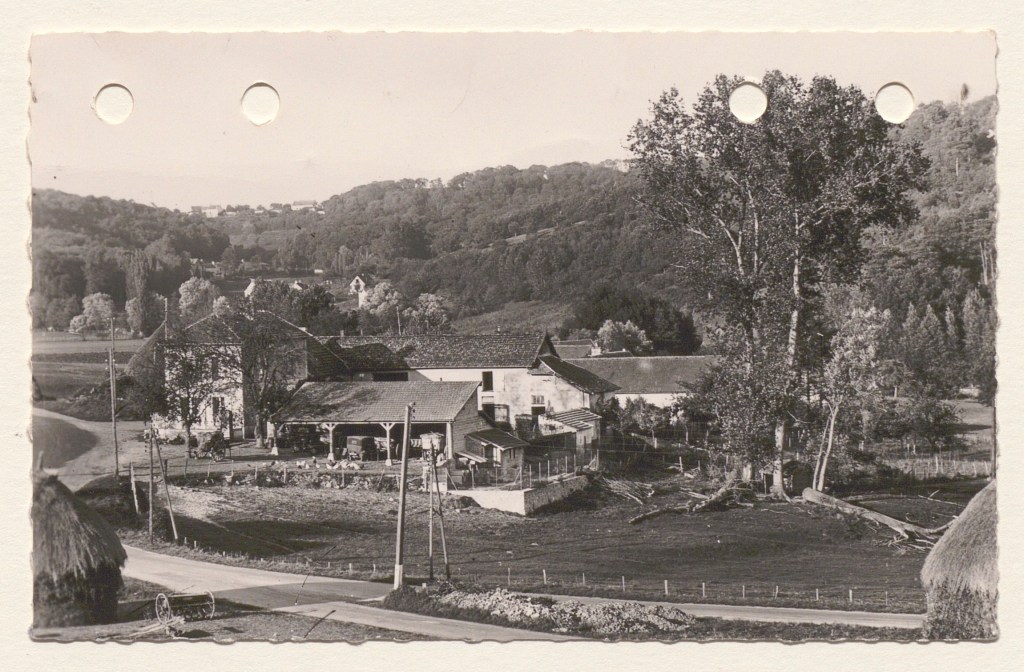
Looking for something else, I chanced upon a postcard to Arne Furumark, available online, signed by the participants at the 1956 Mycenaean Studies conference outside of Paris, which I talk about here. Among the names are the decipherers of Linear B, John Chadwick and Michael Ventris, as well as Georges Dumézil and Émile Benveniste, and several other participants, including Leonard Palmer, who I talk about here.

Furumark was a Swedish archaeologist, with a specialism in Mycenaean Greek pottery. He would have been an obvious participant in the event, and was clearly missed by those who did attend. At the top left of the postcard, Pierre Chantraine has written “Amicales pensées du colloque mycénien qui pense à vous”. The view is of a farm in Gif-sur-Yvette (La Ferme de la Comète), near where the conference was held.

The other signatures are almost all of other participants in the photo I shared in the post about the conference. The postcard is in Furumark’s archives at the University of Uppsala, where he taught for twenty years. Michel Lejeune’s 25 September 1955 circular about the event is also available online.

References

Michel Lejeune (ed.), Études mycéniennes: Actes du Colloque international sur les textes mycéniens (Gif-sur-Yvette, 3-7 avril 1956), Paris: Centre national de la recherche scientifique, 1956.

Archives

Arne Furumarks korrespondens, Uppsala University Archives, https://www.alvin-portal.org/alvin/view.jsf?pid=alvin-record:631665


This note is in the same style as the ‘Sunday histories‘ posts, though its minor status means I’ve posted it mid-week. 

update September 2025: Apparently the sending of a postcard is a tradition that endures at this conference, as is invoking the spirit of the Gif event, in Mycenological conference bingo. Thanks to Dimitri Nakassis for linking to this post.

Posted in Emile Benveniste, Georges Dumézil, Sunday Histories | 4 Comments

Two-part television interview with Georges Dumézil, CBC 1984

Two-part television interview with Georges Dumézil, 1984, Rencontres, CBC with Marcel Brisebois

Entrevue avec Georges Dumézil (1898-1986), membre de l’Académie française et professeur au Collège de France. Sujets abordés : – La signification du terme «indo-européen» et de «peuples indo-européens» -La notion de peuples apparentés. – La comparaison des langues et la comparaison du vocabulaire. -Lui-même précurseur du structuralisme. -Sa définition d’un mythe et sa fonction. -La transmission des mythes par les générations. -Le rôle des rythmes à l’égard des mythes. -Les considérations historiques et mythiques des événements. -Sa théorie des trois fonctions de l’homme et de l’humanité et l’équilibre entre celles-ci.

Part one; part two

I’ve added these to the list of video and audio recordings of Dumézil on this site.

Posted in Georges Dumézil, Uncategorized | 1 Comment

Herbert S. Lewis, Correcting the Record: Essays on the History of American Anthropology – Berghahn Books, December 2024

Herbert S. Lewis, Correcting the Record: Essays on the History of American Anthropology – Berghahn Books, December 2024

The critique of twentieth-century American anthropology often portrays anthropologists of the past as servants of colonialism who “extracted” information from indigenous peoples and published works causing them harm. Herbert S. Lewis recovers the reality of the first century of American anthropology as a vital scholarly discipline that rejected established ideas of race, insisted on the value of very different ways of life, and delivered irreplaceable ethnographic studies. This volume presents powerful refutations of the accumulated damaging myths about anthropology’s history.

Posted in Uncategorized | Leave a comment

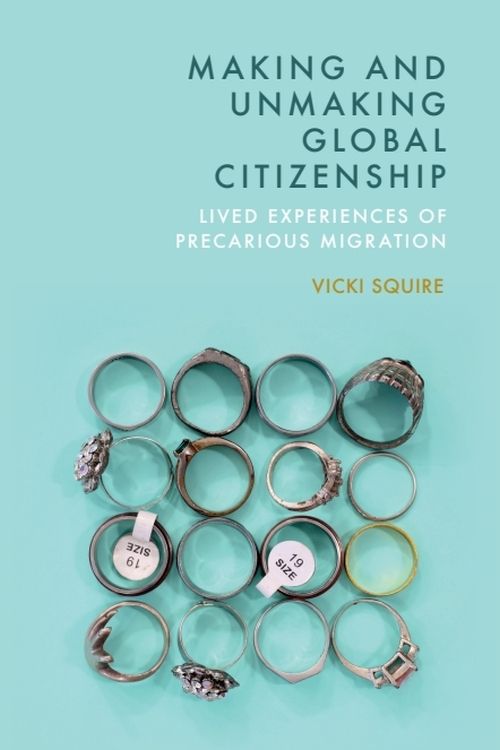
Vicki Squire, Making and Unmaking Global Citizenship: Lived Experiences of Precarious Migration – Edinburgh University Press, December 2025

Vicki Squire, Making and Unmaking Global Citizenship: Lived Experiences of Precarious Migration – Edinburgh University Press, December 2025

Studies how the claims of people with lived experiences of precarity and displacement refuse, disrupt and enact various alternatives to violent bordering practices

  • Introduces ‘global citizenship in the making’ as a framework for the analysis of migratory claims
  • Evaluates different interpretations of the politics of precarious migration, including coloniality, racial capitalism, abolition and global citizenship
  • Develops a novel account of claims as implicit as well as explicit, and as indirect as well as direct
  • Draws on research across multiple contexts conducted over two decades, including the Mediterranean, the Mexico-US border region, sub-Saharan Africa and the UK

How do lived experiences of precarious migration generate claims to rights, belonging and accountability? To what extent does global citizenship in the making provide an analytical framework that helps to make sense of such claims? And in what ways do claims in situations of precarity trouble conventional ideas of citizenship and ‘the international’? This book draws on research conducted over two decades with people experiencing the violence of contemporary governing practices first-hand. Based on case studies including the Mediterranean, the Mexico-US border region, sub-Saharan Africa and the UK, it charts a multiplicity of ways through which claims are enacted in situations of precarity. The book highlights the potential and the limits of global citizenship in the making. Vicki Squire concludes that theories of coloniality, racial capitalism and abolition provide critical insights for a migrant-oriented perspective on the politics of precarious migration.

Posted in Uncategorized | 1 Comment

Dimitris Vardoulakis, The Agonistic Condition: Materialism and Democracy – Edinburgh University Press, June 2025

Dimitris Vardoulakis, The Agonistic Condition: Materialism and Democracy – Edinburgh University Press, June 2025

Examines the philosophical background to theories of conflict in political theory and their sources in philosophy

  • Supplies an engagement of philosophy with political theory
  • Provides a critique of the critique of instrumental reason
  • Proposes a new conception of non-representational politics

Political theory influenced by philosophy examines the political as the sphere of human interaction that is distinct from politics, the sphere of political institutions and parties. The political is usually described in conflictual terms, such as Marx’s class struggle, Heidegger’s polemos, Rancière’s dissensus, or the discourse of agonistic democracy.

This book challenges the premise of such constructions of agonism, namely, that the political is essentially distinct from means and ends calculations. He argues that this premise is derived from the critique of instrumental reason, which assumes that utilitarianism is correct that instrumental ends are measurable. This forgets an ancient tradition that describes phronesis as the primary ethical and political virtue because it calculates the good, which is however impossible to measure with any certainty.

The Agonistic Condition shows that a new consideration of phronesis can help political philosophy and theory to develop more robust conceptions of power that better describe the world we live in.

Posted in Uncategorized | Leave a comment

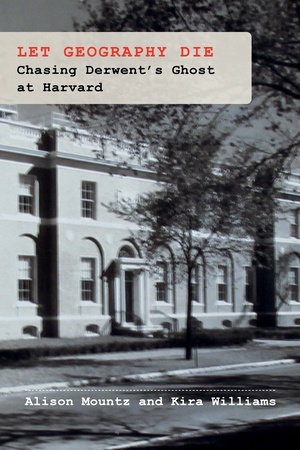
Alison Mountz & Kira Williams, Let Geography Die: Chasing Derwent’s Ghost at Harvard – MIT Press, July 2025 (print and open access)

Alison Mountz & Kira Williams, Let Geography Die: Chasing Derwent’s Ghost at Harvard – MIT Press, July 2025 (print and open access)

An investigative history of the closure of Harvard University’s geography program in the mid-twentieth century due to homophobia and wider institutional politics.

Let Geography Die tells the little-known and oft-misunderstood story of geographical research and education at Harvard University. In investigative fashion, Alison Mountz and Kira Williams unearth the personal and institutional secrets that drove the sudden closure of Harvard’s geography program at the precise moment that it reached its apex. At the heart of this narrative are the hidden personal lives of the queer men recruited to build the geography program—the same ones who were later blamed for its demise. Chief among these figures is Derwent Whittlesey, who eventually became Harvard’s last lone geography professor, once the program he had so successfully built was closed around him.

The book weaves together several histories at once: the enactment of homophobic policies under McCarthyism designed to purge queer people from university campuses and government offices; a university president with little regard for the social sciences on a personal mission to dissolve geographic education; fierce, if failed, university politicking to rescue and then resuscitate the program; personal queer lives hidden in plain sight on the edge of campus; and two contemporary queer political geographers on a mission to memorialize the queer people blamed for society’s ills.

Let Geography Die exposes the truth behind this important story—as well as its wider haunting of an entire discipline 75 years later—while also restoring the humanity of the central characters involved, especially Derwent Whittlesey.

Posted in Uncategorized | 3 Comments

Matthew Beaumont, Nightwalking: A Nocturnal History of London – Verso, July 2025

Matthew Beaumont, Nightwalking: A Nocturnal History of London – Verso, July 2025

A captivating history of the city at night and the people, writers and workers who inhabit the London darkness

In this brilliant work of literary investigation, Matthew Beaumont shines a light on the shadowy perambulations of poets, novelists and thinkers: the fetid, treacherous streets known to Chaucer and Shakespeare; William Blake and his ecstatic peregrinations; the feverish ramblings of opium addict Thomas De Quincey; and, among the lamp-lit literary throng, the supreme nightwalker Charles Dickens. We discover how the nocturnal city has inspired some and served as a balm or narcotic to others. In each case, the city is revealed as a place divided between work and pleasure, the affluent and the indigent, where the entitled and the desperate rub shoulders.

Posted in Uncategorized | Leave a comment

Michel Foucault, Les Hermaphrodites – Gallimard, September 2025

Michel Foucault, Les Hermaphrodites – Gallimard, September 2025, eds. Henri-Paul Fruchaud and Arianna Sforzini, preface by Arianna Sforzini and a postface by Éric Fassin

I’ve shared news of this book before, but the Gallimard site now has a description:

En 1978, Michel Foucault annonce un volume de son Histoire de la sexualité « consacré aux hermaphrodites ». Avec la réorientation de son enquête vers l’Antiquité, il y a renoncé. Demeure dans ses archives ce manuscrit qui aurait pu en faire l’ouverture. À partir de procès échelonnés entre le xvie et le XVIIIᵉ siècle, il met en lumière le passage d’un régime juridique, attribuant un « sexe de décision », à un régime de véridiction, postulant que chaque individu a un seul et « vrai » sexe, qu’il revient à la science médicale de déterminer. C’est aussi le seul écrit dans lequel Foucault élabore la distinction cruciale, à la fois historique et théorique, entre sexe anatomique et sexualité.
La préface d’Arianna Sforzini présente cette histoire par une lecture attentive des concepts organisant le texte, tandis que la postface d’Éric Fassin en fait ressortir les enjeux les plus contemporains, en analysant les rapports entre sexualité, sexe et genre.

The book is part of the Bibliothèque des Histoires series, in which several of Foucault’s books appeared, including the four volumes of the History of Sexuality.

France 24 reports on this here. There is a piece by Hocine Bouhadjera about the book at Actualitté.

Posted in Michel Foucault, Uncategorized | Leave a comment

Claire Blencowe, Spirits of Extraction: Christianity, Settler Colonialism and the Geology of Race – Manchester University Press, March 2025

Claire Blencowe, Spirits of Extraction: Christianity, Settler Colonialism and the Geology of Race – Manchester University Press, March 2025

Spirits of extraction revisits the troubling history of socially reformist, ostensibly anti-racist, Christianity and its role in the expansion of the extractive industries, British imperialism, and settler colonialism. The book explores key moments in the history of Methodism and the evangelical movement. Colonial fears, and the attempt to ‘civilise savages’, were crucial to the movement’s foundation in eighteenth-century industrialising Bristol, England. Through the culture of the Cornish mining diaspora of the nineteenth century, Methodism enmeshed with all the complexity of race and labour-structures of the British empire. At the same time, in Anishinaabewaki/Upper Canda/Ontario, Methodist missionaries laid the foundation of abusive education and racialised ideas of redemption that both enable and sacralise the mining industry. Through these histories of our present, the book theorises the relation of religion and education to racism, modernity, biopower, extractivism, and the geology of race.

Posted in Uncategorized | Leave a comment