Colin Gordon reviews the Cambridge Foucault Lexicon in History of the Human Sciences

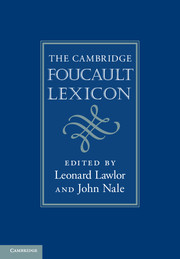
9780521119214Colin Gordon reviews The Cambridge Foucault Lexicon in History of the Human Sciences (requires subscription). I hope a preprint will appear on Colin’s academia.edu page soon. It’s a very detailed review of a huge work, covering a wide range of the entries – and briefly mentioning my entry on ‘space’ with some nice praise.

Update: Sage have made the essay open access for the rest of 2016.

Posted in Colin Gordon, Michel Foucault, Uncategorized | 2 Comments

Reading Marx in 1965; Reading Althusser et. al. and Lefebvre in 2016 at the Verso blog

I have a short piece at the Verso blog, entitled ‘Reading Marx in 1965; Reading Althusser et. al. and Lefebvre in 2016’.

Some of the most important works of post-war French Marxism were published in 1965. Louis Althusser’s For Marx was accompanied by his seminar group’s collaborative volume Reading Capital, and Henri Lefebvre’s Metaphilosophy appeared the same year. Both Reading Capital and Metaphilosophy now appear, in complete translations, from Verso. [continues here]

Both Reading Capital and Metaphilosophy are available at discounted prices, with bundled e-book, and are available at 50% off if you buy both, or any two from Verso’s discounted theory list.

Posted in Henri Lefebvre, Louis Althusser, Uncategorized | Leave a comment

Foucault, the Archive and the Writing of Intellectual History – audio of lecture

2nd_annual_pais_research_conference_2016_poster.jpgAt the end of June I gave the plenary lecture to my Warwick department’s annual conference. It was entitled ‘Foucault, the Archive and the Writing of Intellectual History’, and discussed the writing of the two books Foucault’s Last Decade and Foucault: The Birth of Power.

The audio recording is available here.


Links to my series of updates on the books’ progress can be found here and other audio and video recordings are  here.

Some translations, scans and links are available at Foucault Resources – I mention some of these in the talk.

Posted in Conferences, Foucault's Last Decade, Foucault: The Birth of Power, Michel Foucault, Uncategorized | 1 Comment

Books received – Rankin, Lisle, Springer, Norris

IMG_1620

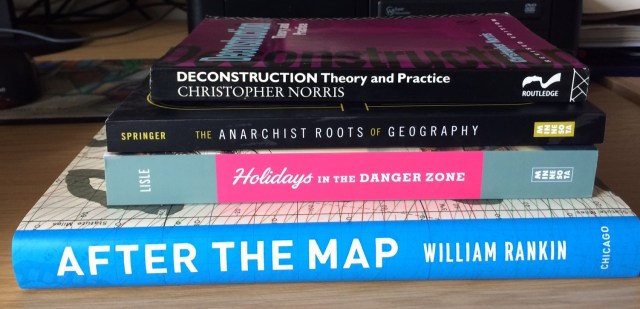
A second-hand copy of Chris Norris’s Deconstruction: Theory and Practice, Simon Springer’s The Anarchist Roots of Geography, Debbie Lisle’s Holidays in the Danger Zone and William Rankin’s After the Map. The last three were all sent by the publishers.

Posted in Uncategorized | Leave a comment

Review of Foucault, Language, Madness and Desire in Cultural Geographies

image_mini

My brief review of Michel Foucault, Language, Madness, and Desire: On Literature, translated by Robert Bonnano, is now available in the new issue of Cultural Geographies. The review requires subscription, but a preprint is available here.

Posted in Michel Foucault, Uncategorized | Leave a comment

Society and Space Volume 34 Issue 4 now online

New issue of Society and Space now online

Posted in Uncategorized | 2 Comments

Debjani Ganguly, This Thing Called the World: The Contemporary Novel as Global Form

978-0-8223-6156-5_prDebjani Ganguly, This Thing Called the World: The Contemporary Novel as Global Form.

In This Thing Called the World Debjani Ganguly theorizes the contemporary global novel and the social and historical conditions that shaped it. Ganguly contends that global literature coalesced into its current form in 1989, an event marked by the convergence of three major trends: the consolidation of the information age, the arrival of a perpetual state of global war, and the expanding focus on humanitarianism. Ganguly analyzes a trove of novels from authors including Salman Rushdie, Don DeLillo, Michael Ondaatje, and Art Spiegelman, who address wars in Iraq, Afghanistan, and Sri Lanka, the Palestinian and Kashmiri crises, the Rwandan genocide, and post9/11 terrorism. These novels exist in a context in which suffering’s presence in everyday life is mediated through digital images and where authors integrate visual forms into their storytelling. In showing how the evolution of the contemporary global novel is analogous to the European novel’s emergence in the eighteenth century, when society and the development of capitalism faced similar monumental ruptures, Ganguly provides both a theory of the contemporary moment and a reminder of the novel’s power.

Posted in Uncategorized | Leave a comment

Felicity D. Scott, Outlaw Territories:Environments of Insecurity/Architectures of Counterinsurgency

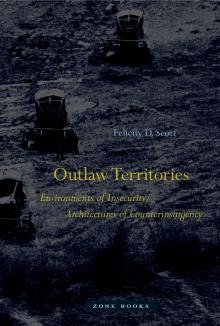
9781935408734_0Recently out with MIT Press – Felicity D. Scott, Outlaw Territories:Environments of Insecurity/Architectures of Counterinsurgency.

In Outlaw Territories, Felicity Scott traces the relation of architecture and urbanism to human unsettlement and territorial insecurity during the 1960s and 1970s. Investigating a set of responses to the growing urban unrest in the developed and developing worlds, Scott revisits an era when the discipline of architecture staked out a role in global environmental governance and the biopolitical management of populations. She describes architecture’s response to the displacement of persons brought on by migration, urbanization, environmental catastrophe, and warfare, and she traces architecture’s relationship to the material, environmental, psychological, and geopolitical transformations brought on by postindustrial technologies and neoliberal capitalism after World War II.

At the height of the U.S.-led war in Vietnam and Cambodia, with ongoing decolonization struggles in many parts of the world, architecture not only emerged as a target of political agitation because of its inherent normativity but also became heavily enmeshed with military, legal, and humanitarian apparatuses, participating in scientific and technological research dedicated to questions of international management and security. Once architecture became aligned with a global matrix of forces concerned with the environment, economic development, migration, genocide, and war, its role shifted at times toward providing strategic expertise for institutions born of neoliberal capitalism. Scott investigates this nexus and questions how and to what ends architecture and the environment came to be intimately connected to the expanded exercise of power within the shifting geopolitical frameworks at this time.

Posted in Territory, Uncategorized, urban/urbanisation | 1 Comment

Chris Rumford 1958-2016

ChrisI was very sorry to hear the news of the death of Chris Rumford, Professor of Politics at Royal Holloway, University of London. I didn’t know Chris well, but I knew his work on borders, Europe, globalisation and cosmopolitanism. He invited me to Royal Holloway in 2009 for the Global Studies conference, and we had a good conversation on a range of things, including a shared love of cricket. There is a tribute on the Royal Holloway site. My condolences to his family, friends and colleagues.

Posted in Uncategorized | Tagged | 1 Comment

Forthcoming publications and some preprints

I’ve updated the list of forthcoming publications and provided links to some preprints.

For published work, see separate pages for articles and chapters, (some)booksinterviews, and audio and video.


Posted in My Publications, Publishing, Uncategorized | Leave a comment