Alexandre Kojève, The Idea of Determinism – trans. Robert B. Williamson, St Augustine’s Press, July 2025
The previous volume of Alexandre Kojève’s (1902–1968) work published by St. Augustine’s Press, The Concept, Time and Discourse (2019), was the introduction to an unfinished magnum opus through which Kojève intended to effectively update Hegelian philosophy. For Kojève, Hegel provides the completion of philosophy’s historical development, with the exception of what Kojève deems an inadequate philosophy of nature. The translation of The Idea of Determinism offers insight into what shape Kojève’s “update” to Hegelian philosophy of nature may have taken.
The notion of determinism plays heavily in the philosophy of nature. In the classical age of physics (Newton through Maxwell) it was a commonly held assumption that everything can be predicted, and chance is nonexistent. There was also the belief in the perpetual progress toward absolute precision in scientific measurement. Then in 1814 Laplace set the groundwork for this idea in the modern era: “[If there were] an Intelligence who could know, for a given instant, all the forces with which nature is animated and the relative position of all the beings that compose it—if, moreover, it were vast enough to submit all its data to analysis [in accordance with the laws of nature—it] would embrace in the same formula the motions of the greatest bodies in the universe and those of the slightest atom: nothing would be uncertain for it, and the future, like the past, would be present to its eyes.”
With dialectical mastery, Kojève examines the implications of these assumptions and finds them wanting, even from within the classical perspective. He then turns to the “modern (quantum) physics” of Planck, Heisenberg and Dirac, which he sees as supporting an epistemological understanding of physical science free of any deterministic assumptions. Kojève also finds it to be rooted in the concrete understanding of physical measurement as an interaction between an observing subject and an observed object, about which statistically accurate predictions can legitimately be made.
Kojève was a contemporary and friend to political philosopher Leo Strauss, and influential in the intellectual formation of Allan Bloom and Stanley Rosen. His political career cannot be ignored when attempting to assess the intentions of his philosophical work, which renders it a brand of political philosophy even when making presentations in the field of natural sciences.
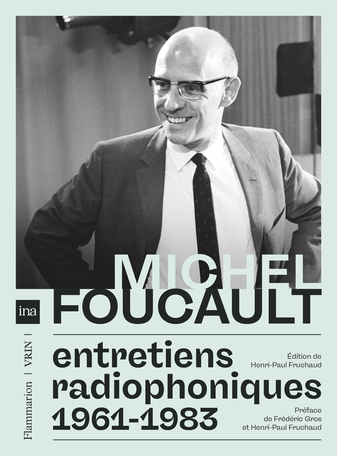
Clare O’Farrell is beginning a series of commentaries on the interviews in Michel Foucault, Entretiens radiophoniques, 1961-1983, Flammarion/VRIN/INA, 2024.
A radical reinterpretation of the Cold War by its most iconoclastic historian.
What was the cold war? Conventional wisdom makes it coextensive with an epoch stretching from the end of the Second World War to the collapse of the Soviet Union, a geopolitical period dominated by the confrontation between the United States and the USSR. In a fundamental challenge to prevailing orthodoxy, Anders Stephanson explodes this misconception, which has misled historians and obscured the US-centered nature of the entire process. He argues that “the cold war” is better understood as the frame that made the global role of the US after 1947 not only possible but imperative, and that in its classic form it ended in 1963, after the Cuban Missile Crisis.
American Imperatives does not assume that the causes of the great superpower rivalry rest solely with the United States. But the frame was unmistakably and ineradicably American. Without it, there would not have been, properly speaking, a cold war.
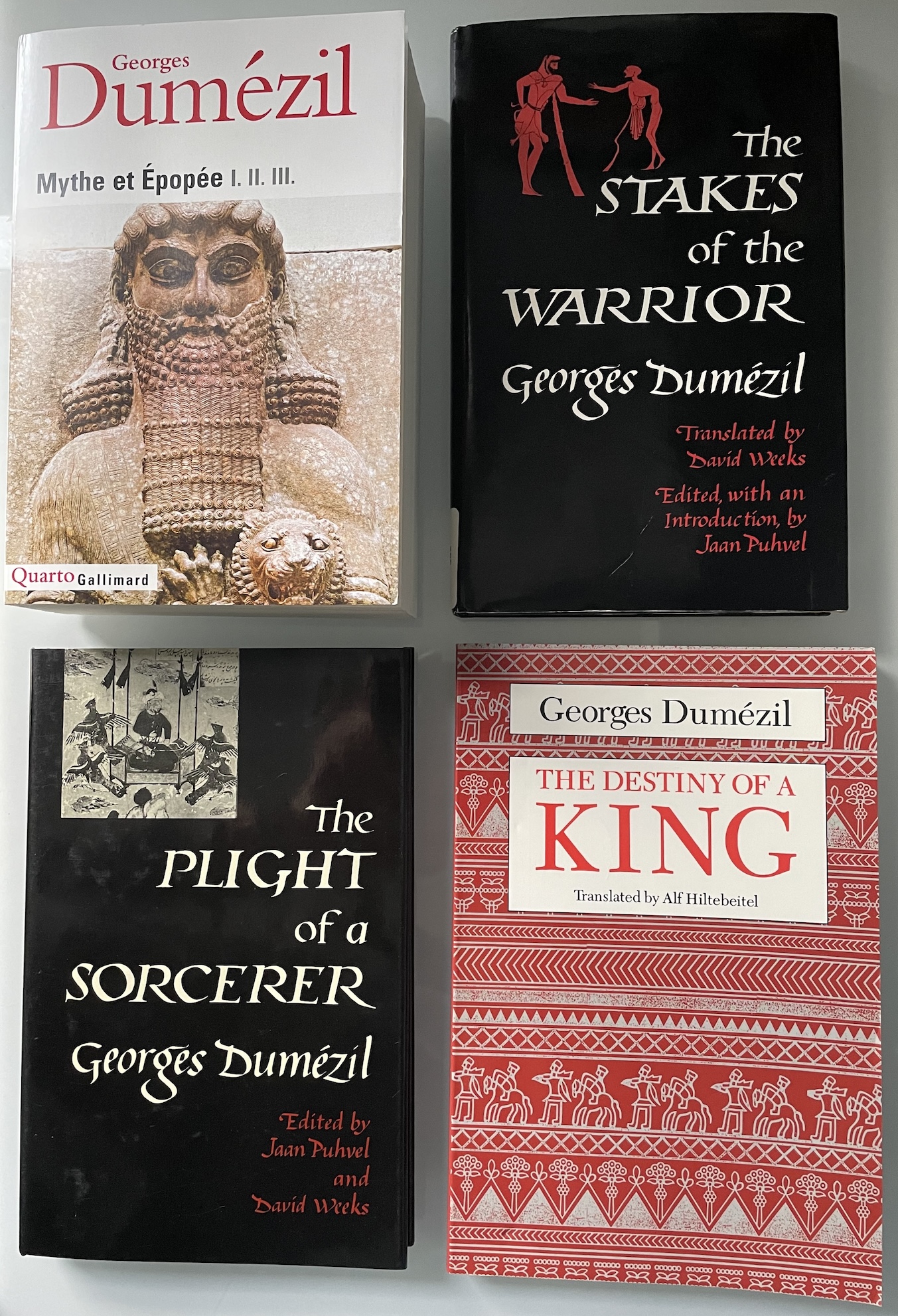
I’ve updated the page on Georges Dumézil’s Mythe et épopée series and its partial English translations with the page references to the 1977 and 1982 notes translated in The Stakes of the Warrior and The Plight of the Sorcerer. The French has notes to all three parts from the editions 1977, 1982 and 1986 gathered at the end of the text in extra pages added to later editions; the English translations of these two parts include the notes in the relevant places. The English translation of the third part, The Destiny of the King, dates from 1973 and so does not include these later notes. None of the 1986 additions are included in English editions.
Apart from the new edition of Mitra-Varuna (print and open access), I think The Destiny of a King is the only work of Dumézil’s in print in English.
This page is part of the research for my project on Indo-European Thought in Twentieth-Century France. For some textual comparison of Dumézil’s major work on the warrior function, Heur et malheur du Guerrier, part-translated as The Destiny of the Warrior, see here; and a few other research resources for that project see here. There are loads more resources here.
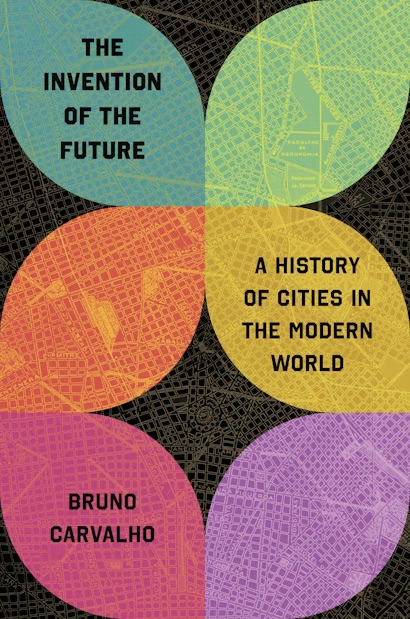
For the past three centuries, urban dwellers and planners have imagined future cities that would be radically different from those of the past. Planners pursued progress, whether focused on flying vehicles above, sewage systems below, or daily life in between. Yet, as Bruno Carvalho shows in this original and wide-ranging history, which features some sixty illustrations, modern cities continuously defied predictions. Visionary designs and technological innovations created dramatic, unforeseen outcomes, and the ongoing urban boom is a story of continuity as well as rupture. A compelling history of imagined futures and the transformation of urban life, The Invention of the Future also suggests what we might learn from the stories of our cities as we shape them for the twenty-first century.
Moving between large-scale changes and detailed examples, this captivating narrative tells the story of key moments and turning points: the rebuilding of Lisbon after the 1755 earthquake; the 1811 Commissioners’ Plan for Manhattan; Parisian reforms from 1853 to 1870; Le Corbusier’s plans for South American cities in the 1920s and 1930s; the postwar victory of the car; the utopian capital of Brasília; and urban growth in Africa.
In recent decades, Carvalho argues, the capacity to invent urban futures has become increasingly constrained. Social and environmental challenges loom large. But the story is not over. While cities helped create current problems, compact and transit-rich urbanization might be our best hope to combine high living standards with sustainability. Sometimes, moving forward can involve reaching back to the future.
This collection brings together scholars from various fields to explore the work, life, and legacy of Henry Corbin (1903–1978), a towering figure in the modern study of Islamic esoteric spirituality. A valuable resource for students and researchers alike, it highlights Corbin’s unique contributions not only to Islamic philosophy and mysticism, but also to Neoplatonism, phenomenology, psychoanalysis, musical and literary theory, film criticism, political thought, and comparative religion.
Corbin is an interesting figure, for as well as the work on Islam mentioned in the book’s abstract, he was also one of the first French translators of Heidegger. He plays a small role in the work I’m currently doing, as a colleague of Dumézil and Benveniste and friend of Mircea Eliade. This book also discusses his importance to Foucault.
Looking beyond the flurry of rapid changes in artificial intelligence, Silicon Empires uncovers the deep economic forces guiding the expansion of AI. Nick Srnicek offers a clear-eyed view of the landscape of generative AI today, while situating it within the broader context of the recent deep learning and cloud computing paradigms. Far from being a disruptive technology, contemporary AI looks set to consolidate the power and position of Big Tech. Yet this power will not come without effort and costs.
Silicon Empires examines the strategies that Big Tech companies are using to expand their control within the AI value chain and across the economy. The implications of this consolidation of power are wide-ranging, particularly in the light of resurgent geopolitical tensions.
This book is a must-read for anyone who wants to understand the forces that are shaping the future of AI.
In 1965, Émile Benveniste published “Structure des relations d’auxiliarité” in Acta Linguistica Hafniensia – a journal founded by the Linguistic Circle of Copenhagen. Its initial editors were Viggo Brøndal and Louis Hjelmslev. Although the journal had been founded in 1939, and published five volumes during the war years, it then became intermittent – volume 6 and 7 in 1951 and 1953, volume 8 only in 1960. (The initial name of the journal was simply Acta Linguistica, and Benveniste had an article in the first issue, “The Nature of the Linguistic Sign”.) Benveniste’s article appeared in volume 9 in 1965, and the journal then published volumes every year or two on a much more regular basis. It continues to appear today.
The Editorial states: “The present volume (IX) marks a new start with a new board of editors”. Some of the delays were due to the death of Brøndal in 1942, after which Eli Fischer-Jørgensen joined Hjelmslev. Hjelmslev died in 1965, and Fischer-Jørgensen worked with Søren Egerod and Hans Christian Sørensen. Benveniste’s text was the lead article, followed by an obituary of Hjelmslev by Fischer-Jørgensen. Fischer-Jørgensen was a phonologist, best known for Trends in Phonological Theory: A Historical Introduction, who had a long-standing correspondence with Roman Jakobson, published in 2020.
There does not seem to be an extensive correspondence between them, but Benveniste was invited to contribute to the journal by Fischer-Jørgensen (8 July 1965) and he must have sent something quickly, because he was asked by Jørgen Rischel for a résumé to accompany the text on 21 September the same year. Benveniste’s article was included in the second volume of his Problèmes de linguistique générale in 1974. That volume was compiled by his students after he had suffered a stroke in 1969 which left him unable to work.
The texts in that volume are generally unchanged from their original publication, though arranged in a thematic way to mirror the structure of the first volume, which Benveniste himself had compiled in 1966. (While the first volume is available in English translation, only a few of the essays in the second have been translated. There is a list here.) The reprint of “Structure des relations d’auxiliarité” in Problèmes 2 is a little different from its original publication – it does not include the summary. It’s not in the archive, but the original article has this summary on the final page (p. 15):
Essai de description synchronique de la relation d’auxiliarité, c’est-à-dire de la fonction des verbes dits auxiliaires et des syntagmes verbaux qu’ils constituent en français moderne. Cette relation, qui se définit comme le rapport entre l’« auxiliant » et l’« auxilié », a une structure binomale. L’analyse permet de dégager trois aspects de l’auxiliation, qui sont successivement étudiés: auxiliation de temporalité (verbe avoir); auxiliation de diathèse (verbe être); auxiliation de modalité (verbe pouvoir). Entre ces trois types d’auxiliation, il y a des possibilités de cumul et aussi des règles d’exclusion. On indique enfin les conditions de l’auxiliation de deuxième degré, ou l’auxiliant devient à son tour auxilié, et les principes généraux relatifs à la structure formelle de l’auxiliation.
An attempt at the synchronic description of the relation of auxiliarity, that is the function of so-called auxiliary verbs and the verbal syntagms/phrases they constitute in modern French. This relation, which is defined as the relation between the ‘auxiliary’ and the ‘auxiliant’, has a binomial structure. The analysis reveals three aspects of auxiliation, which are examined in turn: auxiliation of temporality (verb avoir [to have]); auxiliation of diathesis (verb être [to be]); auxiliation of modality (verb pouvoir [to be able]). Between these three types of auxiliation, are possibilities of accumulation and also rules of exclusion. Finally, the conditions of second-degree auxiliation are indicated, where the auxiliary in turn becomes the auxiliate, and the general principles relating to the formal structure of auxiliation.
(I’m sure this translation could be improved. For the technical terms I’ve tried to follow the precedent of “Mutations of Linguistic Categories”.)
The first page of Benveniste’s summary of the 1965-66 course
The correspondence is in the same box of Benveniste’s archives as what remains of his first 1965-66 Collège de France course, one of a series under the title of Problèmes de Linguistique générale. These courses are interesting, as they are part of a broad reformulation of Saussure’s project. Because of Benveniste’s illness it is not clear how he would have concluded this study, and the course manuscripts and the summaries in the Collège de France Annuaire give only a partial sense. Lectures from the penultimate year of teaching, and the single lecture of the year he had the stroke, have been edited – on the basis of his notes and those of some of his students – in the Last Lectures volume. Irène Fenoglio has talked about the process of editing material into lectures – particularly challenging when there are no known recordings.
Often Benveniste would work up themes from his teaching into publications, but with the course this year it was the other way round. His course did not begin until 6 December 1965, by which time this article on auxiliarity was already in production. The course summary suggests that his course was a development of the themes of the article. In particular, he seems to have gone beyond French, looking at the transition from Latin to Romance languages, and the relation between periphrastic and simple forms of the perfect and future tenses. Tzvetan Todorov attended some of this course, and his notes are in his archive. Benveniste would develop some of these questions in his April 1966 conference presentation in Austin, Texas, “Mutations [Transformations] of Linguistic Categories”, shortly after the completion of the Paris course. In that lecture he draws on further language examples, including Tunica, Aztec, and Old Turkish. While it is part of Benveniste’s final unfinished project, with the course summary, the article, its résumé and the fragmentary notes, and the Austin lecture, there is quite a lot of information on this specific aspect.
[updated above to note Benveniste had published in the first issue of the journal, when it was still simply called Acta Linguistica. Also added a reference to a discussion of the Benveniste-Hjelmslev correspondence.]
References
Viggo Bank Jensen & Giuseppe D’Ottavi eds. From the Early Years of Phonology: The Roman Jakobson-Eli Fischer Jørgensen correspondence 1949-1982, Copenhagen: The Royal Danish Academy of Sciences and Letters, 2020.
Émile Benveniste, “Nature du signe linguistique”, Acta linguistica 1, 1939, 23-29; reprinted in Problèmes de linguistique générale 1, Paris: Gallimard, 1966, Ch. 4; “The Nature of the Linguistic Sign”, Problems of General Linguistics, trans. Mary Elizabeth Meek, Coral Gables: University of Miami Press, 1971, Ch. 4.
Émile Benveniste, Problèmes de linguistic générale 1, Paris: Gallimard, 1966; Problems in General Linguistics, trans. Mary Elizabeth Meek, Coral Gables: University of Miami Press, 1971.
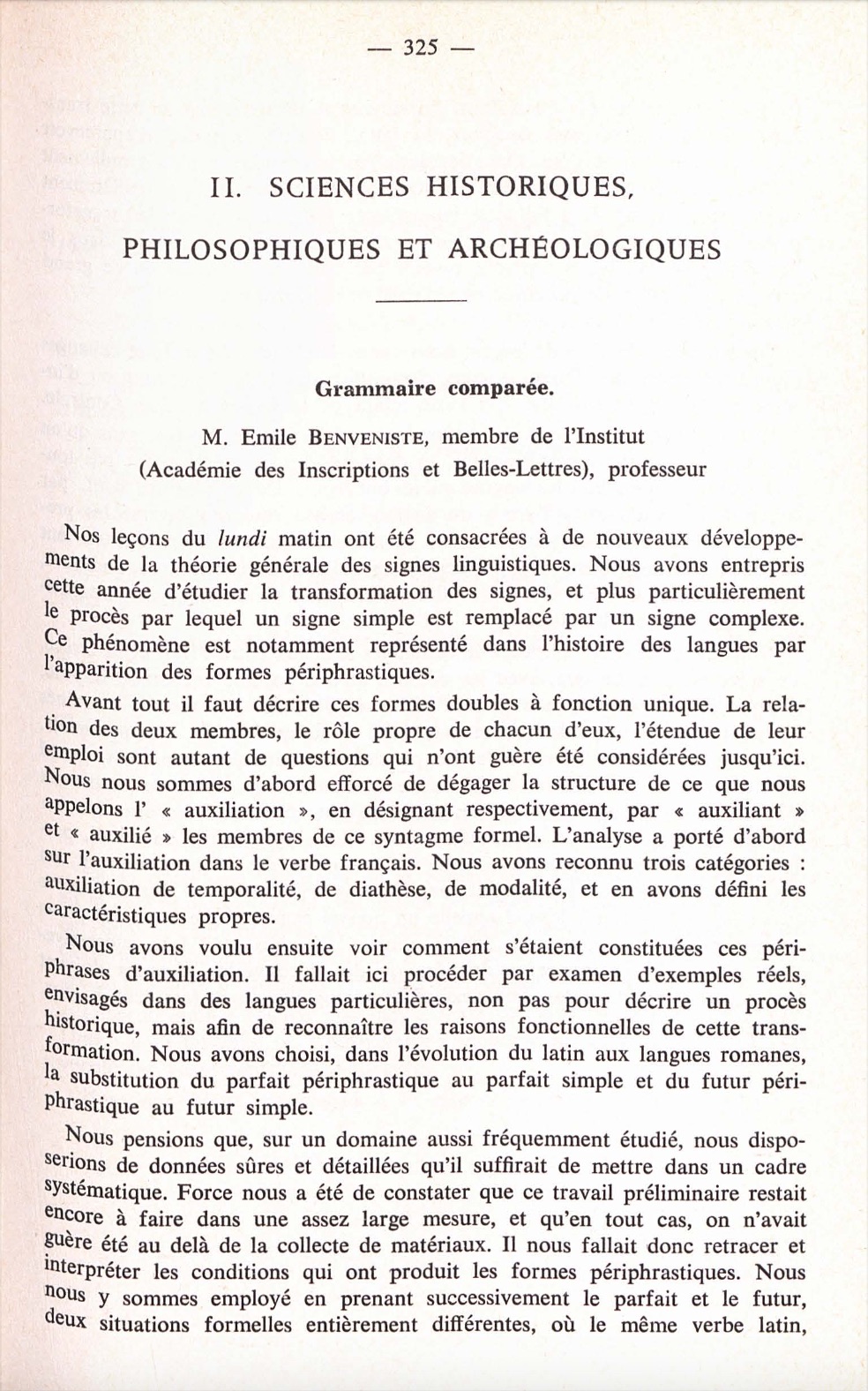
Émile Benveniste, “Grammaire comparée”, Annuaire du Collège de France 66, 1966, 325-26.
Émile Benveniste, “Mutations of Linguistic Categories”, trans. Yakov Malkiel and Marilyn May Vihman, in W.P. Lehman and Yakov Malkiel (eds.), Directions for Historical Linguistics: A Symposium in Historical Linguistics, April 29-30 1966, Austin: University of Texas Press, 1968, 85-94; original French as “Les Transformations des catégories linguistiques” in Problèmes de linguistic générale 2, Paris: Gallimard, 1974, 126-36.
Émile Benveniste, Problèmes de linguistic générale 2, Paris: Gallimard, 1974.
Émile Benveniste, Dernières Leçons: Collège de France 1968 et 1969, ed. Jean-Claude Coquet et Irène Fenoglio, Paris: EHESS/Gallimard/Seuil, 2012; Last Lectures: Collège de France 1968 and 1969, trans. John E. Joseph, Edinburgh: Edinburgh University Press, 2019.
Eli Fischer-Jørgensen, Trends in Phonological Theory: A Historical Introduction, Copenhagen: Akademisk Forlag, 1975.
Irène Fenoglio, “Éditer un cours de linguistique générale à partir d’archives manuscrites. Essai de méthodologie critique”, Langages 209, 2018, 77-96.
Kenji Tatsukawa, “Sous le signe de Saussure : La correspondance L. Hjelmslev – E. Benveniste (1941-1949)”, Linx 9, 1997, 129-41.
Archives
Papiers d’orientalistes box 59, Emile Benveniste, Bibliothèque nationale de France
Fonds Tzvetan Todorov box 19, Bibliothèque nationale de France
This is the 30th post of a weekly series, where I post short essays with some indications of further reading and sources, but which are not as formal as something I’d try to publish more conventionally. They are usually tangential to my main writing focus, a home for spare ideas, asides, dead-ends and possible futures. I hope there is some interest in them. They are provisional and suggestions are welcome.
Michel Foucault, in La volonté de savoir (1976), described how the mechanisms of the examination of conscience belonging to the pastoral tradition of the 17th century progressively extended to all areas of society, marking the threshold of a biopolitical modernity. Here, the ‘will to knowledge’ is not the subject’s drive for research, but the injunction to bring into the field of knowledge-power those borderline domains of life that had been previously excluded from it: death, birth, sexuality. This process of the adherence of knowledge to bodies entirely invests our time and urges us to reflect on the figures of the ‘will to knowledge’ in the new millennium: the questions of surveillance, of the constant and widespread mapping of life in its social and biological dimension, of ubiquitous visibility, of the collapse of the limits between inside and outside, between inside and outside of work, of wakefulness, of private life, are explored by artistic and design forms. ‘The will to knowledge’ also carries a more straightforward, primary meaning: here we encounter the sphere of the desire for knowledge and its challenges, a theme constantly evoked today – above all, that of finding orientation within a hypertrophic labyrinth of information. Thus, a few years after Foucault’s work, we encounter another text on the inexhaustible drive towards knowledge, its infinite resources of seduction, its lethal traps. With The Name of the Rose (1980), Umberto Eco constructs a thriller whose origin lies in the will to knowledge, with a book at its centre and, surrounding it, the desire of the aspiring initiates in opposition to the strenuous defence mounted by the custodians of tradition. The ‘will to knowledge’ evokes both the symbol of infinity, to express the limitless scope of knowledge, and the labyrinth, to indicate its intricate structure and the countless possible paths through it.
Timeline Sections: Project, Essay, Journey, Archive, Ring, Tutorial, Translation, Fundamentals Abstracts must be submitted by September 5, 2025 Abstracts acceptance notification by September 15, 2025 Papers submission by November 10, 2025
Section: Tale Papers submission by September 5, 2025 Papers acceptance notification by September 15, 2025
The business of imperial conflict: Why capitalism needs war.
Maurizio Lazzarato’s War and Money explores the connections between capitalist expansion, international economic conflict, and war, via an analysis of the imperialism of the American dollar. He examines why contemporary left-wing theorists such as Michel Foucault and Antonio Negri have failed to recognize war as a fundamental aspect of capitalism. Renewed readings of Marx, Lenin, and Rosa Luxemburg argue for class struggle against capitalist war as a fundamental aspect of leftist theory.