While Bourdieu’s work on cultural production, the reproduction of inequality and the rise of the modern state is well known, his writings on the phenomena of internationalization and imperialism have received much less attention. Bourdieu’s analyses of the international circulation of ideas and the imperialisms of the universal – where two political powers, such as the United States and France, clash on matters of cultural legitimacy – generated multiple research programmes on topics ranging from translation and scientific exchange to global economic policy. The constitution of globalized domains where national problems like unemployment, ethnicity and poverty are subjected to international import-export processes serves to naturalize the dominant vision of dominant countries and impose it on national political contexts.
Freedom, democracy and human rights have been constituted as universal values and some countries claim to embody these values more than others. However, historical analysis shows that things are not so simple and that the actual content given to these values does not necessarily have the universality they claim. For example, the claim to universality of past colonial or imperial policies arouses suspicion in the eyes of some, to the point of calling into question the very idea of universality. But it is possible to move beyond the alternative between, on the one hand, a naïve belief in universality and, on the other, a disenchanted relativism that sees the universal as nothing more than a disingenuous way to legitimize particular interests. Bourdieu argues that the theory of fields enables us to move beyond this alternative by showing that the struggle for the universal can produce its own forms of universality that transcend particular interests.
This volume of Bourdieu’s writings on internationalization, imperialism and the struggle for the universal will be of interest to students and scholars in sociology, anthropology, politics and the social sciences and humanities generally.
This is a revised, expanded and more fully referenced version of a post from March 2024. There is a Spanish translation of the earlier version here.
Alexandre Kojève’s seminars on Hegel’s Phenomenology of Spirit, given at the École Pratique des Hautes Études in the years before the Second World War, are an important and much discussed moment in European intellectual history. He was deputising for Alexandre Koyré, while Koyré was teaching in Cairo. Koyré’s lectures were on Hegel and the philosophy of religion; Kojève broadened the focus. The lectures were edited and published in 1947 by Raymond Queneau, and about half of that volume was translated into English by in a selection by Allan Bloom. A complete translation of the lectures by Trevor Wilson is forthcoming from Routledge.
While Kojève’s lectures on Hegel are quite often discussed, they are almost as famous for their audience as their content. A lot of interesting figures were there: Henry Corbin, Jacques Lacan, Georges Bataille, Queneau, and Éric Weil all attended in the first year. There are many, often conflicting, reports of who else was there in subsequent years. I’ve seen Hannah Arendt, Raymond Aron, Maurice Blanchot, André Breton, Alexandre Koyré, Emmanuel Lévinas, Maurice Merleau-Ponty, and Jean-Paul Sartre all mentioned. I said in The Early Foucaultthat Louis Althusser attended (p. 11), but I’ve been told I was mistaken, and a December 1946 letter from Althusser to Kojève indicates that this correction is right – it’s clearly not a letter from someone who had attended these classes. I’ve also seen reports that Henri Lefebvre attended, but when I mentioned this in Understanding Henri Lefebvre (p. 96 n. 33), I said this was uncertain.
The focus here is not about Kojève’s seminar itself. Rather, it concerns how Kojève was working on a French translation of the Phenomenology before the war; who he was potentially working with; and why this was never completed.
In the Kojève archive there is correspondence with Gaston Gallimard in June 1938 indicating that a contract for a translation was close to being agreed. Gallimard offered a royalty of 7% and 10 complementary copies. Kojève wanted 12% for the first 1000 sold and 15% of those afterwards, and 25 copies. Bernard Groethuysen acted as an intermediary on behalf of Kojève with Gallimard. Groethuysen is an interesting figure in his own right, as a translator of Goethe and writer on the French Revolution and political theory, as well as important in the French reception of Kafka. He also founded Gallimard’s “Bibliothèque des idées” series with Jean Paulhan, in which Kojève’s Hegel course first appeared. It seems this series would have included the planned translation.
Kojève’s request was conveyed to Gallimard by Groethuysen, but Gallimard argued that increasing the royalty would put up the cost, which would make the book prohibitively priced, and therefore would benefit none of them. But Gallimard would happily agree to additional copies. Then the surviving Kojève-Gallimard correspondence ends, until it is picked up after the war in relation to publishing books written by Kojève, notably his Essai d’une histoire raisonnée de la philosophie païenne, which also appeared in the Bibliothèque des idées series. Could it really be that Gallimard’s low royalty had derailed the translation?
Kojève’s correspondence with Groethuysen suggests there had previously been another idea. In January 1938 Groethuysen had said that he hopes the saga of the translation could be ended, and that he wanted to introduce Kojève to Henri (misspelt as Henry) Lefebvre. He suggests a three-way meeting, which from subsequent correspondence seems to have happened. (This seems to confirm that Lefebvre had not attended the earlier seminars.) There is one letter from Lefebvre to Kojève in which Lefebvre agrees they should join forces, but notes when they met that they had not decided on a division of labour. Lefebvre indicates the sections of the text for which he has a translation already, and suggests that they could each work on parts. Would Kojève agree to this divide?
The correspondence with Lefebvre predates the correspondence with Gallimard, so it is possible Kojève rejected the offer and decided to go alone. Notably Lefebvre, along with Norbert Guterman, would publish Morceaux choisis of Hegel with Gallimard shortly afterwards. That book has gone through multiple editions, and Gallimard’s website says it was published on 1 January 1939. Georges Canguilhem damns the book with faint praise: “A useful book, but more likely, by its very nature, to whet the appetite than to satisfy it” (“Hegel en France”, Œuvres completes IV, 327). However, the amount of translated material Lefebvre tells Kojève could be part of a joint venture is much more extensive than the short passages included in Morceaux choisis.
In April 1939 – ten months after the discussion of royalties – Groethuysen writes to Kojève to say that Gallimard has told him that Fernand Aubier will be publishing a translation of the Phenomenology by Jean Hyppolite – misspelt as ‘Hippolyte’. Gallimard doesn’t think two versions in quick succession would be viable. Groethuysen tells Kojève that this is “more than annoying… it’s a disaster”. He says that Hyppolite’s translation was known about, but that he had been assured it was not going to be published. Groethuysen wonders if at least a part of Kojève’s translation could be published, with a commentary. A second-best solution, he thinks, but at least something. Here, again, the correspondence in the files breaks off.
Hyppolite had reportedly chosen not to attend Kojève’s seminar for fear of being influenced. His translation of Hegel’s Phenomenology of Spirit would appear in two volumes in 1939 and 1941, and his massive commentary on the text, Genesis and Structure in Hegel’s Phenomenology of Spirit, also in two volumes in 1946. The latter was recently reedited by Giuseppe Bianco for Classiques Garnier. Amazing as it might seem, these two pieces of work were submitted for his doctoral degree: Genesis and Structure the primary thesis; the translation the secondary thesis. Hyppolite is a major and, I think, somewhat neglected figure today, though there has been some interest in his work in English recently – Philosophy, Politics and Critique recently had a few pieces about him, for example. Hyppolite was the supervisor of Foucault’s recently rediscovered and published diploma thesis on Hegel and rapporteur for his secondary doctoral thesis translating and commenting on Kant’s Anthropology. Bianco has edited a good collection on Hyppolite, which includes his Collège de France course summaries (on which, see here).
Kojève’s commentary, when it did appear after the war in 1947, was a significant moment in itself. The different readings of Hyppolite and Kojève have been discussed in various places. I briefly talk about this in a piece on “Canguilhem, Dumézil, Hyppolite” (requires subscription), mainly through the reading Canguilhem made of “Hegel en France”. Canguilhem rightly indicates the importance of Jean Wahl and Koyré’s earlier work on Hegel in shaping the French reception. Koyré’s important essays on Hegel, including ones on the translation challenges, are reprinted in Études d’histoire de la pensée philosophique. That’s a side of his work which is neglected today, compared to his work on the philosophy and history of sciences.
The correspondence in the fonds Kojève indicates that Lefebvre had much more material than he and Guterman published – or, possibly more likely, he and Guterman had more material which Lefebvre told Kojève he could use for their project. By 1938 Guterman, who was Jewish, was in exile in the United States, and he and Lefebvre’s joint working relationship was largely conducted by letter. I’d long thought it was Guterman who did most of the translation work for their joint ventures before the war, with Lefebvre taking the lead on the commentaries. Guterman would carve out a career in the US as a translator, as well as working with Leo Löwenthal on Prophets of Deceit: A Study of the Techniques of the American Agitator, first published in 1949, recently reedited by Verso. The Second World War and the German occupation made publishing much more complicated, as I discuss in relation to Lefebvre in an earlier piece – “Henri Lefebvre and the “Liste Otto” of Prohibited Books in Occupied France“.
Although the translation work itself doesn’t seem to be discussed in Marco Filoni or Jeff Love’s books on Kojève, Stefanos Geroulanos has indicated how much work Kojève had done preparing his lectures over several years, including translating Hegel.
With the exception of the final year of his course, 1938–39, where his lectures numbered to twelve, Kojève always gave more than twenty lectures (twenty-one the first year, twenty-two the second, twenty-four the third, twenty-six the fourth, and twenty-five the fifth). Kojève numbered the pages of his lecture notes, including in this count the translations he worked off. Though notes from the first four years are relatively scarce, the translation survives in full, and the final page numbers in each of these years indicate a total of more than 2,682 pages of notes.
Those notes are in the Kojève archive. Perhaps the Lefebvre archive will shed light on what, if anything, survives of the material he told Kojève about. Lefebvre’s papers have been deposited at IMEC, and are currently being catalogued. 140 boxes of material is going to take some time for researchers to make sense of – that’s a similar amount of material to the different Foucault collections at the Bibliothèque nationale. How a collaborative project to merge these two translations by Kojève and Lefebvre could have worked is open to question. But the correspondence alone sheds a little light on an interesting aspect of the story of Hegel in twentieth-century France.
Giuseppe Bianco ed., Jean Hyppolite: Entre Structure et Existence, Paris: ENS, 2013.
Georges Canguilhem, “Hegel en France”, Revue d’histoire et de philosophie religieuses 28-29 (4), 1948, 282-97, reprinted in Œuvres complètes tome IV: Résistance, philosophie biologique et histoire des sciences 1940-1965, ed. Camille Limoges, Paris: Vrin, 2015, 321-41.
Stuart Elden, Understanding Henri Lefebvre: Theory and the Possible, London: Continuum, 2004.
Stuart Elden, The Early Foucault, Cambridge: Polity, 2021.
Marco Filoni, The Life and Thought of Alexandre Kojève, Evanston: Northwestern University Press, 2025.
Marco Filoni and Massimo Palma eds., Tyrants at Work: Philosophy and Politics in Alexandre Kojève, Napoli: Editions ETS, 2024.
Michel Foucault, La constitution d’un transcendantal historique dans la Phénoménologie de l’esprit de Hegel: Mémoire du diplôme d’études supérieures de philosophie, ed. Christophe Bouton, Paris: Vrin, 2024.
Stefanos Geroulanos, An Atheism that is not Humanist Emerges in French Thought, Stanford University Press, 2010.
Boris Groys, Alexandre Kojève: An Intellectual Biography, London: Verso, forthcoming 2025.
Norbert Guterman and Leo Löwenthal, Prophets of Deceit: A Study of the Techniques of the American Agitator, Verso, 2021 [1949].
G.W.F. Hegel, Morceaux Choisis, ed. and trans. Henri Lefebvre and Norbert Guterman, Paris: Gallimard, 1939.
G.W.F. Hegel, Phénoménologie de l’esprit, trans. Jean Hyppolite, Paris: Aubier, two volumes, 1939-41.
Jean Hyppolite, Genèse et structure de la Phénoménologie de l’esprit de Hegel, ed. Giuseppe Bianco, Paris: Classiques Garner, 2022 [1946]; Genesis and Structure in Hegel’s Phenomenology of Spirit, trans. Samuel Cherniak and John Heckmann, Evanston: Northwestern University Press, 1974.
Isabel Jacobs and Trevor Wilson eds. “Alexandre Kojève and Russian Philosophy”, Studies in East European Thought, Vol 76 No 1, 2024.
Immanuel Kant, Anthropologie du point de vue pragmatique, trans. Michel Foucault; and MichelFoucault, Introduction à l’Anthropologie, Paris: Vrin, 2008.
Alexandre Kojève, Introduction à la Lecture de Hegel, ed. Raymond Queneau, Paris, Gallimard, 1947.
Alexandre Kojève, Introduction to the Reading of Hegel: Lectures on the Phenomenology of Spirit, ed. Allan Bloom, trans. James H. Nicholls, Jr., New York: Basic Books, 1969.
Alexandre Kojève, Essai d’une histoire raisonée de la philosophie païenne, Paris: Gallimard, three volumes, 1968-73.
This is the twenty-ninth post of a weekly series, where I post short essays with some indications of further reading and sources, but which are not as formal as something I’d try to publish more conventionally. They are usually tangential to my main writing focus, a home for spare ideas, asides, dead-ends and possible futures. I hope there is some interest in them. They are provisional and suggestions are welcome.
Despite the Mycenaean Linear B script having been deciphered some seventy years ago, much has remained uncertain regarding the ritual ideology of Mycenaean society that the Linear B documents reveal. Roger Woodard here explores this problem by investigating a new range of sources from the Late Bronze Age and Early Iron Age, together with processes of the transfer of knowledge between Anatolia and European Hellas. Bringing together evidence from Mycenaean culture with mythic and cult traditions of Iron Age Greek culture and Indo-Iranian sources, he reveals the close parallels between Mycenaean and Vedic ritual structures and practices, these being particular expressions of Mycenaean Asianism. He also demonstrates how features inspired from Indo-Iranian sources are present in Aeolian Greek epic traditions that emerged during the Iron Age, notably the Argonautic search for the Golden fleece.
Provides examples of inter-disciplinary and multi-disciplinary approaches to the study of Mycenaean and Early-Iron-Age Greek language, myth, society, and culture
Provides examples of inter-disciplinary approaches to the study of Indic and Iranian cult as it existed along the frontiers of Anatolia and its influence on Mycenaean Greek mythic thinking within Anatolia
Makes the arguments and findings accessible to specialist and non-specialist readers alike
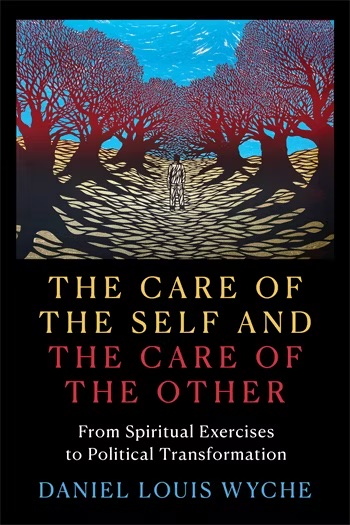
What is the relationship between the ethical transformation of the self and the political transformation of the world? This book explores the ways several twentieth-century thinkers can help us relate the “care of the self” to the “care of the other,” tracing their accounts of how and why practices intended to change an individual can help spur social and political change, just as collective political action can produce a transformation of the self.
Daniel Louis Wyche examines the political implications of what he calls practices of ethical self-change. These include Pierre Hadot’s notion of “spiritual exercises”; what the French sociologist of labor Georges Friedmann calls the “interior effort”; Michel Foucault’s ethics of the “care of the self”; what Martin Luther King Jr. refers to as the work of “self-purification” integral to direct action; and Audre Lorde’s claim that caring for herself constitutes a form of “political warfare.” Wyche argues that these concepts can collectively provide an understanding that effaces distinctions between the care of the self, the other, and the community in a way that avoids reducing the political to the ethical. Ambitious and nuanced, The Care of the Self and the Care of the Other offers a framework for unifying individual moral action and collective political life.
Empowering Workers in an Age of Automation explores how labour market policymakers should respond to the threats and opportunities that arise from automation, artificial intelligence, and other forms of technological progress. The book’s aim is twofold. First, it is to develop and defend a novel philosophical framework for theorizing about the demands of social justice in the labour market, which Parr calls ‘the empowerment model’. At the heart of this view is a concern for fairness and, more specifically, a concern for the growing inequality in prospects between members of the working-class and their middle- and upper-class counterparts. Second, it is to examine a range of concrete political controversies relating to labour markets and the future of work in the light of the empowerment model. The analysis presented is wide-ranging, and includes discussion of technological unemployment, the four day work week, the gender earnings gap, working from home, and role of higher education.
Throughout the text, Parr is keen to caution against sensationalist narratives, and instead emphasizes the more prosaic but still hugely consequential ways in which technology is changing how we work. To do this, he draws on a wealth of empirical research, and extensively from findings in labour economics. The result is a book that takes seriously, and aims to shed light on, some of the most pressing challenges that we actually face.
Au fond de la politique, qu’y a-t-il sinon la guerre ? Et cette guerre, comment la définir ? Telles sont les questions posées par Michel Foucault dans son cours au Collège de France, Il faut défendre la société, comme une analyse des fondements de la conception raciste et exclusiviste de la société. À la première question, il répond que la politique a été pensée depuis toujours comme un rapport de force. À la deuxième question, la réponse toujours actuelle ne manque pas de faire grincer des dents, puisqu’au fondement des batailles menées par la politique, que trouvons-nous sinon des « guerres de races » ? Renversant l’axiome de Carl von Clausewitz qui soutenait qu’avec la modernité « la guerre n’est que la simple continuation de la politique par d’autres moyens », Foucault affirme, au contraire, qu’aujourd’hui la politique est de plus en plus continuée par la guerre. À l’interrogation « sommes-nous à la veille de faire la guerre ? », il invite à se demander s’il est possible d’arrêter cette machine infernale.
Au sujet de la représentation des conflits comme « guerre des races », Foucault demande s’il est possible de filtrer la « violence barbare ». De la même façon, comment filtrer la « violence de l’État » ? À la première question, il répond que le récit historique a produit trois filtres qui permettent de rendre compte à la fois de la monarchie absolutiste et de son épuisement jusqu’à la Révolution avec l’émergence de l’État-nation. À la deuxième question relative au racisme d’État et à l’État d’exception qui apparaît au nom de la « défense de la société », il reste plus circonspect, en particulier quant aux attentes placées dans l’espérance de la société assurancielle ou à l’égard de ce qu’il appelle le « chantage des Lumières ». Les questions essentielles restant pour lui : comment arriver à se détacher de la représentation du conflit politique ou du dissensus intellectuel en termes de guerre ou de guerre des races ? À quelles conditions pouvons-nous renouveler la culture politique contemporaine ?
With the publication of Georges Bataille, Critical Essays Volume 2: 1949-51 (trans. Chris Turner, eds. Alberto Toscano and Benjamin Noys), English readers now have access to all of the essays in volume 11 of Bataille’s Œuvres complètes and a good chunk of volume 12. The last promised volume of Critical Essays should cover the rest of volume 12.
Given the very useful “Bibliography and Notes” in Critical Essays, doing this update was an easy task. With Volume 11, this site’s bibliography is now mainly of use for showing where the pieces which are not in Critical Essays can be found – mostly in The Absence of Myth and Essential Writings.
We should be grateful to the editors and translator for including all the hitherto untranslated pieces from the years they cover, without leaving any missing from the years they cover, and generally not providing new translations of ones already in English just for the sake of it. Given the sporadic and inconsistent approach to translations of Bataille before this, this more systematic approach is very welcome. One thing which initially confused me is that some of Bataille’s longer reviews are split into two or three essays in the English.
Shakespeare in Tongues interrogates the popular conflation of “the language of Shakespeare” with English by examining the role Shakespeare’s works have played in overlapping histories of colonialism, slavery, and migration that continue to shape the linguistic cultures of the United States.
Opening up urgent and overdue conversations about linguistic oppression, racism, and resistance within the settler colonial nation-state, Kathryn Vomero Santos draws our attention to artists, activists, and educators who have conjured, embraced, remade, and rejected Shakespeare in service of multilingual counternarratives that push back against dominant perspectives, refuse assimilation, and strive for more polyglot and polyvocal futures. As they shine a bright light on the legacies of the federal Indian boarding school system, Indigenous language revitalization efforts, the militarization of the U.S.–Mexico border, and battles over ethnic studies in classrooms, these critical and creative engagements with Shakespeare offer powerful examples of how his works might be used to facilitate a more truthful understanding of the past and to identify restorative paths forward.
Shakespeare in Tongues issues an imperative to redirect the material and intellectual resources that have been devoted to Shakespeare and his language toward truth, justice, and healing. This is essential reading for anyone studying or researching Shakespeare, race, translation, adaptation, and comparative literatures.
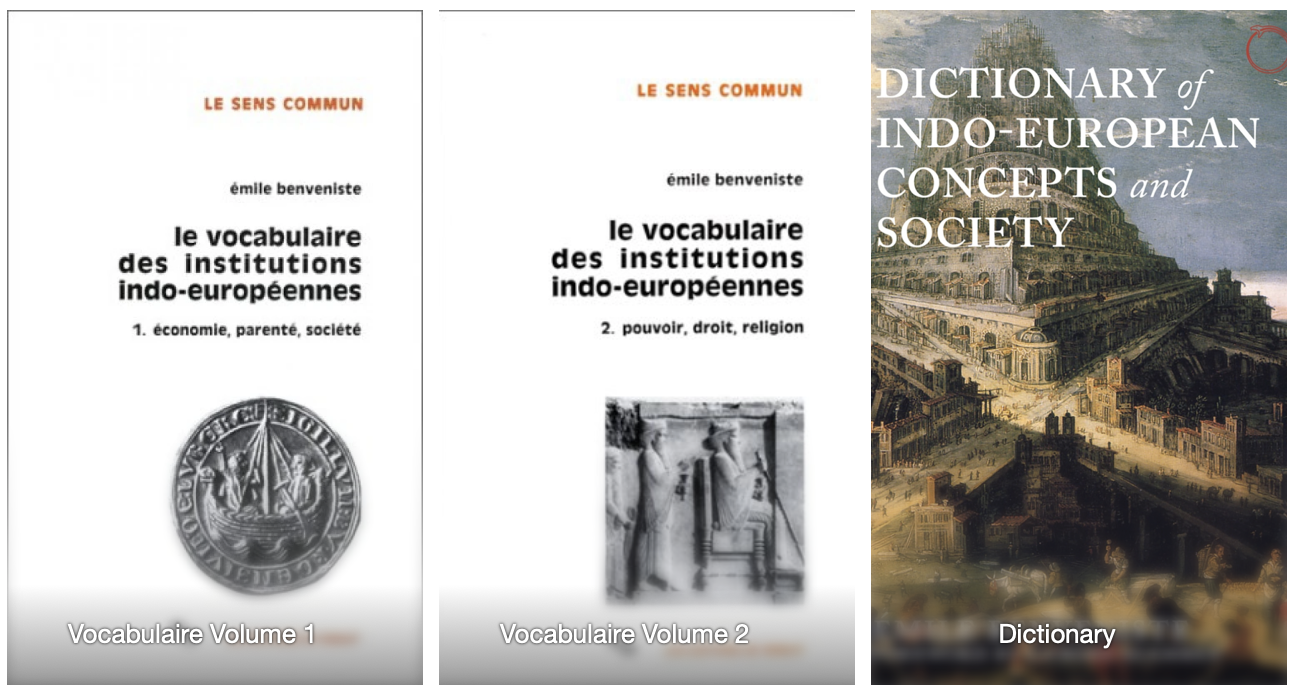
In his Vocabulaire, the Dictionary of Indo-European Concepts and Society,Émile Benveniste mentions some questions relating to spatiality and territory that I have briefly surveyed here. One question he raised I said was worthy of further attention.
In his French text, and its English translation, the word in question is transliterated as wánaks, but it is usually rendered as wanax. It is a term from Mycenaean Greek, first accessed through the deciphering of the Linear B script. It is found in a later form in Homer, usually written as anax,but there is a danger in assuming that term straight-forwardly explains the earlier one (see Palaima, “The Nature of the Mycenaean Wanax”, 123; Yamagata, “ἂναξ and βασιλεύς in Homer”). (I understand the difference in spelling is because the letter digamma or wau at the beginning of the word became obsolete.) James T. Hooker sets out the linguistic evidence, and its limitations, in “The wanax in the Linear B Texts”; Lothar Willms explores its plausible roots in “On the IE Etymology of Greek (w)anax”.
Benveniste was an interested participant in the first international conference after Michael Ventris’s decipherment of Linear B in the early 1950s (on which, see here). In his Vocabulaire Benveniste describes the wanax as the “holder of royal power, even if we cannot define the extent of his territory [l’étendue de son territoire]” (Vocabulaire Vol II, 24; Dictionary,320). In the earlier post I gave this as one example of how his work was more interesting for spatial and territorial questions than I had perhaps previously recognised.
Benveniste indicates that:
Greek possesses two names for the king, basileús (βασιλεύς) and wánaks (wάναξ). These two terms do not exist on the same level, but they both defy any etymological analysis. They have no correspondent in other languages, and we cannot even detect any connections, even partial ones, within Greek itself (Vocabulaire Vol II, 23; Dictionary, 319).
For Benveniste, the Mycenaean sources indicate that “the basileús was merely a local chieftain, a man of rank [notable] but far from a king”, without “political authority”, whereas the wánaks was “the holder of royal power” (Vocabulaire Vol II, 24; Dictionary, 320). Benveniste suggests that the analysis of the words in Homer can be revealing. Wánaks is a term used to describe Apollo and also Zeus, while basileús is not used to describe a god. A human could be both a wánaks and a basileús, but not all the chieftains have the higher status. “There are even degrees and a kind of hierarchy among basileîs, to judge by the comparative basileúteros and the superlative basileútatos, whereas there is no such variation on wánaks in Homer” (Vocabulaire Vol II, 25; Dictionary, 321). Benveniste therefore suggests this distinction:
This implies that wánaks alone designates the reality of royal power; basileús is no more than a traditional title held by the chief of the génos, but which does not correspond to a territorial sovereignty [une souveraineté territoriale] and which a number of persons may hold in the same place (Vocabulaire II, 26; Dictionary,321).
The relation of the basileus, often translated as king, to the genos, the people in the sense of a shared kinship or tribe, is another question entirely. But the idea of the wanax is interesting, since it suggests a higher form of kingships over more tribal chiefs, with a meaning close to king of kings or high king. If the basilieús is subservient, Benveniste stresses that this form of power could be shared and is not territorial in its object.
As Margalit Fox indicates:
At the head of each palace hierarchy stood the wanax, the early Greek word for ‘king’ or ‘ruler’, written, according to Linear B spelling rules, as wa-na-ka. (The word’s descendant, anax, meaning ‘lord’ or ‘master’, turns up five hundred years later in Homeric Greek. The wanax was the administrative leader of each Mycenaean kingdom, overseeing domestic economics and foreign trade, military preparedness, ritual observance, law, and in an inevitability that seems a hallmark of every human civilization, taxation (The Riddle of the Labyrinth, 272).
This is important in terms of a type of political power and its relation to a spatial question. In a discussion of the Greek word krátos, Benveniste draws some distinctions. In the first sense, it implies “superiority [prevalence] or advantage”, which may be “power [pouvoir] as an individual attribute”, i.e. being master of oneself, or“‘power [pouvoir]’ as power [puissance] in a territorial or political sense”. The other sense is about power as hard compared to soft, and may mean “brutal, cruel, painful”. Of the latter, he says that “it never acquires a social or political value and it has unfavourable connotations” (Vocabulaire II, 80-81; Dictionary,369). The first though, itself split, and there is a distinction made between pouvoir and puissance, hard to render in English, but perhaps power as capacity and power as force might capture something of this. (Foucault almost exclusively uses ‘pouvoir’.)
If some rulers do not necessarily have a spatial extent of their power, Benveniste does recognise that other terms do have a spatial component. One example is the demos, from which of course we get the word democracy – the kratos of the demos. “Dēmos is a territorial and political concept [concept territorial et politique], and it designates both a division of land [une portion de territoire] and the people who inhabit it” (Vocabulaire II, 90; Dictionary,378). This fits with an analysis I have made elsewhere of the different senses of the Greek deme (see Elden, The Birth of Territory, Chapter 1, 37-38).
The wanáks or wanax might be a large land-owner, but the power they exercise is not primarily tied to land. As Cynthia Shelmerdine says:
His superior rank and title make it easy to see him as the political and administrative head of state, and the throne in the main megaron [great hall] was no doubt reserved for him, but other archaeological evidence for kingship is almost non-existent: the Mycenaeans, like the Minoans, lacked the impulse to depict their ruler in frescoes or other arts. The limited focus of the tablets, in turn, means that it is hard to discern the full range of his functions. We never see the king acting directly as a military leader, a lawgiver, or an international statesman. Indeed, the noun wanax appears fewer than 20 times in the whole Linear B corpus of some 4500 tablets, and only two texts show the king actually doing anything (“Mycenean Society”, 128).
These two instances are appointing someone to a role “probably a provincial official”, and taking part in a ceremony. Shelmerdine says the role is clearer as an “economic administrator” (“Mycenean Society”, 128-29). Thomas G. Palaima offers a detailed discussion, relating this to Georges Dumézil’s analysis of the three functions, and following Dumézil’s cautions about the situation of the king in relation to them. Palaima also wants to guard against projecting back from subsequent understandings into earlier models – the later Greek basileus, the Homeric wanax or basileus, and the Mycenaean wanax may not be straight-forwardly equivalent; nor are these understandings “purely or mainly Indo-European”, since the words are “likely borrowings from foreign cultures” (“The Nature of the Mycenaean Wanax”, 122-23).
While Shelmerdine (and Benveniste) both stress the rule or administrative oversight role are not territorial, other analyses do stress that aspect. Klaus Kilian argues that the wanax is both the “head of the social hierarchy” and “the most important (though not the sole) co-ordinator of the landholding system” (“The Emergence of Wanax Ideology in the Mycenaean Palaces”, 293). He goes on to suggest that the wanax of Tiryns was “the secular and religious lord of his territory” (293-94). Palaima suggests that:
At the pinnacle of the Mycenaean socio-political hierarchy stood the wanax, the figure around whom the Mycenean palatial system was created. It is not difficult to speculate how and why a borrowed, non-Greek term was used for this central figure of authority and power. There was a transition from a society with many locally based chieftains (each a basileus) to one in which single figures (each a wanax) held power over larger, separate territories and over the local communities in which the basilêes continued to function (“The Nature of the Mycenaean Wanax”, 125).
In time, basileus would become the more common term for a ruler, and the wanax seems to have become less common. I would hesitate over the use of ‘territory’ to describe the object of their rule, but the distinction, and the spatial extent of their power, is an interesting question raised by Benveniste, and as I’ve indicated here, by other writers on Greek kingship.
Émile Benveniste, Le Vocabulaire des institutions indo-européennes, 2 volumes,Paris: Éditions de Minuit, 1969; Dictionary of Indo-European Concepts and Society, trans. Elizabeth Palmer, Chicago: Hau Books, 2016; originally published as Indo-European Language and Society, Coral Gables: University of Miami Press, 1973.
Pierre Carlier, “Wa-na-ka derechef: Nouvelles réflexions sur les royautés mycéniennes”, BCH [Bulletin de Correspondance Hellénique] 122 (2), 1998, 411-15, https://una-editions.fr/wa-na-ka-derechef/
Stuart Elden, The Birth of Territory, Chicago: University of Chicago Press, 2013.
Margalit Fox, The Riddle of the Labyrinth: The Quest to Crack an Ancient Code and the Uncovering of a Lost Civilisation, New York: Ecco, 2014.
J.T. Hooker, “The Wanax in the Linear B Texts”, Kadmos 18, 1979, 100-11.
Klaus Kilian, “The Emergence of Wanax Ideology in the Mycenaean Palaces”, Oxford Journal of Archaeology 7 (3), 1988, 291-302.
Stephen O’Brien, “The Development of Warfare and Society in ‘Mycenaean’ Greece”, Stephen O’Brien and Daniel Boatright (eds.), Warfare and Society in the Ancient Eastern Mediterranean. Papers arising from a colloquium held at the University of Liverpool, 13th June 2008, BAR International Series, 2013, 25-42.
Thomas G. Palaima, “The Nature of the Mycenaean Wanax: Non-Indo-European Origins and Priestly Functions”, in Paul Rehak (ed.), The Role of the Ruler in the Prehistoric Aegean, Liège: Université de Liège, 1995, 119-39.
Cynthia W. Shelmerdine, “Mycenaean Society” in Yves Duhoux and Anna Morpurgo Davies (eds.), A Companion to Linear B: Mycenaean Texts and their World, Louvain-la-Neuve: Peeters, 2008, Vol I, 115–58.
Cynthia W. Shelmerdine, “The Individual and the State in Mycenaean Greece”, Bulletin of the Institute of Classical Studies 54 (1), 2011, 19-28.
Lothar Willms, “On the IE Etymology of Greek (w)anax”, Glotta: Zeitschrift für griechische und lateinische Sprache 86, 2010, 232-71.
Naoko Yamagata, “ἂναξ and βασιλεύς in Homer”, The Classical Quarterly 47 (1), 1997, 1-14.
This is the twenty-eight post of a weekly series, where I post short essays with some indications of further reading and sources, but which are not as formal as something I’d try to publish more conventionally. They are usually tangential to my main writing focus, a home for spare ideas, asides, dead-ends and possible futures. I hope there is some interest in them. They are provisional and suggestions are welcome.