The Italian Difference: Between Nihilism & Biopolitics (pdf)

Open access collection of and on recent Italian theory.

dmf's avatarDeterritorial Investigations

Click to access OA_Version_9780980544077_The_Italian_Difference.pdf

“This volume brings together essays by different generations of Italian thinkers which address, whether in affirmative, problematizing or genealogical registers, the entanglement of philosophical speculation and political proposition within recent Italian thought. Nihilism and biopolitics, two concepts that have played a very prominent role in theoretical discussions in Italy, serve as the thematic foci around which the collection orbits, as it seeks to define the historical and geographical particularity of these notions as well their continuing impact on an international debate. The volume also covers the debate around ‘weak thought’ (pensiero debole), the feminist thinking of sexual difference, the re-emergence of political anthropology and the question of communism. The contributors provide contrasting narratives of the development of post-war Italian thought and trace paths out of the theoretical and political impasses of the present—against what Negri, in the text from which the volume takes its…

View original post 87 more words

Posted in Uncategorized | 1 Comment

Gramsci and Foucault: A Reassessment (2015)

News of a recent collection on Gramsci and Foucault.

Clare O'Farrell's avatarFoucault News

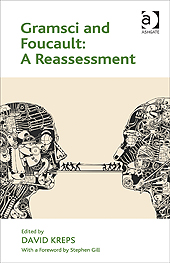
krepsGramsci and Foucault: A Reassessment.Edited by David Kreps, Ashgate, February 2015

Mapping the resonances, dissonances, and linkages between the thought of Gramsci and Foucault to uncover new tools for socio-political and critical analysis for the twenty-first century, this book reassesses the widely-held view that their work is incompatible.

With discussions of Latin American revolutionary politics, indigenous knowledges, technologies of government and the teaching of paediatrics in post-invasion Iraq, complexity theory, medical anthropology and biomedicine, and the role of Islam in the transition to modern society in the Arab world, this interdisciplinary volume presents the latest theoretical research on different facets of these two thinkers’ work, as well as analyses of the specific linkages that exist between them in concrete settings.

A rigorous, comparative exploration of the work of two towering figures of the twenty-first century, Gramsci and Foucault: A Reassessment will appeal to scholars and students of social and…

View original post 365 more words

Posted in Uncategorized | 1 Comment

An ‘Abe Doctrine’ as Japan’s Grand Strategy: New Dynamism or Dead-End?

Chris Hughes discusses Japanese foreign and security policy at Warwick’s Politics Reconsidered blog.

politicsreconsidered's avatarPolitics Reconsidered

Japan’s Foreign and Security Policy Under the ‘Abe Doctrine' Japan’s Foreign and Security Policy Under the ‘Abe Doctrine’

By Professor Chris Hughes

This post originally appeared on Japan Focus.

Prime Minister Abe Shinzō’s stunning return to power in the December 2012 landslide election victory, and the consolidation of his leadership in a repeat victory in December 2014, has heralded the resurgence for Japan of a more assertive, high-profile, and high-risk, foreign and security policy.[i] However, as Japan’s Foreign and Security Policy Under the ‘Abe Doctrine’ suggests, Abe’s status as an arch-‘revisionist’ ideologue, combined with the track record of his first administration in 2006-2007, made clear that he would move aggressively to shift Japan towards a more radical external agenda—characterized by a defense posture less fettered by past anti-militaristic constraints, a more fully integrated US-Japan alliance, and an emphasis on ‘value-oriented’ diplomacy with East Asian states and beyond.[ii] Indeed, Abe’s diplomatic agenda has been so distinctive and forcefully articulated in…

View original post 2,357 more words

Posted in Uncategorized | Leave a comment

Transnationalisms: two new reviews

two new reviews at the Society and Space open site

Posted in Uncategorized | Leave a comment

Top posts on Progressive Geographies this week

Posted in Uncategorized | 1 Comment

The week after completing a book – initial new work on Shakespeare and Foucault

When I finished my first book, Mapping the Present, I remember asking a much more senior academic friend ‘what do I do now?’ His response was clear: ‘Write another one!’

This came back to me this week as I’ve been contemplating the next work after the completion of the Foucault’s Last Decade revised manuscript (more on that here). It’s of course possible that the press will ask me to do a bit more work, and then there is the copy-editing, proofs, index, promotional material, etc. But the intellectual work is done, and it’s a strange feeling of absence. I’ve lived with this book, as an ever-growing and transforming manuscript, for two years, with over fifteen years of working on this material. Really the idea has been growing since 1997, when Foucault’s first lecture course, «Il faut défendre la société» came out, and especially since Les anormaux in 1999, which was the first course I wrote about.

So bringing it to a completion has been, as it has to varying degrees with all my books, a major relief and loss in about equal measure. The nature of how I work means that there is plenty stored up to do. First it was a pile of accumulated emails and small tasks from the several days when I was in effective writing-lockdown. Then there are some less pressing matters that need to be taken care of. One of the unpredictable things about a book submission and completion is that you are never sure when the reports will come in, nor, of course, how much work they will require. With my previous two books, it was six to nine months before all the reports were on hand; with this one six weeks. So I couldn’t easily schedule a break immediately after the re-submission. I have a proper holiday coming up in early August, but am at least going away for the weekend.

Next week I’m off to Paris, for a return to the Bibliothèque Nationale. And that’s when I plan to really begin the next book, Foucault: The Birth of Power, in earnest. If I wasn’t so tired, then perhaps I’d have spent this week going over the materials I already have for that – two long chapters cut from Foucault’s Last Decade earlier this year; some more recent cuts from that manuscript; a review essay of La société punitive; long working notes on Surveiller et punir/Discipline and Punish; and some more notes on collaborative projects. I think sitting down with all that material is an important next step, perhaps shaping things into draft chapters and organized notes files.

I don’t have any talks scheduled until early September, having done three earlier this month. In that September talk I’ll be speaking about Théories et institutions pénales, which gives me a clear timeframe to work on for that text. It’s the most substantial text by Foucault that I’ve yet to work on in detail. I did publish a long review in Berfrois earlier this year, but the book will have much more about it, and I’ve already begun getting hold of some of the texts Foucault used in the first half of the course. I may be speaking about the course again in the autumn, and likely on it and/or La société punitive in Copenhagen in December. My other autumn talks are on territory, or Shakespeare and territory.

And it’s been Shakespeare that I’ve returned to this week. Light stuff – watching the old BBC production of Henry VI, Part One; going to see a fun production of Twelfth Night in a Covent Garden churchyard with Susan; and a wonderful, fast-paced, four-person The Tempest in a small theatre above an Islington pub. The days in the British Library this week have largely been spent going over some introductory materials for the history plays. I still can’t work out quite how to approach these, or even which plays to address, but I’ve done some preliminary thinking on Henry VI this week.

So the plan is to work primarily on the second Foucault book, but alongside that to do a little with Shakespeare, over the next several months. With a sabbatical year coming up, and no teaching until October 2016, it seems a good way forward. So, just as I’ve finished one book, I’m about to work on two more…

Posted in Books, Conferences, Foucault's Last Decade, Foucault: The Birth of Power, Mapping the Present, Michel Foucault, Publishing, Shakespearean Territories, Territory, William Shakespeare | 3 Comments

Henri Lefebvre, open access in Antipode – ‘The Theory of Ground Rent and Rural Sociology’

More details on the Lefebvre translation and introduction, from the Antipode Foundation site.

Antipode Editorial Office's avatarAntipodeFoundation.org

39078-1Hot off the press this week we have something special courtesy of Stuart Elden (University of Warwick) and Adam David Morton (University of Sydney) – a translation (by Warwick’s Matthew Dennis) of Henri Lefebvre’s 1956 essay ‘Théorie de la rente foncière et sociologie rurale’ / ‘The Theory of Ground Rent and Rural Sociology’.

La renta de la tierra 5 ensayosIt was first published in the Transactions of the Third World Congress of Sociology, and later reprinted in Lefebvre’s Du rural à l’urbain (1970/2001). There are two Spanish translations available, in La renta de la tierra (1983) and De lo rural a lo urbano (1971), and this is the first time it has been available in English.

De lo rural a lo urbanoAs Stuart and Adam note in their introduction, ‘Thinking Past Henri Lefebvre’, Lefebvre will be known to most geographers for his prodigious work on everyday life, the city / urban society, the production of…

View original post 139 more words

Posted in Uncategorized | 1 Comment

Henri Lefebvre, ‘The Theory of Ground Rent and Rural Sociology’ – translation and introduction now out in Antipode open access

A new translation of a piece by Lefebvre, along with an introduction, is now available in Antipode early view – both open access:

cover

Henri Lefebvre, The Theory of Ground Rent and Rural Sociology : Contribution to the International Congress of Sociology, Amsterdam, August 1956, translated by Matthew Dennis, edited by Stuart Elden and Adam David Morton

Stuart Elden and Adam David Morton, Thinking Past Henri Lefebvre: Introducing “The Theory of Ground Rent and Rural Sociology”

This introduction to the translation of Henri Lefebvre’s 1956 essay “The theory of ground rent and rural Sociology” moves through three stages. First, it suggests that Anglophone appropriations of Lefebvre have tended to focus too much on his urban writings, at the expense of understanding his early work on rural sociology, and failing to recognise how his urban focus emerged as a result of his interest in rural–urban transformation. Second, it provides a summary of his wider work on rural questions, including his unfinished work on a major treatise of rural sociology; and outlines the key themes of the present essay in relation to these other projects. Third, it connects Lefebvre’s issues to wider debates in political economy and geography about aspects of the rural, land and ground rent, not least including the work of Antonio Gramsci and José Carlos Mariátegui.

Posted in Adam David Morton, Henri Lefebvre | 1 Comment

Interview with Maurizio Ferraris by Peter Gratton

A new interview at the Society and Space open site.

Posted in Uncategorized | Leave a comment

Remembering Srebrenica in Different Contexts

A new piece at the Warwick Politics Reconsidered blog

politicsreconsidered's avatarPolitics Reconsidered

srebrenica 3 ‘Što Te Nema?’ memorial monument being constructed in Geneva. Credit: Dženeta Karabegović, 2015

By Dženeta Karabegović and Maria Koinova

On July 11, 2015 the 20th anniversary of the Srebrenica genocide was commemorated across the globe. In 1995, during the war of disintegration of Yugoslavia, Bosnian Serb paramilitary forces led by Ratko Mladić, currently on trial at the International Criminal Tribunal on former Yugoslavia (ICTY) in the Hague, systematically killed more than 8,000 Bosnian Muslims (Bosniaks) over the course of a few days in the UN declared safe-zone of Srebrenica. The UN-mandated Dutch peacekeeping forces in charge of protecting the enclave ceded control to Mladic’s paramilitary forces, which committed what is widely acknowledged as the worst crime against humanity committed in Europe since the Second World War. The memorial cemetery in Potočari, across from where Dutch peacekeeping forces were headquartered at the time, holds over 6,000 graves today. Still, more…

View original post 1,692 more words

Posted in Uncategorized | Leave a comment