This book concerns the elemental geographies and lives and deaths of the drowned to confront enduring forms of oppression. Elaine Stratford documents with penetrating compassion and acumen how human and more-than-human bodies lose personhood in acts of violence, exploitation, marginalisation, cultural imperialism, and powerlessness. This work is both a scholarly and deeply personal call to rethink how we live with, remember, and honour the drowned. It offers profound insights to all those interested in human geography and allied disciplines.
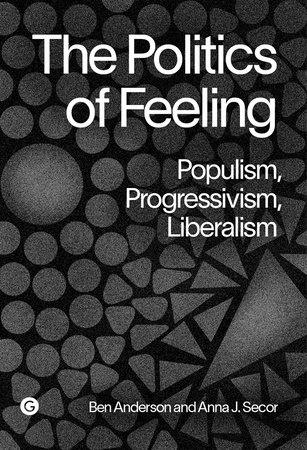
How today’s dominant political forms—right-wing populism, progressivism, and liberalism—offer differentiated responses to shared conditions of uncertainty.
The Politics of Feeling argues that politics has become a matter of political feelings in an age of uncertainty. If the second half of the 20th century saw the defeat and exhaustion of fascism and socialism, what remained of ideological certainty in neoliberal democracies such as the UK and the US ran aground in the wake of the 2008 financial crisis. The Politics of Feeling is diagnostic of how the uncertainties of the post-2008 period have transformed the political arena and made the question of how people feel central to the formation of political affiliations and divisions. We identify three competing political forms in the US and the UK today: right-wing populism, progressivism, and contemporary liberalism. We argue that rather than naming coherent programs of political thought, these popular political forms are operating as arrangements or modes of attachment and political intensity. Each one suggests a different way of remembering the past, imagining the future, and making the present politically meaningful. Each one elevates some affective orientations over others and thereby etches differences of race, class, and gender within its structure. Tracing contemporary articulations of populism, progressivism and liberalism across US and UK contexts, we at once draw out commonalities and underline the way these forms diverge both between and within these societies. The Politics of Feeling is a critique of the living edge of politics: the emergent and shifting clusters of orientations and affects that continually work to differentiate political subjects, to intensify or alienate attachments and allegiances.
On 21 November 2024, in Rome, the historian of science Lorraine Daston was awarded the Balzan Prize for History of Modern and Contemporary Science, one of the world’s most prestigious academic awards. Administered by the International Balzan Prize Foundation, this award honours the work of scholars with internationally outstanding achievements. The General Prize Committee recognized Professor Daston ‘for the extent, originality and variety of her work, which has drawn on a wide range of scientific fields to highlight the mental representations and values underlying research activity’.
Daston has mainly explored concepts – such as probability, evidence, rationality, objectivity and many others – which shape our practices of knowledge, structure our thought and constitute the conditions of the possibility of our experience. For Daston, these organizing concepts – as we may call them – come into being through specific historical and social processes, and change and get their meaning from the uses we make of them in a certain period of history. Through tracing the trajectory of scientific objects and concepts in this way, Daston has expanded the field of historical epistemology. She attributes a special role to rationality, which could be described as a sort of meta-organizing concept that gets its meaning from the interaction of different organizing concepts and other epistemic elements in a given historical and social context. One of her best-known books, Objectivity (2007), co-authored with Peter Galison, charts the history of the conceptions of objectivity that emerged in the last three centuries and shows how each of these conceptions is rooted in an epistemic virtue, as the two scholars call the scientific ideal to which scientists are committed in a particular period or circumstance….
Explores how grief can help to negotiate our loss of affect for liberal democracy
Develops a timely diagnosis of the sources of contemporary discontent with democracy
Rereads the literature on mourning to develop a novel account of grief – as an experience and a response to affective loss, rather than an ontological condition
Brings together scholarship from a range of disciplinary areas – democratic theory, philosophy, feminist theory, cultural studies, and psychoanalysis
Critically engages with feminist discussions of vulnerability and care to show their importance for democratic thinking
Draws on examples from art and culture to illustrate how grief can be relevant to democratic politics
The book proposes that loss of affect for liberal democracy is a key problem today, in need of closer analysis. Manifested in an unprecedent suspicion of democratic governments, a readiness to elect authoritarian rulers, and a rise in reactionary politics, loss of affect pertains to the way that citizens experience democracy – their growing disinvestment from the democratic form of rule. It raises worrying questions, about the survival of democratic values into the twenty-first century, that democratic theorists often tend to either ignore or exaggerate. To navigate these questions, the book argues that grief can be a useful political resource. Understood as a response to loss, grief engages the imagination, opening the way to another, perhaps more caring, experience of democracy. To illuminate the nature of this experience, the book draws on feminist scholarship and work on contemporary culture, where grief and affect intersect.
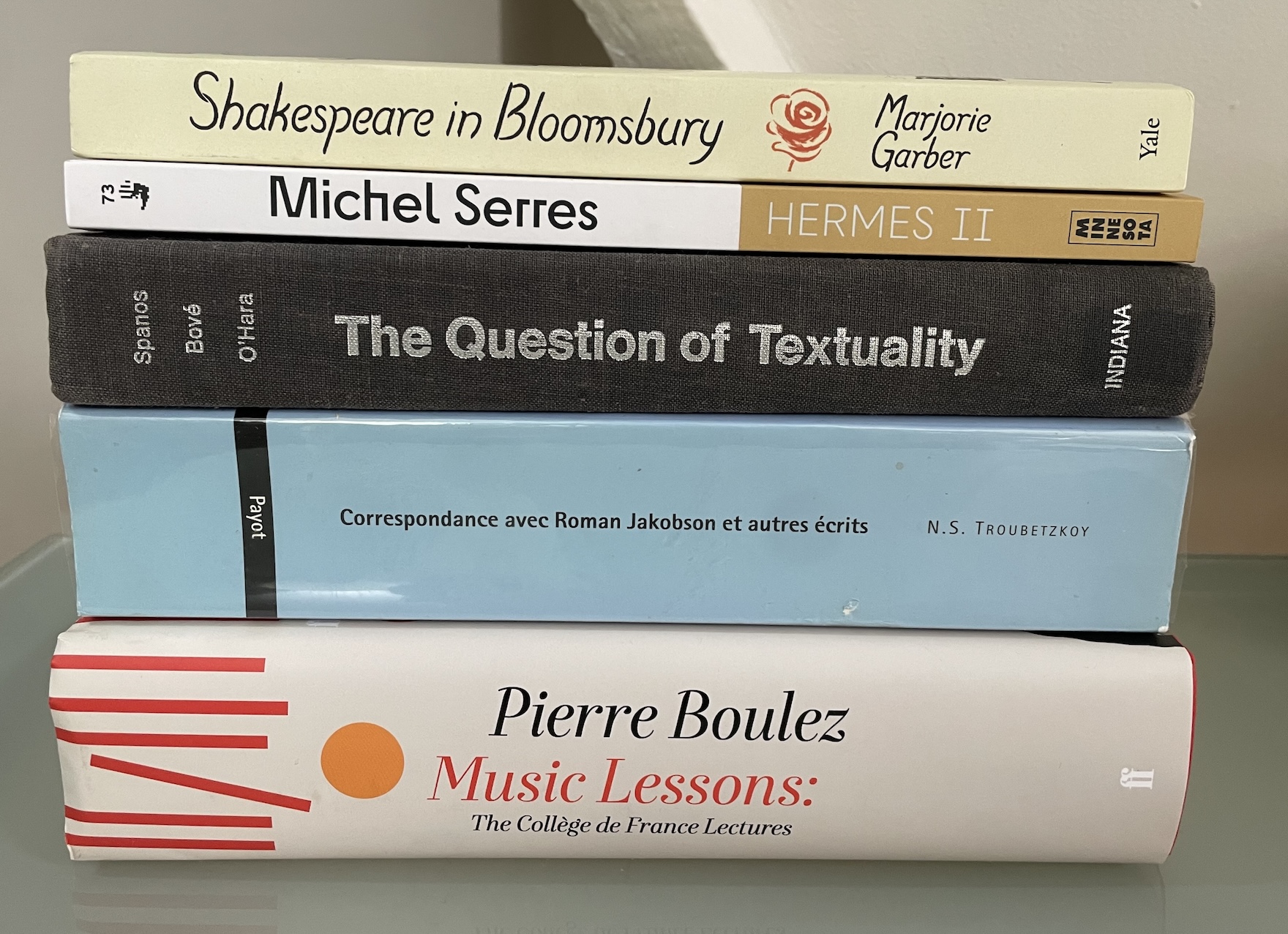
Marjorie Garber, Shakespeare in Bloomsbury, now in paperback; Michel Serres, Hermes II: Interference; the older collection The Question of Textuality: Strategies of Reading in Contemporary American Criticism; Nikolai Trubetzkoy’s correspondence with Roman Jakobson in French translation; and Pierre Boulez’s lectures at the Collège de France. University of Minnesota Press sent the translation of Serres, and the others were bought new or second-hand.
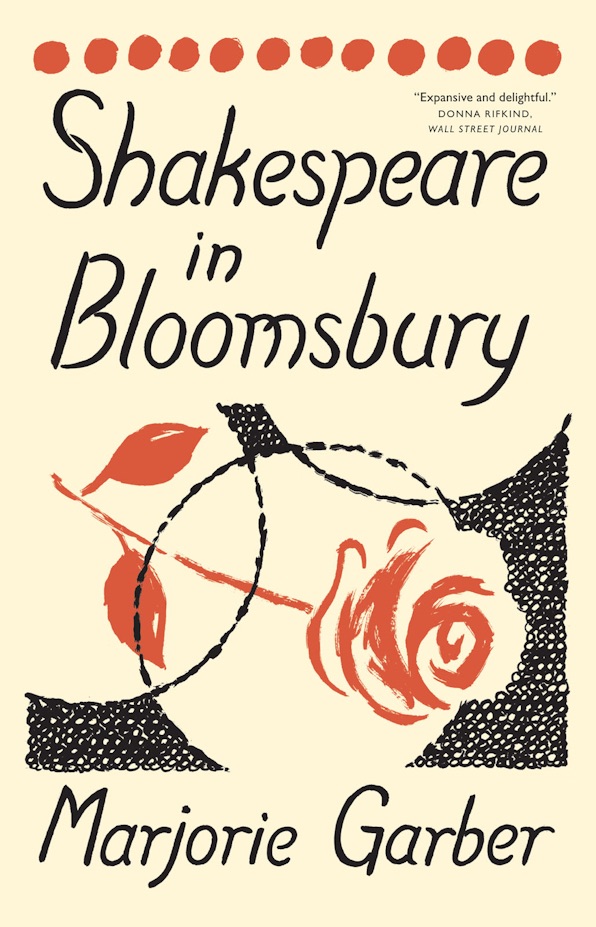
For the men and women of the Bloomsbury Group, Shakespeare was a constant presence and a creative benchmark. Not only the works they intended for publication—the novels, biographies, economic and political writings, stage designs and reviews—but also their diaries and correspondence, their gossip and small talk turned regularly on Shakespeare. They read his plays for pleasure in the evenings, and on sunny summer afternoons in the country. They went to the theater, discussed performances, and speculated about Shakespeare’s mind. As poet, as dramatist, as model and icon, as elusive “life,” Shakespeare haunted their imaginations and made his way, through phrase, allusion, and oblique reference, into their own lives and art.
This is a book about Shakespeare in Bloomsbury—about the role Shakespeare played in the lives of a charismatic and influential cast, including Virginia and Leonard Woolf, Vanessa Bell, Clive Bell, Roger Fry, Duncan Grant, Lytton Strachey, John Maynard Keynes and Lydia Lopokova Keynes, Desmond and Molly MacCarthy, and James and Alix Strachey. All are brought to sparkling life in Marjorie Garber’s intimate account of how Shakespeare provided them with a common language, a set of reference points, and a model for what they did not hesitate to call genius. Among these brilliant friends, Garber shows, Shakespeare was in effect another, if less fully acknowledged, member of the Bloomsbury Group.
The vital and untold story of Karl Marx’s stamp on American life.
To read Karl Marx is to contemplate a world created by capitalism. People have long viewed the United States as the quintessential anti-Marxist nation, but Marx’s ideas have inspired a wide range of people to formulate a more precise sense of the stakes of the American project. Historians have highlighted the imprint made on the United States by Enlightenment thinkers such as Adam Smith, John Locke, and Thomas Paine, but Marx is rarely considered alongside these figures. Yet his ideas are the most relevant today because of capitalism’s centrality to American life.
In Karl Marx in America, historian Andrew Hartman argues that even though Karl Marx never visited America, the country has been infused, shaped, and transformed by him. Since the beginning of the Civil War, Marx has been a specter in the American machine. During the Gilded Age, socialists read Marx as an antidote to the unchecked power of corporations. In the Great Depression, communists turned to Marx in hopes of transcending the destructive capitalist economy. The young activists of the 1960s were inspired by Marx as they gathered to protest an overseas war. Marx’s influence today is evident, too, as Americans have become increasingly attuned to issues of inequality, labor, and power.
After decades of being pushed to the far-left corner of intellectual thought, Marx’s ideologies have crossed over into the mainstream and are more alive than ever. Working-class consciousness is on the rise, and, as Marx argued, the future of a capitalist society rests in the hands of the people who work at the point of production. A valuable resource for anyone interested in Marx’s influence on American political discourse, Karl Marx in America is a thought-provoking account of the past, present, and future of his philosophies in American society.
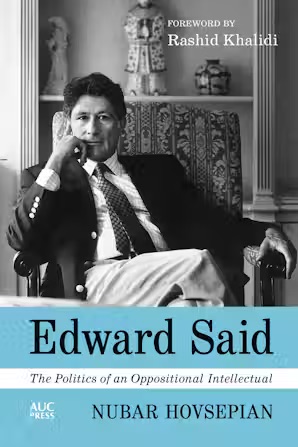
An exploration of the political thought of one of the twentieth century’s most influential thinkers and the foremost advocate for the Palestinian cause in the West
Edward Said was one of the most influential intellectuals of the twentieth century. A literary scholar with an aesthete’s temperament, he did not experience his political awakening until the 1967 Arab–Israeli war, which transformed his thinking and led him to forge ties with political groups and like-minded scholars. Said’s subsequent writings, which cast light on the interplay between cultural representation and the exercise of Western political power, caused a seismic shift in scholarly circles and beyond. In this intimate intellectual biography, by a close friend and confidant, Nubar Hovsepian offers fascinating insight into the evolution of Said’s political thought.
Through analysis of Said’s seminal works and the debates surrounding them, Edward Said: The Politics of an Oppositional Intellectual traces the influence of Foucault on Said, and how Said eventually diverged from this influence to arrive at a more pronounced understanding of agency, resistance, and liberation. He consequently affiliated more closely with Raymond Williams, Antonio Gramsci, and more contemporaneously, with his friends the late Eqbal Ahmad and Ibrahim Abu-Lughod.
Said held that it is the intellectual’s responsibility to expose lies and deceptions of the holders of power. A passionate advocate for the Palestinian cause, his solidarity did not prevent him from launching a sustained critique of the Palestinian leadership. Hovsepian charts both Said’s engagement with the Palestinian national movement and his exchanges with a host of intellectuals over Palestine, arguing that Said’s interventions have succeeded in changing the parameters of the discourse in the humanities, and among younger Jews searching for political affiliation.
Drawing on his diaries, in which he recorded his meetings with Said, as well as access to some of Said’s private letters, Hovsepian illuminates, in rich detail, the trajectory of Said’s political thinking and the depth and breadth of his engagement with peers and critics over issues that continue to resonate to this day.
This issue of Foucault Studies is the first to be published by the University of Pennsylvania Press: https://www.pennpress.org/journals/journal/foucault-studies/. The journal retains its full intellectual independence and keeps publishing according to a diamond open access model under the guidance of an editorial collective composed of Knut Ove Eliassen, Robert Harvey, Daniele Lorenzini, Clare O’Farrell, Sverre Raffnsøe, and Dianna Taylor.
Cover art has been created by Leonardo Martin Baños Ballenas, and is used by courtesy of the Bibliothèque Nationale de France and Poulpy.
The image shows Foucault’s Bibliothèque nationale de France reader card, on a photograph of one of its reading rooms. A few years ago I made an attempt to decipher the card.
Update July 2025: The designer Leonardo Baños talks about the cover here (in Spanish).
At the beginning of 2025 I decided to try to post a short essay each week on Progressive Geographies. I felt the blog had become too much of a noticeboard, sharing information about interesting books, talks or shorter pieces by other people and, much less often, a few things about my own work. I had not been writing very much for the blog itself, apart from the research updates on my Mapping Indo-European thought in twentieth-century France project; and some research resources – bibliographies, a few textual comparisons, sometimes very short translations.
Somewhat to my surprise I’ve managed to keep to a weekly schedule to these essays, usually with a few pieces in development at the same time. I called these ‘Sunday histories’ after the condescending name of ‘Sunday historian’ given to amateurs by professional historians, since these were people whose only time for doing history was outside of the working week. Philippe Ariès called his memoir Un Historien du Dimanche for this reason. But these short posts are also histoires in the French sense of stories as much as formal histories. At the end of each of these pieces I’ve tried to provide indications of sources which would provide much more information, some of which are published and others are archives.
The intention was not that the pieces would be parts of a paper or book chapter I’m writing, but usually something tangential to what I’m working on, perhaps a development of something which would only be a footnote or aside in another text. Sometimes they are some notes on a topic which might be further developed in the future, or where I’ve reached a dead end. A couple of times they have developed from a talk I’ve given or are a summary of what will be a longer piece published in a more formal way. A few times I’ve revisited earlier occasional pieces on this blog, and tidied them up into a similar format. A couple have seemed more minor, and have been posted mid-week.
These pieces are something of a reaction against academic publishing – its slow processes, its costs, and its metrics. These pieces are posted shortly I’ve finished them, though they might be revised later; they are free to access (I don’t plan to turn these into subscription-only); and they are not ‘outputs’ in the tradition sense.
I have a few drafts of future posts – another one relating to the early reception of Foucault’s work in the United States; a reworked version of the story of a possible collaboration between Alexandre Kojève and Lefebvre; and on Jakobson’s 1972 lectures at the Collège de France. There will maybe be something on Pierre Bourdieu and Erwin Panofsky, perhaps on Jean Hyppolite, probably on ancient Greek words for kings.
When I have been asked about running a blog, I’ve said the three guidelines I set myself were these: be useful to yourself, since you never know if anyone else will read it; be useful to others, if you do want an audience; and be nice, which means I rarely post about things I don’t like. Those still seem like good ideas to me, and they are ones that shape these little posts. The posts are provisional and suggestions are welcome. I’m sure specialists in the areas I discuss will know much more or correct details. I hope there is some interest in them.