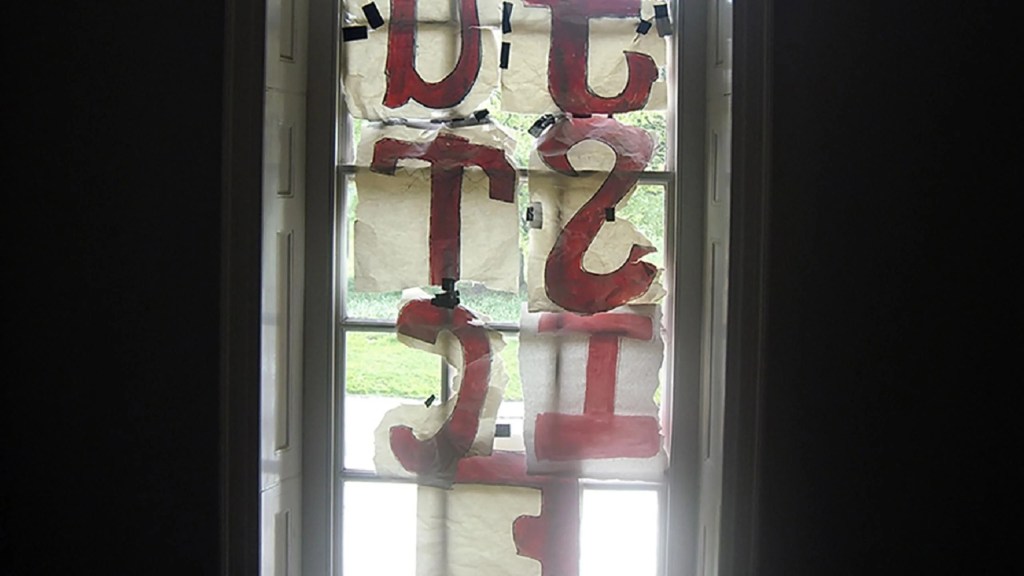
‘Keep your mind in hell, and despair not’ – Rose’s discovery of Silouan the Athonite’s maxim provided the occasion for Love’s Work and guided its weaving journey along the quotidian verges of hell and despair. Whether passing through the three cities of death or across the thresholds of stormed paradises, Rose’s work refuses any alleviation of the state of perdition. For her, trying to keep the mind out of hell is the real council of despair. And yet the promise that sustains her season in hell is not the humility of Christian hope taught by the Athonite nor the pride of Stephen Daedalus evoked throughout Love’s Work, but one of divine comedy or fidelity to the movements of the bacchanalian revel and repose in its sin. The Gillian Rose Memorial Lecture conference this year departs from Love’s Work in an exploration of the play of promise and perdition throughout the full range of Rose’s philosophical writing.
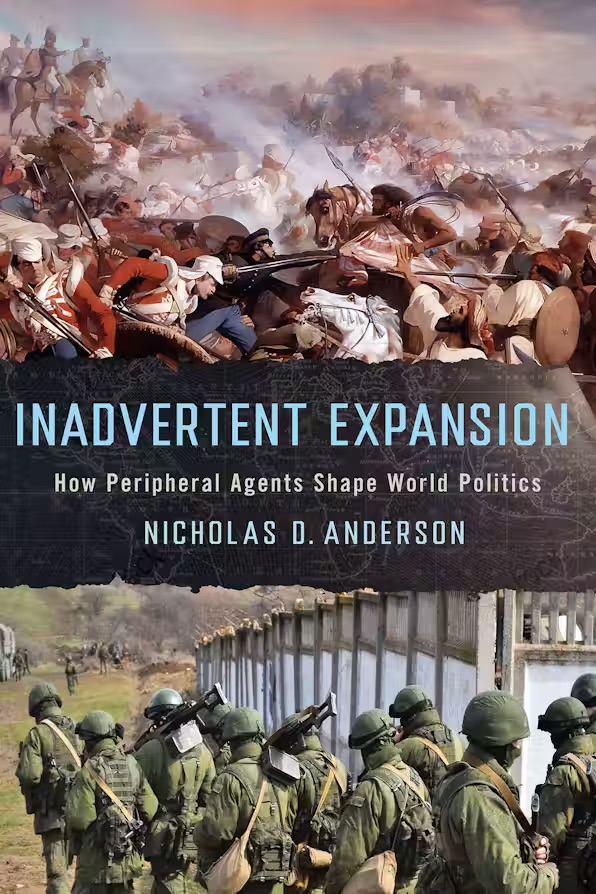
In Inadvertent Expansion, Nicholas D. Anderson investigates a surprisingly common yet overlooked phenomenon in the history of great power politics: territorial expansion that was neither intended nor initially authorized by state leaders.
Territorial expansion is typically understood as a centrally driven and often strategic activity. But as Anderson shows, nearly a quarter of great power coercive territorial acquisitions since the nineteenth century have in fact been instances of what he calls “inadvertent expansion.” A two-step process, inadvertent expansion first involves agents on the periphery of a state or empire acquiring territory without the authorization or knowledge of higher-ups. Leaders in the capital must then decide whether to accept or reject the already-acquired territory.
Through cases ranging from those of the United States in Florida and Texas to Japan in Manchuria and Germany in East Africa, Anderson shows that inadvertent expansion is rooted in a principal-agent problem. When leaders in the capital fail to exert or have limited control over their agents on the periphery, unauthorized efforts to take territory are more likely to occur. Yet it is only when the geopolitical risks associated with keeping the acquired territory are perceived to be low that leaders are more likely to accept such expansion.
Accentuating the influence of small, seemingly insignificant actors over the foreign policy behavior of powerful states, Inadvertent Expansion offers new insights into how the boundaries of states and empires came to be and captures timeless dynamics between state leaders and their peripheral agents.
Interview at New Books Network with Eleanora Mattiacci. Thanks to dmf for the link
speakers: Chris Philo, Stuart Elden, Felicitas Kübler
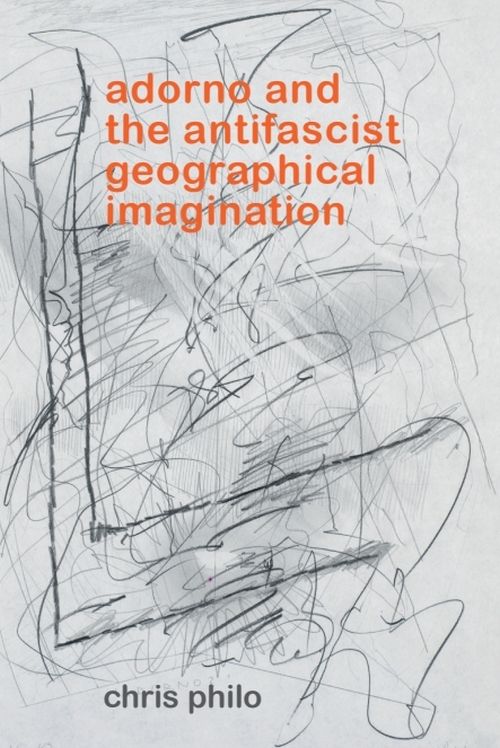
To think antifascistically is necessarily to think geographically; to think geographically ought to be to think antifascistically. This aphorism sets the compass for this book’s ambitious attempt to fold questions of fascism and antifascism into the remit of Geotheory (the focus of the host book series). Alert to fascism’s pernicious haunting of our contemporary moment, it reaches for intellectual resources through which to fashion constellations of antifascist thought hinging on attentiveness to space, place, landscape and nature.
Specifically, the book offers the first attempt to systematically explore the ‘geographies’ integral to the thinking of Theodor W. Adorno, premier exponent of the Frankfurt School of critical theory whose writings – on philosophy and sociology, politics and culture, literature and music – were often framed precisely against the threat of fascistic regression. By disclosing Adorno’s geographies, the shape of a geographical antifascism comes into view as a transformational restatement of critical geography’s spirit and purpose.
I’ve continued my work with archives in the USA over the past several weeks. Some of this has been in relation to the Indo-European Thought project, but I’ve managed to work on some peripheral things too. I had two days in Princeton, one at the Derrida book collection in the Firestone Library of Princeton University, and one at the special collections of the Institute of Advanced Study. I had everything set up for a visit to the Derrida library in March 2020 – flight, hotel, book orders – but it had to be cancelled due to the pandemic restrictions. An archivist there was willing to help with the work on Foucault via a virtual consultation – a Teams call with a document camera, where I could watch her turning the pages of Derrida’s copy of Foucault’s Folie et déraison. This was invaluable at the time, and it enabled me to finish The Early Foucault.But it was good to see the actual book itself, albeit five years later than planned. There are some other books by Foucault in Derrida’s collection, some dedicated by Foucault and some marked up. I also looked at a few things by Benveniste, Dumézil, Eliade and Koyré in the collection.
At the IAS, I asked to see the files on Jean de Menasce and Jean Gottmann. So many people central or peripheral to this project spent time there. I’d already been given scans of material relating to other people I had an interest in – Georges Dumézil, Ernst Kantorowicz, Alexandre Koyré, and Walter Bruno Henning. I discuss what the Henning files reveal about his Khwarezmian dictionary project here. But though I’m really grateful for the remote access, I wanted to visit at least once – I’d never been to Princeton before. I did walk around the lake (famously used in the Oppenheimer film) and went to the Einstein statue in the lunch break.
In New York, I went to the Berg collection of the New York Public Library, to look at two things in the Vladimir Nabokov collection – his correspondence with Roman Jakobson, and the marked-up typescript of his translation of The Song of Igor. I had to get permission from the Nabokov estate to access the letters, which took a little while. I had previously written a short piece on this site about the failed collaboration on a critical edition of the Igor text by Jakobson and English translation by Nabokov. I’ve since found some new sources for this story – some published and some not, and wrote an update on this story.
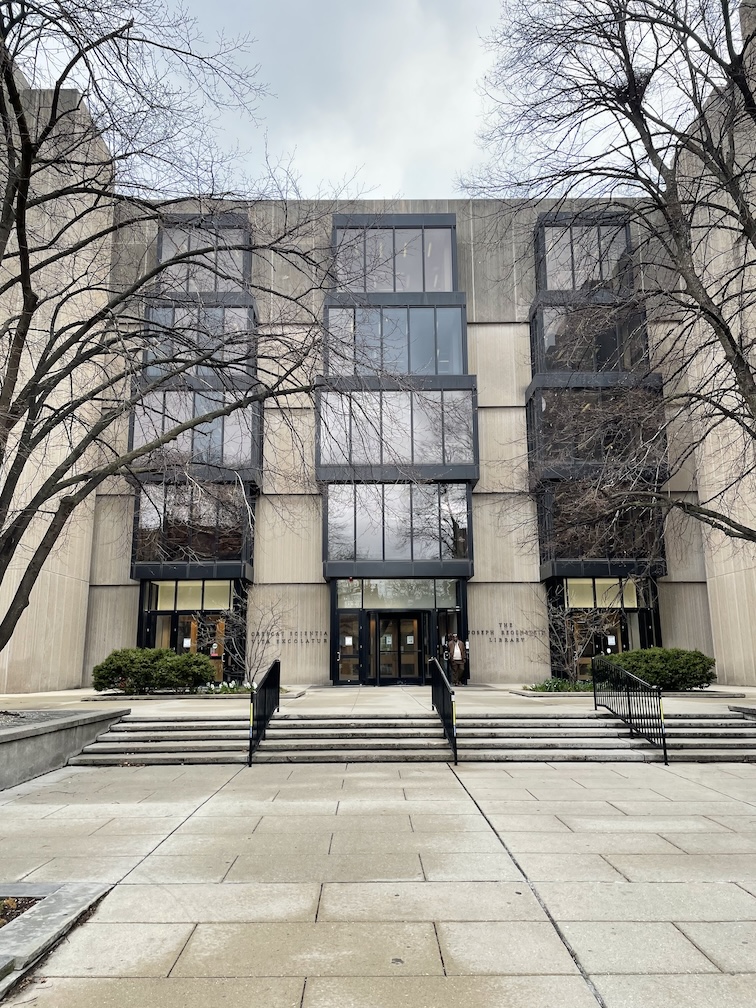
One of the reasons for the falling out was that Nabokov was convinced that Jakobson was a Soviet agent. Exploring the basis for this accusation has become a very deep rabbit-hole. It’s led me through the Columbia and MIT archives, and to some unexpected places. One of those was the Gottesman libraries of Teachers College of Columbia University, which has some interesting documents relating to the climate at Columbia in the late 1940s and early 1950s. There is a lot more in the main Columbia archives relating to the story. I am not sure what I will do with this, but I have more than a draft of something. At the very least it’s been interesting and opens up a whole range of questions. I also had a few days in Chicago, mainly working with the Mircea Eliade papers and a few things relating to Eliade in the Ioan Culianu collection at the Regenstein library. This was one of the US archives I’d initially planned to visit for the Indo-European project, but it ended up being almost the last I got to visit. I hope to have a chapter on the decade Eliade spent in Paris after the Second World War. There isn’t much realting to that period in Chicago, but there is an extensive correspondence with Dumézil, which is important for the story of his career. Some of what I looked at in Chicago got me thinking about a notorious story relating to Eliade – the murder of Ioan Culianu. I wrote a piece about that, partly in relation to Bruce Lincoln’s recent book on the story, for this site.
Clockwise from left: Firestone Library, Princeton University; Institute for Advanced Study; Regenstein Library, University of Chicago; Teachers College
I made some additional visits to Columbia University archives, some relating to the Jakobson story and some things from the Edward Said papers, and had one day back at the Rockefeller Archives Center to go over things I hadn’t had time with on the previous visit. Some of the initial work Jakobson did in the United States in 1941 and 1942 related to North American and Siberian languages, from material given by Franz Boas to the New York Public Library, so I took a look at that. He also did some work on the medieval Yiddish spoke by Czech Jews for YIVO, the Yiddish Scientific Institute which is just a few minutes’ walk from the Remarque Institute. They don’t have much in the archives relating to Jakobson, as far as I can tell, but I did look at some correspondence they have. I will write about Jakobson’s library work in the next ‘Sunday History’ [update: now available here].
I also presented on Benveniste again at an event at Remarque, on the theme of ‘Troubling Classical Bodies’, with Brooke Holmes and Anurima Banerji. There is a video of the event here, and the text of my piece on “Émile Benveniste and the Sogdian Word for ‘Knee’” is here.
My time in New York ended last week and I’m now back in the UK. I’m not sure when I’ll next be back in the US. I spent most of the time there doing archival work or – as important – writing up the notes on the things I’ve seen or photographed there. I really didn’t want to head back with too many files of things unprocessed. That is definitely the less glamorous part of archival work.
I really appreciate that so many archives are willing to digitise things, and I made a lot of requests. Sometimes those are of things I realised were more important than I’d initially thought in an archive I’d been to already; others were more speculative requests for any correspondence with someone that is in an archive. I did a few side trips, but wasn’t able to get everywhere. Archives in Baltimore, Wisconsin, Cincinnati and Philadelphia were all really helpful at a distance. But I also stumbled across things that happened to be in the next folder to one I was initially looking at; or some other chance discovery. With archives nearby in New York it wasn’t difficult to go back. I’ll miss that, and much more, about my time there. I can thoroughly recommend the Remarque Institute as a place to spend time – I feel very fortunate to have had a semester there.
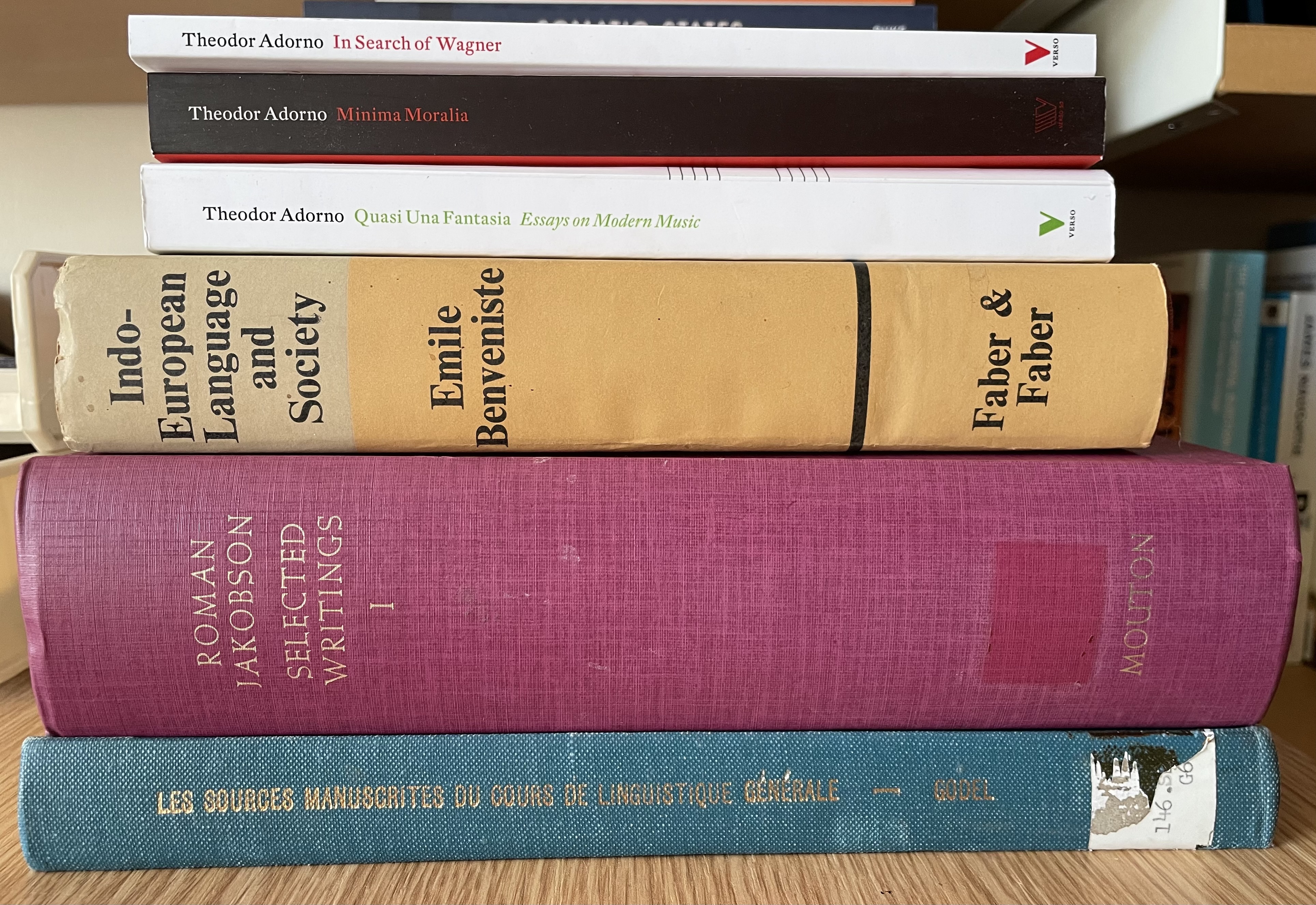
Three books by Adorno from Verso, and second-hand copies of Émile Benveniste’s Indo-European Language and Society, the first volume of Roman Jakobson’s Selected Writings, and Robert Godel, Les Sources Manuscrites du cours de linguistique générale de F. de Saussure.
The edition uses the existing translation by Derek Coltman, long out of print, and has a new critical apparatus and Introduction by me. There is a discussion of the editing work here. This is part of the work of my Mapping Indo-European thought in twentieth-century France research project, funded by the Leverhulme Trust.
A classic text that develops one prong of Dumézil’s tripartite hypothesis of Indo-European tribes: the sacred sovereign.
Georges Dumézil’s fascination with the myths and histories of India, Rome, Scandinavia, and the Celts yielded an idea that became his most influential scholarly legacy: the tripartite hypothesis, which divides Indo-European societal functions into three classes: the sacred sovereign, the warrior, and the producer. Mitra-Varuna, originally published in 1940, concentrates on the first function, that of sovereignty. Dumézil identifies two types of rulers, the first judicial and worldly, the second divine and supernatural. These figures, both priestly, are oppositional but complementary. The title nods to these roles, referring to the gods Mitra, a rational mediator, and Varuna, an awesome religious figure.
Stuart Elden’s critical edition, based on the 1988 English translation by Derek Coltman, identifies variations between the first and second French editions and completes—and in places corrects—Dumézil’s references. The editor’s detailed introduction situates Mitra-Varuna within Dumézil’s career, outlines how his treatment of its themes developed over time, and relates the book to the political controversy around his ideas. Two new appendices contain passages that did not appear in the second French edition.
Alexandre Koyré’s teaching career was predominantly in Paris and the United States. Born in Russia, he studied in Paris and Germany, before beginning teaching at the École Pratique des Hautes Études in the inter-war years. His EPHE teaching was in a temporary post from 1921-22 and then as Directeur d’études from 1932-33. He spent much of the Second World War in the United States, teaching at the École Libre des Hautes Études along Roman Jakobson, Claude Lévi-Strauss, Jean Gottman and others. His work there as its first general secretary, until he was replaced by Lévi-Strauss, has been discussed in some histories of French intellectuals in New York, particularly by Emmanuelle Loyer. He also taught courses at the New School for Social Research. I have indicated the titles of his courses at both these institutions here. After the war he returned to France, resuming his career at the EPHE. As I have discussed in History of European Ideas(open access), in 1951 he tried, unsuccessfully, to get elected to a chair at the Collège de France. He would continue teaching at the EPHE, but also combined this with various visiting posts in the USA, including at the Institute for Advanced Study in Princeton and at the University of Chicago and Johns Hopkins University. From autumn 1962 his health meant that others often had to cover his teaching. He died in April 1964.
All of his teaching is, I think, interesting to explore. He taught on topics both within the history of science and in philosophy more generally. His earliest teaching was on religion and mysticism, and the relation between science and religion was a regular theme. His book on Plato was a development from war-time teaching. Perhaps his most famous book, From the Closed World to the Infinite Universe,developed from teaching at Johns Hopkins University. I had thought it was a course there, but though he taught courses there in two academic years, the book’s immediate genesis was a single lecture given the following year, on a return visit when he was teaching at the University of Wisconsin-Madison. Before the war, it was his course on Hegel and religion which Alexandre Kojève took over when Koyré was absent, turning it into the famous courses on The Phenomenology of Spirit which had such a remarkable audience and which were so influential. (I say a bit more about those lectures and a planned co-translation of the Phenomenology by Kojève and Henri Lefebvre here.)
Koyré also had visiting posts in Cairo in the 1930s and early 1940s, at what was originally the Egyptian University, then the King Fuad University and is now the University of Cairo. Paola Zambelli’s biography of Koyré gives the Cairo dates as 1933-34, 1936-37, February to June 1940 and 1940-41. With the aid of EPHE teaching records, the first two dates can be specified as 1 December 1933-end May 1934 and 1 November 1936-1 June 1937. The EPHE also records a visit from 1 November 1937 to 1 June 1938. Around 1940 Charles de Gaulle and his colleagues in the France Libre government in exile persuaded Koyré that he could make a more significant contribution by running the École Libre than by joining the army. His return to Cairo after the Occupation of France was to facilitate his transfer to the United States in 1941, though he did this by travelling east rather than west across the Atlantic.
Compared to Paris, where annual reports were published of his teaching, we know less about his work in Cairo. The main record of his teaching is his book Trois leçons sur Descartes, later republished as Entretiens sur Descartes. These three lectureswere first given in Cairo. The first publication was a bilingual French-Arabic edition in 1937, the second in French alone in 1944. The first version maintains the spoken form more, which is edited out of the reprint. The lectures are later included in re-editions of hisIntroduction à Platon,but though the first part of the book was published as Discovering Plato, I don’t think the Descartes material is in English. (Discovering Plato was published slightly before the French version, even though the manuscript was written in French.) The copy of the Trois leçons at the Bibliothèque nationale de France, in the Rare Books room, is the one Koyré gave to Kojève, with a very brief dedication.
In Cairo Koyré lived in Zamalek, and some of his letters to Henry Corbin from this time have been published. Corbin was a French scholar of Islam and, among other things, a Heidegger translator. Heidegger’s “What is Metaphysics?” appeared in Bifur in 1931, translated by Corbin and introduced by Koyré. But most of the other letters of Koyré’s which are published are from earlier or later periods of his life. The letters to Edmund Husserl are much earlier, while his surviving letters to Hannah Arendt, for example, are all later than this period (on their friendship, see here). There is limited correspondence in Koyré’s archive.
In teaching in Cairo Koyré was following in the footsteps of the philosopher of science André Lalande, and among their students was Abdul Rahman Badawi. Some online sources suggest Koyré supervised Badawi’s doctoral thesis, but a more reliable obituary says Lalande initially, and then Koyré, supervised Badawi’s master’s level thesis on the problem of death in existentialist philosophy, written in French. It was published only in 1964 in Cairo, and is not easy to find. Badawi went on to write a doctoral thesis, Le temps existentiel, in Arabic. Given the importance of Badawi’s work in Arabic philosophy, this is quite significant. Sevinç Yasargil has an interesting piece on Badawi in the Heidegger in the Islamicate Worldcollection. Koyré was therefore an important figure in introducing both France to phenomenology and Egypt to existentialism.
I think Louis Massignon was also teaching in Cairo still too, which perhaps gives another connection. Massignon was Catholic but an important scholar of Islam, and did work to bring understandings of each faith closer to the other. Koyré’s work in Cairo is briefly discussed in Yoav Di-Capua’s work on Arab existentialism, but on this point doesn’t seem to add much beyond other sources.
Zambelli’s biography equally does not have much information about this part of his career. She actually spends much of the section on this discussing the courses on Hegel which Kojève took over. The historian and philosopher of chemistry, Hélène Metzger also covered some of his teaching in 1936-37, and on this and much else about Metzger, Cristina Chimisso’s book is an invaluable guide. Henry Corbin also covered some teaching in 1937-38, and post-war, several other people did when he was in the USA, or unwell. But the visits to Cairo seem interesting not just for who took over from him in Paris, but what Koyré himself did there.
Beyond what I outline above, I’ve not found much about this period of Koyré’s career. I say a bit more about his role in a European network of ideas here, with some reading suggestions. I also have said something some of the archival links to Georges Canguilhem and Jean Gottmann, and spoke about his connections to Canguilhem in Bristol in September 2024 (audio). As I mentioned above, I outline his New York teaching here, and I might follow up with more on his Paris teaching at the EPHE, and his other post-war courses in the United States.
References
Abdurrahman Badawi, Le Problème de la mort dans la philosophie existentielle: Introduction historique à une ontologie, Le Caire: Imprimerie de l’Institut français d’archéologie orientale, 1964.
François Chaubet and Emmanuelle Loyer, “L’École Libre des Hautes Études de New York: Exil et resistance intellectuelle (1942-1946)”, Revue Historique 302 (4), 2000, 939-72.
Cristina Chimisso, Hélène Metzger, Historian and Historiographer of the Sciences, London: Routledge, 2019.
Yoav Di-Capua, “Arab Existentialism: An Invisible Chapter in the Intellectual History of Decolonization”, The American Historical Review 117, 2012, 1061-91.
Yoav Di-Capua, No Exit: Arab Existentialism, Jean-Paul Sartre, and Decolonialization, Chicago: University of Chicago Press, 2018.
Sevinç Yasargil, “Anxiety, Nothingness, and Time: Abdurrahman Badawi’s Existentialist Interpretation of Islamic Mysticism”, in Kate Moser, Urs Gösken and Josh Hayes (eds.), Heidegger in the Islamicate World, London/New York, Rowman & Littlefield, 2019, 99-112.
Paola Zambelli, Alexande Koyré in Incognito, Firenze: Leo S. Olschki, 2016; trans. Irène Imbart, Alexandre Koyré, un juif errant? Firenze: Musée Galileo, 2021.
Aristide R. Zolberg with Agnès Callard, “The Ecole Libre at the New School 1941-1946”, Social Research 65 (4), 1998, 921-51.
This is the twentieth post of a weekly series, where I post short essays with some indications of further reading and sources, but which are not as formal as something I’d try to publish more conventionally. They are usually tangential to my main writing focus, a home for spare ideas, asides, dead-ends and possible futures. I hope there is some interest in them. They are provisional and suggestions are welcome.
In 1851, the physicist Léon Foucault performed an unforgettable experiment. By suspending a large pendulum inside the dome of Paris’ Pantheon, Foucault provided the first simple, direct empirical evidence of the Earth’s rotation—an undeniable demonstration of heliocentrism. This experiment, conducted long after the Copernican Revolution and using a laboratory apparatus rather than astronomical observation, visually confirmed what had previously been accepted as theory. The pendulum’s motion clearly illustrated the Earth’s rotation. But Foucault’s experiment did not end there. It sparked a range of subsequent reenactments and interpretations, each adding new layers to its meaning. Repeated over and again, its afterlives were many as were its ramifications.
Historian Michael Hagner revisits this epoch-making experiment and its reception from the nineteenth century to the present day and follows how cosmological questions conjoined political and aesthetic judgments about the public staging and history of science. The pendulum experiment, Hagner argues, is more than just a mere scientific demonstration. It contains within it the histories of technological innovation, ideological conflicts, and the rise of popular culture and visual media. In a series of insightful studies of literary, artistic, and scientific reenactments, Hagner uses both words and images to narrate the rich and complex legacy of this experiment.
Seeing Foucault’s Pendulum includes among other fascinating tales, a short but stunning history of the Copernican Revolution, the paradigm-shifting work of the nineteenth-century astronomer Camille Flammarion, and the reenactments of Foucault’s experiment at the Smithsonian Institution and New York’s United Nations building. Linking nature to culture and calling for world unity, the experiment’s legacy extends beyond science. It has been reimagined in Umberto Eco’s novel Foucault’s Pendulum and in Gerhard Richter’s 2018 installation, enchantments of the postmodern world theater where the relationship between knowledge and sensory experience is problematized anew. A complex symbol in the history of ideas—challenging our assumptions, inspiring artistic expression, and prompting philosophical reflection on our place in the cosmos—Foucault’s experiment serves as a powerful reminder that both the Earth and the universe should never be reduced to a disposable mass of human hubris and of irresponsible manipulation.