This book is the long-overdue publication in English of Aimé Césaire’s account of Toussaint Louverture, the legendary leader of the revolution in Saint-Domingue – a slave revolt against French colonial rule that led to the founding of the independent republic of Haiti. Saint-Domingue was the first country in modern times to confront the colonial question in practice and in all its complexity. When Toussaint Louverture burst onto the historical stage, various political movements already existed for political autonomy, free trade and social equality. But the French Revolution established a compelling understanding of universal liberty: the Declaration of Human Rights opened up the possibility of claims to liberty and equality by wealthy free Black men in the colony, claims which, when they could not be realized, led to the armed uprising of enslaved Blacks. A battle for the liberation of one class in colonial society resulted in a revolution to achieve equal rights for all men. And for universal emancipation to be possible, Saint-Domingue itself had to become independent.
Toussaint Louverture put the Declaration into practice unreservedly, demonstrating that there could be no pariah race. He inherited bands of fighters and united them as an army, turning a peasant revolt into a full-scale revolution, a population into a people and a colony into an independent nation-state.
Aimé Césaire’s historical and analytical gifts are magnificently displayed in this highly original analysis of the context and actions of the famous revolutionary leader. It will be of great interest to students and scholars of critical and cultural theory and of Latin American history as well as anyone concerned with the nature and impact of colonialism and race.
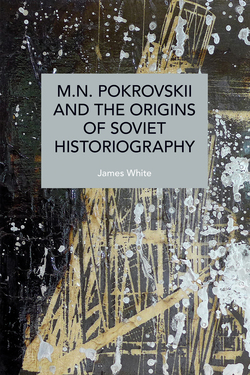
How did Soviet historians interpret modern Russian history? Focusing on the career of the Soviet historian M.N. Pokrovskii, James D. White examines the evolution of historical writing in the first decade of Soviet rule.
As Deputy People’s Commissar for Education, Pokrovskii was among those who established the academic institutions of the new regime. The study of Pokrovskii’s writings and the political context in which they were conceived helps explain the origin of interpretations of modern Russian history in Soviet times. This book serves as a preliminary guide to the study of the Russian revolutionary era, and as a key text in the critical evaluation of the historical sources of the period.
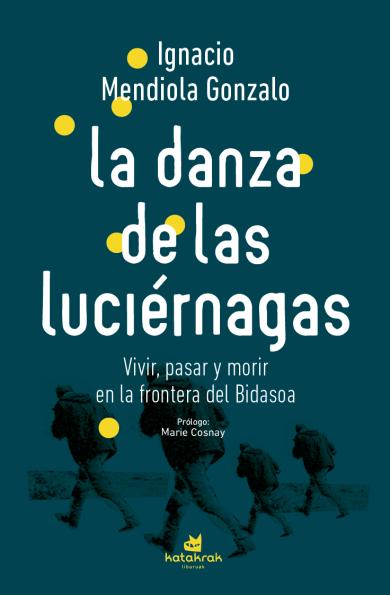
En verano de 2018, el Bidasoa se cierra para las personas migrantes. Vuelven el control, la vigilancia, la batida; se despliega la violencia. Pero la frontera no acaba en una línea estática que separa estados: se desplaza como línea móvil sobre los cuerpos que huyen, impregnando su piel.
Se activa la ayuda a ambos lados del cierre fronterizo para dignificar la fuga frente al hostigamiento policial. Este libro da cuenta de este entrecruzamiento entre las personas migrantes y las redes de solidaridad, los movimientos que ahí se tejen, una suerte de coreografía política y afectiva que resiste al capitalismo racial y securitario, una danza de luciérnagas que quiere abrir espacios y tiempos humanizados.
Con ambición teórica y literaria, Ignacio Mendiola trenza ese relato de huida, violencia y apoyo, allí donde el poder estatal ha dibujado una línea para apropiarse del espacio y para disciplinar a la fuerza de trabajo.
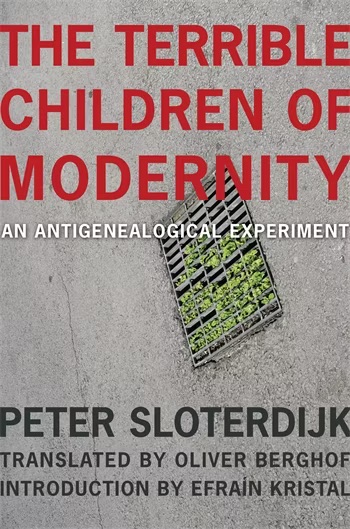
Peter Sloterdijk is among the most acclaimed and widely read philosophers of the past half-century. Called “Germany’s most controversial thinker” by the New Yorker, he has challenged and provoked readers worldwide with extraordinarily ambitious and wide-ranging works of philosophical and cultural critique. In The Terrible Children of Modernity, Sloterdijk offers a magisterial and profound investigation into the vicissitudes of historical change and the nature of modernity.
For Sloterdijk, modernity is defined by its need to break with the past. Moderns are perpetual rebels who seek to sever the ties of tradition and forms of inheritance that bind generations and eras together. With deep philosophical, historical, and literary range, he traces this antigenealogical experiment from the French Revolution onward, from Madame de Pompadour and Napoleon through Nietzsche, Marx, Wagner, the Dadaists, and Deleuze. Acutely aware of the destructive potential of cultural discontinuities, Sloterdijk is no less critical of the “fathers” who condemn change than the “terrible children” who seek a drastic rupture with their predecessors. Equally concerned with the grand sweep of history and our current predicaments, he instead calls for new ways to live together in the intersubjectivity of the human condition. Incisive and daring, breathtaking in its scope, this account of youthful rebellion against tradition asks us to reimagine the ethics of genealogy.
Kelly Dombroski, Mark Goodwin, Junxi Qian, Andrew Williams, Paul Cloke eds. Human Geography, fourth edition, Routledge, August 2024
Introducing Human Geographies is a ‘travel guide’ into the academic subject of human geography and the things that it studies. The coverage of the new edition has been thoroughly refreshed to reflect and engage with the contemporary nature and direction of human geography.
This updated and much extended fourth edition includes a diverse range of authors and topics from across the globe, with a completely revised set of contributions reflecting contemporary concerns in human geography. Presented in four parts with a streamlined structure, it includes over 70 contributions written by expert international researchers addressing the central ideas through which human geographers understand and shape their subject. It maps out the big, foundational ideas that have shaped the discipline past and present; explores key research themes being pursued in human geography’s various sub-disciplines; and identifies emerging collaborations between human geography and other disciplines in the areas of technology, justice and environment. This comprehensive, stimulating and cutting-edge introduction to the field is richly illustrated throughout with full colour figures, maps and photos.
The book is designed especially for students new to university degree courses in human geography across the world, and is an essential reference for undergraduate students on courses related to society, place, culture and space.
Michel Foucault’s historical approach is usually understood as moving from archaeology to genealogy, the former describing his work of the 1960s and the latter the 1970s. From the mid-1970s Foucault certainly describes his work as genealogy, and he explicitly relates this to Nietzsche’s project, which he had critically explored in lectures and the famous ‘Nietzsche, Genealogy, History’ essay published in 1971. But in lectures and one interview from the early 1970s, Foucault uses another term to describe the complementary approach to archaeology, which is that of dynastics, a mode of analysis he relates to both power and knowledge. Tracing the usage of these terms over time, this article explores their relation. Foucault uses the term dynastics to describe his approach after his explicit engagement with Nietzsche, and before settling on genealogy as the appropriate term. Foucault’s use of dynastics is interesting for many reasons, including the way he glosses this as dunamis dunasteia. Foucault is here thinking about a range of senses, from dynamics or power to dynasties, heredities, and lineage. Even after he drops the term to describe his approach, Foucault is perhaps invoking the notion of dynastics every time he subsequently writes about power relations.
This piece took a long time to come together – it was presented in much shorter form in 2021 and 2022; the first of which led to a shorter online piece. It was then submitted to this journal and accepted back in 2023 – it’s a new journal and the first volume was committed to theme issues. So it’s good to have it finally out.
The article requires subscription, but as ever please email me if you don’t have access and would like a copy.
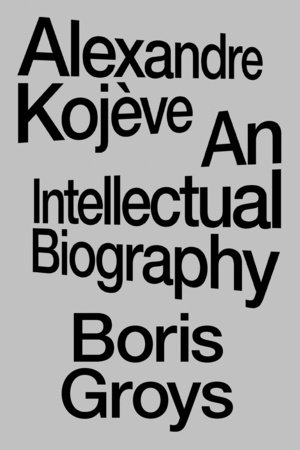
Boris Groys’s new book is an intellectual biography of the fascinating and mysterious figure of Alexandre Kojève, discussing his involvement with Hegel’s dialectics, his idea of communism and his vision of a universal empire as the end of history. Kojève proclaimed himself to be a Stalinist and at the same time was one of the creators of the European Union. His anthropology that describes humans as always negating their nature and their identity, and always desiring to be different from what they are, is highly political. It explains why humans can never be fully satisfied by a political system based on their allegedly “natural” rights.
speakers: Chris Philo, Stuart Elden, Felicitas Kübler
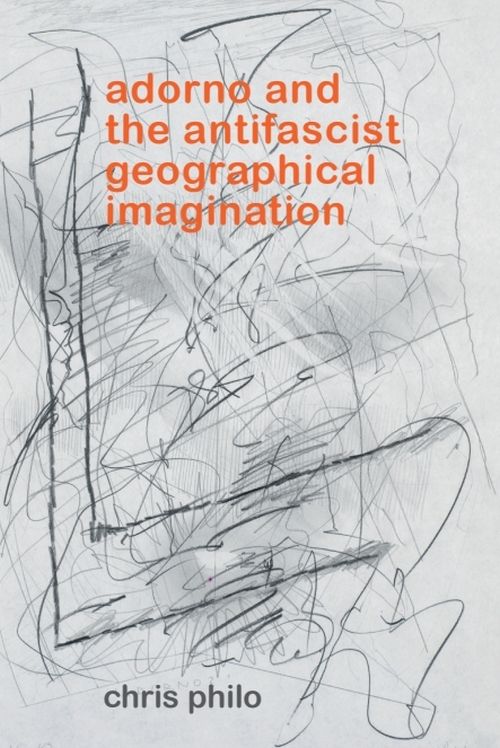
To think antifascistically is necessarily to think geographically; to think geographically ought to be to think antifascistically. This aphorism sets the compass for this book’s ambitious attempt to fold questions of fascism and antifascism into the remit of Geotheory (the focus of the host book series). Alert to fascism’s pernicious haunting of our contemporary moment, it reaches for intellectual resources through which to fashion constellations of antifascist thought hinging on attentiveness to space, place, landscape and nature.
Specifically, the book offers the first attempt to systematically explore the ‘geographies’ integral to the thinking of Theodor W. Adorno, premier exponent of the Frankfurt School of critical theory whose writings – on philosophy and sociology, politics and culture, literature and music – were often framed precisely against the threat of fascistic regression. By disclosing Adorno’s geographies, the shape of a geographical antifascism comes into view as a transformational restatement of critical geography’s spirit and purpose.
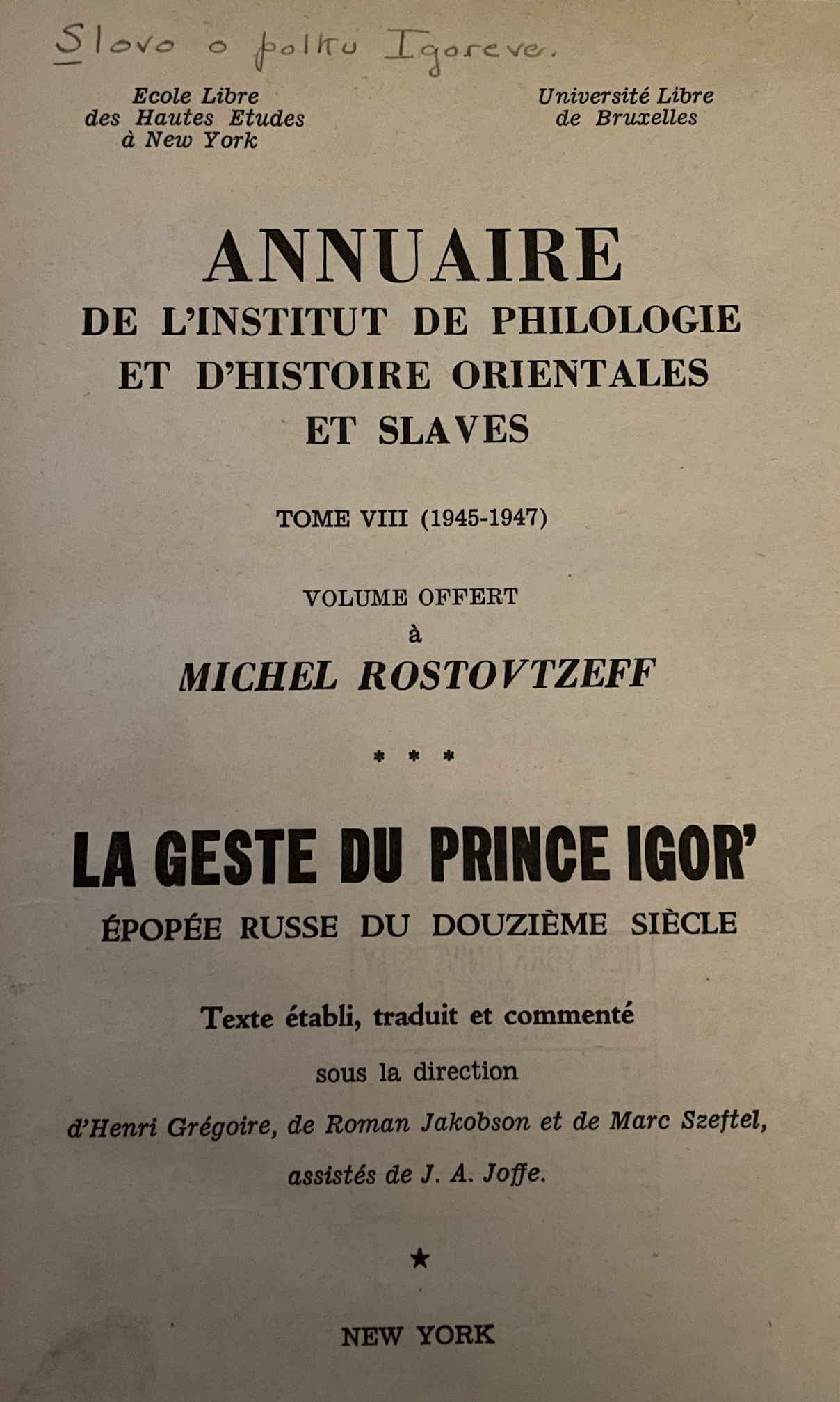
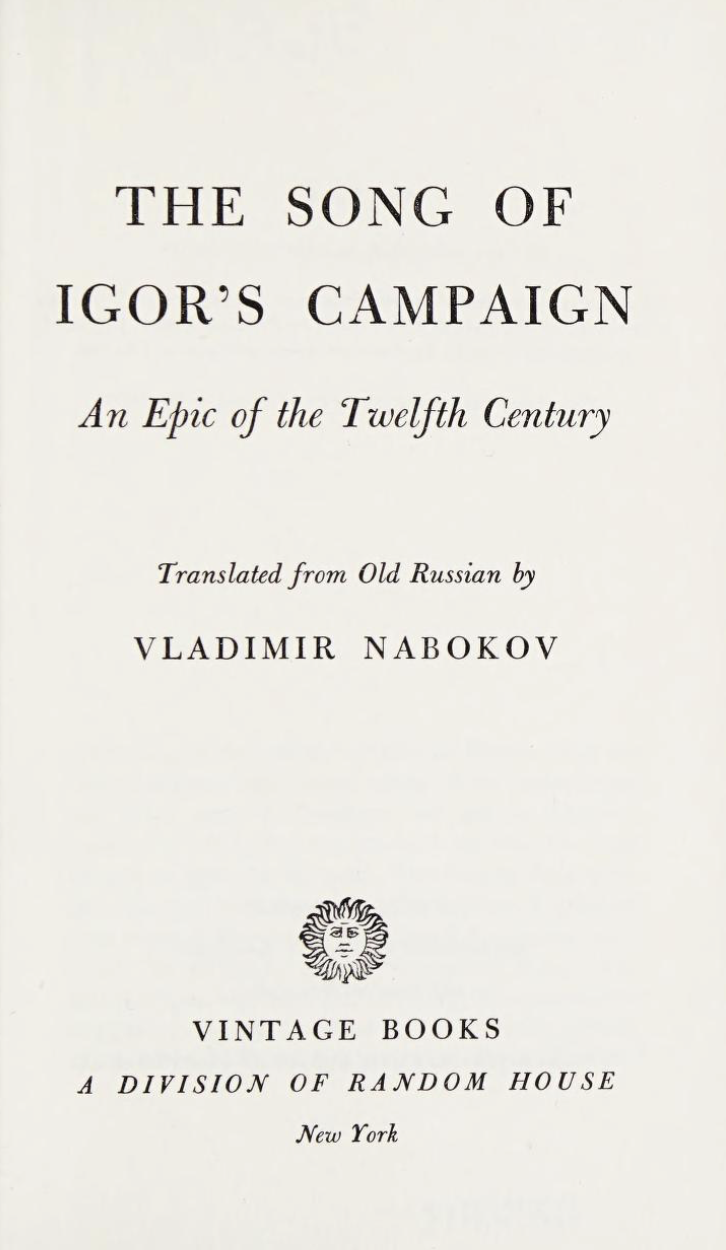
In a previous piece on Vladimir Nabokov, Roman Jakobson, Marc Szeftel and The Song of Igor, I outlined the story of a planned collaborative edition and English translation of the Slavic epic The Song of Igor. This is a text of disputed provenance, probably late 12th or early 13th century, on which Jakobson had led a collaborative French edition in 1948, La Geste du Prince Igor’,along with Henri Grégoire and Marc Szeftel. Nabokov wrote a review of the text, but struggled to find an outlet, and a discussion led to an alternative plan to work together – Jakobson providing a critical edition of the text; Nabokov an English translation – before they fell out. Nabokov published his translation separately; Jakobson did not publish his planned new edition. I discuss all of that more fully in the earlier piece.
Since writing that, I have continued to think about this story and, although it feels like a digression from a digression, to explore some sources which I hadn’t made use of in the previous piece. There I should have mentioned that Jakobson published two pieces on The Song of Igor in 1952, especially because they are his most detailed discussions in English. One, in the medieval journal Speculum, was on the current academic debates about the piece, and the other in the Harvard Library Bulletin was a philological study of the extant manuscripts. Both are reprinted in hisSlavic Epic Studies, which also contains Jakobson’s parts of La Geste du Prince Igor’. That volume of Jakobson’s Selected Writings also includes Jakobson’s parts of a book he co-edited with Ernest Simmons, Russian Epic Studies, published in 1949, mostly concerning The Song of Igor, and including essays by Grégoire, Manfred Kridl, Margaret Schlauch and Szeftel. It is a companion volume, most of whose essays are in English, to La Geste du Prince Igor’.
Some of Nabokov’s archive is in the Berg collection at the New York Public Library. This includes Nabokov’s typescript copy of his translation, with his handwritten corrections. It was interesting to see this, but it did not reveal anything particularly useful for this story. But the Berg collection also has correspondence between Jakobson and Nabokov. Unlike the typescript, this required permission from the Nabokov estate to consult, but that was eventually given. The correspondence fills in some useful detail of the plans for the collaboration between Jakobson, Szeftel and Nabokov, but the 14 April 1957 letter which broke off the collaboration still feels like an abrupt interruption. That letter has been published (Vladimir Nabokov, Selected Letters, 1940-1977, p. 216) and I reproduce it in the earlier piece. But the previous letter – at least in the files in New York – is from two years before (27 April 1955), and at that time the collaboration was progressing well.
I hoped that this and some other correspondence would shed some more light on this. One thing which is interesting and useful about the Nabokov archive is that this has carbon copies of his letters to Jakobson, rather than just the letters he received from Jakobson. Often with correspondence it’s necessary to consult two (or more) archives to get both sides of the story. (The parallel file of Nabokov correspondence in Jakobson’s archive at MIT has only a few letters, only one of which isn’t in the Nabokov archive) There is also some correspondence in the George Vernadsky papers at Columbia University, both from Jakobson and Nabokov. Some of the Jakobson letters to Vernadsky are in English; some others, and all of Nabokov’s, are in Russian. If I was to pursue this story further, I would need help. But almost all the Jakobson-Nabokov letters are in English.
La Geste du Prince Igor’Nabokov’s translation – The Song of Igor’s CampaignDear Bunny, Dear Volodya
I had, however, neglected an important published source for detail on the story – the correspondence between Nabokov and Edmund Wilson. Wilson was a literary critic and journalist, author of To the Finland Station, among other works, and husband of Mary McCarthy between 1938-46. The Nabokov-Wilson correspondence was published in 1979, and in an expanded edition in 2001 as Dear Bunny, Dear Volodya. In 1943, Edmund Wilson told Nabokov of an event he went to in New York with Roman and Sophie Grynberg:
I also went with them to a Russian occasion which was tout autrement intéressant than the Stalinist evening I described to you: the first in a series of lectures devoted to rescuing the Slovo o Polku Igorebe from the aspersions of André Mazon – a matter, I gathered, of patriotic duty. The discussion had many humors which would have amused you. Vernadsky said that the French, not content with having burned the manuscript in Moscow [in 1812], were now trying to deprive them of the poem itself. The French Byzantologist [Henri] Grégoire, who presided, seemed to get a little nettled by the Russians and the session ended with a debate which became I thought, rather acrimonious (1 April 1943, p. 108).
The Mazon book in question is Le Slovo d’Igor, published in 1940, which suggested the Igor text was a much later forgery. The New School teaching records note an École Libre des Hautes Études course in Spring 1943, under the title “Le Dit d’Igor et la question de son authenticité”, organised by the Slavic Section, with Grégoire, Alexandre Koyré, Roman Jakobson, Wacław Lednicki and Vernadsky. It is a lecture in this course which Wilson attended, but which Nabokov did not. So, it would seem Nabokov was first told of this project by Wilson, even though he had known Vernadsky at least for a few years before.
The course directly led to the collaborative volume La Geste du Prince Igor’ in 1948, though not all those participating in the teaching were involved with that. Koyré’s involvement, in particular, seems to have ended with the seminar. The named editors of the book were Grégoire, Jakobson and Szeftel, with the assistance of J.A. Joffe. Jakobson and Grégoire’s seminar feud had clearly been overcome, at least temporarily, with Grégoire’s contribution to the volume a French translation of the tale. (In 1946, Jakobson also wrote a laudatory piece about Grégoire for Byzantina Metabyzantina, which was reprinted in Le Flambeau – a journal Grégoire co-edited – after Grégoire’s death in 1964.) Jakobson contributes by far the most material, including a critical edition and reconstruction of the text, a long essay on its authenticity and notes. He also edited Samuel H. Cross’s English translation for the volume. Szeftel and Vernadsky provide historical contextualisation.
On 1 November 1948, Nabokov told Wilson he was translating the text into English (p. 236). In reply, Wilson told him about the publication:
Do send me your Igor translation. I’ve just received an elaborate volume, La Geste du Prince Igor, published by the Ecole Libre des Hautes Etudes à New York, under the auspices of Jakobson and others. Have you seen it? It includes translating into various languages, a vindication of the Слово authenticity, commentary, etc. (15 November 1948, p. 238).
Nabokov wrote back:
I know the La Geste volume well, – and am, as a matter of fact, reviewing it for the American Anthropologist. It is on the whole an admirable work, Szeftel’s and Jakobson’s studies being especially brilliant. There is a touch of kvasnoǐ [jingoist] Russian patriotism about Vernadsky’s essay. Cross’s translation, although revised and corrected by Jakobson in regard to sense, is couched in hopelessly pedestrian English, so that many images are distorted or lost. It would be nice if you wrote something about the book for the New Yorker (21 November 1948, p. 241).
Nabokov’s planned review for the American Anthropologist never appeared. One letter to Jakobson suggests they wanted it to be much shorter, and Nabokov refused. (I’ve not found the unpublished review in his papers, unfortunately.) But for a French volume about a Russian text, there was quite a lot of attention in English-language journals. There are reviews in, at least, Comparative Literature; Language; The American Slavic and East European Review; The Journal of American Folklore; Modern Languages Notes; Journal of American Oriental Society;and The Catholic Historical Review. These almost all support Jakobson’s claims about the text’s authenticity against Mazon’s position. To take just one example. René Wellek says that “Jakobson demonstrates beyond the possibility of doubt that André Mazon’s bold attempt… to prove the poem a forgery of the late eighteenth century is totally mistaken” (p. 502). He concludes: Jakobson and his colleagues’ work “illuminates the most important poem of ancient Russia in its historical relations and definitely, even crushingly, refutes the doubts about its authenticity raised by M. Mazon” (p. 503).
Wilson, in reply to the November 1948 letter, said that it should be Nabokov who wrote for the New Yorker, and that he would speak to them about it, telling Nabokov not to mention that most of the texts in the volume were in French. (Nabokov told him that his piece was too good to give away to American Anthropologist without payment, and so he liked the New Yorker idea. But this too never appeared.) Wilson went on to retell the story of attending one of the École Libre lectures, repeating most of the details of his letter from five years before. But he adds some detail about the clash between the French and Russians at the class, especially Henri Grégoire presiding over the event and his confrontation with Jakobson. Jakobson apparently kept interrupting and then Grégoire said: “M. Jakobson, c’est un monstre [Mr Jakobson is a monster]”. Wilson continues:
There was a terrible silence, as the audience remembered poor Jakobson’s extraordinary appearance and wondered whether the meeting would have to end in violence. But the speaker went on: “Je veux dire qu’il est un monstre de science – il est philologue, sociologue, anthropologue [I mean that he is a monster of learning – he is a philologist, a sociologist, an anthropologist]” etc. It was at the moment [April 1943] when the Russians were standing up to the Germans after the ignoble flop of the French, and I was struck by the Russian propensity for using events in the literary world as pretexts for creating issues in connection with current politics (which you seem to have reacted against by leaning in the other direction at an angle of forty-five degrees and denying that literature has anything to do with social institutions) (2 December 1948, pp. 243-44).
In the end, the planned Jakobson-Nabokov collaboration did not happen, and Nabokov’s review was not published either. Nabokov reworked his earlier translation, telling Wilson it was “completely revamped”. He said that “The commentary to it has inherited a Eugene gene and is threatening to grow into another mammoth” (2 March 1959, p. 361). The commentary of the 1960 translation is, however, nothing like as extensive as Nabokov’s edition of Eugene Onegin, which appeared in four volumes.
The editor of the Wilson-Nabokov letters, Simon Karlinsky, says of Nabokov’s 1960 translation: “Because Nabokov’s edition, while tending to accept the work’s authenticity, also outlines the grounds for skepticism, Jakobson took a strongly negative attitude to it” (p. 244 n. 5). As my earlier post indicates, the Nabokov-Jakobson acrimony predates the publication of the translation, and their falling out is the reason for its appearing without the critical edition of the text by Jakobson. There are more possible leads to follow about this failed collaboration, in archives in New York and nearby. And there is another aspect of the Jakobson story, with a minor connection to Nabokov, about which I’m trying to find out more. However these additional sources hopefully give some more detail about The Song of Igor aspect.
As a footnote to this story, here’s another fractured relationship. Even though Jakobson and Grégoire had managed to work together on the collaborative volume, almost as soon as it was published, they fell out again because of this project. This was because in 1948, Grégoire wrote a piece about The Song of Igor for the journal he co-edited, Le Flambeau. At the time of the collaborative volume’s publication, an article is not surprising to raise the profile of the book. But Grégoire raises doubts about the text’s authenticity, and while he hesitantly suggests that it is genuine, he at times sides with Mazon. He is also critical of La Geste du Prince Igor’; a book of which he was one of the named editors. In particular, he concludes in an extraordinary way:
André Mazon’s book is certainly more fun to read that the rather pedantic and massive collective work which is his refutation. (We can regret, in particular, the rather heavy-handed ‘manner’ of Jakobson, author of a decisive series of magnificent discoveries, but who often gives himself the air of an irritated theologian.) André Mazon, I believe, is wrong, but he is wrong with spirit; and his indictment, by its very brilliance, has made the weakness of the accusation more apparent. The Song of Igor is so sophisticated, in the American sense of the word, that it can be called a forgery. But it is a forgery… of the twelfth century, as Boris Unbegaun, a distinguished convert, has just told me, very wittily (p. 103).
Jakobson, outraged, wrote a furious letter to him, a copy of which is in Vernadsky’s papers. As well as worrying what this would do for their sales, Jakobson is incredulous that Grégoire could now turn against Jakobson’s critique of Mazon, after having published it in their collaborative volume. He points out that Grégoire “had read the largest part, namely the severest, of my manuscript. You corrected it and you agreed completely”. Jakobson resigned from being Vice-President of Grégoire’s Byzantine Congress, and withdrew a paper on Old Church Slavonic and Byzantine poetry he was planning to present there. In a 1965 postscript to his Slavic Epic Studies, written after Grégoire’s death the previous year, Jakobson tells his version of the story, in relation to Mazon and Grégoire (pp. 738-51).
The debate about the Song’s authenticity rumbles on. Edward Keenan wrote a very detailed new attempt at proving it a forgery in 2003. Norman Ingham delivered an uncompromising rebuttal, published only posthumously in 2017. In Jakobson’s view, there was no room for compromise. As he wrote to Vernadsky later on 29 May 1948: “The Igor struggle has to be unconditionally won”. His inability to entertain any doubts from Grégoire may also have been a factor with Nabokov, nearly a decade later. But as my earlier piece indicates, there were other reasons for the split with Nabokov.
Update 9 Nov 2025: I discuss Nabokov’s original translation and Jakobson’s intent to complete his edition here.
References
La Geste du Prince Igor’: Épopée Russe du douzième siècle, ed. and trans. Henri Grégoire, Roman Jakobson and Marc Szeftel, New York: Columbia University Press, 1948. Jakobson’s parts are reprinted in Selected Writings IV: Slavic Epic Studies, The Hague: Mouton & Co, 1966, 106-300.
The Song of Igor’s Campaign: An Epic of the Twelfth Century, trans. and foreword by Vladimir Nabokov, London: Weidenfeld and Nicolson, 1960.
Henri Grégoire, “La Geste du Prince Igor: un faux… du XIIe siècle”, Le Flambeau 31 (1), 1948, 93-103.
Norman W. Ingham, “The Igor’ Tale and the Origins of Conspiracy Theory”, ed. Valentina Pichugin, Russian History 44 (2-3), 2017, 135-49.
Roman Jakobson, “Henri Grégoire: Investigateur de l’épopée”, Byzantina Metabyzantina: A Journal of Byzantine and Modern Greek Studies I (1), 1946, k-kb’; reprinted in Selected Writings IV: Slavic Epic Studies, The Hague: Mouton & Co, 1966, 101-5.
Roman Jakobson, “The Archetype of the First Edition of the Igor’ Tale”, Harvard Library Bulletin VI (1), 1952, 5-14;reprinted in Selected Writings IV: Slavic Epic Studies, The Hague: Mouton & Co, 1966, 464-73.
Roman Jakobson, “The Puzzles of the Igor’ Tale on the 150th Anniversary of its First Edition”, Speculum 27, 1952, 43-66; reprinted in Selected Writings IV: Slavic Epic Studies, The Hague: Mouton & Co, 1966, 380-410.
Roman Jakobson and Ernest J. Simmons (eds.), Russian Epic Studies, Philadelphia: American Folklore Society, 1949.
Edward L. Keenan, Josef Dobrovský and the Origins of the Igor’ Tale, Cambridge, MA: Ukrainian Research Institute, 2003.
André Mazon, Le Slovo d’Igor, Paris: Librairie Droz, 1940.
Vladimir Nabokov, Selected Letters, 1940-1977, eds. Dmitri Nabokov & Matthew J. Bruccoli, London: Weidenfeld & Nicolson, 1990.
Vladimir Nabokov and Edmund Wilson, Dear Bunny, Dear Volodya: The Nabokov-Wilson Letters, 1940-1971, ed. Simon Karlinsky, Berkeley: University of California Press, revised and expanded edition, 2001
Robert Roudet, “Mazon et le ‘Slovo d’Igor’”, Revue des études slaves 82 (1), 2011, 55-67.
René Wellek, “La Geste du Prince Igor’ Épopée russe du douzième siècle by Henri Grégoire, Roman Jakobson and Marc Szeftel”, Modern Language Notes 63 (7), 1948, 502-3.
Edmund Wilson, The Forties: From Notebooks and Diaries of the Period, ed. Leon Edel, New York: Farrar, Straus, and Giroux, 1983.
This is the eighteenth post of a weekly series, where I post short essays with some indications of further reading and sources, but which are not as formal as something I’d try to publish more conventionally. They are usually tangential to my main writing focus, a home for spare ideas, asides, dead-ends and possible futures. I hope there is some interest in them. They are provisional and suggestions are welcome.
« Ôtez Canguilhem et vous ne comprenez plus grand-chose à toute une série de discussions. »
Par ces mots, Michel Foucault faisait de Georges Canguilhem l’invisible clef de voûte de la philosophie française. Pourtant, à son décès en 1995, l’austère historien des sciences ne nous avait légué qu’une œuvre bien circonscrite, consistant pour l’essentiel en cinq livres. Ce premier ensemble, où trônaient Le Normal et le Pathologique et La Connaissance de la vie, n’est plus que la pointe émergée d’un iceberg. Les Œuvres complètes de Canguilhem, dont le sixième volume paraît ce mois-ci, comptent désormais plusieurs milliers de pages. Renouvelé et enrichi, ce corpus modifie profondément l’image que nous nous formions de sa pensée. Trente ans après, l’œuvre de Canguilhem, plus vivante que jamais, ouvre de nouvelles pistes – à l’histoire des sciences biologiques et médicales, mais aussi à la philosophie tout court.
Sommaire :
Thierry HOQUET : (De quoi) Canguilhem fut-il philosophe ?
ENTRETIENS Pierre-Olivier MÉTHOT : « Canguilhem pense avant Foucault que “tout est normé dans une culture” »
Élodie GIROUX : « Canguilhem peut servir de ressource pour appréhender une médecine extrêmement technicisée »
Marie GAILLE et Agathe CAMUS : En quête de matière étrangère. La philosophie de terrain à l’épreuve des maladies chroniques
Lucie LAPLANE : PhiLabo. La philosophie dans le laboratoire
VARIA Frédéric KECK : Portrait de René Girard en Maître Renard
Francis WOLFF : Engel lecteur de Foucault. Pour une généalogie positive