Offers a new systematic account of the philosophical potential of Saint Paul’s letters
Shows the present-day philosophical importance of the letters of the founder of Christianity
Argues that important ontological problems concerning dualism, nihilism and the event appear in an unexpected light when read through a Pauline lens
Shows a new philosophical appraisal of the Pauline conception of faith in terms of an art of living
Offers a new systematic approach to the intriguing present-day philosophical turn to the Letters of Saint Paul in the works of Heidegger, Taubes, Badiou, Agamben and Zizek
Discusses how Saint Paul allows philosophers to rethink the notions of law and community giving rise to a new type of political philosophy
The re-examination of Saint Paul’s letters in contemporary European philosophy is one of the most important developments at the crossroads of philosophy and theology today.
The “mapness of maps”—how maps live in interaction with their users, and what this tells us about what they are and how they work.
In a sense, maps are temporarily alive for those who design, draw, and use them. They have, for the moment, a cognitive life. To grapple with what this means—to ask how maps can be alive, and what kind of life they have—is to explore the core question of what maps are. And this is what Roberto Casati does in The Cognitive Life of Maps, in the process assembling the conceptual tools for understanding why maps have the power they have, why they are so widely used, and how we use (and misuse) them.
Drawing on insights from cognitive science and philosophy of mind, Casati considers the main claims around what maps are and how they work—their specific syntax, peculiar semantics, and pragmatics. He proposes a series of steps that can lead to a precise theory of maps, one that reveals what maps have in common with diagrams, pictures, and texts, and what makes them different. This minimal theory of maps helps us to see maps nested in many cognitive artifacts—clock faces, musical notation, writing, calendars, and numerical series, for instance. It also allows us to tackle the issue of the territorialization of maps—to show how maps can be used to draw specific spatial inferences about territories. From the mechanics of maps used for navigation to the differences and similarities between maps and pictures and models, Casati’s ambitious work is a cognitive map in its own right, charting the way to a new understanding of what maps mean.
There are now fifteen ‘Sunday Histories‘ posted on Progressive Geographies – short essays about something related, directly or indirectly, to my research. I’ve been posting these weekly through 2025. I could have predicted the three on Foucault would get the most interest, but I hope the others are worth reading too.
So far there are short essays on Arendt, Benveniste, Eco, Foucault, Henning, Jakobson, Kantorowicz, Krell, Koyré, Nabokov, Raucq, Sebeok, Sjoestedt, territory…
On Sunday there will be a short piece on Foucault’s visits to Buffalo in 1970 and 1972 [now here], in advance of a longer piece for Foucault Studies on that topic. I’ll follow that with the text of a recent talk on Benveniste [now here]. Some ideas for the future include pieces on Gillian Rose and the Indo-Europeans, Roman Jakobson and politics, Pierre Bourdieu and Erwin Panofsky, Vladimir Nabokov and Edmund Wilson, more on Alexandre Koyré’s teaching, the murder of Ioan Culianu, and Greek words for a king and their relation to territory.
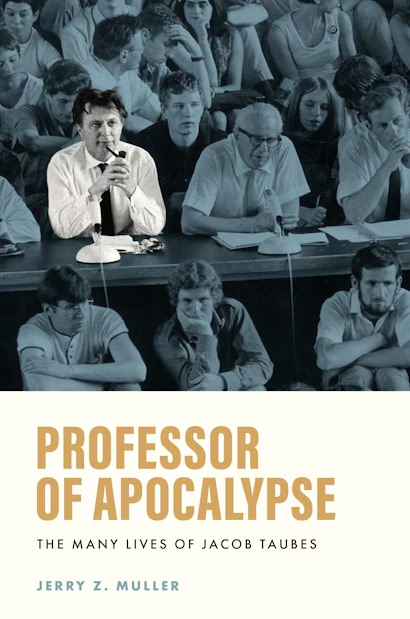
Scion of a distinguished line of Talmudic scholars, Jacob Taubes (1923–1987) was an intellectual impresario whose inner restlessness led him from prewar Vienna to Zurich, Israel, and Cold War Berlin. Regarded by some as a genius, by others as a charlatan, Taubes moved among yeshivas, monasteries, and leading academic institutions on three continents. He wandered between Judaism and Christianity, left and right, piety and transgression. Along the way, he interacted with many of the leading minds of the age, from Leo Strauss and Gershom Scholem to Herbert Marcuse, Susan Sontag, and Carl Schmitt. Professor of Apocalypse is the definitive biography of this enigmatic figure and a vibrant mosaic of twentieth-century intellectual life.
Jerry Muller shows how Taubes’s personal tensions mirrored broader conflicts between religious belief and scholarship, allegiance to Jewish origins and the urge to escape them, tradition and radicalism, and religion and politics. He traces Taubes’s emergence as a prominent interpreter of the Apostle Paul, influencing generations of scholars, and how his journey led him from crisis theology to the Frankfurt School, and from a radical Hasidic sect in Jerusalem to the center of academic debates over Gnosticism, secularization, and the revolutionary potential of apocalypticism.
Professor of Apocalypse offers an unforgettable account of an electrifying world of ideas, focused on a charismatic personality who thrived on controversy and conflict.
Undoing Things explores all the ways in which things become undone, be they objects, bodies, places, or worlds.
Although archaeologists have long attended to the productive dimensions of materiality and material culture as a coherent phenomenon—making objects, building things, constructing identities—the discourse around undoing is more fragmented. Topics such as ruination, death, decay, demolition, and collapse are usually examined separately. Undoing Things asks what connections or continuities can be discerned in a diverse range of practices, both intentional and taphonomic, both destructive and healing. Is there a creative component to undoing ? How visible are different processes of undoing? How is time implicated? Is undoing reversible? Who has the power to undo and when is undoing empowering? What does it take to undo knowledge? These and other questions are examined through archaeological studies ranging from classical Maya and colonial Caribbean examples to present-day Liberia, historical and ethnographic approaches to present-day Argentina, and the contemporary art world.
In the first quarter of the 21st century, human worlds have experienced a series of ruptures from climate-related disasters, political violence, and the Covid-19 pandemic. Undoing Thingshelps move us beyond a cloud of chaos with a deeper understanding of how and why things fall apart and is vital reading for archaeologists and those in related disciplines.
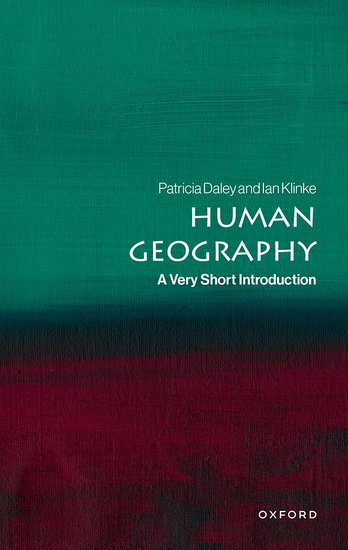
Human geography offers answers to some of the most important challenges of our time. To understand contemporary struggles over global economic inequality, forced migration, racial injustice, gender justice, and the climate crisis, we must grasp the ways in which these are fought over and through space.
Human Geography, A Very Short Introduction by Patricia Daley and Ian Klinke explains how the subject can aid a better knowledge of the modern world. It examines the formation of power systems and the ways in which they have been constructed, subverted, and resisted over time. This Very Short Introduction explores the topic through seven spaces that define the present: the colony, the pipeline, the border, the high rise, the workplace, the conservation area, and outer space. In addition, the authors take a critical view of the discipline and its history, but argue for its continuing vitality.
ABOUT THE SERIES: The Very Short Introductions series from Oxford University Press contains hundreds of titles in almost every subject area. These pocket-sized books are the perfect way to get ahead in a new subject quickly. Our expert authors combine facts, analysis, perspective, new ideas, and enthusiasm to make interesting and challenging topics highly readable.
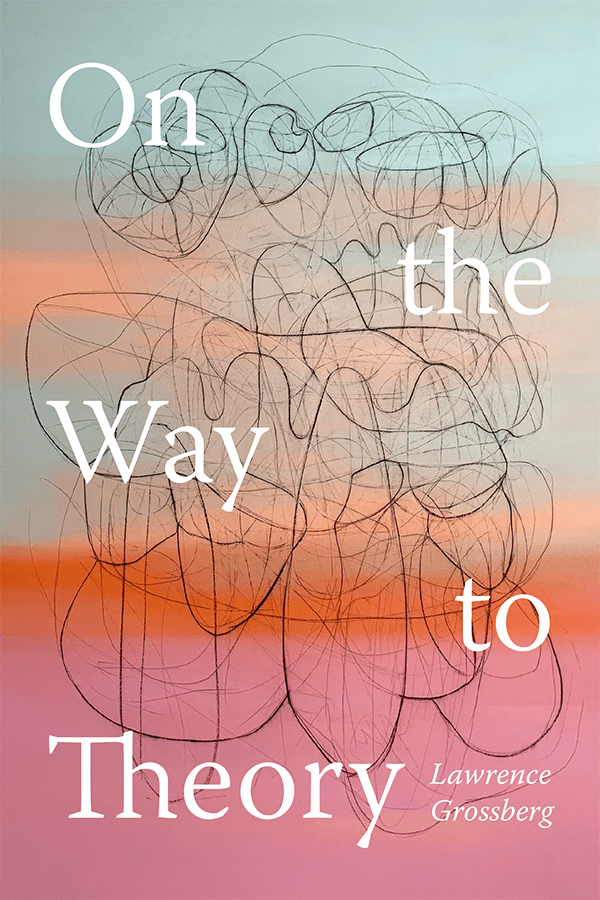
In On the Way to Theory, Lawrence Grossberg introduces the major ways of thinking that provide the backstory for contemporary Western theory. Asking readers to think about thinking, Grossberg traces cultural and critical theory’s foundations from the contested enlightenments to modern and postmodern conceptualizations of power, experience, language, and existence. He introduces key figures as historical characters and lays out the unique set of tools for thought that their “deep theories” offer. Through finely tuned and accessible descriptions of their concepts and logics, Grossberg highlights thinkers including Spinoza, Kant, Hegel, Marx, Nietzsche, Wittgenstein, Heidegger, Derrida, Foucault, Deleuze, and Hall, defining the possibilities of their thought. This book is essential for those interested in how theories shape our understanding of the world, influence our choices, and define our realities. It challenges us to recognize the multiplicity and complexities of ways of thinking in our quest for knowledge and understanding. By setting out a story of theoretical foundations, Grossberg invites readers to think toward the future of theory and expand conversations around theoretical scrutiny and criticism.
In the preface to the second edition of his Mitra-Varuna, Georges Dumézil mentions some of the people who attended the lecture course which became the book. Delivered at the École Pratique des Hautes Études in 1938-39, this was the last year of teaching before the war. Attendees included Roger Caillois, Lucien Gerschel, Marie-Louise Sjoestedt, Deborah Lifschitz and Elisabeth Raucq. He also mentions an assistant professor at the University of Ghent called Pintelon (English edition, p. xxxvii). Some of these people – Sjoestedt, Lifschitz and Pintelon – did not survive the war. Dumézil says his fondness for this class is therefore “a memory peopled by ghosts” (p. xxxvii). Caillois is a well-known figure; Gerschel was one of Dumézil and Benveniste’s most loyal students. I have written about the Celtic language scholar Sjoestedt before on this site.
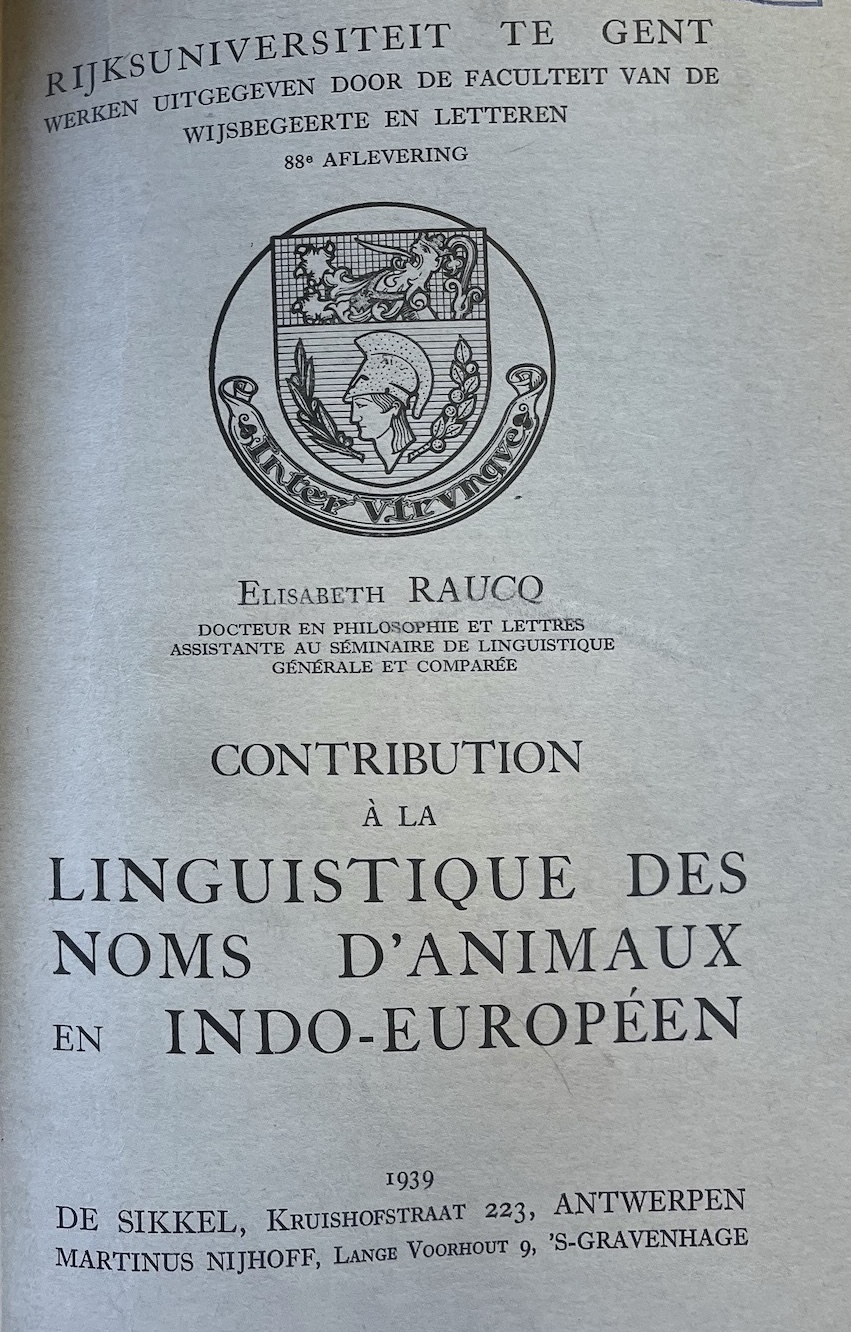
Here I want to say something about the work of Elisabeth Raucq, though there are few published traces of her career. Raucq also attended Émile Benveniste’s Comparative Grammar and Iranian lecture courses in 1938-39, as well as classes with Jules Bloch and Jean Filliozat. There are no indications she attended the EPHE in previous years, so it seems this was a visiting year from the University of Ghent, where she was working with George van Langenhove. The book which I focus on is a linguistic study of animal names or nouns in Indo-European languages: Contribution à la linguistique des noms d’animaux en indo-européen, published by De Sikkel in Antwerp in 1939. This was a publication series from the University of Ghent, and I suspect it was her thesis. She is working in the tradition of van Langenhove, and references work by Antoine Meillet in the book, and two of his most important students, Jerzy Kuryłowicz and Benveniste. Her reference to Benveniste’s work is to his 1936 book Origines de la formation des noms en indo-européen.
Given what else was happening in 1939 it is unsurprising there were few reviews at the time of publication. The three I know are by the medievalist Urban T. Holmes Jr. in Language in 1940, Alfred Ernout in the Revue de Philologie, de Littérature et d’Histoire Anciennes, and by Berhard Rosenkranz in Indogermanische Forschungen, bothin 1941. Ernout’s review is just a book note, but in only a few words raises some significant issues:
This book develops from the teaching of Monsieur van Langenhove: it is an application of his theory of the structure of ‘primitive’ Indo-European. According to Mlle Raucq in her preface, “Animal nouns are fixed [immotivés] in the system of nominal formations characteristic of Indo-European in the verbal period. They can be analysed as semantemes belonging to the static period of Indo-European” [p. viii]. Her study is devoted to this analysis. The noun ox [bœuf], for example, can be traced back to a root ǝg2 suffixed by *-eu- and variously expanded (p. 88), or rather to a primary IE form *ǝg2ǝ3eu- (p. 90). One can admire the ease with which Mlle Raucq proceeds with these reconstructions. For my part, they worry me a bit, and I see emerging, more or less implicitly, the idea that through Indo-European we can reconstitute ‘original’ forms. It is the same idea, rejuvenated and presented in a more complicated form, that Bopp expressed in the preface of his 1833 Grammar: I am afraid it will lead to the same misunderstandings.
Holmes also situates Raucq within the lineage of van Langenhove, but includes Meillet’s students too: “In this investigation of the semantemes and idea-signifiers of pre-dialectal Indo-European, the author is a disciple of Van Langenhove, and therefore of Kurylowicz and Benveniste” (241). Holmes concludes: “This type of linguistic reasoning is still in its experimental stage, and no one as yet can judge its ultimate value. We must read with care the studies of Benveniste, Kurylowicz, Van Langenhove, Raucq, and others” (p. 241).
Rosenkranz suggests the book “appears extremely convincing… partly due to the consistency with which she pursues her principles and methods”. But he identifies “serious concerns”, particularly around the way it follows a line, excludes material which does not fit, and proposes some dubious etymologies. Ultimately he sees Raucq’s “‘test case’” for van Langenhove’s theory as “a failure” (p. 61). The book is also mentioned in passing by Albert Cuny in the Revue Hittite et Asianique in 1939, again seeing it in the lineage of van Langenhove, but on a topic outside the scope of that journal.
Another review appeared somewhat belatedly, because of the war, in the Bulletin de la société de linguistique de Paris, in an issue spanning 1942-45. The author of this review was Benveniste, who discussed the book alongside the first two volumes of van Langenhove’s Linguistische Studiën. It is, frankly, brutal, and clearly disassociates his work from this approach. While he acknowledges van Langenhove makes some valuable analyses of Germanic morphology, he is sceptical of the wider claims. “I must confess that, in these long considerations and these meticulous analyses, I was unable to grasp any useful ideas; I even admit that most of the principles behind them remain unintelligible to me” (p. 44). He contrasts the documentation and the theory: the former is “extensive, precise, generally taken from the best authors”, but the latter is a “nebulous and inconsistent doctrine which is superimposed on it” (pp. 44-45).
In the second part of his review he argues that Raucq’s project is entirely based on these “pseudo-principles”, because she believes only van Langenhove’s method “leads to results”. This is its problem for Benveniste: “it is a question of establishing that nouns considered simple are prehistoric compounds”. Her work is misled by thinking about Greek words without considering they are “borrowings from some other Indo-European language”. He closes with the wish that “I hope Mlle Raucq abandons these sterile paths and in future devotes her gifts and knowledge to more real objects” (p. 45).
For a while at least, Raucq continued in the lineage of van Langenhove. Her other book-length study was a Dutch work, Bijdrage tot de studie van de morphologie van het Indo-Europeesch verbum, published in 1947, but completed on 14 July 1943 (p. 194). Its title would translate as Contribution to the study of the morphology of the Indo-European verb. Being in Dutch would have narrowed its audience, even within linguistic specialists, and I cannot find any indication it was translated into another language. From the reviews I have seen (i.e. Edgar Polomé in 1951 and Arthur Beattie in 1952), it seems that this continued to build on van Langenhove’s work. He died, suddenly, in 1943, at the age of just 51, and a third volume of his Linguistische Studiën was published posthumously in 1946, edited by two of his colleagues. The first volume of this series is mostly in Dutch; one essay of the first volume and the other two volumes in French. There were plans for additional volumes, which van Langenhove did not achieve. Raucq dedicates Bijdrage tot de studie to van Langenhove’s memory: the completion date is the day of his death.
The only other publication by Raucq of which I’m aware is a very specialist study of a manuscript held in Brussels, “Die Runen des Brüsseler Codex No. 9565 – 9566”. Runes were another of van Langenhove’s interests. The article begins with a Dutch summary, but is mostly in German. It is in a 1941 issue, but notes that it was a paper delivered on 21 June 1942. (I suspect this discrepancy is because publication schedules were erratic during the war, and that the 1941 volume was delayed enough to allow a 1942 paper to appear within it.)
Contribution à la linguistique des noms d’animaux en indo-européenDie Runen des Brüsseler Codex No. 9565 – 9566Bijdrage tot de studie…
Beyond these pieces, I can find nothing of what Raucq went on to do. The cover page of Bijdrage tot de studie says that she was an “assistant to the seminar in general and comparative linguistics (1938-1944)”. Perhaps that role did not continue after van Langenhove’s death. Or she may have married and changed her name. It is possible she did not pursue an academic career. If that is the case, it’s hard not to think the highly critical reviews played a part.
Her career therefore appears to be highly abbreviated: a 1939 book, a 1942 paper, and another book completed in 1943 and published in 1947. One each in French, German and Dutch. The book on animals is especially remarkable for its date of 1939. The methodological differences are significant between Benveniste and Raucq, as his review indicates, but thematically there are parallels. Benveniste would himself publish on animal nouns in his later work, both in Indo-European in 1949 and in the High-Yukon native American language in 1953. It is striking that, even as a contrast, Benveniste does not mention Raucq’s book in the first of these. The Native American essay was based on fieldwork on the Pacific Northwest coast, and builds on the limited work on native American languages in European research of the time. It lists the names of multiple kinds of mammals, birds, fish and insects, and provides a short text, “The Bear and the Porcupine”, with a translation.
Raucq’s work might even be seen as something of a model for Benveniste’s later work on the vocabulary of Indo-European institutions, which we have in English as the Dictionary of Indo-European Concepts and Society. But in that work, Benveniste is not so much concerned with trying to reconstruct words in Indo-European but rather the subsequent forms, their relations and significations. It is also a book which by its nature is much more explicitly political.
References
A.J. Beattie, “E. Raucq: Bijdrage tot de Studie van de Morphologie van het Indo-Europeesch Verbum…”, The Classical Review 2 (2), 1952, 111-12.
Émile Benveniste, Origines de la formation des noms en indo-européen, Paris, Adrien Maisonneuve, 1935.
Émile Benveniste, “George van Langenhove. – Linguistische Studiën I, II… Élisabeth Raucq. – Contribution à la linguistique des noms d’animaux…”, Bulletin de la société de linguistique 42 (2), 1942-45, 44-45.
Émile Benveniste, “Noms d’animaux en indo-européen”, Bulletin de la Société de linguistique 45 (1), 1949, 74-103.
Émile Benveniste, “Le vocabulaire de la vie animale chez les indiens du Haut-Yukon”, Bulletin de la société de linguistique 138 (1), 1953, 79-106.
Émile Benveniste, Le Vocabulaire des institutions indo-européennes, 2 volumes,Paris: Éditions de Minuit, 1969; Dictionary of Indo-European Concepts and Society, trans. Elizabeth Palmer, Chicago: Hau Books, 2016; originally published as Indo-European Language and Society, Coral Gables: University of Miami Press, 1973.
Albert Cuny, “G. van Langenhove, Linguistische Studiën, II”, Revue Hittite et Asianique 5 (37-38),1939, 185-86.
Georges Dumézil, Mitra-Varuna. Essai sur deux représentations indo-européennes de la souveraineté,Paris: Gallimard, second edition, 1948; Mitra-Varuna: An Essay on Two Indo-European Representations of Sovereignty,critical edition, trans. Derek Coltman, ed. Stuart Elden, Chicago: Hau, 2023.
A. Ernout, “Elisabeth Raucq, Contributions à la Linguistique des Noms d’Animaux en Indo-Européen”, Revue de Philologie, de Littérature et d’Histoire Anciennes 15, 1941, 177.
Urban T. Holmes, Jr., “Contributions à la Linguistique des Noms d’Animaux en Indo-Européen by Elisabeth Raucq”, Language 16 (3), 1940, 241.
George van Langenhove, Linguistische Studiën, Antwerpen: De Sikkel, three volumes, 1936-46.
E. Polomé, “Raucq (E.). Bijdrage tot de studie van de morphologie van het indo-europeesch verbum”, Revue belge de philologie et d’histoire 29 (4), 1951, 1199-1205.
Elisabeth Raucq, Contribution à la linguistique des noms d’animaux en indo-européen, Antwerpen: De Sikkel, 1939.
Elisabeth Raucq, “Die Runen des Brüsseler Codex n° 9565-9566”, in Mededeelingen van de Koninklijke Vlaamsche Academie voor wetenschappen, Letteren en schoone kunsten van België. Klasse der letteren III (4), 1941, 1-26.
Elisabeth Raucq, Bijdrage tot de studie van de morphologie van het Indo-Europeesch verbum, Brugge: De Tempel, 1947.
B. Rosenkranz, “George van Langenhove: Linguistische Studien II: Essais de linguistique indo-européenne… Elisabeth Raucq, Contribution à la linguistique des noms d’animaux en Indo-Européen…”, Gnomon 17 (2), 1941, 56-61.
Archives and Sources
Fonds Georges Dumézil, Collège de France, DMZ 56.4.
École pratique des hautes études, Section des sciences historiques et philologiques. Annuaire 1939-1940, 1939.
This is the fifteenth post of a weekly series, where I post short essays with some indications of further reading and sources, but which are not as formal as something I’d try to publish more conventionally. They are usually tangential to my main writing focus, a home for spare ideas, asides, dead-ends and possible futures. I hope there is some interest in them. They are provisional and suggestions are welcome.
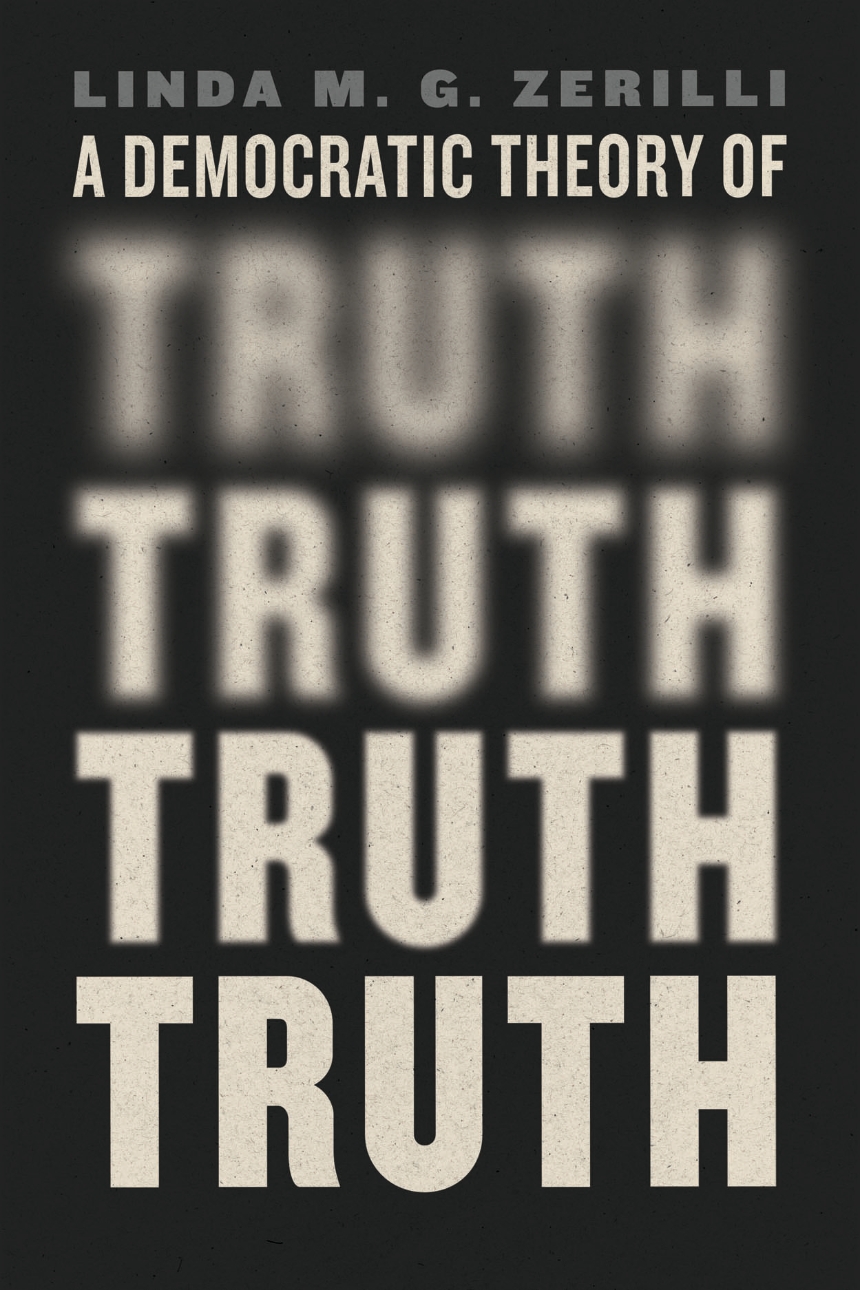
A critique of the concept of truth presupposed by the post-truth debate—and a bold new vision for a more pluralistic citizenry.
We say that we live in a “post-truth” era because disinformation threatens our confidence in the existence of a shared public world. Affirming objective truth may, therefore, seem necessary to save democracy. According to political theorist Linda M. G. Zerilli, such affirmation can stifle political debate and silence dissent. In fact, Zerilli argues that the unqualified insistence on objective truth is as dangerous for democracy as denying it.
Drawing on Arendt, Foucault, and Wittgenstein, A Democratic Theory of Truth challenges the concept of truth presupposed by the post-truth debate. It argues that we, the people, have an essential role in discovering and evaluating any truth relevant to the political realm. The result is a striking defense of plurality, dissent, and opinion in contemporary democratic societies.
How did Europeans achieve global dominance and continue to satisfy their ever-growing needs? How do we explain the effects this has on the rest of the world?
In his magnum opus, published here in English for the first time as an open access book, world-renowned critical development scholar Benoit Daviron blends Braudelian history and a food systems approach to show how biomass–as the metabolism of societies and as a source of matter and energy–explains key historical phases of Western capitalist hegemony and the transitions between them. By examining various uses of biomass, technical production and extraction methods, forms of labour mobilization, and exchange systems, Daviron provides startling new insights into capitalist development from the 16th century to the present.
This book is essential reading for students and scholars of critical approaches to global development, and for anyone interested in how capitalist domination came to be and how the bio-meatabolic imbalances it created might be redressed.
The ebook editions of this book are available open access under a CC BY-NC-ND 4.0 licence on bloomsburycollections.com.