« Ôtez Canguilhem et vous ne comprenez plus grand-chose à toute une série de discussions. »
Par ces mots, Michel Foucault faisait de Georges Canguilhem l’invisible clef de voûte de la philosophie française. Pourtant, à son décès en 1995, l’austère historien des sciences ne nous avait légué qu’une œuvre bien circonscrite, consistant pour l’essentiel en cinq livres. Ce premier ensemble, où trônaient Le Normal et le Pathologique et La Connaissance de la vie, n’est plus que la pointe émergée d’un iceberg. Les Œuvres complètes de Canguilhem, dont le sixième volume paraît ce mois-ci, comptent désormais plusieurs milliers de pages. Renouvelé et enrichi, ce corpus modifie profondément l’image que nous nous formions de sa pensée. Trente ans après, l’œuvre de Canguilhem, plus vivante que jamais, ouvre de nouvelles pistes – à l’histoire des sciences biologiques et médicales, mais aussi à la philosophie tout court.
Sommaire :
Thierry HOQUET : (De quoi) Canguilhem fut-il philosophe ?
ENTRETIENS Pierre-Olivier MÉTHOT : « Canguilhem pense avant Foucault que “tout est normé dans une culture” »
Élodie GIROUX : « Canguilhem peut servir de ressource pour appréhender une médecine extrêmement technicisée »
Marie GAILLE et Agathe CAMUS : En quête de matière étrangère. La philosophie de terrain à l’épreuve des maladies chroniques
Lucie LAPLANE : PhiLabo. La philosophie dans le laboratoire
VARIA Frédéric KECK : Portrait de René Girard en Maître Renard
Francis WOLFF : Engel lecteur de Foucault. Pour une généalogie positive
This book explores the key conceptual stakes underpinning historical epistemology. The strong Anglophone interest in historical epistemology, since at least the 1990s, is typically attributed to its simultaneously philosophical and historical synthetic approach to the study of science. Yet this account, considered by critics to be an unreflective assumption, has prevented historical epistemology from developing a clear understanding and definition, especially regarding how precisely historical and philosophical reflections on the sciences should be combined. Thus, this book uniquely analyses how the problems and tensions inherent to the “contemporary” phase of historical epistemology can be clarified by reference to the “classical” French phase. The archaeological method of Michel Foucault, which draws on and transforms fundamental insights by Gaston Bachelard and Georges Canguilhem, is used to exert an enduring influence on the field—especially through the work of Ian Hacking and his philosophical cum historical analyses of “styles of scientific reasoning”. Though this book is of great value to academic specialists and graduate students, the fact it addresses questions broad in scope ensures it is also relevant to a range of scholars in many disciplines and will provoke discussion among those interested in foundational issues in history and philosophy of science.
The distant past is commonly characterized in terms of dominant materials of the time – the Stone Age, the Bronze Age, the Iron Age, etc. Since the dawn of writing, however, characterizing eras in terms of materials has fallen by the wayside, and yet materials have continued to exert a powerful influence on our collective imagination.
Viewed from this perspective, France in the period from 1815 to 1855 could be seen as the half-century of plaster. After the French Revolution, plaster was used for a great variety of things: building, moulding, sculpting, decorating. Cheap and easy to use, plaster was everywhere, from Napoleon’s death mask to household ornaments, from walls to elaborate mouldings. Plaster was king – but a fragile king that easily crumbled and fell apart. The age of plaster was also the reign of the ephemeral and the transient, the vulgar and the eclectic, and the men and women of the time struggled to maintain stability and continuity with the past. In the space of a few decades, no fewer than seven political regimes succeeded one another. Plaster – symbol of the ephemeral, the flaking and the vulgar – is the material which defines the first half of the nineteenth century.
Written with his characteristic brilliance and eye for unconventional topics, Alain Corbin’s highly original exploration of the role of plaster in history will be of interest to a wide readership.
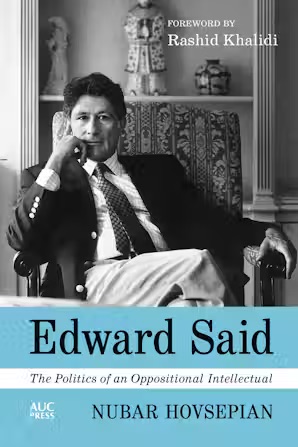
An exploration of the political thought of one of the twentieth century’s most influential thinkers and the foremost advocate for the Palestinian cause in the West
Edward Said was one of the most influential intellectuals of the twentieth century. A literary scholar with an aesthete’s temperament, he did not experience his political awakening until the 1967 Arab–Israeli war, which transformed his thinking and led him to forge ties with political groups and like-minded scholars. Said’s subsequent writings, which cast light on the interplay between cultural representation and the exercise of Western political power, caused a seismic shift in scholarly circles and beyond. In this intimate intellectual biography, by a close friend and confidant, Nubar Hovsepian offers fascinating insight into the evolution of Said’s political thought.
Through analysis of Said’s seminal works and the debates surrounding them, Edward Said: The Politics of an Oppositional Intellectual traces the influence of Foucault on Said, and how Said eventually diverged from this influence to arrive at a more pronounced understanding of agency, resistance, and liberation. He consequently affiliated more closely with Raymond Williams, Antonio Gramsci, and more contemporaneously, with his friends the late Eqbal Ahmad and Ibrahim Abu-Lughod.
Said held that it is the intellectual’s responsibility to expose lies and deceptions of the holders of power. A passionate advocate for the Palestinian cause, his solidarity did not prevent him from launching a sustained critique of the Palestinian leadership. Hovsepian charts both Said’s engagement with the Palestinian national movement and his exchanges with a host of intellectuals over Palestine, arguing that Said’s interventions have succeeded in changing the parameters of the discourse in the humanities, and among younger Jews searching for political affiliation.
Drawing on his diaries, in which he recorded his meetings with Said, as well as access to some of Said’s private letters, Hovsepian illuminates, in rich detail, the trajectory of Said’s political thinking and the depth and breadth of his engagement with peers and critics over issues that continue to resonate to this day.
We’re really excited to be working with AK Press on the preorder campaign for this new book on Buffalo legend, Martin Sostre! For each copy of A Continuous Struggle preordered through us or AK Press, we’re partnering with AK to send a free copy of the paperback Prison Edition to an incarcerated reader. …
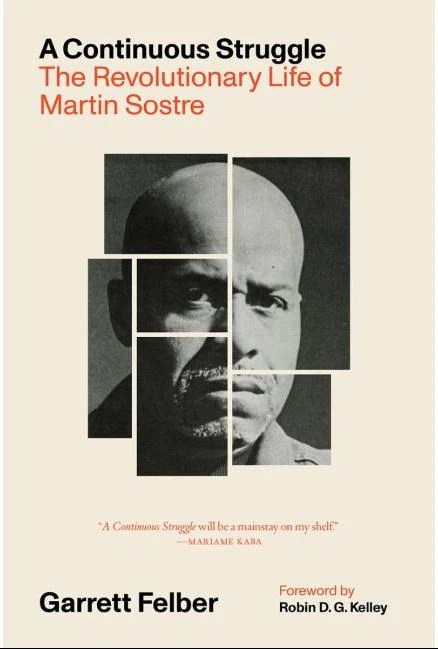
The biography of an underappreciated legend in the history of anti-prison and Black freedom movements.
A Continuous Struggle is a political biography of one of the most important–if since forgotten–revolutionary figures of the twentieth century in the United States. Martin Sostre (1923-2015) was a Black Puerto Rican from East Harlem who became a politicized prisoner and jailhouse lawyer, winning cases in the early 1960s that helped secure the constitutional rights of incarcerated people. He opened one of the country’s first radical Black bookstores and was scapegoated and framed by police and the FBI following the Buffalo rebellion of 1967. He was sentenced by an all-white jury to thirty-one to forty-one years.
Throughout his nine-year imprisonment, Sostre transformed himself and the revolutionary movements he was a part of, eventually identifying as a revolutionary anarchist and laying the foundation for contemporary Black anarchism. During that time, he engaged in principled resistance to strip frisks for which he was beaten eleven times, raising awareness about the routinized sexual assault of imprisoned people.
The decade-long Free Martin Sostre movement was one of the greatest and most improbable defense campaign victories of the Black Power era, alongside those to liberate Angela Davis and Huey Newton. Although Sostre receded from public view after his release in 1976, he lived another four decades of committed struggle as a tenant organizer and youth mentor in New York and New Jersey. Throughout his long life, Martin Sostre was a jailhouse lawyer, revolutionary bookseller, yogi, mentor and teacher, anti-rape organizer, housing justice activist, and original political thinker. The variety of strategies he used and terrains on which he struggled emphasize the necessity and possibility of multi-faceted and continuous struggle against all forms of oppression in pursuit of an egalitarian society founded on the principles of “maximum human freedom, spirituality, and love.”
With a foreword by Robin D. G. Kelley.
Foucault spoke at a press conference in Buffalo in 1972, demanding a retrial for Sostre. Thanks to Hope Dunbar for the link.
Todd Meyers, Gone Gone – Duke University Press, March 2025
In Gone Gone, Todd Meyers reckons with grief in the face of overdose death and with the afterlives of loss created by the opioid crisis. Through conversations with friends, lovers, and family members of those who are gone, Meyers brings readers into an inquiry about lives shared, told through tenderness and tragedy. Meyers seeks to find methods to record and convey the many experiences of grief in ways that do not simply consign sorrow to the world of drugs and addiction. Blending prose, poetry, and ethnography, Gone Gone is a lucid and devastating record that reminds readers that the grief felt by those who lose ones they love to overdose is varied and untamable.
The state of nature is a powerful idea at the heart of the fragmented and sometimes conflicting stories the modern West tells about itself. It also makes sense of foundational Western commitments to equality and accumulation, freedom and property, universality and the individual. By exploring the social and cultural imaginaries that emerge from the distinct and often contradictory accounts of the state of nature in the writing of Hobbes, Locke and Rousseau, The State of Nature and the Shaping of Modernity offers a fresh perspective on some of the most pressing debates of our time, showing how the state of nature idea provides a powerful lens through which to focus the complex forces shaping today’s political and cultural landscape. It also explores how ideas about human nature and origins drive today’s debates about colonialism, secularism, and the environment, and how they can shed new light on some of society’s most heated debates.
In this engaging Handbook, Alice Mattoni brings together an international team of scholars to provide a multifaceted exploration of progressive politics. Contributing authors expertly discuss progressive politics within contemporary global debates, addressing contentious issues and acknowledging the impact of technological advances on the political landscape.
This Handbook identifies issues central to the progressive agenda, such as climate change, migration, and international conflict, while considering progressive politics in relation to digitalization and datafication. Authors illustrate the tensions within progressive politics, examining the roles of different political and non-political actors, such as social movement organizations. It demonstrates how the interactions and disagreements of these actors reshape the idea of what progressive politics has been, is, and will become in the near future.
This is a compelling resource for scholars of political science, political sociology, social movements and civil society. This Handbook”s interdisciplinary approach also makes it valuable to scholars across media and communication studies, gender politics, and environmental studies who are interested in how their disciplines intersect with progressive politics.
Andy Merrifield, Roses for Gramsci – Monthly Review Press, April 2025
A remarkable personal journey through the life and writings of the great Sardinian Marxist, Antonio Gramsci
In June 2023, author Andy Merrifield and his partner and their daughter moved from the UK to Rome, she to take a new job, he to get his creative juices flowing again, and both to begin a new life. A short time later, he visited Gramsci’s grave at the Non-Catholic Cemetery, home as well to the great Romantics, Percy Bysshe Shelley and John Keats. Soon he took a volunteer position helping to maintain the cemetery and as it turned out, to keep a watchful eye on Gramsci’s tombstone, admiring the roses and notes that visitors left, talking to some of them and communing with the sentinel cat that kept watch near the gravesite. Thus began Merrifield’s deep dive into Gramsci’s life.
The result is a stunning portrait that offers fresh insights into nearly every aspect of Gramsci’s often tortured existence: a childhood scarred by severe health problems; his growing understanding of political economy; his generosity and kindness; his grasp of the culture of workers and peasants; his friendship with the economist Piero Sraffa; and his frustration trying to communicate with and be father to the son he never saw. Above all, Merrifield illuminates how Gramsci kept his humanity, suffering horribly in prison while writing a revolutionary classic, The Prison Notebooks.
Personal, compassionate, moving—and illustrated with the author’s photographs —Merrifield revives both the legacy and meaning of Gramsci’s work and the dying art of belles lettres. Roses for Gramsci is an evocative and indelible book.
This was written for an event on ‘Troubling Classical Bodies‘ at the Remarque Institute at New York University on 11 April 2025. My thanks to Stefanos Geroulanos and Brooke Holmes for the invitation to give this short talk, and to them, Anurima Banerji and the audience for the discussion.
In 1907, the British-Hungarian explorer Aurel Stein negotiated with a Buddhist monk to access the library cave of a temple complex in Dunhuang, in Chinese Turkestan, now part of Gansu province and relatively close to the border with Xinjiang. The library cave had been sealed sometime around the 11th-13th century of the modern era, and it contained a wealth of material in a range of languages. Stein paid the monk a small sum to be used for temple renovation, and in return was able to remove manuscripts and bring them back to London. The French scholar Paul Pelliot arrived at Dunhuang in 1908, and made a rapid survey of the material there. He too was able to bring back a huge range of documents to Paris.
Back in Europe, various academics were set to work on the material. Stein was an Indologist, Pelliot a Sinologist, but others were brought on board. The French linguist Antoine Meillet did some work on the language known as Tocharian B, but on the largely unknown Sogdian, an East Iranian language, he got one of his students, and at the time his designated successor, Robert Gauthiot, to do the work. In parallel, German scholars led by Friedrich Carl Andreas were working with other Sogdian texts brought back by the Turfan expeditions. Gauthiot died from wounds received in the First World War, and progress on deciphering and publishing the texts slowed. Gauthiot’s grammar was left incomplete until the very young Emile Benveniste, a student of Meillet and now being prepared as Meillet’s successor – and Gauthiot’s replacement – took up the work.
Emile Benveniste, “Un emploi du nom du «genou» en vieil-irlandais et en sogdian”, Bulletin de la Société de Linguistique de Paris, 1926Gauthiot’s edition and translation of the Vessantara Jātaka
One of Benveniste’s very earliest publications, in 1926, when he was in his early 20s, is on a question of Sogdian vocabulary. It was his second short article in the Bulletin de la Société de Linguistique de Paris; a journal in which he would publish much of his work and later edit. It is on the word for ‘knee [genou]’, z’nwk- *zānūk, and he says its sense in Sogdian texts is usually clear from context, or in relation to Indo-European languages generally, and to Indo-Iranian in particular.
But there are two instances in Robert Gauthiot’s translation of the Vessantara Jātaka where the meaning is unclear. The Vessantara Jātaka is a Buddhist tale, about one of the Buddha’s past lives, in which the prince Vessantara gives away all that he owns, including his wife and children, as an exemplar of generosity. There are versions of the tale in many languages, including Pali, Sanskrit and Chinese. The story was known in these other languages, and the discovery of the story in Sogdian helped with that language’s interpretation. Gauthiot published “Une version sogdienne du Vessantara Jātaka” in two parts in the Journal Asiatique in 1912, comprising a transcription and translation. It was also reprinted as a book.
In his article, Benveniste gives the Sogdian text and Gauthiot’s translation. VJ = line number of the transliteration.
VJ 64 – “the king on his knees (?) ordered his son to be brought forward so he could be named [le roi à genoux (?), ordonna d’amener son fils pour qu’il fût nommé]”.`
VJ 1386 – “I forgive my son on my knees; come with your wife Mandri [Je pardonne à genoux à mon fils; viens avec ton épouse Mandri]”.
Benveniste questions both of these choices. It is not normal to order or to forgive on your knees, rather you would beg forgiveness that way. The figure in the position of power is not the one making the supplication. In the second case there is another complication: it is addressed to the “son on knees” or the “son of the knee [fils du genou]” (p. 51).
Benveniste draws on an article by Joseph Loth in the Revue Celtique in 1923, about an Old Irish use of ‘knee’ that invokes a generation, in the sense of “infant of the knee”, and there is a parallel in Anglo-Saxon (i.e. Old English), of the sense of a direct parent. Loth makes a link between sitting in the lap, of a father recognising a child by lifting them up and placing them on their knee. Benveniste thinks this more plausible than the ‘knee’ being a euphemism for a penis, or childbirth from a kneeling woman (p. 52). He argues that even if that was the child birthing practice, the lineage argument is a challenge:
But there’s a long way to go from the purely physiological notion of ‘giving birth’ to the entirely legal one of ‘filiation’, for in primitive societies there is no necessary relationship between consanguinity and kinship. Kinship is only sanctioned by legitimation, which, among Indo-Europeans, is the exclusive prerogative of the father. By taking the child on his lap, after lifting him from the ground, the head of the family exercises one of his essential prerogatives, attesting to the authenticity of his descent, and maintaining the continuity of his lineage (p. 53).
Benveniste therefore suggests that the Irish sense maps onto the Sogdian one, and helps to unlock a puzzle of meaning. (It’s worth noting that the limited surviving materials in Sogdian make for many such challenges in its interpretation.) If “son of the knee” in the earlier examples from the Vessantara Jātaka actually mean ‘son as heir’ or ‘heir-son’, then the difficulties of sense disappear:
VJ 64 – “and the king ordered his heir-son to be brought forward, etc. [Et le roi ordonna d’amener son fils héritier, etc.]”.
VJ 1386 – “I forgive my heir-son; come with your wife Mandri [J’accorde mon pardon, ô mon fils héritier; reviens ici avec ta femme Mandri]”.
He notes that there are no other Iranian dialects that have a similar expression, nor is it found in modern Indian languages.
So we can’t decide whether we’re dealing here with a creation or a calque [i.e. a literal word-for-word translation], a noble or popular expression, a chance conservation or a living locution. But the concordance of a designation and no doubt of an identical usage at the two most distant ends of the Indo-European world seems to us worthy of note, and deserves to be joined to the similar correspondences grouped by M. [Joseph] Vendryes.
What is interesting about this short, three-page article, it seems to me, is that Benveniste is already working in a related manner to his much more renowned later work. A small issue in a text, what might appear to be a textual crux, a corrupted or problematic passage, which might need to be corrected in the source text before being open to translation and interpretation, can be examined from another angle. But the reading of the text can also indicate something about the practices of the people – the idea of kinship, lineage, and patriarchy. Benveniste published a new edition of Vessantara Jātaka in 1946, indicating that though Gauthiot’s work was pioneering, aspects of it were outdated by the 1940s. It was a transliteration, translation and commentary on the text. In the two instances at stake, Benveniste now translates the term as “dear son” or “loving or sweet son”.
Benveniste’s edition and translation of the Vessantara Jātaka
VJ 64 “the king ordered his dear son to be brought in for the proclamation (of the name?) [le roi ordonna d’amener son cher fils pour la proclamation (du nom?)]”.
VJ 1386 “I grant my forgiveness, my loving son. Come back with your wife Mandri! [J’accorde mon pardon, ô mon tendre fils. Reviens ici avec ta femme Mandri!]”
Benveniste describes his edition of the Vessantara Jātaka as completing the work of his Textes sogdiens – a transliteration, translation, commentary and glossary of available material, completed shortly before he was called up for his military service and published in 1940. A reproduction of all the previously-unpublished Sogdian manuscripts in Paris, Codices Sogdiani, was sent to the printer shortly before war broke out, and the texts were moved from Paris for safe-keeping. Benveniste wrote its introduction.
Benveniste would continue to work on the Sogdian language throughout his career. The text on the knee was also reprinted as the first text in the posthumous collection of his Études sogdiennes in 1979, edited by his former student Georges Redard after Benveniste’s death.
While Benveniste worked on many other topics, and languages, his career was fundamentally shaped by the findings of expeditions to the Silk Road which happened when he was a young child. The haul of Stein and, especially, Pelliot provided a wealth of material for scholars. And in his first publications on the Sogdian language, Benveniste is one of the major figures in this interpretative and reconstructive work.
This is therefore a twentieth-century reading, of a medieval manuscript, of a classical text – in which a body, or at least a body part, is in question.
References
Emile Benveniste, “Un emploi du nom du «genou» en vieil-irlandais et en sogdian”, Bulletin de la Société de Linguistique de Paris 27 (1), 1926, 51-53.
E. Benveniste, Textes Sogdiens: Édités, traduits et commentés, Paris: Librarie Orientaliste Paul Geuthner, 1940.
E. Benveniste, Vessantara Jātaka: Texte sogdienédité, traduit et commenté, Paris: Librarie Orientaliste Paul Geuthner, 1946.
Émile Benveniste, Études Sogdiennes, ed. Georges Redard, Wiesbaden: Dr. Ludwig Reichert Verlag, 1979.
Robert Gauthiot, “Une version sogdienne du Vessantara Jātaka: Publiée en transcription et avec traduction”, Journal Asiatique 19, 1912, 163-93 and 429-510; reprinted as Une version sogdienne du Vessantara Jātaka, Paris: Imprimerie Nationale, 1912.
K. Grønbech (ed.), Codices sogdiani: Manuscrits de la Bibliothèque nationale (Mission Pelliot) reproduits en fac-similé, introduction Emile Benveniste, Copenhagen: Ejnar Munksgaard, 1940.
Joseph Loth, “Le mot désignant le genou au sens de génération chez les Celtes, les Germains, les Slaves, les Assyriens”, Revue Celtique 40, 1923, 143- 52.
Joseph Vendryes, “Les correspondances de vocabulaire entre l’indo-iranien et l’italo-celtique”, Mémoires de la société linguistique de Paris XX, 1917, 265-85.
This is the seventeenth post of an occasional series, where I try to post short essays with some indications of further reading and sources, but which are not as formal as something I’d try to publish more conventionally. They are usually tangential to my main writing focus, a home for spare ideas, asides, dead-ends and possible futures. I hope there is some interest in them. They are provisional and suggestions are welcome.