Academic debate tends to create conflicts among straw figures. That is certainly what has often happened in the many debates over Karl Marx and Michel Foucault. But we need to get beyond straw figures and reductionist readings to understand how to read together Marx and Foucault—the one with the other, the other with the one.
Matteo Polleri does that in his work. Polleri is one of the world’s leading experts on the relationship between the work of Marx and Foucault.
So I reached out to him to interview him about his work and to have a deep conversation about how we can enrich our own thinking today through a productive confrontation between the texts of Marx and the texts of Foucault.
This interview was conducted at the EHESS in Paris on March 29, 2025. Enjoy the conversation!
This is part of the Marx 13/13 series of lectures and discussions. There are lots more recordings and readings at that site.
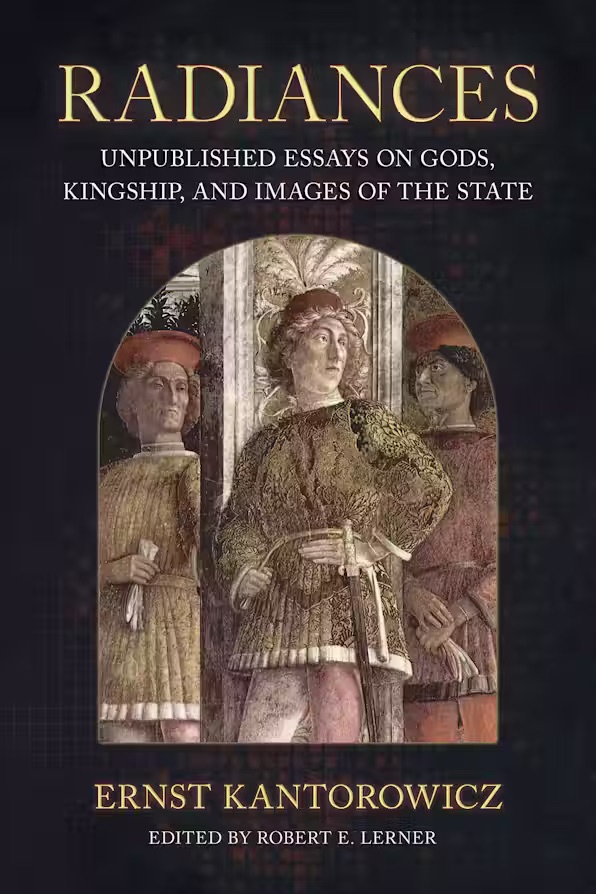
Radiances gathers previously unpublished essays by one of the greatest historians of the twentieth century. Although best known for The King’s Two Bodies (1957), Ernst Kantorowicz’s scholarly expertise ranged from classical antiquity to early modernity and from political pageantry to numismatics. These essays traverse the breadth of his expertise, exploring “radiations” of the themes that were central to his published work: sovereignty, theology, law, and iconography.
The radiations in these engaging essays include the imagery of throne-sharing from the Hellenistic era and Pharaonic Egypt to early Christianity, coronation ceremonies in Byzantium and the West, the Carolingian and Burgundian Renaissances, the relationship between Rome and Christianity, the importance of history as a humanistic pursuit, and the significance of postage stamps in political myth-building. Robert E. Lerner discusses each essay’s composition, themes, and place in Kantorowicz’s oeuvre. Combining vast knowledge with intellectual delight, Radiances teems with the profound historical insights that distinguished Kantorowicz’s scholarship.
Thanks to Florian Louis for the link.
Update May 2025: I’ve been asked to review the book so will post a link to that when it’s available.
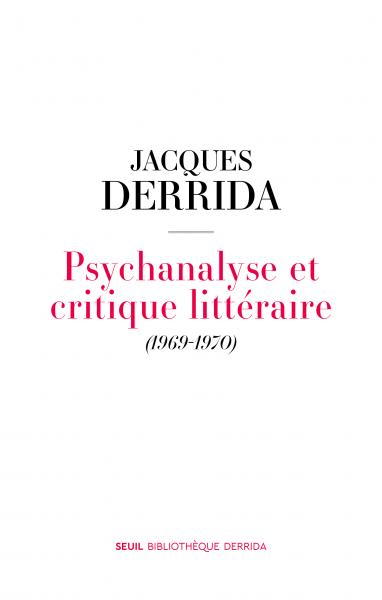
Durant l’année universitaire 1969-1970, Jacques Derrida consacre un séminaire au problème des rapports entre la psychanalyse et la critique littéraire. Ce séminaire, l’un des rares à traiter de l’esthétique freudienne, est l’occasion pour Derrida d’analyser ce qu’il appelle la « première doctrine » de Freud, à savoir sa théorie marquée par la toute-puissance du plaisir.
Or, avec l’introduction par Freud de la catégorie du double et ses spéculations sur la pulsion de mort, tout change ou aurait dû changer, d’après Derrida. La remise en question de la toute-puissance du principe de plaisir dans Au-delà du principe de plaisir (1920) aurait dû conduire à une refonte, à une réorganisation, à un déplacement de la « poétique » psychanalytique. Pourtant il n’en est rien : d’où, selon Derrida, un certain boitement de la théorie freudienne de l’art et de la littérature et de tout ce qui en dépend ou y fait retour.
Ce boitement va se répéter dans la critique littéraire d’inspiration psychanalytique. Qu’il s’agisse de la psychanalyse de l’imagination matérielle de Bachelard, la psychanalyse existentielle de Sartre ou la méthode psychocritique de Mauron, Derrida constate que rien n’a changé. C’est seulement avec Lacan, à la toute fin du séminaire, que se produit un tournant décisif, la psychanalyse reconnaissant l’instance proprement signifiante du texte littéraire, qu’elle avait largement négligée jusqu’ici.
Psychanalyse et critique littéraire propose ainsi un contexte (littéraire) fascinant et déterminant pour le travail ultérieur de Derrida sur la psychanalyse.
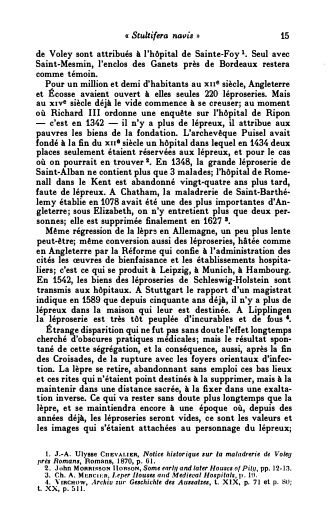
There is a small historical error in Foucault’s History of Madness, which endures through the different French versions with the exception of Oeuvres, but which is corrected in one of the English versions. Yes, there are other errors, but I’m focused on this one, because Foucault tried to correct it.
In 1961, in Folie et déraison: Histoire de la folie à l’âge classique, it says:
Pour un million et demi d’habitants au XIIe siècle, Angleterre et Écosse avaient ouvert à elles seules 220 léproseries. Mais au XIVe siècle déjà̀ le vide commence à se creuser ; au moment où Richard III ordonne une enquête sur l’hôpital de Ripon – c’est en 1342 – il n’y a plus de lépreux, il attribue aux pauvres les biens de la fondation.
Richard III was King of England from 1483 until 1485. So, either Foucault’s date is incorrect or it was another King.
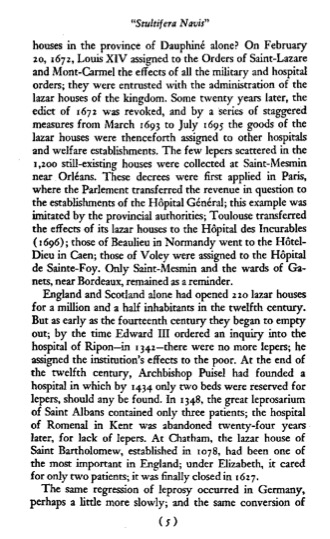
The passage appears on p. 5 of the original 1961 Plon edition and its 1964 reprint, and p. 15 of the abridged 1964 edition. In the 1965 English translation of the abridged edition, Madness and Civilization, this King is changed to Edward III, who ruled 1327-1377. In Richard Howard’s translation:
England and Scotland alone had opened 220 lazar houses for a million and a half inhabitants in the twelfth century. But as early as the fourteenth century they began to empty out; by the time Edward III ordered an inquiry into the hospital of Ripon -in 1342- there were no more lepers; he assigned the institution’s effects to the poor (p. 5).
The change was made by Howard as translator, but on Foucault’s direction: there is a letter from the Georges Borchardt literary agency to Pantheon books on 28 May 1964, conveying Foucault’s wish that the correction is made. Foucault hadn’t spotted the mistake when abridging the text, but presumably soon afterwards.
But the 1972 version of the French, as Histoire de la folie à l’âge classique (p. 15), and the 1976 Tel reprint (p. 15 in some printings; p. 17 in others), both have Richard III. In resetting the text for this edition Gallimard simply carried over the error from the earlier French editions, and Foucault didn’t spot it on the proofs.
Histoire de la folieMadness and Civilisation
The 2005 English translation of the unabridged text, History of Madness, has this:
For their million-and-a-half inhabitants in the twelfth century, England and Scotland had opened 220 leper houses. But even by the fourteenth century they were beginning to empty: when Richard III ordered an inquiry into the state of Ripon hospital in 1342, it emerged that there were no more lepers, and the foundation was charged with the care of the poor instead.
In this case, the translator is working from a defective French text – either the 1961 or 1972/1976 edition – not realising the earlier English translation had a correction of an original French error. The reprinted text in Oeuvres has “… au moment où [Eduoard] III ordonne une enquête” (Vol I, p. 11), where the editor of this text, Jean-François Bert, has corrected the mistake. But it’s not clear whether he did this because he spotted the error, or realised Foucault once had, or both.
We are left with the curious situation that the one accurate version of this passage in a standalone version of the text is the much-criticised Madness and Civilization. There it is both historically correct and amended to Foucault’s wish.
On the different French and English editions, and persistent confusions over dating and status, see here.
This note is in the same register as the ‘Sunday histories‘ posts, though its minor status means I’ve posted it mid-week. I should have posted it yesterday for Shakespeare’s birthday given he wrote plays on Richard III and – disputed – on Edward III.
The music industry is being reshaped by a fresh round of platform intermediation – one based on MusicTech, social media platforms and user-generated content, live streaming, crowdfunding and gamification. Leyshon and Watson critically examine this latest wave of new platform music industries and consider how they are influencing music creation, distribution and consumption as well as their wider economic and cultural impact.
Drawing on contemporary case studies and examples from throughout the industry, the authors situate this latest wave of innovation within the historical context of earlier rounds of platform reintermediation, which saw the music industry lurch from a file-sharing crisis to the emergence of the major streaming platforms that first halted and then reversed the decline in revenues derived from recorded music. While debates about the moral economy of streaming dominate both media and academic accounts of the music industries, they show that a focus on streaming alone obscures much of the complexity resulting from related and concurrent platform innovations.
The book provides an up to date and comprehensive study of the latest developments in one of the fastest-moving and innovative sectors of the cultural economy.
Michel Foucault, Binswanger and Existential Analysis, ed. Elisabetta Basso, trans. Marie Satya McDonough – Columbia University Press, July 2025, with foreword by Bernard Harcourt
Really good to see the translation of this important volume scheduled.
In the early 1950s, the young Michel Foucault took a keen interest in the method of existential analysis—Daseinsanalyse—developed by the Swiss psychiatrist Ludwig Binswanger. He gave a lecture course on this topic at the University of Lille in the spring of 1953 and wrote a detailed introduction to the 1954 French translation of Binswanger’s Dream and Existence (1930), in which he promised a forthcoming book that would “situate existential analysis within the development of contemporary reflection on man.” This book presents Foucault’s unpublished manuscript on Binswanger and existential analysis for the first time in English, offering crucial insight into his intellectual development.
Foucault carries out a systematic examination of Daseinsanalyse, contrasting it with psychiatry, psychoanalysis, and phenomenology and championing its ambition to understand mental illness. In his critique of existential analysis, Foucault began his turn toward emphasizing the primacy of experience, which would lead to the radically new perspective and genealogical methods of The History of Madness and The History of Sexuality. Revealing a little-known influence on Foucault’s historicist approach, Binswanger and Existential Analysis reminds us of his unparalleled ability to destabilize our conceptions of self.
Karl Marx gave us not just a critique of the political economy of capital but a way of confronting the impoverished ethical quality of life we face under capitalism. Interpreting Marx anew as an ethical thinker, Absolute Ethical Life provides crucial resources for understanding how freedom and rational agency are impacted by a social world formed by value under capitalism, with consequences for philosophy today.
Michael Lazarus situates Marx within a shared tradition of ethical inquiry, placing him in close dialogue with Aristotle and Hegel. Lazarus traces the ethical and political dimensions of Marx’s work missed by Hannah Arendt and Alasdair MacIntyre, two of the most profound critics of modern politics and ethics. Ultimately, the book claims that Marx’s value-form theory is both a continuation of Aristotelian and Hegelian themes and at the same time his most distinctive theoretical achievement.
In this normative interpretation of Marx, Lazarus integrates recent moral philosophy with a historically specific analysis of capitalism as a social form of life. He challenges contemporary political and economic theory to insist that any conception of modern life needs to account for capitalism. With a robust critique of capitalism derived from the determinations of what Marx calls the “form of value,” Lazarus argues for an ethical life beyond capital.
I have discussed Foucault’s two visits to Buffalo before. First, most briefly, in Foucault: The Birth of Power (2017).In that book, which is on the first half of the 1970s, I simply indicated that Foucault gave some lectures in Buffalo (pp. 12, 31, 40). I mention the ones on Flaubert, Sade, Nietzsche and ‘What is an Author?’ in 1970, and a course in 1972, giving the title ‘The Will to Truth in Ancient Greece’, and mentioning that it discussed Oedipus, Hesiod, Homer, Sophocles and Euripides’ Bacchae, and the history of money. At that time, my key sources were Daniel Defert’s chronology in Dits et écrits and his editorial material in Lectures on the Will to Know. I also discussed Foucault’s side-trip to Attica prison in April 1972, which he visited with John K. Simon, his main host at Buffalo (pp. 136-37). A discussion between them about Attica was published and is reprinted here; which followed their earlier discussion in Partisan Review which, among other themes, reflects on the University in France and North America, available here.
There is more detail about Foucault’s visits to Buffalo in The Archaeology of Foucault(2023). Even though that book concentrates on the 1960s, in the Coda it felt appropriate to discuss the 1970 visit (pp. 198-204), with some other comments on his lectures (pp. 44, 56, 128, 133-35, 149, 192-93). Part of the reason for a focus again on 1970 is that there a thematic link – Foucault was mainly teaching on literature, which I discuss in the book. The other reason was that because a new source became available to me – there is a copy of some of the material from the University at Buffalo archives at the Bibliothèque nationale de France. I was told about this material and was able to make use of it in The Archaeology of Foucault. One of the things I was able to stress there is that the different lectures in 1970 had been part of a course with the title “The desire for knowledge or the phantasms of knowledge in French literature in the nineteenth and twentieth centuries”. This was the theme which linked together various lectures on Sade, Balzac and Flaubert, and, outside the French focus, Nietzsche. I also added a little detail about the 1972 courses, the visit to Attica, which was with law professor Herman Schwartz as well as with Simon, and Foucault’s support of the prison activist Martin Sostre, which I took from newspaper reports (pp. 207-8).
Until now I had not been able to get to the Buffalo archives myself. It had been on a wish list for some time, and I’d hoped it would have been possible in 2020. But the pandemic restrictions on travel and more recently my own health problems meant I wasn’t able to get to Buffalo until March 2025. An invitation to give a lecture at the University, in the Just Theory series of the Department of Comparative Literature, gave me the opportunity for a short visit to the archives.
Baird Point – the pillars were relocated from the south campus to the north campus. This is where Bruce Jackson took some of his photos of Foucault. For two of these, see hereEntrance to the Special Collections reading room in Capen Hall
There are three folders in the Buffalo archives, and eight digital recordings, transferred from older tapes. One of the folders is a brief biographical file; the other two relate to the 1970 and 1972 visits. The richness of the material is mainly due to John K. Simon’s correspondence with Foucault being included, but there is a lot beyond this. There are over 400 pages across the files – mostly letters, internal memos, flyers, offprints but also some original photographs, including ones by Bruce Jackson, newspaper clippings, voting slips, and even Foucault’s nameplate from what I assume was his office door. Some material has been redacted, and some is copied in Paris, but there is a lot of information beyond what I knew before. The recordings last for over twenty hours. It would have been great if there was a comparable amount of material for Foucault’s autumn 1972 visit to Cornell, but my requests to archivists there have yielded almost nothing. What I do know of Foucault in Cornell is outlined here.
My fuller treatment of the Buffalo archives will be published in Foucault Studies, along with a detailed discussion of the 1972 course by Leonhard Riep. Both essays, as all pieces in that journal, will be open access. The 1972 Buffalo course, whose final title was “Histoire de la vérité”, is due to be published later this year [Update: here]. Almost all of the recordings at Buffalo relate to that course. But two lectures seem to be part of the 1970 course.
Equally, as I realised a few years ago, the version of “What is an Author?” published in Textual Strategies is not the Buffalo lecture. Rather it is an edited version of the Paris lecture, in a different translation to the one in Language, Counter-Memory, Practice, with a few additions from Buffalo at the end. The complete Buffalo lecture is transcribed in the Buffalo archive and its manuscript is in Paris. The Buffalo lecture will be published in a future volume of Foucault’s texts.
On the basis of these materials these were the courses Foucault gave in Buffalo:
1970 lecture series: “The desire for knowledge or the phantasms of knowledge [désir de savoir ou les fantasmes du savoir] in French literature in the nineteenth and twentieth centuries”
There were also lectures on Manet and ‘What is an Author?’
1972 seminar: “The Criminal in the Literature of the 18th and 19th Centuries”
1972 lecture series: “The Origins of Culture”; renamed as “History of Truth”
(Although the 1970 course title might be better rendered as “The desire to know…”, the above is the way Simon translates it for Buffalo advertising.)
My piece for Foucault Studies will give some more details of the 1970 course, and in particular indicate that some of its parts have been published, but that the order of the material and their integrated treatment as a course has generally not been recognised. It comprised lectures on Sade, Balzac, Flaubert, and Nietzsche, and possibly other figures. My fuller treatment also discusses what the archives indicate about Foucault’s other lectures in North America during these early 1970s visits. Together with Leonhard Riep’s piece it will comprise a ‘Buffalo dossier’ for Foucault Studies, shedding some new light on Foucault’s early visits to North America.
Update November 2025: my article in Foucault Studies is now available here (open access).
References
Stuart Elden, Foucault: The Birth of Power, Cambridge: Polity, 2017.
Stuart Elden, The Archaeology of Foucault, Cambridge: Polity, 2023.
Stuart Elden, “Foucault at Buffalo in 1970 and 1972: The Desire for Knowledge; The Criminal in Literature; and The History of Truth”, Foucault Studies, forthcoming 2025. [now available here]
Michel Foucault, Dits et écrits 1954–1988, eds. Daniel Defert and François Ewald, Paris: Gallimard, 4 vols, 1994.
Michel Foucault, Leçons sur la volonté de savoir: Cours au Collège de France, 1970–1971, suivi de Le savoir d’Œdipe, ed. Daniel Defert, Paris: Gallimard/Seuil, 2011; Lectures on the Will to Know: Lectures at the Collège de France 1970–1971, trans. Graham Burchell, London: Palgrave-Macmillan, 2013.
Michel Foucault, La Grande étrangère: À propos de littérature, ed. Philippe Artières, Jean-François Bert, Mathieu Potte-Bonneville and Judith Revel, Paris: Éditions EHESS, 2013; Language, Madness, Desire: On Literature, trans. Robert Bononno, Minneapolis: University of Minnesota Press, 2015.
Michel Foucault, Théories et institutions pénales: Cours au Collège de France (1971–1972), ed. Bernard E. Harcourt, Paris: Gallimard/Seuil/EHESS, 2015; Penal Theories and Institutions: Lectures at the Collège de France 1971-1972, trans. Graham Burchell, London: Palgrave, 2019.
Michel Foucault, Folie, langage, littérature, ed. Henri-Paul Fruchaud, Daniele Lorenzini and Judith Revel, Paris: Vrin, 2019; Madness, Language, Literature, trans. Robert Bononno, Chicago: University of Chicago Press, 2023.
Michel Foucault, Nietzsche, Cours, conférences et travaux, ed. Bernard Harcourt, Paris: Gallimard/Seuil/EHESS, 2024.
Michel Foucault, Histoire de la verité: Cours au département de français de l’Université d’État de New York à Buffalo Mars et avril 1972, ed. Henri-Paul Fruchaud and Orazio Irrera, Paris: Vrin, forthcoming, 2025.
Michel Foucault and John K. Simon, “Michel Foucault on Attica: An Interview”, Social Justice 18 (3), 1991, 26-34 (originally published in Telos 19, 1974, 154-61).
Leonhard Riep, “‘The History of Truth’—Foucault in Buffalo, 1972”, Foucault Studies, forthcoming 2025. [now available here]
John K. Simon, “A Conversation with Michel Foucault”, Partisan Review 38 (2), 1971, 192-201.
Archives
Bibliothèque nationale de France –
NAF 28730, Fonds Michel Foucault
NAF 29005, Archives personnelles et professionnelles Michel Foucault – Daniel Defert
University at Buffalo special collections –
16-6-596: Department of Modern Languages Personnel Files, 1960-1980, box 2, Foucault, Michel, Spring 1970
16-1-444: Faculty of Arts and Letters Personnel Files, 1972-1973, box 2, “Foucault, Michel, Visiting Professor 8/31/72”
Biographical File Collection, “Michel Foucault”
Audio recordings WBFOUK1010, four parts and WBFOUK1011, four parts
Thanks to Leonhard Riep for sharing his article ahead of publication, and for helpful orientations; Marcelo Hoffman and Daniele Lorenzini for useful discussions; Luke Folk and Krzysztof Ziarek for the invitation to Buffalo; and William Offhaus and Hope Dunbar and their colleagues at the University at Buffalo special collections for access to archival material about Foucault’s time there.
This is the sixteenth post of an occasional series, where I try to post short essays with some indications of further reading and sources, but which are not as formal as something I’d try to publish more conventionally. They are usually tangential to my main writing focus, a home for spare ideas, asides, dead-ends and possible futures. I hope there is some interest in them. They are provisional and suggestions are welcome.
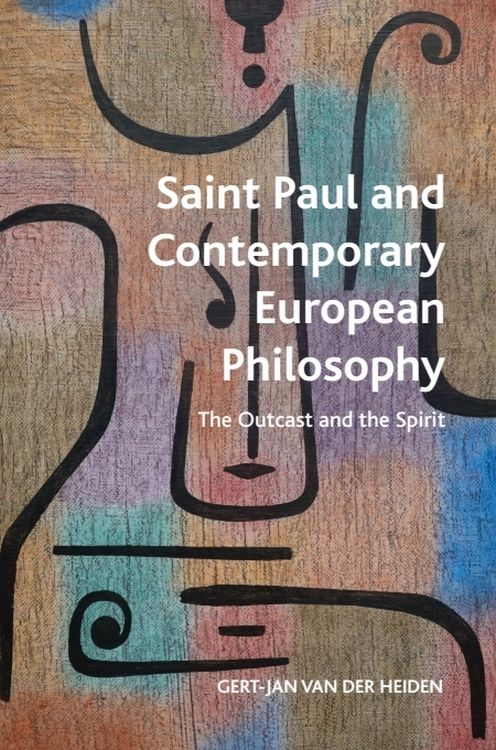
Offers a new systematic account of the philosophical potential of Saint Paul’s letters
Shows the present-day philosophical importance of the letters of the founder of Christianity
Argues that important ontological problems concerning dualism, nihilism and the event appear in an unexpected light when read through a Pauline lens
Shows a new philosophical appraisal of the Pauline conception of faith in terms of an art of living
Offers a new systematic approach to the intriguing present-day philosophical turn to the Letters of Saint Paul in the works of Heidegger, Taubes, Badiou, Agamben and Zizek
Discusses how Saint Paul allows philosophers to rethink the notions of law and community giving rise to a new type of political philosophy
The re-examination of Saint Paul’s letters in contemporary European philosophy is one of the most important developments at the crossroads of philosophy and theology today.