A couple of audio recordings of talks I’ve given on my ‘Mapping Indo-European Thought in Twentieth-Century France‘ project. There is background on the project and some other recordings, updates on the research, short pieces and research resources at that page.
Emile Benveniste and Georges Dumézil both lost their teaching positions under the Vichy regime, but for different reasons and with different outcomes. Benveniste was Jewish, had been captured shortly before the Armistice, and when he escaped, he went into exile in Switzerland. Before being deployed to Turkey, Dumézil had briefly been a Freemason and was excluded due to the laws on secret societies. He got his position back, remained in Paris, and published throughout the war with Gallimard. At the Liberation he was under suspicion of collaboration, and temporarily lost his position again. Benveniste returned to the Collège de France, and in 1949 proposed Dumézil for a chair in Indo-European civilisation. For the next two decades Benveniste and Dumézil taught there in parallel – Benveniste usually teaching one course on linguistics, and another on vocabulary; Dumézil teaching on mythology but also his interest in Caucasian languages and folklore. Some of their most important publications, including Dumézil’s Myth and Epic and Benveniste’s Vocabulary of Indo-European Institutions, were originally presented in their classes.Using teaching records, publications, archival materials and correspondence, this talk will discuss the period when Indo-European thought was at the centre of one of France’s elite institutions.
This talk was an edited version of the St Andrews one. It’s a bit shorter, and drops some of the examples, especially on linguistics. But given the ‘Ideologies’ focus of the seminar series, I do say more about that aspect. As I say at the beginning, I understand the title in the dual sense of what might be said about the ideology of people labelled Indo-European, and the ideology that there were such people who could be labelled that way.
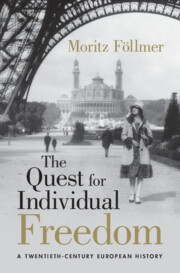
What does it mean to see oneself as free? And how can this freedom be attained in times of conflict and social upheaval? In this ambitious study, Moritz Föllmer explores what twentieth-century Europeans understood by individual freedom and how they endeavoured to achieve it. Combining cultural, social, and political history, this book highlights the tension between ordinary people’s efforts to secure personal independence and the ambitious attempts of thinkers and activists to embed notions of freedom in political and cultural agendas. The quest to be a free individual was multi-faceted; no single concept predominated. Men and women articulated and pursued it against the backdrop of two world wars, the expanding power of the state, the constraints of working life, pre-established moral norms, the growing influence of America, and uncertain futures of colonial rule. But although claims to individual freedom could be steered and stymied, they could not, ultimately, be suppressed.
From the darkness of a plagued and war-torn Middle Ages, the Renaissance (we’re told) heralds the dawning of a new world—a halcyon age of art, prosperity, and rebirth. Hogwash! or so says award-winning novelist and historian Ada Palmer. In Inventing the Renaissance, Palmer turns her witty and irreverent eye on the fantasies we’ve told ourselves about Europe’s not-so-golden age, myths she sets right with sharp clarity.
Palmer’s Renaissance is altogether desperate. Troubled by centuries of conflict, she argues, Europe looked to a long-lost Roman Empire (even its education practices) to save them from unending war. Later historians met their own political challenges with a similarly nostalgic vision, only now they looked to the Renaissance and told a partial story. To right this wrong, Palmer offers fifteen provocative portraits of Renaissance men and women (some famous, some obscure) whose lives reveal a far more diverse, fragile, and wild Renaissance than its glowing reputation suggests.
I missed this when it came out last year, but looks interesting – Wakefield was part of Foucault’s 1983 seminar at Berkeley, which is why the cover has a picture of some of that group. I talk about the photo, and its lesser-known companion, and the people in it here – Foucault’s 1983 seminar at Berkeley – the two cowboy hat photographs
In Foucault Versus Freud, Jerome C. Wakefield offers a novel analysis of one of the great intellectual clashes of our times, the attack on Sigmund Freud’s influential sexual theories by the eminent French philosopher and historian of ideas Michel Foucault.
Starting from Foucault’s question, “What makes the psychoanalytic theory of incest acceptable to the bourgeois family?”, and drawing on Foucault’s relatively unexplored published lectures as well as his celebrated History of Sexuality, Vol. 1, Wakefield evaluates Foucault’s argument that there is a continuity between the two-century medical anti-masturbation crusade and Freud’s theory, providing the reader with an accessible introduction to Foucault’s conceptual innovations including power/knowledge, the deployment of sexuality, and the use of surveillance and confession as tactics in medicalizing sexuality and reshaping family life.
Rather than allowing the argument to stay at the evidentially uncertain level one often finds in Foucault’s writings, Wakefield undertakes close readings of both Freud’s “seduction-theory” texts and later Oedipal-period texts to test whether Foucault’s provocative arguments find support or disconfirmation. Despite identifying weaknesses in Foucault’s position, Wakefield argues that a careful look at Freud’s sexual theories through Foucault’s theoretical lens changes forever the way one sees Freud’s theory—and has the potential to help psychoanalysis move forward in a constructive way.
This book is written to be understandable for those who are not steeped in philosophy or familiar with Foucault’s philosophy, offering a lucid introduction to Foucault’s ideas and his clash with Freud that will be of interest to clinicians, students, and scholars alike.
Beginning with the Alien Friends Act of 1798, the United States has passed laws in the name of national security to bar or expel foreigners based on their beliefs and associations. From the War on Anarchy to the War on Terror, the government repeatedly turns to ideological exclusions and deportations to suppress radicalism and dissent.
Threat of Dissent delves into major legislation and court decisions at the intersection of immigration and the First Amendment without losing sight of the people involved. We follow the cases of foreign-born activists and artists such as Emma Goldman and Carlos Fuentes, meet determined civil rights lawyers like Carol Weiss King, and discover how the ACLU and PEN challenged the constitutionality of exclusions and deportations. While sensitively capturing the particular legal vulnerability of foreigners, Julia Rose Kraut reminds us that deportations are not just a tool of political repression but a deliberate instrument of demagogic grandstanding.
An original reflection on shame as the central feeling of our age — the expression of an anger that is the necessary condition for new struggles
Can shame become a source of political strength? Faced with injustice, growing inequality and systemic violence, we cry out in shame. We feel ashamed of obscene wealth amid wider deprivation. We feel ashamed of humanity for its ruthless and relentless exploitation of the earth. We feel ashamed of the racism and sexism that permeate society and our everyday lives.
This difficult emotion is not just sadness or a withdrawal into oneself, nor is it a paralysing sense of inadequacy. As Frédéric Gros argues in A Philosophy of Shame, it arises when our perception of reality rejects passivity and resignation and instead embraces imagination. Shame thus becomes the expression of an anger that is a powerful, transformative force —one that assumes a radical character.
In dialogue with authors such as Primo Levi, Annie Ernaux, Virginie Despentes and James Baldwin, Gros explores a concept that is still little understood in its anthropological, moral, psychological and political depths. Shame is a revolutionary sentiment because it lies at the foundation of any path of subjective recognition, transformation and struggle.
Ce livre raconte, à partir d’archives inédites, l’histoire de la rencontre entre deux figures emblématiques des sciences humaines du XXe siècle, Pierre Bourdieu (1930-2002) et Erwin Panofsky (1892-1968). Rien de commun, en apparence, entre le jeune sociologue français, œuvrant au milieu des années 1960 à la refondation de sa discipline dans un monde intellectuel dominé par le structuralisme, et le vieil historien d’art allemand reconnu internationalement, émigré aux États-Unis après avoir fui le nazisme. Et pourtant, c’est dans la collection « Le sens commun », dirigée par Bourdieu aux Éditions de Minuit, que paraît la première traduction française de Panofsky, Architecture gothique et pensée scolastique, au printemps 1967, en même temps que les Essais d’iconologie chez Gallimard.
L’édition d’Architecture gothique et pensée scolastique est minutieusement préparée par Bourdieu qui, fait unique dans sa carrière, réalise lui-même la traduction. Il y joint une longue postface qui deviendra célèbre : c’est là qu’apparaît sous sa plume la première théorisation du concept d’habitus.
En s’appuyant sur des sources multiples – dont la correspondance des deux savants reproduite en annexe –, cette enquête retrace pas à pas une aventure éditoriale et intellectuelle unique, moment clé dans la réception d’Erwin Panofsky, mais aussi dans la carrière d’un Pierre Bourdieu en pleine construction des outils qui lui permettront de s’imposer dans les décennies suivantes comme l’auteur d’une œuvre capitale.
This looks interesting – the story behind the edition of Erwin Panofsky, Architecture gothique et pensée scolastique – translated by Bourdieu, who contributed a postface. Foucault reviewed this book, and Panofsky’s Essais sur l’iconographie (Gallimard, 1967) as “Les mots et les images” in Le Nouvel observateur (reprinted as Dits et écrits, text 51). There is no published translation of the review.
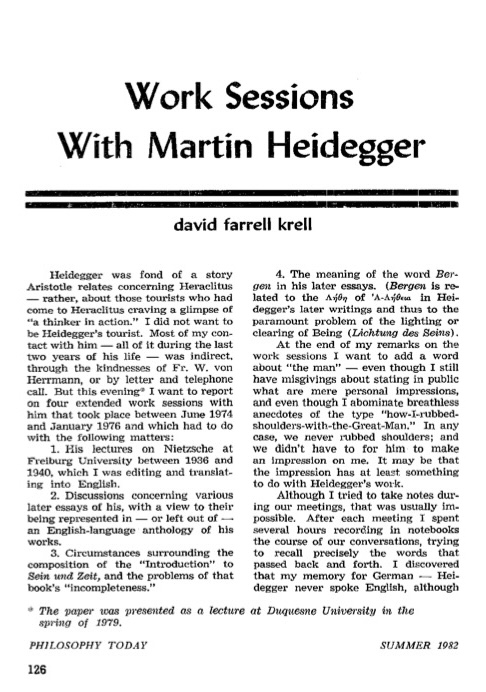
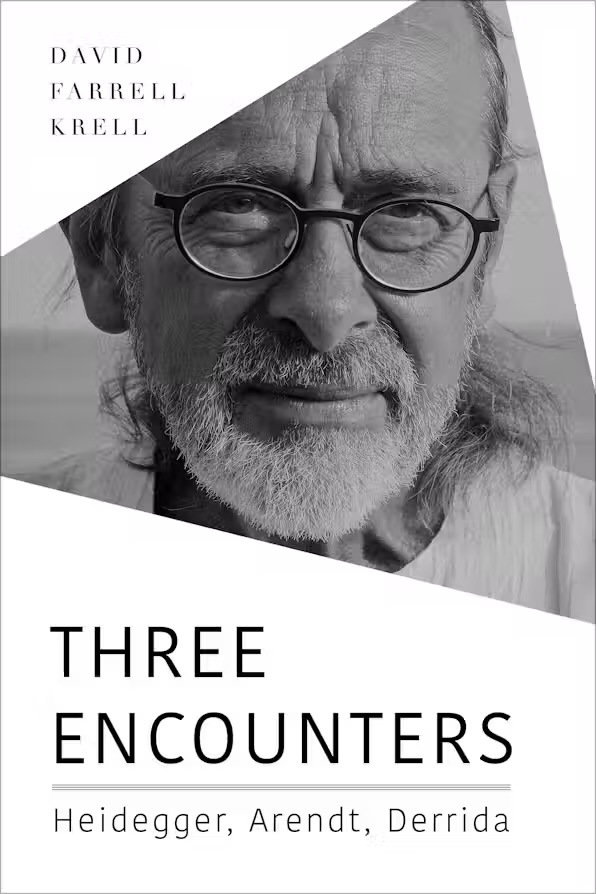
Some years ago, when I was working on Heidegger, I read David Farrell Krell’s “Work Sessions with Martin Heidegger” essay. These were sessions in which Krell discussed some of Heidegger’s vocabulary and worked with him on possible English renderings, as well as questions of interpretation and chronology. Krell was a really important editor and translator of Heidegger, from Early Greek Thinking in 1975 with Frank Capuzzi,to Basic Writings in 1977 (with a second edition from 1993), and the four Nietzsche volumes, with Capuzzi and Joan Stambaugh (between 1979 and 1987, and reprinted in two volumes in 1991.) Krell also discussed with Heidegger which essays to include in Basic Writings. Krell has written a huge amount on Heidegger, and many other themes. Of the Heidegger work, I particularly liked his Daimon Life. All very important for me during the PhD and a few years afterwards. I haven’t been reading the Heidegger literature for a long time now, and have not revisited my own early work on him. But I did review Krell’s book on Derrida’s Geschlecht series of essays on Heidegger, Phantoms of the Other,for Derrida Today. So, I was curious when Krell published his Three Encounters: Heidegger, Arendt, Derrida book in 2023.
All of Three Encounters is extremely interesting, and the discussion of Derrida, who he knew well for many years, is very revealing of the work and the man. But for me the most fascinating parts are his discussions of working with Heidegger and Arendt on translations of Heidegger. An earlier version of part of the Heidegger discussion was published in the Heidegger and his Anglo-American Reception collection, and some of it is, of course, similar to the “Work Sessions” piece, though he notes that in the book he is transcribing from his journals afresh (Three Encounters, 45). Krell only knew Heidegger right at the end of his life – Heidegger died in 1976 – and Arendt for only a couple of years too, since she died just before Heidegger in 1975. Arendt’s involvement in English Heidegger translations is something I’ve known for a long time – it’s mentioned in passing in most of the biographies (i.e. Young-Bruehl on Arendt, 304, 442; Safranski on Heidegger, 427; Grunenberg, 248-49) – but Krell adds a lot of detail to the story. He stresses how closely Arendt was involved, notably alongside J. Glenn Gray, in the Harper & Row editions. Gray had translated What is Called Thinking? in 1968, which was one of the first translations of Heidegger’s later work. As Krell says: “Nothing appeared in the Harper series in those days that did not pass through her hands and under her alert eyes” (Three Encounters, 17-18; see Arendt to Heidegger 17 March 1968; 19 August 1971). The late 1960s was also when Arendt very publicly wrote about Heidegger, in the “Martin Heidegger at Eighty” piece, first published in English in The New York Review of Books.
The whole question of Arendt and Heidegger’s relationship, from student and lover to a complicated post-war friendship and partial reconciliation has been discussed in great detail by her biographers and others. Antonia Grunenberg’s Hannah Arendt and Martin Heidegger is especially good. There is an even larger literature on Heidegger’s politics, on which Arendt briefly and notoriously wrote in a note to the “Martin Heidegger at Eighty” piece. Neither their personal relation nor the political question is my concern here. I have written about the political issue before. But the translation question is one that interests me.
While looking at Alexandre Koyré’s letters to Arendt (I discuss their friendship here), I went to the Library of Congress website, which has digitised much of the Arendt archive. Although the Koyré-Arendt letters have been published, it’s always nice to see the originals, and comparing a handwritten text to a printed one is a good way to learn the idiosyncrasies of written style before I attempted my own transcriptions of some of his other letters. Immediately after ‘Koyré’ in the Finding Aid is ‘Krell’. The file online has several Krell offprints, taking up over half of the pages in the document. But then there is some very interesting correspondence. Some, but not all, is quoted by Krell in Three Encounters. I also wondered if the archive had the originals of correspondence with Heidegger, even though that has of course also been published. I quickly realised that those letters are actually in Marbach, at the Deutsche Literaturarchiv. Samantha Rose Hill writes about visiting that archive here, and the Library of Congress here. But the Library of Congress does have two Heidegger files online, which contain letters to and from Arendt about Heidegger, and they were very interesting too. There is also a file of notes of a seminar Arendt taught on Heidegger and Jaspers in 1951, and some other material, including the German text of “Martin Heidegger at Eighty”, which was initially a lecture, and a French version, presumably also given as a talk.
The correspondence at the Library of Congress shows that Arendt was involved with Heidegger’s translation into English long before Krell became involved in the early to mid-1970s. Krell indicates that the most recent edition of the Arendt-Heidegger correspondence adds a letter that shows she was in correspondence with Edward Robinson in 1954 about a translation of Being and Time (Arendt to Heidegger, 29 April 1954, copied to Robinson). Krell says it is unclear when Robinson began working with John Macquarrie (Three Encounters,187-88). The Arendt-Robinson letters clarify this. Arendt praises Robinson’s translation sample, but offers a whole range of very detailed comments on terminology – it’s on five typewritten, single-spaced pages. In subsequent letters to Robinson she tries to help with funding for the project, which was considered at one point might be bilingual, on facing pages, but the German publisher prevented this. Nor did Robinson have much luck with English publishers. One rejection is quoted by Robinson: “I think the greatest service we could perform for Professor Robinson would be to persuade him not to spend any more time on this hopeless and thankless task”. Robinson nevertheless continued, and one press he contacted said that they had already been in contact with Macquarrie about doing a translation. By April 1955 Macquarrie and Robinson are working together, and are asking Arendt’s advice on translation issues, on Heidegger’s prompting. The Macquarrie and Robinson translation was published in 1962, with SCM [Student Christian Movement] Press, which became part of Blackwell, rather than other presses which were being discussed. Krell’s Basic Writings includes a different version of Being and Time’s Introduction, translated by Stambaugh. She was working on a translation of the whole book for years, which stretched to decades, and it was finally published in 1996, before that version was revised by Dennis J. Schmitt in 2010. Krell praises Schmitt’s “valiant efforts” but thinks it “has to be retranslated from beginning to end”. He doubts this will be anytime soon (Three Encounters,32).
In Three Encounters Krell uses his own archives and correspondence with Heidegger and Arendt, as well as with his parents and others to provide a lot of detail about his translating and editing work on Heidegger, along with some of the rights issues that complicated the work of Basic Writings. Heidegger and, especially after Heidegger’s death, his wife were involved in some of the negotiations. Some of the translations were already in English, and there was a complication about whether the publishers of those controlled the English rights, even if the translations were to be done anew. This was complicated by Vittorio Klostermann – the man initially, and then the press that bears his name – beginning the work of editing the Gesamtausgabe of Heidegger’s writings in the mid-1970s. The problem was that some of Heidegger’s books had been published by different German presses. The volumes of the Gesamtausgabe which edit texts published with different publishers in Heidegger’s lifetime are therefore only available to subscribers to the edition, not for individual sale. But it also meant Klostermann could not release the rights to some texts for Basic Writings, which delayed the book until the Heideggers intervened. There was a plan for a follow-up volume of essays edited by Krell in the history of being, but this never materialised.
There are some indications of Arendt’s work on the translations in her letters to Heidegger, but the Arendt archives add a lot of interesting detail. There are many letters from Krell to Arendt, and some of her replies to him. She was also writing on his behalf to get funding, as was Gray. There are also letters to others that relate to this story, including with Fred Wieck of Harper & Row about some of the other translations in the Harper series, and Friedrich-Wilhelm von Herrmann about plans for the Gesamtausgabe, which von Herrmann edited. Krell also sent Arendt at least one of his work notes written up after one of the meetings with Heidegger. There are some other letters sent to Arendt, often with replies, where people were asking her questions about interpretation of his work or, at times, his political actions. And a little correspondence about a failed plan to bring Heidegger to America, of which he had doubts, and which was prevented in the end by his health.
So, although Arendt’s involvement in the translation of Heidegger is mentioned in studies of her and Heidegger, it is so overshadowed by the biographical, and at times the intellectual links, that it doesn’t receive much discussion. There are other published sources for a fuller story. Krell published some parts of his correspondence with Gray in 1981, and says he still has sixty-eight letters from 1973 to 1977 (Three Encounters, 25). He also adds in a note: “I am also wondering whether Glenn and Hannah’s correspondence will be published; clearly, it would be crucial for understanding her writing of The Life of the Mind” (Three Encounters, 33 n. 8). Many of those letters are available in the Arendt papers, along with the typescript of her Introduction to Gray’s The Warriors. Discussing them would require a whole new post, at least – they are very interesting on precise terminological choices in translating Heidegger, the challenges of publication, the problems of the translators they commissioned, and other issues.
I don’t think Arendt mentions the detail of translating Heidegger in her letters to her second husband Heinrich Blücher, but in 1958 she does mention corresponding with Ralph Manheim, who translated An Introduction to Metaphysics, and reading the galley proofs of Heidegger’s 1961 Nietzsche book (Within Four Walls, 328, 369-70, 373, 375-76). Blücher died before Krell was in contact with Arendt, so he’s not mentioned in these letters, and nor is Gray. But it seems to me that there is a lot available now – from Krell’s fascinating memories to correspondence and these archives – which would enable a much fuller treatment.
In 2020 Krell wrote a piece called “Three Last Dubious Projects”, in which he outlines ideas for books he is not sure he will manage to complete. One of them is this book on the memories of Arendt, Heidegger and Derrida, and in the essay it is the theme which receives by far the most discussion. The two other projects are a “genealogy of Nietzsche interpretations devolving from Bataille and Heidegger” and “a discussion of Derrida’s strange mix of biology and biography in his work on Nietzsche”. I’d very much like to read both.
References
Hannah Arendt, “Martin Heidegger at Eighty”, trans. Albert Hofstadter, New York Review of Books, 21 October 1971; reprinted in Michael Murray (ed.), Heidegger and Modern Philosophy: Critical Essays, New Haven: Yale University Press, 1978, 293–303.
Hannah Arendt and Heinrich Blücher, Within Four Walls: The Correspondence between Hannah Arendt and Heinrich Blücher, ed. Lotte Kohler, trans. Peter Constantine, New York: Harcourt, Inc., 1996.
Hannah Arendt and Martin Heidegger, Letters 1925-1975, ed. Ursula Ludz, trans. Andrew Shields, Orlando: Harcourt Inc., 2004.
Stuart Elden, Speaking Against Number: Heidegger, Language and the Politics of Calculation, Edinburgh: Edinburgh University Press, 2006.
Stuart Elden, “David Farrell Krell, Phantoms of the Other: Four Generations of Derrida’s Geschlecht, Albany: State University of New York, 2015”, Derrida Today 9 (1), 2016, 85-88.
Antonia Grunenberg, Hannah Arendt and Martin Heidegger: History of a Love, trans. Peg Birmingham, Kristina Lebedeva and Elizabeth von Witzke Birmingham, Bloomington: Indiana University Press, 2017.
Martin Heidegger, Being and Time, trans. Edward Robinson and John Macquarrie Oxford: Blackwell, 1962; trans. Joan Stambaugh, Albany: State University of New York Press, 1996.
Martin Heidegger, What is Called Thinking? trans. J. Glenn Gray, New York: Harper & Row, 1968.
Martin Heidegger, Nietzsche, ed. David Farrell Krell, San Francisco: Harper Collins, four volumes, 1991.
Martin Heidegger, Basic Writings, ed. David Farrell Krell, London: Routledge, 2nd edition 1993.
David Farrell Krell, “A Smile and a Sense of Tragedy: Letters from J. Glenn Gray”, Philosophy Today 25 (2), 1981, 95-113.
David Farrell Krell, “Work Sessions with Martin Heidegger”, Philosophy Today 26 (2), 1982, 126-38.
David Farrell Krell, Daimon Life: Heidegger and Life-Philosophy, Indiana: Indiana University Press, 1992.
David Farrell Krell, Phantoms of the Other: Four Generations of Derrida’s Geschlecht, Albany: State University of New York, 2015.
David Farrell Krell, “Three Last Dubious Projects”, Research in Phenomenology 50 (3), 2020, 407-24.
David Farrell Krell, Three Encounters: Heidegger, Arendt, Derrida, Bloomington: Indiana University Press, 2023.
This is the eleventh post of an occasional series, where I try to post short essays with some indications of further reading and sources, but which are not as formal as something I’d try to publish more conventionally. They are usually tangential to my main writing focus, a home for spare ideas, asides, dead-ends and possible futures. I hope there is some interest in them. They are provisional and suggestions are welcome.
A deeply moving exploration of the relationship between thinking and drawing, from the author of the groundbreaking Ways of Seeing
The seventeenth-century philosopher Baruch Spinoza (a.k.a. Bento) spent the most intense years of his short life writing. He also carried with him a sketchbook. After his sudden death, his friends rescued letters, manuscripts, notes—but no drawings.
For years, without knowing what its pages might hold, John Berger has imagined finding Bento’s sketchbook, wanting to see the drawings alongside his surviving words. When one day a friend gave him a beautiful virgin sketchbook, Berger said, ‘This is Bento’s!’ and he began to draw, taking inspiration from the philosopher’s vision.
In this beautifully illustrated book, Berger uses the imaginative space opened up in this experiment to explore politics, storytelling, Spinoza’s life and times, and the process of drawing itself.
A powerful meditation on political resistance and the global search for justice
From the ‘ War on Terror’ to resistance in Ramallah and traumatic dislocation in the Middle East, Berger explores the uses of art as an instrument of political resistance. Visceral and passionate, Hold Everything Dear is a profound meditation on the far extremes of human behaviour, and the underlying despair. Looking at Afghanistan, Palestine and Iraq, he makes an impassioned attack on the poverty and loss of freedom at the heart of such unnecessary suffering.
These essays offer reflections on the political at the core of artistic expression and at the center of human existence itself.
Why should an artist’s way of looking at the world have any meaning for us? Any artwork reflects the artist’s intentions, but also its times: therefore all art is political
In Permanent Red, John Berger argues that the contemporary artist should strive for a realism that aims for hope, to transform the world. Surveying the work of historical artists as well as that of near contemporaries such as Picasso, Léger and Matisse, he explores the role of the artist, dividing these figures into those that struggle, those that fail, and the true masters. He explains why we should study the work of the past: in order to understand the present and to rethink the future.
First published in 1960, Permanent Red established John Berger as a firebrand critic willing to broadcast controversial opinions on some of the most important British artists of the day, including Henry Moore and Barbara Hepworth.
Update August 2025: it is reviewed for Antipode by Danny McNally here.
A firsthand look at the lives of those who reside in no man’s land—the violence they endure and their immense resilience.
“No man’s land” invokes stretches of barren landscape, twisted barbed wire, desolation, and the devastation of war. But this is not always the reality. According to Noam Leshem in Edges of Care, the term also reveals radical abandonment by the state. From the Northern Sahara to the Amazon rainforests, people around the world find themselves in places that have been stripped of sovereign care. Leshem is committed to defining these spaces and providing a more intimate understanding of this urgent political reality.
Based on nearly a decade of research in some of the world’s most challenging conflict zones, Edges of Care offers a profound account of abandoned lives and lands, and how they endure and sometimes thrive once left to fend for themselves. Leshem interrogates no man’s land as a site of radical uncaring: abandoned by a sovereign power in a relinquishment of responsibility for the space or anyone inside it. To understand the ramifications of such uncaring, Leshem takes readers through a diverse series of abandoned places, including areas in Palestine, Syria, Colombia, Sudan, and Cyprus. He shows that no man’s land is not empty of life, but almost always inhabited and, in fact, often generative of new modes of being. Beautifully written and evocative, Edges of Care reveals the unexamined complexities and political dynamics hidden within and around places governed by callous indifference.