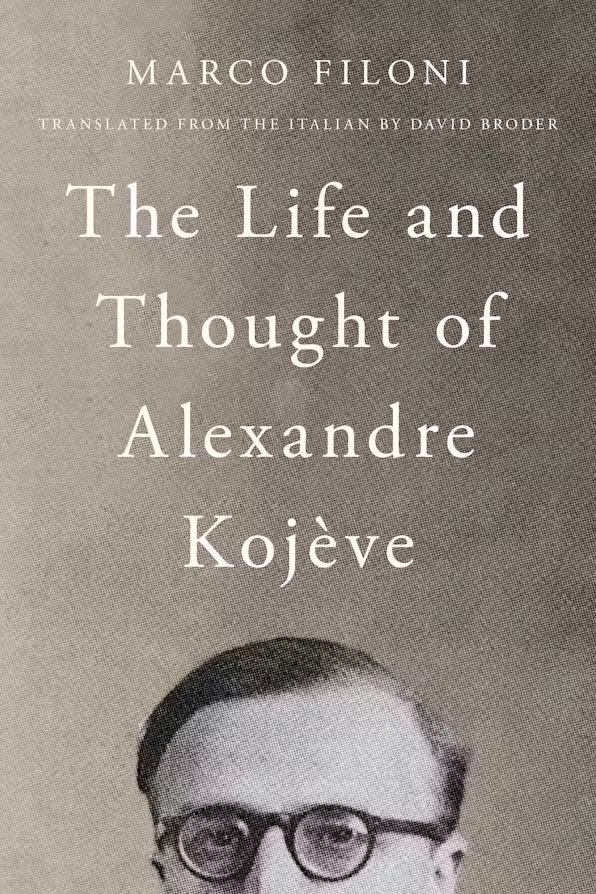
Alexandre Kojève is one of the twentieth century’s most seductive and intriguing figures. A product of the Russian merchant bourgeoisie, he became, depending on one’s point of view, either an overzealous bureaucrat or a secret agent who infiltrated the upper echelons of French state bureaucracy, spending the last twenty years of his life working in international diplomacy and high finance. Marco Filoni describes each facet of Kojève’s different lives in crystalline detail: the cultural circles of his youth, his studies, his philosophical passions, his fundamental theoretical choices, and his intellectual network, as well as the students who would become part of the intellectual elite, including Lacan, Bataille, and Merleau-Ponty. Drawing on rich archival material, unpublished texts, correspondence, and written and oral testimonies, The Life and Thought of Alexandre Kojève is a major benchmark for scholars of Kojève and of twentieth-century intellectual and political history. Filoni paints a vibrant portrait of one of the most influential intellectuals of the modern era, deftly composing Kojève’s personal, political, and philosophical lives.
Hau set a low level of copies which needed to be sold before the book was fully available open access. This was to cover the costs of rights, and the book’s production, rather than to pay me as editor. That level has been met, so it is now freely available. The Introduction and Afterword were available open access from publication.
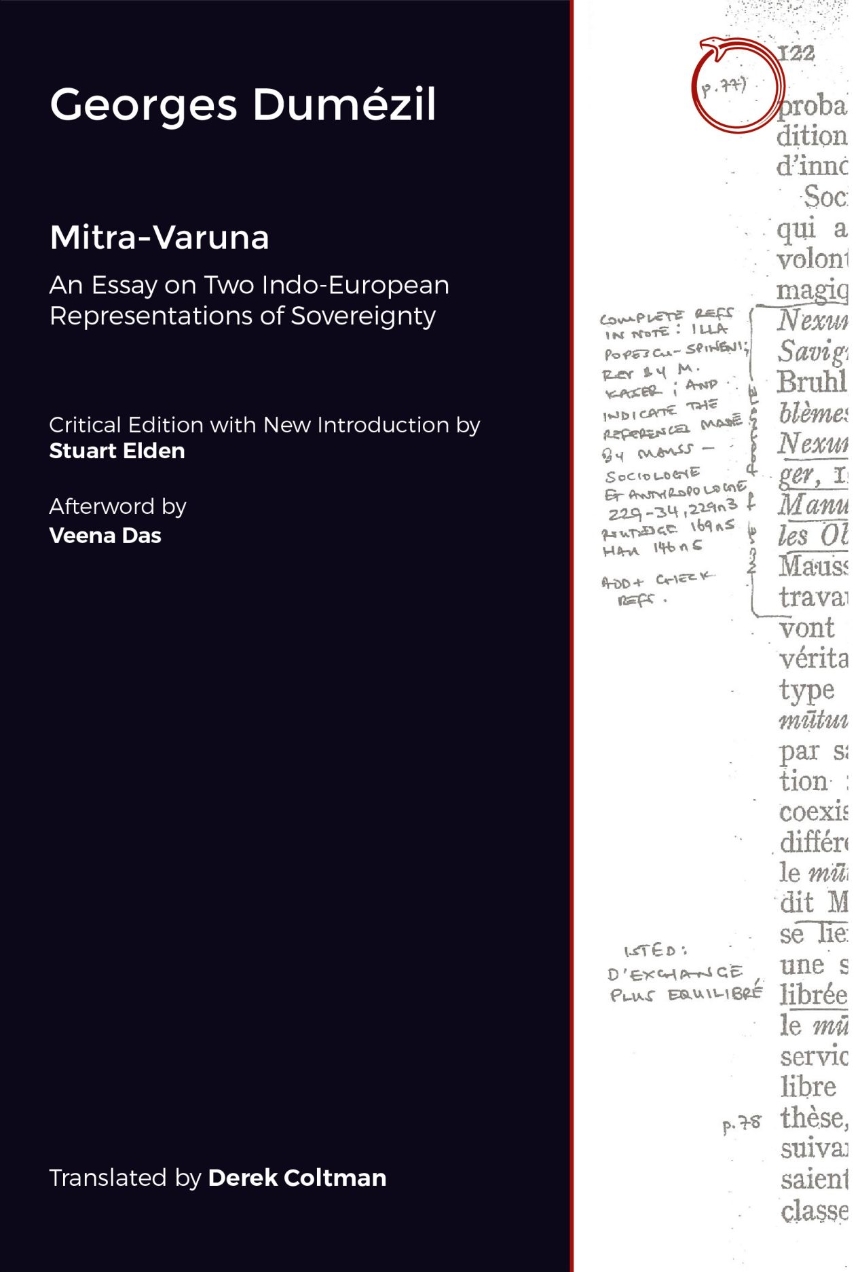
The edition uses the existing translation by Derek Coltman, long out of print, and has a new critical apparatus and Introduction by me. There is a discussion of the editing work here. This is part of the work of my Mapping Indo-European thought in twentieth-century France research project, funded by the Leverhulme Trust.
A classic text that develops one prong of Dumézil’s tripartite hypothesis of Indo-European tribes: the sacred sovereign.
Georges Dumézil’s fascination with the myths and histories of India, Rome, Scandinavia, and the Celts yielded an idea that became his most influential scholarly legacy: the tripartite hypothesis, which divides Indo-European societal functions into three classes: the sacred sovereign, the warrior, and the producer. Mitra-Varuna, originally published in 1940, concentrates on the first function, that of sovereignty. Dumézil identifies two types of rulers, the first judicial and worldly, the second divine and supernatural. These figures, both priestly, are oppositional but complementary. The title nods to these roles, referring to the gods Mitra, a rational mediator, and Varuna, an awesome religious figure.
Stuart Elden’s critical edition, based on the 1988 English translation by Derek Coltman, identifies variations between the first and second French editions and completes—and in places corrects—Dumézil’s references. The editor’s detailed introduction situates Mitra-Varuna within Dumézil’s career, outlines how his treatment of its themes developed over time, and relates the book to the political controversy around his ideas. Two new appendices contain passages that did not appear in the second French edition.
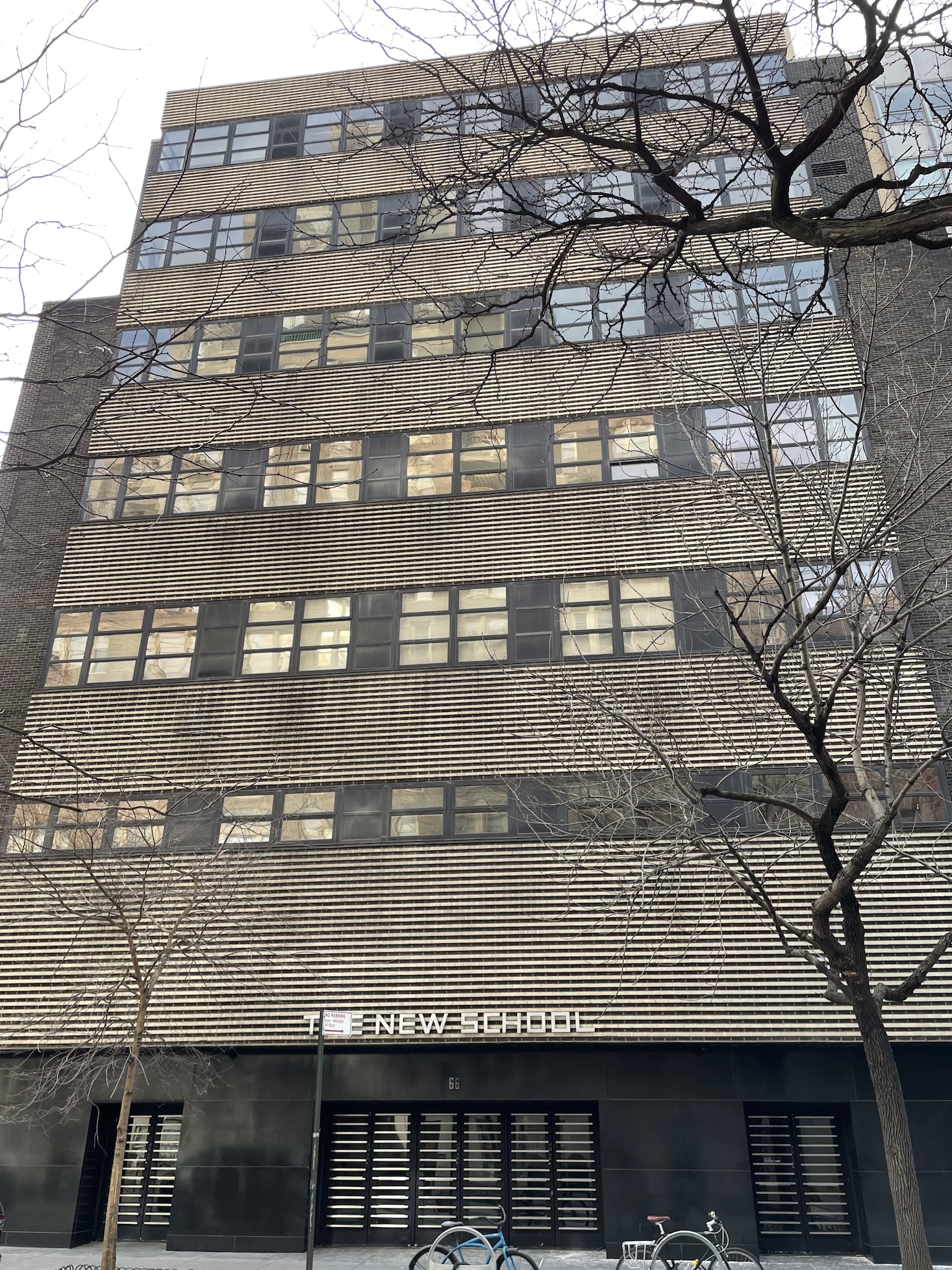
In 1940, Alexandre Koyré was persuaded by Charles de Gaulle’s government in exile that he could make his most useful contribution to the French war effort by moving to New York and acting as secretary general of the planned École Libre des Hautes Études (ELHE). In his late 40s, Koyré had initially tried to join the army instead. Modelled on Paris’s École Pratique des Hautes Études, but explicitly tied to France Libre, the ELHE was to be a home for several French and Belgian exiles, teaching predominantly in French, in New York. It was given accommodation and other support by the New School for Social Research, which had been initially founded by Columbia University academics disputing US involvement in World War I, and hosting the University in Exile, made up of scholars leaving Nazi Germany or Fascist Italy in the 1930s. (The University in Exile was renamed the Graduate Faculty of Political and Social Science in 1935.)
Koyré’s role at the ELHE is relatively well-known, at least from the administrative side, as is his role editing its journal Renaissance. His teaching there is perhaps less known, especially since he was also teaching at the New School itself, where he was an Associate Professor. A Russian, whose education was in Germany and France, he was now teaching classes in French at the ELHE and in English at the New School. Koyré was not financially supported by the Emergency Committee in Aid of Displaced Foreign Scholars, but they did consider him as a recipient of support, and sent his details to several universities which they urged to consider him for a post. The Rockefeller Foundation partially supported his position at the New School.
Some of the teaching in New York relates to his publications – most explicitly to his books on Plato and Descartes. Some of the themes would be later discussed in his 1957 book From the Closed World to the Infinite Universe, which developed from teaching at Johns Hopkins University in the early 1950s, and in his work on Galileo, Newton and astronomy. But there are also some themes which are less developed in his major publications. In her biography of Koyré, Paola Zambelli gives some of the details of his teaching but not a full list of classes. Perhaps there is some interest in setting out what I currently know, taken from the course catalogues of the ELHE and New School, and other material in the New School archives and elsewhere.
66 W 12th Street – École Libre teaching took place here21 W 12th Street – École Libre administration
1941-42
New School: 3 October 1941 “What is Truth?”
ELHE launched 24 November 1941, formal opening 14 February 1942.
Spring 1942
ELHE: “Descartes et le cartésianisme”, six lessons (public)
ELHE: “Conférences de licence, travaux d’étudiants, explication de textes”, 15 classes (closed)
New School: “Readings of Philosophical Classics”, 15 weeks (on Plato’s Meno, Protagoras, and Theaetetus)
New School: “Introduction to Modern Logic”, 15 weeks
Fall 1942
ELHE: “Pascal”, six classes (public)
ELHE: “Problèmes de logique et d’épistémologie”, 15 lectures (closed)
New School: “Introduction to Medieval Philosophy” (Fall and Spring)
Spring 1943
ELHE: “Philosophie médiévale”, ten classes (public)
ELHE: “Textes de philosophes médiévaux: S. Augustin, S. Anselme” (closed)
ELHE: “Philosophie Tchèque du moyen-âge et de la renaissance”, four classes
He also participated in an ELHE course on “Le Dit d’Igor et la question de son authenticité”, organised by the Slavic Section, alongside Henri Grégoire, Roman Jakobson, Wacław Lednicki and George Vernadsky. The Song (or Tale) of Igor was an Old East Slavic poem, probably dating from the 12th-13th century CE. Grégoire, Jakobson and Marc Szeftel would collaborate on an edition and translation of the text as La Geste du Prince Igor’ in 1948 (on which, see here.)
New School: “Introduction to Medieval Philosophy” (continuation)
Fall 1943
ELHE: “La Doctrine politique de Platon”, 12 classes
ELHE: “Lecture de textes de Platon”, 12 classes
New School: “Introduction to Logic”
Koyré’s 1945 book Introduction à la lecture de Platon, translated as Discovering Plato, treats the Meno, Protagoras and Theatetus in its first part (the dialogues discussed in 1942), after an introductory discussion of “Philosophic Dialogue”; and its second part is on Politics.
Spring 1944
ELHE: “Les origins intellectuelles du monde moderne”
New School: “History of Modern Philosophy”
Fall 1944
ELHE: “Les Grandes Problèmes de la Métaphysique”, 15 classes (October-January)
ELHE: “Lecture de Textes et Exercises Pratiques”, 30 lessons (October-May)
New School: “Science and the Modern World: Studies in the Origin and Rise of Scientific Outlook from Copernicus to Newton”
New School: “Theory of Knowledge”, joint seminar with Kurt Riezler and Leo Strauss on “Idealism and empiricism on the basis of Plato’s dialogue, Theaetetus”
Spring 1945
ELHE: “L’Age de la Raison: de Montesquieu à Voltaire” (February-May)
ELHE: “Lecture de Textes et Exercises Pratiques” (continuation)
New School: “Reading of Philosophical Texts” (Descartes’ Meditations and Principles of Philosophy and Hume’s Dialogues on Natural Religion)
1945-46
These courses were announced but not delivered, as he returned to Europe after the war ended:
New School: “Plato and Parmenides”, joint seminar with Kurt Riezler (Fall)
New School: “Philosophical Problems of Contemporary Science” (Spring)
In the post-war period, Koyré regularly returned to the United States. He returned to the New School in 1946 and 1950.
1946 New School (visiting professor)
“Present Trends in French Thought”
“Science and Technics in the Modern World”
Both courses were announced as being of eight lectures. In the end only one of the first course was delivered and the latter was expanded to 15 lectures. Other records call the second course “Science and Technology in the Modern World”.
1950 New School (visiting professor)
“New Approaches in France to the Problems of Philosophy”, three lectures.
These were held on 13 October, 27 October and 17 November 1950, within Horace M. Kallen’s course on “Basic Problems in Philosophy”. The topics of Koyré’s three lectures were existentialism; neo-Thomism and “his own approaches to these subjects”.
The lecture “Present Trends of French Philosophical Thought”, published in 1998, is either from 1946 or possibly 1950, as the editor Paola Zambelli indicates. In her biography of Koyré she more clearly indicates the 1946 date, which seems likely (Alexandre Koyré: Un juif errant? 191, 226). Much of the lecture focuses on existentialism.
In her notes to that lecture, Zambelli says the first 1946 course had the subtitle “Existentialism, Personalism, and Rationalism”, and she describes the second 1946 course as “Les philosophes et la machine”. Koyré would publish a two-part essay of that latter title in Critique 23 and 26 in 1948, as a review of Pierre-Maxime Schuhl’s Machinisme et Philosophie, and also published “Du monde de l’a peu près a l’univers de la precision” in Critique 28 later that year. (They are all reprinted in his Études d’histoire de la pensée philosophique.)
Koyré also taught in Paris at the École Pratique des Hautes Études before and after the war, in Cairo before and during the war, and at various other US universities later in his career. I’ve briefly discussed his time in Cairo before, and will update that post soon; and have published about his failed attempt to get elected to the Collège de France in an open-access article in History of European Ideas. I may say more about his Paris teaching or his other US lectures in a future post. I discuss his friendship with Hannah Arendt here.
References
La Geste du Prince Igor’: Épopée Russe du douzième siècle, ed. and trans. Henri Grégoire, Roman Jakobson and Marx Szeftel, New York: Columbia University Press, 1948.
François Chaubet and Emmanuelle Loyer, “L’École Libre des Hautes Études de New York: Exil et resistance intellectuelle (1942-1946)”, Revue Historique 302 (4), 2000, 939-72.
Emergency Committee in Aid of Displaced Foreign Scholars records, New York Public Library special collections, https://archives.nypl.org/mss/922
Rockefeller Archives Center, Refugee Scholars files
This is the tenth post of an occasional series, where I try to post short essays with some indications of further reading and sources, but which are not as formal as something I’d try to publish more conventionally. They are usually tangential to my main writing focus, a home for spare ideas, asides, dead-ends and possible futures. I hope there is some interest in them. They are provisional and suggestions are welcome. The other posts so far are:
Analyses the resurgence of the radical Right and the psychodynamic basis of authoritarian politics
Updates the thinking of Theodor Adorno in light of the work of Slavoj Zizek
Presents a psychoanalytic theory of authoritarian propaganda
Explores authoritarian dystopias as templates for terrorism
The worldwide resurgence of authoritarianism has sparked renewed interest in the Frankfurt School theory of the authoritarian personality, not as a topic of academic debate but as an urgent political factor. Critical Theory and the Authoritarian Personality brings Theodor Adorno’s critique up-to-date in light of new forms of authoritarian politics, recent kinds of authoritarian propaganda and current findings about authoritarian personalities.
Drawing on the work of Slavoj Zizek and the psychoanalysis of Jacques Lacan, this is the first sustained application of psychoanalytic theory to the problem of the authoritarian personality since the classical work of the Frankfurt School. It explores a pressing problem—the resurgence of the radical Right—and proposes new solutions, grounded in the idea of an affective approach to authoritarian politics as something based on transgressive fantasies and political anxieties. Throughout, the book illustrates its theoretical claims with reference to new kinds of authoritarian literature, which today forms an important part of right-wing propaganda.
Responding to ever-increasing pressures of migration, states, supranational, and subnational actors deploy complex moves and maneuvers to reconfigure borders, rights, and territory, giving rise to a changing legal cartography of international relations and international law. The purpose of this volume is to study this new reconfiguration of rights, territoriality, and jurisdiction at the empirical and normative levels and to examine its implications for the future of democratic governance within and across borders. Written by a diverse and accomplished group of scholars, the chapters in this volume employ legal, historical, philosophical, critical, discursive, and postcolonial perspectives to explore how the territoriality of the modern states – ostensibly, the most stable and unquestionable element undergirding the current international system – has been rewritten and dramatically reimagined. This title is also available as Open Access on Cambridge Core.
Provides an innovative perspective on the reconfiguration of territory, rights, and jurisdiction which helps to enlighten states’ behaviors in their attempts to deal with the movement of peoples across borders and their international obligations
Features fresh theoretical insights into pressing questions of sovereignty and migration, drawing on real world examples from the United States and Europe, as well as Turkey, Rwanda, Canada and South Asia
A rich methodological diversity combines empirical and normative approaches to the study of migration, territoriality, refugee law and policy, and democratic governance of human mobility across borders
This title is also available as Open Access on Cambridge Core
This groundbreaking work presents a transformative perspective on political theory. This text is not just an introduction to political theory, it’s a call to broaden the discipline’s horizons, making it more globally aware and methodologically diverse.
The authors introduce a novel approach to political theory that expands the scope of the discipline beyond traditional philosophical texts and Eurocentric perspectives. The text integrates canonical Western texts with diverse sources of political thought from a wide range of times and places – spanning the Vedas to the Quran, the Upanishads to the Popol Vuh. This is the first introductory text to incorporate such a variety of texts and authors with each thinker (whether Plato or Laozi, Du Bois or Confucius) introduced in a way that’s both accessible and relevant today.
The text also demonstrates the possibilities for comparison and connections in teaching political theory. Cross-cutting themes of gender, race and colonialism connect disparate ideas across time periods and geographies, forging a comprehensive network of political thought.
This pioneering textbook reshapes the way political theory is taught and understood and is an essential companion for all undergraduate and postgraduate students of political theory as much as it will be for anyone interested in global political thought. This text is a must-read for anyone looking to understand the full spectrum of political thought and its application in today’s interconnected world.
On the occasion of the publication of the second volume of Bataille’s Critical Essays, which collects previously untranslated texts by George Bataille, Jared Bly interviewed its editors, Benjamin Noys and Alberto Toscano. The interview covers Bataille’s complex relationship with fascism, the relationship between heteronormativity and the sciences in his work, the status of the “lacerating image” in a mediatized world, and the significance of thinking through the “instant” in the context of predominant future-oriented thinking.
This has been online first for a while, but has now appeared in an issue. Available open access.
This article discusses an important moment in the career of Alexandre Koyré, and the history of philosophy in France. It looks at the 1951 election of a successor to Étienne Gilson at the Collège de France, for which Koyré was one of the possible candidates, alongside Henri Gouhier and Martial Gueroult. Koyré came close, but Gueroult was elected to the chair. In time, Gueroult was succeeded first by Jean Hyppolite and then, in 1970, by Michel Foucault. Using archival documents to discuss the process in detail, this article shows the weakness of Koyré’s proposers, and the strength of Gouhier’s application. Finally, drawing on Koyré’s outline of his proposed teaching programme, it discusses how success might have shaped his future career, using this as an indication of his position within and beyond a French tradition in the philosophy and history of the sciences.
This is very interesting – the discovery of typescript versions of Foucault’s History of Madness and introduction and translation of Kant’s Anthropology, annotated by Foucault –
(open access, in French; some good images of pages)
Folie et déraison. Histoire de l’expérience de la folie à l’âge classique, M. Foucault, Paris, Thèse principale de doctorat en Lettres, 1961. Page de titre. BU Henri-Piéron. Cote : FP TH 124 (1). Cliché : Colas Rosset
When I was researching The Early Foucault, I was curious about the early versions of Folie et déraison, but there was no typescript of this kind in Foucault’s own archive, or in Canguilhem’s. I did manage to see a copy of the printed text bound for the defence, which was the same as the 1961 Plon version except for the cover and endpapers. The history of the book’s printing and variants still causes confusion – there is a list of the different versions here. The version discussed in the above article obviously precedes all of these printed versions – a fascinating addition to the story of this text.
Henri Lefebvre and Patrick Tort, “The Lukács Question”, translated by Federico Testa, edited and introduced by Stuart Elden and Adam David Morton, Historical Materialism. Now available online first and open access.
This developed out of the work that went into Henri Lefebvre, On the Rural: Economy, Sociology, Geography, edited by Stuart Elden and Adam David Morton, translated by Robert Bononno with Matthew Dennis and Sîan Rosa Hunter Dodsworth, Minneapolis: University of Minnesota Press, 2022.
This piece obviously doesn’t fit that theme, but connects in particular to some of the work Adam and colleagues have been doing on Lukács in recent years – discussed and linked at the Progress in Political Economy site.