A compelling proposal for new international law and institutions to address the planetary crisis that improves biodiversity protection, supports Indigenous peoples, and prevents catastrophic climate change.
In The Ecology Politic, Anthony Burke and Stefanie Fishel contend that the roots of our planetary crisis lie in the modern state: in its destructive entanglement with capitalism and its colonial legacies of extraction and oppression. This, in turn, has shaped global governance and international law, as they continue to fail to curb global heating, deforestation, and extinction. In a far-reaching critique of the foundational political theory of the modern state—the body politic—the authors insist that nothing less than a radically different model of the polity—an ecology politic—is needed if we are to escape this impasse.
Burke and Fishel argue that the international rule of law enacts a sovereign ban of nature that appropriates nonhuman lives for profit and use while denying them political and legal standing. We fail because we rely on the very institutions, worldviews, and systems that generated the crisis to solve it. The authors reconsider political power, agency, scale, and democracy in the Anthropocene and assert a biospheric ethic that values the entangled planetary structure of matter, energy, and life. Further, they argue for more-than-human beings to be represented in an ecological democracy that flows across borders. In short, they imagine a polity whose fundamental purpose is to protect planetary ecosystems and nurture interlocking systems of social and ecological justice.
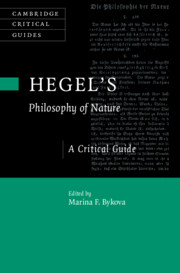
Hegel’s Philosophy of Nature constitutes the second part of his mature philosophical system presented in the Encyclopaedia of the Philosophical Sciences, and covers an exceptionally broad spectrum of themes and issues, as Hegel considers the content and structure of how humanity approaches nature and how nature is understood by humanity. The essays in this volume bring together various perspectives on Hegel’s Philosophy of Nature, emphasizing its functional role within the Encyclopaedia and its importance for understanding the complexity of Hegel’s philosophical project. Together they illuminate the core ideas which form Hegel’s philosophical framework in the realm of nature.
Offers a systematic reading of the Philosophy of Nature, emphasizing its functional role within Encyclopaedia and its importance for understanding the complexity of Hegel’s philosophical project
Brings together fourteen contributors who represent various traditions and a diverse array of interpretive positions
Addresses both traditional themes and new, rarely explored topics within Hegel scholarship
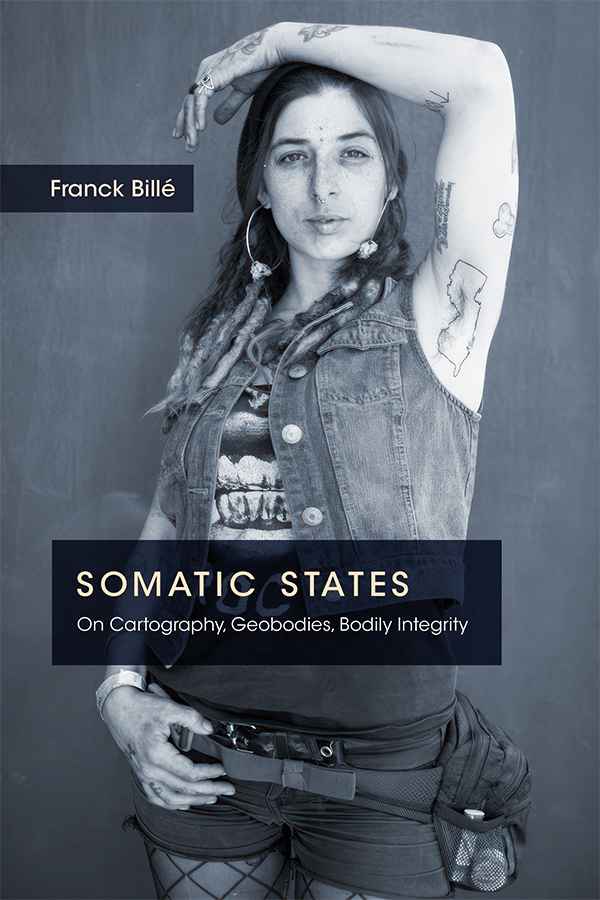
In Somatic States, Franck Billé examines the conceptual link between the nation-state and the body, particularly the visceral and affective attachment to the state and the symbolic significance of its borders. Billé argues that corporeal analogies to the nation-state are not simply poetic or allegorical but reflect a genuine association of the individual body with the national outline—an identification greatly facilitated by the emergence of the national map. Billé charts the evolution of cartographic practices and the role that political maps have played in transforming notions of territorial sovereignty. He shows how states routinely and effectively mobilize corporeal narratives, such as framing territorial loss through metaphors of dismemberment and mutilation. Despite the current complexity of geopolitics and neoliberalism, Billé demonstrates that corporeality and bodily metaphors remain viscerally powerful because they offer a seemingly simple way to apprehend the abstract nature of the nation-state.
Updated June 2025: The full list of essays in this series is here.
Over the past several years, my Progressive Geographies blog has become too much of a noticeboard, sharing information about books, talks or shorter pieces by other people that look interesting, and, much less often, a few things about my own work. I’ve shared some research resources – bibliographies, a few textual comparisons, sometimes very short translations – but not written very much for the blog itself, apart from the research updates on my Mapping Indo-European thought in twentieth-century France project.
While I don’t intend to stop sharing links to other people’s work, I am going to try to write a bit more for this site. The first few of what I’m calling ‘Sunday histories’ are these:
I didn’t want to commit to doing this until I had a few out there, and ideas for a few more, but I hope to make this a regular thing.
These pieces are intended to be short and accessible, lacking the full scholarly references of something I’d try to publish more formally. They are usually tangential to what I’m working on, perhaps a development of something which would only be a footnote or aside in another text. Sometimes they will be some notes on a topic which might be further developed in the future, or where I’ve reached a dead end. Or they might be a few thoughts on a recent book I’ve just read – not quite a review, but perhaps close to that.
The title ‘Sunday histories’ comes from the condescending name of ‘Sunday historian’ given to amateurs by professional historians, since these were people whose only time for doing history was outside of the working week. Philippe Ariès called his memoir Un Historien du Dimanche for this reason. My first degree is in Politics and Modern History, and although I’ve had visiting posts in History, I’ve not had a teaching position in a History department. But these short posts are also histoires in the French sense of stories as much as formal histories. At the end of each of these texts I’ve tried to provide a few indications of sources which would provide much more information.
These pieces are also a bit of a reaction against academic publishing – its slow processes, its costs, and its metrics. These pieces are posted when I’ve finished them, though they might be revised later; they are free to access (I have no plans to turn these into subscription-only); and they are not intended as ‘outputs’ in the tradition sense.
As with the post about Sjoestedt I might revisit some of the earlier occasional pieces on this blog, revise and expand them in a similar format. They are provisional and suggestions are welcome. I’m sure specialists in the areas I discuss will know much more or correct details. I hope there is some interest in them.
The oldest texts preserved are inscriptions which date back about 5,000 years, though the dating is disputed, and how they should be read presents its own controversies. Most of the earliest texts are on tablets or in stone; with surviving manuscripts on papyrus probably only about 2,500 years old. The languages spoken then, and their forms of representation in pictograms, syllabaries and alphabets, present many challenges of interpretation in our present. If even specialist scholars find these texts difficult, it seems likely future people will find our languages not immediately comprehensible. So, if humans of today want to write something that could be read thousands of years in the future, how should they do this? That was one of the challenges faced in the early nuclear age. Waste created by nuclear technologies would need to be stored securely, but how could those storing it be sure that it would not be disturbed by future humans? What message would warn them away?
One of the linguists tasked with trying to think about this question was Thomas Sebeok, born in Hungary as Sebök Tamás, who became an American citizen during the Second World War. He worked with Roman Jakobson, and through his editorial role with the journal Semiotica connects to the Benveniste story I’m trying to tell. There is some grumpy correspondence between him and Benveniste (and sometimes Julia Kristeva, acting on Benveniste’s part) about a late article delaying the first issue of the journal. It was eventually delivered in instalments and published in two parts, in the first two issues in 1969, which Sebeok said was “a very undesirable precedent”. That is perhaps a story for another time.
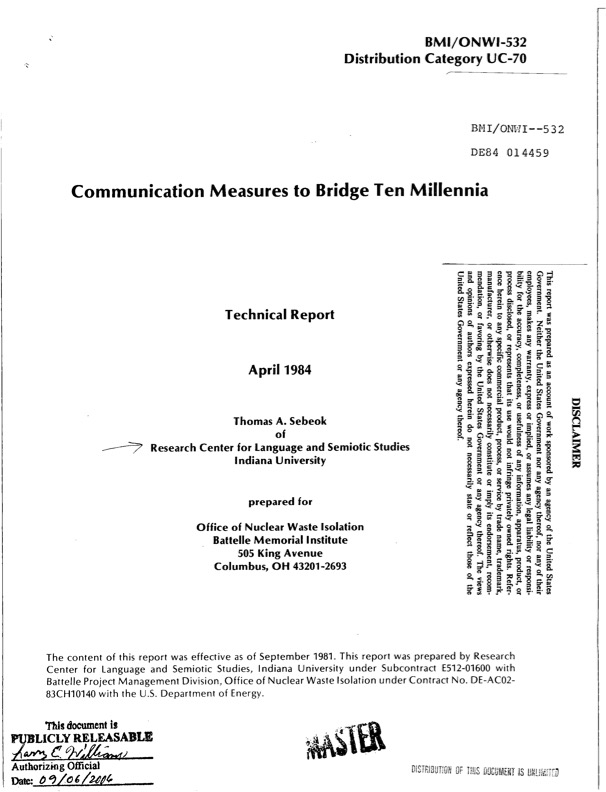
For the nuclear challenge, Sebeok authored a short report commissioned by the Bechtel group for the Office of Nuclear Waste Isolation. Written in 1984, “Communication Measures to Bridge Ten Millenia“, was submitted to the United States government department of Energy. It was once a classified report but is now available online. Its summary reads:
Cover page of Sebeok’s report
The Department of Energy created the Human Interference Task Force (HITF) in 1980 to investigate the problems connected with the postclosure, final marking of a filled nuclear waste repository. The task of the HITF is to devise a method of warning future generations not to mine or drill at that site unless they are aware of the consequences of their actions. Since the likelihood of human interference should be minimized for 10,000 years, an effective and long-lasting warning system must be designed. This report is a semiotic analysis of the problem, examining it in terms of the science or theory of messages and symbols. Because of the long period of time involved, the report recommends that a relay system of recoding messages be initiated; that the messages contain a mixture of iconic, indexical, and symbolic elements; and that a high degree of redundancy of messages be employed. (source)
Department of Energy, Compliance Certification Application, 1994, for the Waste Isolation Pilot Plant, New Mexico, USA; taken from Peter C. van Wyck: Signs of danger: waste, trauma, and nuclear threat, University of Minnesota Press 2005, p. 74, Public Domain, https://commons.wikimedia.org/w/index.php?curid=29455602
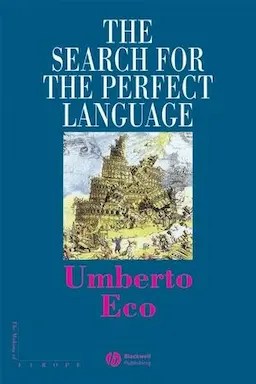
Umberto Eco was on the editorial board of Semiotica and worked closely with Sebeok, both at conferences and in editing The Sign of Three: Dupin, Holmes, Peirce together in 1983. He discusses the nuclear waste project in The Search for a Perfect Language (pp. 176-77). As Eco puts it, ten thousand years in the future is “more than enough time for great empires and flourishing civilisations to perish”.
Almost immediately, Sebeok discarded the possibility of any type of verbal communication, of electric signals as needing a constant power supply, of olfactory messages as being of brief duration, and of any sort of ideogram based on convention. Even a pictographic language seemed problematic (p. 176).
The idea of passing on the message between generations was more plausible, but if society broke down could prove problematic. Every known language and sign system could be used together, with the idea that at least one would be at least part-intelligible. But again, “even this solution presupposed a form of cultural continuity (however weak it would be)” (p. 177).
Eco’s account of Sebeok’s additional suggestion is just the sort of story that would appeal to him – it sounds like the premise of one of his novels.
The only remaining solution was to institute a sort of ‘priesthood’ of nuclear scientists, anthropologists, linguists and psychologists supposed to perpetuate itself by co-opting new members. This caste would keep alive the knowledge of the danger, creating myths and legends about it. Even though, in the passage of time, these ‘priests’ would probably lose a precise notion of the peril that they were committed to protect humanity from, there would still survive, even in a future state of barbarism, obscure but efficacious taboos (p. 177).
The idea was to make nuclear storage sites taboo, sites where no one would wish to go. The messages or the scripture warning this would need to be periodically updated to ensure that the instruction remained comprehensible. As Sebeok’s report says:
The legend-and-ritual, as now envisaged, would be tantamount to laying a ‘false trail’, meaning that the uninitiated will be steered away from the hazard site for reasons other than the scientific knowledge of the possibility of radiation and its implications; essentially, the reason would be accumulated superstition to shun a certain area permanently (p. 24).
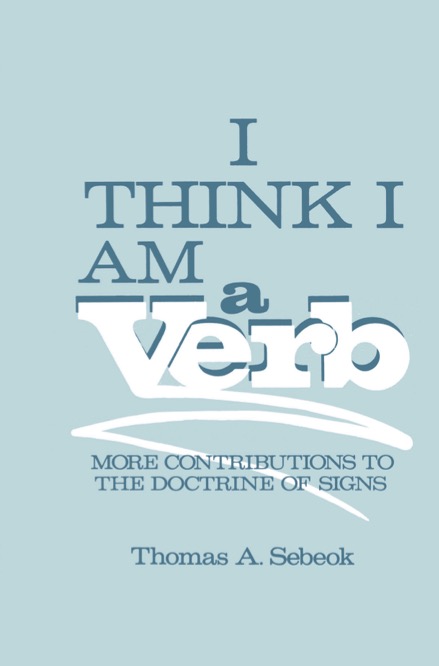
This aspect of Sebeok’s ideas did not find their way into the final report, nor were they taken seriously in subsequent proposals for what remains a problem and will continue to be so for millennia to come. The idea of an “atomic priesthood” – borrowed from the nuclear physicist Alvin M. Weinberg – and a “folkloric relay” were never adopted, and his report was I think relatively unknown during his career. One online article in Slate about the wider problem of warning people away calls his idea “silly”. Was it just an elaborate joke? The report online gives a creation date of 1 April, though the report itself only gives the month. It gives the notional 1st of the month to other reports so this just seems a convention. Sebeok published a version of his report in 1986, in his collection I Think I am a Verb.
This story is hardly unknown – there are a lot of indications online, and Sebeok’s report is fairly widely cited. The ideas have found most purchase in science fiction, as Sebastian Musch has explored (2016), and there is, as you might expect, a project website – https://www.theatomicpriesthoodproject.org – with the indicative dates of 01984 to 9999+.
Sebeok died in 2001, and his report was publicly released on 9 June 2006. Eco’s The Search for a Perfect Language was published in 1993, so he either relied on the chapter or had access to a copy of the report from Sebeok himself. And the early-mid 1980s was when he was writing Foucault’s Pendulum, first published in 1988.
Sebastian Musch: “The Atomic Priesthood and Nuclear Waste Management – Religion, Sci-fi Literature and the End of our Civilization”, Zygon: Journal of Religion and Science 51 (3), 2016, 626-39.
Sebastian Musch: “Hans Jonas, Günther Anders, and the Atomic Priesthood: An Exploration into Ethics, Religion and Technology in the Nuclear Age”, Religions 12 (9), 2021, 741-50, https://doi.org/10.3390/rel12090741
Office of Nuclear Waste Isolation, “Reducing the Likelihood of Future Human Activities That Could Affect Geologic High-Level Waste Repositories”, May 1984, https://www.osti.gov/biblio/6799619
Thomas A. Sebeok, “Pandora’s Box in Aftertimes”, in I Think I am a Verb: More Contributions to the Doctrine of Signs. New York: Springer, 1986, 149-73.
As far as I’m aware, Umberto Eco’s archives are not yet accessible, but have been acquired by the Italian state and will be loaned to the University of Bologna where Eco taught for 90 years (report here; English story here).
This is the fifth post of an occasional series, where I try to post short essays with some indications of further reading and sources, but which are not as formal as something I’d try to publish more conventionally. They are usually tangential to my main writing focus, a home for spare ideas, asides, dead-ends and possible futures. I hope there is some interest in them. They are provisional and suggestions are welcome. The other posts so far are:
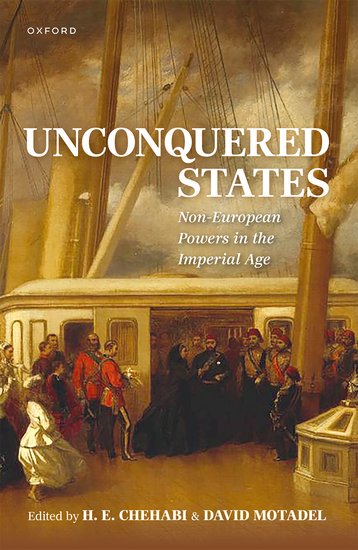
In the heyday of empire, most of the world was ruled, directly or indirectly, by the European powers. Unconquered States explores the struggles for sovereignty of the few nominally independent non-Western states in the imperial age. It examines the ways in which countries such as China, Ethiopia, Japan, the Ottoman Empire, Persia, and Siam managed to keep European imperialism at bay, whereas others, such as Hawai’i, Korea, Madagascar, Morocco, and Tonga, long struggled, but ultimately failed, to maintain their sovereignty.
The chapters in this book address four major aspects of the relations these countries had with the Western imperial powers: armed conflict and military reform, unequal treaties and capitulations, diplomatic encounters, and royal diplomacy. Bringing together scholars from five continents, this book provides the first comprehensive global history of the engagement of the independent non-European states with the European empires, reshaping our understanding of sovereignty, territoriality, and hierarchy in the modern world order.
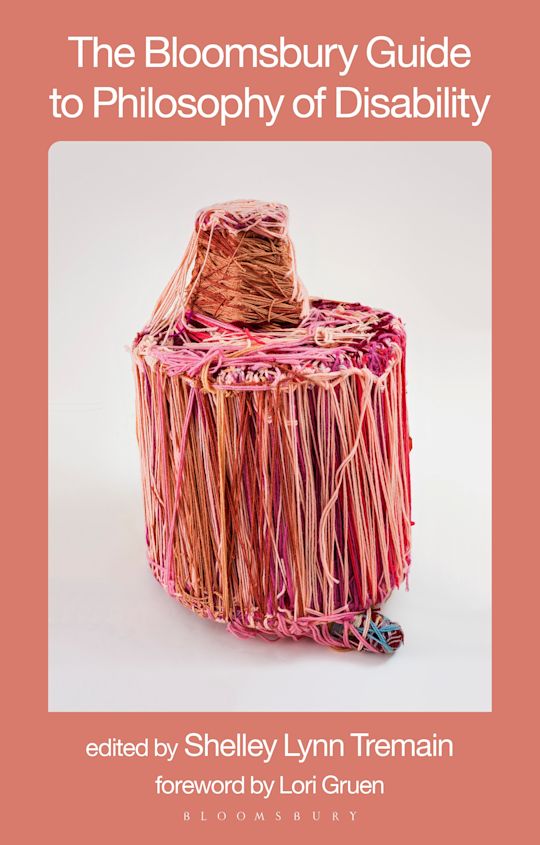
The Bloomsbury Guide to Philosophy of Disability is a revolutionary collection encompassing the most innovative and insurgent work in philosophy of disability. Edited and anthologized by disabled philosopher Shelley Lynn Tremain, this book challenges how disability has historically been represented and understood in philosophy: it critically undermines the detrimental assumptions that various subfields of philosophy produce; resists the institutionalized ableism of academia to which these assumptions contribute; and boldly articulates new anti-ableist, anti-sexist, anti-racist, queer, anti-capitalist, anti-carceral, and decolonial insights and perspectives that counter these assumptions.
This rebellious and groundbreaking book’s chapters–most of which have been written by disabled philosophers–are wide-ranging in scope and invite a broad readership. The chapters underscore the eugenic impetus at the heart of bioethics; talk back to the whiteness of work on philosophy and disability with which philosophy of disability is often conflated; and elaborate phenomenological, poststructuralist, and materialist approaches to a variety of phenomena. Topics addressed in the book include: ableism and speciesism; disability, race, and algorithms; race, disability, and reproductive technologies; disability and music; disabled and trans identities and emotions; the apparatus of addiction; and disability, race, and risk. With cutting-edge analyses and engaging prose, the authors of this guide contest the assumptions of Western disability studies through the lens of African philosophy of disability and the developing framework of crip Filipino philosophy; articulate the political and conceptual limits of common constructions of inclusion and accessibility; and foreground the practices of epistemic injustice that neurominoritized people routinely confront in philosophy and society more broadly.
A crucial guide to oppositional thinking from an international, intersectional, and inclusive collection of philosophers, this book will advance the emerging field of philosophy of disability and serve as an antidote to the historical exclusion of disabled philosophers from the discipline and profession of philosophy.
The Bloomsbury Guide to Philosophy of Disability is essential reading for faculty and students in philosophy, disability studies, political theory, Africana studies, Latinx studies, women’s and gender studies, LGBTQ studies, and cultural studies, as well as activists, cultural workers, policymakers, and everyone else concerned with matters of social justice.
In 1918 the Russian-French philosopher Alexandre Kojève (1902-1968) was caught selling soap on the black-market in Moscow by the Tchèka, the political police of the Bolshevik party. After Kojève’s stepfather was killed by raiding peasants in 1917, the Kozhevnikov’s, an archetypical Muscovite bourgeois family, plunged into financial precarity leading Kojève to earn an extra buck in the informal economy. At the time of the Russian Civil War, the Tchèka were executing thousands of people for petty crimes. Kojève’s niece, Nina Kousnetzoff, stated that Kojève, while sitting in his prison cell, fully understood the risk of being executed. There were adolescents, the same age as Kojève, who were being executed for much less. Luckily, after three days, he was released via family connections. In this think-piece, I argue, following Dominique Auffret’s biography of Kojève, that this short imprisonment in a Tchèka cell was an intellectually formative moment for him, that is, it held a Bildungseffekt on Kojève’s later work on revolutionary terror in his lectures on Hegel’s Phenomenology of Spirit during the 1930s, specifically his analysis on Hegel’s commentary of the French Revolution…. [continues here]
*Yet what surprises me most of all at this time is that what I have written consists, as it were, almost entirely of quotations. – Compositions so produced are to poetry what mosaic is to painting. – It is the craziest mosaic technique you can imagine – and the very mind which directs the hands in formation is incapable of accounting to itself for the origin, the gradations, or the media of the process.
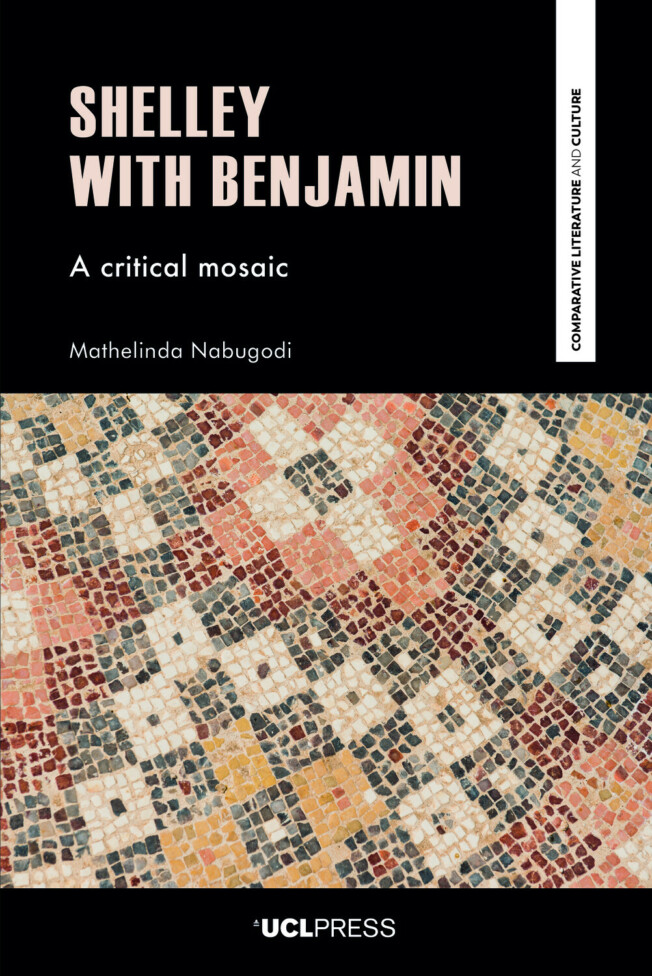
Shelley with Benjamin: A critical mosaic is an experiment in comparative reading. Born a century apart, Percy Bysshe Shelley and Walter Benjamin are separated by time, language, temperament and genre – one a Romantic poet known for his revolutionary politics and delicate lyricism, the other a melancholy intellectual who pioneered a dialectical method of thinking in constellations. Yet, as the above montage of citations from their works demonstrates, their ideas are mutually illuminating: the mosaic is but one of several images that both use to describe how literature lives on through practices of citation, translation and critical commentary.
In a series of close readings that are by turns playful, erotic and violent, Mathelinda Nabugodi unveils affinities between two writers whose works are simultaneously interventions in literary history and blueprints for an emancipated future. In addition to offering fresh interpretations of both major and minor writings, she elucidates the personal and ethical stakes of literary criticism. Throughout the book, marginal annotations and interlinear interruptions disrupt the faux-objective and colourblind stance of standard academic prose in an attempt to reckon with the barbarism of our past and its legacy in the present.
The book will appeal to readers of Shelley and Benjamin as well as those with an interest in comparative literature, literary theory, romantic poetics, and creative critical writing.