A revealing account of how German Protestant leaders embraced democratic ideals after WWII, while firmly and consequentially refusing to account for their earlier complicity with Nazism.
Germany’s Protestant churches, longtime strongholds of nationalism and militarism, largely backed the Nazi dictatorship that took power in 1933. For many Protestant leaders, pastors, and activists, national and religious revival were one and the same. Even those who opposed the regime tended toward antidemocratic attitudes. By the 1950s, however, Church leaders in West Germany had repositioned themselves as prominent advocates for constitutional democracy and human rights.
Brandon Bloch reveals how this remarkable ideological shift came to pass, following the cohort of theologians, pastors, and lay intellectuals who spearheaded the postwar transformation of their church. Born around the turn of the twentieth century, these individuals came of age amid the turbulence of the Weimar Republic and were easily swayed to complicity with the Third Reich. They accommodated the state in hopes of protecting the Church’s independence from it, but they also embraced the Nazi regime’s antisemitic and anticommunist platform. After the war, under the pressures of Allied occupation, these Protestant intellectuals and their heirs creatively reimagined their tradition as a fount of democratic and humanitarian values. But while they campaigned for family law reform, conscientious objection to military service, and the protection of basic rights, they also promoted a narrative of Christian anti-Nazi resistance that whitewashed the Church’s complicity in dictatorship and genocide.
Examining the sources and limits of democratic transformation, Reinventing Protestant Germany sheds new light on the development of postwar European politics and the power of national myths.
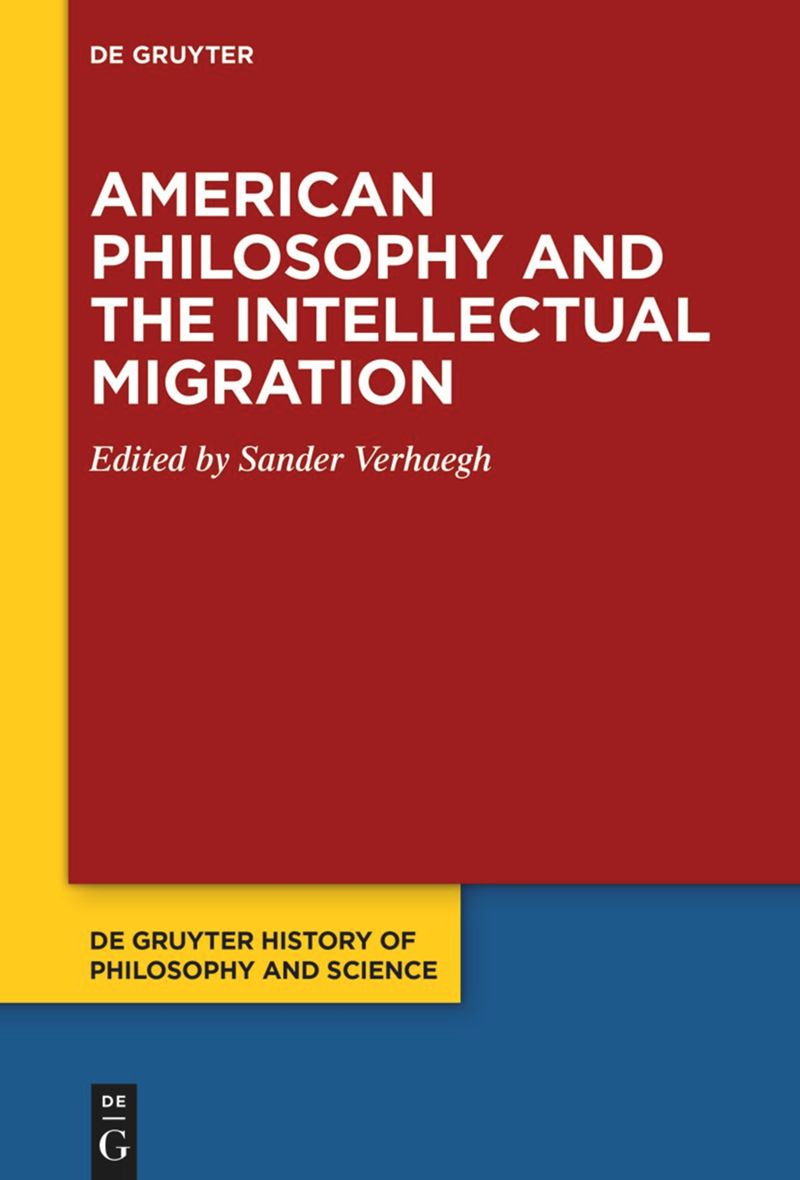
How did immigrant scholars such as Rudolf Carnap, Max Horkheimer, and Alfred Schütz influence the development of American philosophy? Why was the U.S. community more receptive to logical empiricism than to critical theory or phenomenology? This volume brings together fifteen historians of philosophy to explore the impact of the intellectual migration.
In the 1930s, the rise of fascism forced dozens of philosophers to flee to the United States. Prominent logical empiricists acquired positions at prestigious U.S. universities. Critical theorists moved their Frankfurt School to Columbia University. And a group of phenomenologists taught at the New School for Social Research. Though many refugee scholars acquired some American following, logical empiricism had the biggest impact on academicphilosophy. The exiled empiricists helped the country turn into a bastion of ‘analytic philosophy’ after the war. Phenomenology and critical theory became prominent schools from the 1970s onwards and continue to be influential in American philosophy today.
This is the first book to investigate to the migration from an integrated perspective, bringing together historians of American philosophy, logical empiricism, phenomenology, and critical theory.
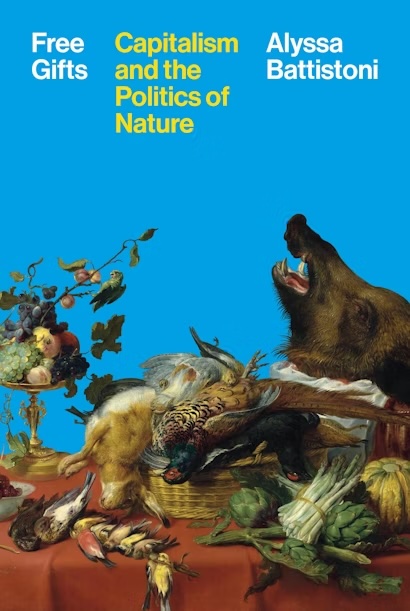
Capitalism is typically treated as a force for relentless commodification. Yet it consistently fails to place value on vital aspects of the nonhuman world, whether carbon emissions or entire ecosystems. In Free Gifts, Alyssa Battistoni explores capitalism’s persistent failure to value nature, arguing that the key question is not the moral issue of why some kinds of nature shouldn’t be commodified, but the economic puzzle of why they haven’t been. To understand contemporary ecological problems from biodiversity collapse to climate change, she contends, we have to understand how some things come to have value under capitalism—and how others do not. To help us do so, Battistoni recovers and reinterprets the idea of the free gift of nature used by classical economic thinkers to describe what we gratuitously obtain from the natural world, and builds on Karl Marx’s critique of political economy to show how capitalism fundamentally treats nature as free for the taking. This novel theory of capitalism’s relationship to nature not only helps us understand contemporary ecological breakdown, but also casts capitalism’s own core dynamics in a new light.
Battistoni addresses four different instances of the free gift in political economic thought, each in a specific domain: natural agents in industry, pollution in the environment, reproductive labor in the household, and natural capital in the biosphere. In so doing, she offers new readings of major twentieth-century thinkers, including Friedrich Hayek, Simone de Beauvoir, Garrett Hardin, Silvia Federici, and Ronald Coase. Ultimately, she offers a novel account of freedom for our ecologically troubled present, developing a materialist existentialism to argue that capitalism limits our ability to be responsible for our relationships to the natural world, and imagining how we might live freely while valuing nature’s gifts.
Update August 2025: interview with Jochen Schmon at the Journal of the History of Ideas blog.
Situated between the history of pain, history of childhood and history of emotions, this innovative work explores cultural understandings of children’s pain, from the 1870s to the end of the Second World War. Focusing on British medical discourse, Leticia Fernández-Fontecha examines the relationship between the experience of pain and its social and medical perception, looking at how pain is felt, seen and performed in contexts such as the hospital, the war nursery and the asylum. By means of a comparative study of views in different disciplines – physiology, paediatrics, psychiatry, psychology and psychoanalysis – this work demonstrates the various ways in which the child in pain came to be perceived. This context is vital to understanding current practices and beliefs surrounding childhood pain, and the role that children play in the construction of adult worlds.
Guest editors Johanna Jaschik, Machteld Venken, and Birte Wassenberg bring time into border studies with this new collection, Border Temporalities in and Beyond Europe, featuring 12 research articles. The new issue also includes a portfolio, poetry, policy work, and more!
There are some good histories of the Linguistic Circle of Prague, which met in the years before the Second World War, and which included Russian scholars as well as ones from Czechoslovakia. Jindřich Toman’s The Magic of a Common Language is a particularly useful guide. Roman Jakobson, Nikolai Trubetzkoy, René Wellek and Vilém Mathesius were regular attendees to the circle. In 1929, the group founded a journal, Travaux du Cercle Linguistique de Prague.
Émile Benveniste presented a paper to the Linguistic Circle of Prague on 8 March 1937. His topic was “Linguistic expression of quantity (grammatical number and numerals)”. It presented some of the material he had first used in his second 1935-36 course at the Collège de France, while he was deputising for Antoine Meillet, whom he would later succeed in 1937 to the chair of Comparative Grammar. He never published the talk, telling Jakobson that the materials were lost when his flat was occupied during the war. (Benveniste spent most of the war either as a prisoner of war or in exile in Switzerland.) He confessed to Jakobson he did not have the courage to return to projects he had completed but never published. He did revisit one incomplete project, saying that he had to reconstitute its data from scratch, but that seems to have been an exception. Jakobson recounts this story both in an unpublished interview (which I’ve seen in the Tzvetan Todorov archives in Paris, but I understand is also in Jakobson’s archive at MIT) and in a note to his edition of Trubetzkoy’s letters to him. Trubetzkoy died in Vienna in 1938 from a heart attack, brought on by Nazi persecution. A volume of the Travaux du Cercle linguistique du Prague was dedicated to Trubetzkoy in 1939, and Benveniste was one of the contributors. His piece then was not the one on quantity, but an analysis of phonology and the distribution of consonants in words. Given Trubetzkoy’s major contribution to linguistics was in phonology, the choice of topic was appropriate, though Benveniste presumably did not know that that Trubetzkoy had told Jakobson he found Benveniste’s writings on phonology “usually not very successful” (10 January 1937).
In this text Benveniste works through examples from Latin, Ancient Greek and modern Persian, before suggesting some connections to the languages of Asia Minor, and from them back to what can be reconstructed of Proto Indo-European, before broadening the analysis in the final pages to languages outside of the Indo-European family. These examples show that even at this early stage of his career he already had an interest in native American languages. (Benveniste would do linguistic fieldwork in the Pacific northwest in the early 1950s.) He closes with the comment that his brief remarks indicate a need for a fuller study, but this is yet another example of one of his possible projects interrupted and then seemingly abandoned due to the war.
The Travaux du Cercle linguistique series ceased publication with the invasion of Czechoslovakia and the exile of many of the circle’s members. Jakobson fled in March 1939, first to Denmark, then later to Norway, Sweden and the United States. At one point he thought he might move to England, and he was supported by the Society for the Protection of Science and Learning. He recounts that he burned all of his papers in Brno shortly before the Nazi invasion, saving just the letters from Trubetzkoy, which were put in a briefcase, buried and retrieved after the war. It was this correspondence that Jakobson published many years later, in the original Russian with an English apparatus. The book has been translated into French. Jakobson and Benveniste corresponded after the war, and those letters have been published. But the destruction of Benveniste and Jakobson’s pre-war letters, as well as nearly all of Jakobson’s letters to Trubetzkoy, leaves important gaps in the record.
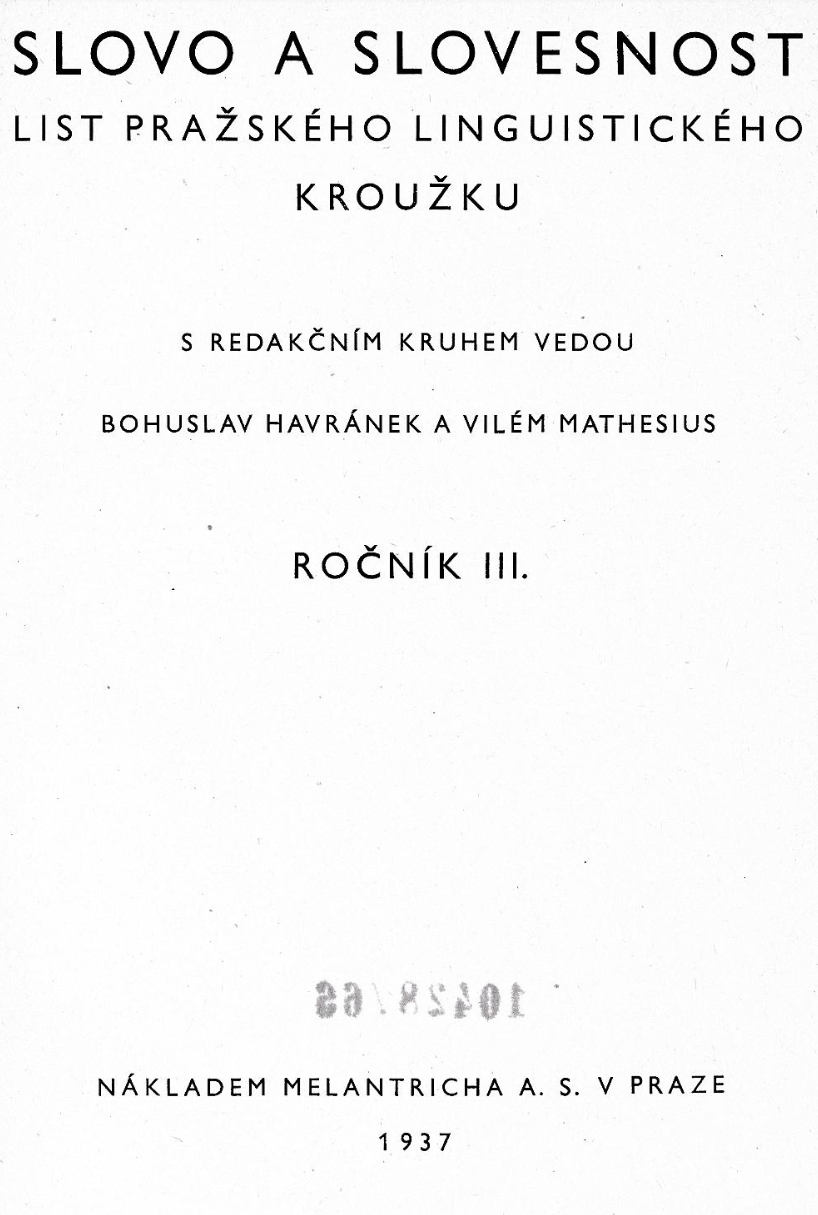
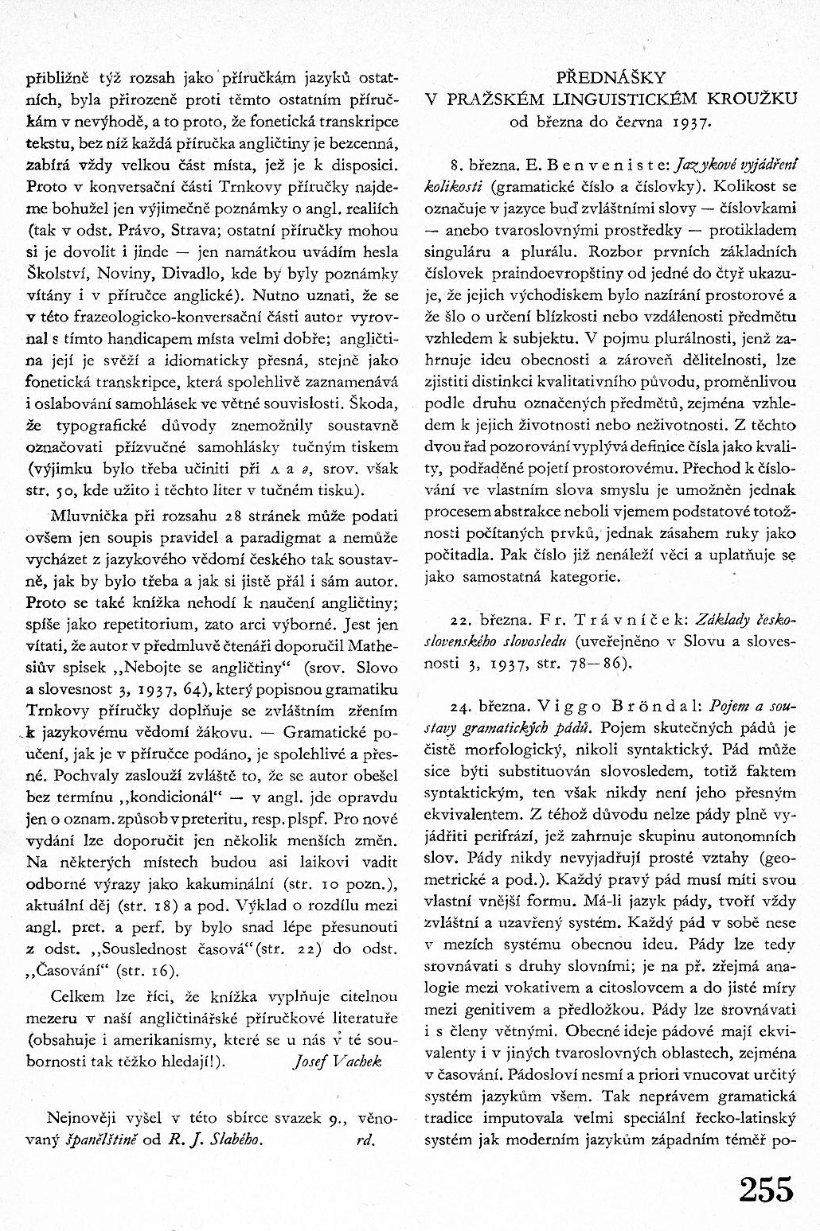
Cover of Slovo a slovesnost, 1937The page with the summary of Benveniste’s lecture
Jakobson’s note to Trubetzkoy’s letter about Benveniste and phonology mentions that a brief Czech summary of Benveniste’s 1937 lecture was published in the Circle’s journal Slovo a slovesnost. I was surprised to find this online. As far as I can tell, this is the only surviving trace of what Benveniste said in Prague, presumably itself a translation of a lost French original:
8. března. E. Benveniste: Jazykové vyjádření kolikosti (gramatické číslo a číslovky). Kolikost se označuje v jazyce buď zvláštními slovy — číslovkami — anebo tvaroslovnými prostředky — protikladem singuláru a plurálu. Rozbor prvních základních číslovek praindoevropštiny od jedné do čtyř ukazuje, že jejich východiskem bylo nazírání prostorové a že šlo o určení blízkosti nebo vzdálenosti předmětu vzhledem k subjektu. V pojmu plurálnosti, jenž zahrnuje ideu obecnosti a zároveň dělitelnosti, lze zjistiti distinkci kvalitativního původu, proměnlivou podle druhu označených předmětů, zejména vzhledem k jejich životnosti nebo neživotnosti. Z těchto dvou řad pozorování vyplývá definice čísla jako kvality, podřaděné pojetí prostorovému. Přechod k číslování ve vlastním slova smyslu je umožněn jednak procesem abstrakce neboli vjemem podstatové totožnosti počítaných prvků, jednak zásahem ruky jako počitadla. Pak číslo již nenáleží věci a uplatňuje se jako samostatná kategorie.
March 8 [1937]. E. Benveniste: Linguistic expression of quantity (grammatical number and numerals). Quantity is indicated in language either by special words – numerals – or by morphological means – the opposition of singular and plural. An analysis of the first basic Proto-Indo-European numerals from one to four shows that their starting point was spatial perception and that it was a matter of determining the proximity or distance of an object relative to the subject. In the concept of plurality, which includes the idea of generality and at the same time divisibility, it is possible to detect a distinction of qualitative origin, variable according to the type of objects indicated, especially with regard to their animacy or inanimacy [životnosti nebo neživotnosti – literally life or non-life or livingness]. From these two series of observations follows the definition of number as a quality, a concept subordinate to that of space. The transition to numbering in its proper sense is made possible both by the process of abstraction, or the perception of the essential identity of the counted elements, and on the other hand by the intervention of the hand as a counter [počitadla – calculator or abacus]. Then the number no longer belongs to the thing and is applied as a separate category.
[Many thanks to John Raimo for the translation of this text.]
In their apparatus to the Benveniste and Jakobson correspondence, Chloé Laplantine and Pierre-Yves Testenoire note that on the 12 March 1937, Benveniste gave a lecture on the structure of Proto-Indo-European to the Masaryk University in Brno, on Jakobson’s invitation (pp. 140-41). Jakobson wrote a brief report on this lecture for the Lidové noviny newspaper on 16 March: “Prof. Benveniste v Brně”. The text is reprinted in Jakobson’s Selected Writings (Vol IX, Part II, p. 246). The lecture seems to have been mainly for non-specialists, and to have summarised some of Benveniste’s Paris teaching and publications. Jakobson indicates that Benveniste stressed the coherence of his views with those of the Czechoslovak school, talked of the relation of Hittite to Proto-Indo-European, and stressed some of the grammatical functions lacking in the reconstructed language. He also adds that Benveniste, together with the Norwegian Slavic scholar Stang – Christian Schwigaard Stang – visited Brno’s Town Hall and other sites.
Émile Benveniste, “Répartition des consonnes et phonologie du mot”, in Études phonologiques dédiées à la mémoire de M. le Prince N.S. Trubetzkoy, Prague: Jednota Československých Matematiků a Fysiků, 1939, 27-35; reprinted in Benveniste, Langues, Cultures, Religions, eds. Chloé Laplantine and Georges-Jean Pinault, Limoges: Lambert-Lucas, 2015, Ch. 12.
Roman Jakobson (ed.), N.S. Trubetzkoy’s Letters and Notes, The Hague: Mouton, 1975; Correspondance avec Roman Jakobson et Autres Écrits, trans. Patrick Sériot and Margarita Schönenberger, Lausanne: Payot, 1996.
Roman Jakobson, “Prof. Benveniste v Brně”, Selected Writings Vol IX: Uncollected Works, 1916–1943, Part Two, 1934–1943, ed. Jindřich Toman, Berlin: Walter de Gruyter, 2014, 246.
Chloé Laplantine and Pierre-Yves Testenoire (eds.), “La correspondance d’Émile Benveniste et Roman Jakobson (1947-1968)”, Histoire Épistémologie Langage 43 (2), 2021, 139-68, https://journals.openedition.org/hel/1284
Patrick Sériot, Structure and the Whole: East, West and Non-Darwinian Biology in the Origins of Structural Linguistics, trans. Amy Jacobs-Colas, Berlin: Walter de Gruyter, 2014.
Jindřich Toman, The Magic of a Common Language: Jacobson, Mathesius, Trubetzkoy, and the Prague Linguistic Circle, Cambridge, MA: The MIT Press, 1995.
This is the third post of an occasional series, where I try to post short essays with some indications of further reading and sources, but which are not as formal as something I’d try to publish more conventionally. They are usually tangential to my main writing focus, a home for spare ideas, asides, dead-ends and possible futures. I hope there is some interest in them. They are provisional and suggestions are welcome. The other posts so far are:
This book is a succinct yet comprehensive history of East Germany which provides a differentiated picture of the communist state. It offers a sophisticated analysis of life under dictatorship which candidly confronts the abuses of the East German Communist Party (SED) and the Stasi state security service. Ned Richardson-Little delves into the central contradictions of the GDR as a state meant to overcome the horrors of the Third Reich and create a new utopia, while itself a brutal dictatorship. He also convincingly argues that while the existence of the GDR was a product of the Cold War, it was also entangled in international politics well beyond the rivalry between the United States and the Soviet Union. In this way, the book offers a history of the GDR in a global perspective that illustrates the worldview of those who ruled it, those who rebelled against the strictures of state socialism, and those in between who sought a normal life under dictatorship.
The German Democratic Republic traces the foundation of the GDR from its origins as the Soviet Zone of Occupation after the Second World War through key events such as the 1953 Uprising, the building of the Berlin Wall, the Helsinki Accords and the collapse of state socialism in 1989. Some of the key themes explored include the memory of Nazism and national identity, everyday life under dictatorship, the global politics of the GDR, the diversity of dissent and the competing visions for East Germany’s democratic future.
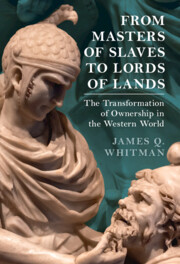
Today we think of land as the paradigmatic example of property, while in the past, the paradigmatic example was often a slave. In this seminal work, James Q. Whitman asserts that there is no natural form of ownership. Whitman dives deep into the long Western history of this transformation in the legal imagination – the transformation from the ownership of humans and other living creatures to the ownership of land. This change extended over many centuries, coming to fruition only on the threshold of the modern era. It brought with it profound changes, not only in the way we understand ownership but also in the way we understand the state. Its most dramatic consequence arrived in the nineteenth century, with the final disappearance of the lawful private ownership of humans, which had been taken for granted for thousands of years.
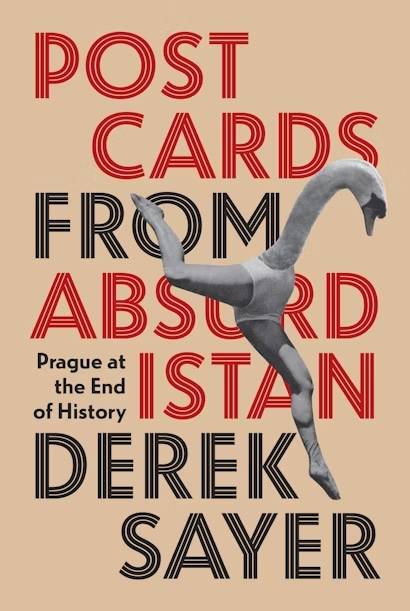
Postcards from Absurdistan is a cultural history of Prague from 1938, when the Nazis destroyed Czechoslovakia’s artistically vibrant liberal democracy, to 1989, when the country’s socialist regime collapsed after more than four decades of communist party rule. Derek Sayer shows that Prague’s twentieth century, far from being a story of inexorable progress toward some “end of history,” whether fascist, communist, or democratic, was a tragicomedy of recurring nightmares played out in a land Czech dissidents dubbed Absurdistan. Situated in the eye of the storms that shaped the modern world, Prague holds up an unsettling mirror to the absurdities and dangers of our own times.
In a brilliant narrative, Sayer weaves a vivid montage of the lives of individual Praguers—poets and politicians, architects and athletes, journalists and filmmakers, artists, musicians, and comedians—caught up in the crosscurrents of the turbulent half century following the Nazi invasion. This is the territory of the ideologist, the collaborator, the informer, the apparatchik, the dissident, the outsider, the torturer, and the refugee—not to mention the innocent bystander who is always looking the other way and Václav Havel’s greengrocer whose knowing complicity allows the show to go on. Over and over, Prague exposes modernity’s dreamworlds of progress as confections of kitsch.
In a time when democracy is once again under global assault, Postcards from Absurdistan is an unforgettable portrait of a city that illuminates the predicaments of the modern world.
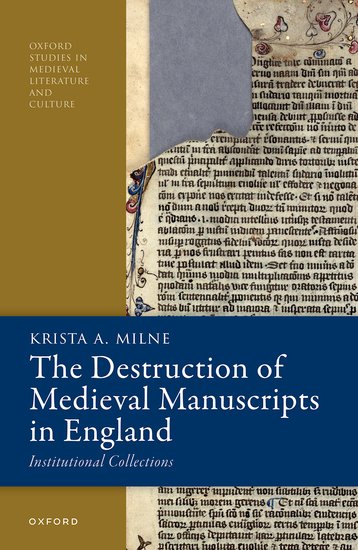
The Dissolution of the Monasteries (1536-40) is widely held as the single most significant event in England’s history of the destruction and loss of medieval manuscripts. Despite this consensus, the ultimate impact of the Dissolution – and of medieval manuscript destruction during the centuries that followed – remains unclear. How did Reformation-era losses compare to those which preceded the Reformation, and to those that followed it? How did the losses caused by sectarian conflicts compare to more quotidian kinds of loss, such as improper storage or deliberate de-acquisition? Which manuscripts were targeted, when were they targeted, and how should one account for the inevitably skewed record?
In The Destruction of Medieval Manuscripts in England, Krista A. Milne asks these questions to better understand literary taste, behavioural patterns, and the circulation of knowledge throughout the medieval period. Milne explores methods drawn from quantitative codicology to explore the most significant moments of manuscript loss in the history of England. The evidence suggests that this destruction was much more limited in its targets, but far more extensive in scope, than is usually acknowledged. Overwhelmingly, throughout the investigation, the manuscripts most at risk were those considered too new to qualify as antique but too old to be au courant. This pattern of destruction, which Milne describes as the principle of ‘age without vintage,’ remains apparent in many different domains today.