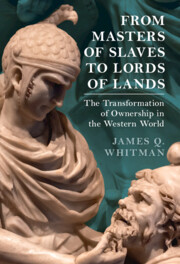
Today we think of land as the paradigmatic example of property, while in the past, the paradigmatic example was often a slave. In this seminal work, James Q. Whitman asserts that there is no natural form of ownership. Whitman dives deep into the long Western history of this transformation in the legal imagination – the transformation from the ownership of humans and other living creatures to the ownership of land. This change extended over many centuries, coming to fruition only on the threshold of the modern era. It brought with it profound changes, not only in the way we understand ownership but also in the way we understand the state. Its most dramatic consequence arrived in the nineteenth century, with the final disappearance of the lawful private ownership of humans, which had been taken for granted for thousands of years.
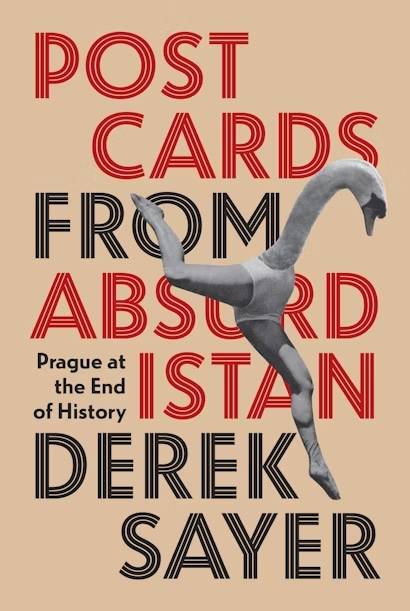
Postcards from Absurdistan is a cultural history of Prague from 1938, when the Nazis destroyed Czechoslovakia’s artistically vibrant liberal democracy, to 1989, when the country’s socialist regime collapsed after more than four decades of communist party rule. Derek Sayer shows that Prague’s twentieth century, far from being a story of inexorable progress toward some “end of history,” whether fascist, communist, or democratic, was a tragicomedy of recurring nightmares played out in a land Czech dissidents dubbed Absurdistan. Situated in the eye of the storms that shaped the modern world, Prague holds up an unsettling mirror to the absurdities and dangers of our own times.
In a brilliant narrative, Sayer weaves a vivid montage of the lives of individual Praguers—poets and politicians, architects and athletes, journalists and filmmakers, artists, musicians, and comedians—caught up in the crosscurrents of the turbulent half century following the Nazi invasion. This is the territory of the ideologist, the collaborator, the informer, the apparatchik, the dissident, the outsider, the torturer, and the refugee—not to mention the innocent bystander who is always looking the other way and Václav Havel’s greengrocer whose knowing complicity allows the show to go on. Over and over, Prague exposes modernity’s dreamworlds of progress as confections of kitsch.
In a time when democracy is once again under global assault, Postcards from Absurdistan is an unforgettable portrait of a city that illuminates the predicaments of the modern world.
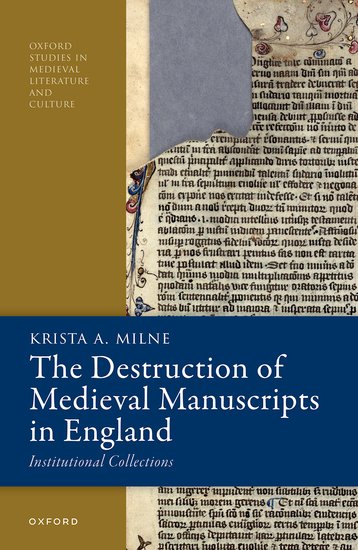
The Dissolution of the Monasteries (1536-40) is widely held as the single most significant event in England’s history of the destruction and loss of medieval manuscripts. Despite this consensus, the ultimate impact of the Dissolution – and of medieval manuscript destruction during the centuries that followed – remains unclear. How did Reformation-era losses compare to those which preceded the Reformation, and to those that followed it? How did the losses caused by sectarian conflicts compare to more quotidian kinds of loss, such as improper storage or deliberate de-acquisition? Which manuscripts were targeted, when were they targeted, and how should one account for the inevitably skewed record?
In The Destruction of Medieval Manuscripts in England, Krista A. Milne asks these questions to better understand literary taste, behavioural patterns, and the circulation of knowledge throughout the medieval period. Milne explores methods drawn from quantitative codicology to explore the most significant moments of manuscript loss in the history of England. The evidence suggests that this destruction was much more limited in its targets, but far more extensive in scope, than is usually acknowledged. Overwhelmingly, throughout the investigation, the manuscripts most at risk were those considered too new to qualify as antique but too old to be au courant. This pattern of destruction, which Milne describes as the principle of ‘age without vintage,’ remains apparent in many different domains today.
Worm-Time challenges conventional narratives of the Cold War and its end, presenting an alternative cultural history based on evolving South Korean aesthetics about enduring national division. From novels of dissent during the authoritarian era to films and webtoons in the new millennium, We Jung Yi’s transmedia analyses unearth people’s experiences of “wormification”—traumatic survival, deferred justice, and warped capitalist growth in the wake of the Korean War.
Whether embodied as refugees, leftists, or broken families, Yi’s wormified protagonists transcend their positions as displaced victims of polarized politics and unequal development. Through metamorphoses into border riders who fly over or crawl through the world’s dividing lines, they reclaim postcolonial memories buried in the pursuit of modernization under US hegemony and cultivate a desire for social transformation. Connecting colonial legacies, Cold War ideologies, and neoliberal economics, Worm-Time dares us to rethink the post-WWII consensus on freedom, peace, and prosperity.
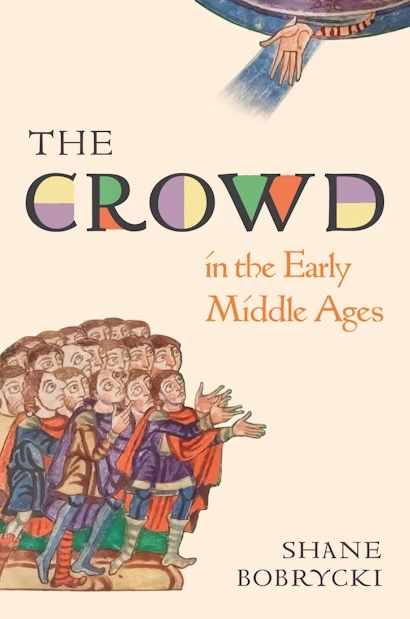
By the fifth and sixth centuries, the bread and circuses and triumphal processions of the Roman Empire had given way to a quieter world. And yet, as Shane Bobrycki argues, the influence and importance of the crowd did not disappear in early medieval Europe. In The Crowd in the Early Middle Ages, Bobrycki shows that although demographic change may have dispersed the urban multitudes of Greco-Roman civilization, collective behavior retained its social importance even when crowds were scarce.
Most historians have seen early medieval Europe as a world without crowds. In fact, Bobrycki argues, early medieval European sources are full of crowds—although perhaps not the sort historians have trained themselves to look for. Harvests, markets, festivals, religious rites, and political assemblies were among the gatherings used to regulate resources and demonstrate legitimacy. Indeed, the refusal to assemble and other forms of “slantwise” assembly became a weapon of the powerless. Bobrycki investigates what happened when demographic realities shifted, but culture, religion, and politics remained bound by the past. The history of crowds during the five hundred years between the age of circuses and the age of crusades, Bobrycki shows, tells an important story—one of systemic and scalar change in economic and social life and of reorganization in the world of ideas and norms.
Teaching a Dark Chapter explores how textbook narratives about the Fascist/Nazi past in Italy, East Germany, and West Germany followed relatively calm, undisturbed paths of little change until isolated “flashpoints” catalyzed the educational infrastructure into periods of rapid transformation. Though these flashpoints varied among Italy and the Germanys, they all roughly conformed to a chronological scheme and permanently changed how each “dark past” was represented.
Historians have often neglected textbooks as sources in their engagement with the reconstruction of postfascist states and the development of postwar memory culture. But as Teaching a Dark Chapter demonstrates, textbooks yield new insights and suggest a new chronology of the changes in postwar memory culture that other sources overlook. Employing a methodological and temporal rethinking of the narratives surrounding the development of European Holocaust memory, Daniela R. P. Weiner reveals how, long before 1968, textbooks in these three countries served as important tools to influence public memory about Nazi/Fascist atrocities.
As Fascism had been spread through education, then education must play a key role in undoing the damage. Thus, to repair and shape postwar societies, textbooks became an avenue to inculcate youths with desirable democratic and socialist values. Teaching a Dark Chapter weds the historical study of public memory with the educational study of textbooks to ask how and why the textbooks were created, what they said, and how they affected the society around them.
For his initial trips to the United States, Michel Foucault was often invited by French departments. His visits to SUNY Buffalo in 1970 and 1972, and the first of his multiple visits to the University of California, Berkeley in 1975 were all to French programmes. (He also visited McGill University in Francophone Canada in 1971.) Not only were these programmes with an interest in his work, initially he spoke in French, and when he did speak to an Anglophone audience – such as his 1975 talk to the Semiotext(e) conference in New York – it was with the aid of an interpreter. In time, his ability to speak in English would improve and he would lecture or discuss directly in that language.
Cornell University Sign, photograph by Claude-Étienne Armingaud, CC BY-SA 3.0 via Wikimedia Commons
Foucault also made a visit to Cornell University in 1972, and compared to those other visits to North America, less seems to be known of this. Daniel Defert, in the invaluable ‘Chronologie’ he contributed to Dits et écrits, says that Foucault visited in October 1972:
At the invitation of the Department of Romance Studies at Cornell University, he gives talks on “Knowledge in Sophocles’ Oedipus the King,” on “Literature and Crime,” and on “The Punitive Society.”
Foucault gave the lecture on Oedipus in multiple places, including in Paris in the course published as Lectures on the Will to Know, which also includes a manuscript on “Oedipal Knowledge”. The manuscript may be a development of the material presented in several visiting lectures, or alternatively their source. In his editorial material to the course, Defert says that there are six or seven versions of this lecture in Foucault’s files, now at the Bibliothèque nationale de France (NAF28730 box 59). It seems likely one of them is the Cornell version.
“The Punitive Society” is the title of a course Foucault would give in Paris in the 1972-73 academic year. That Foucault gave a lecture with this title in Cornell is interesting in part because it precedes the beginning of the Paris course on 3 January 1973 by a few months. The manuscript of the Cornell lecture is in Foucault’s archives, alongside the manuscript of the Paris course (NAF28730 box III, Cours 72-3, folder 8). I don’t know of plans to publish this, but it would have made an interesting addition to the reedition of the course, or would sit well with other material on this theme. I’m unaware of any manuscript of “Literature and Crime”, unless this is a description of the lecture on the Marquis de Sade. Foucault gave a lecture or two on Sade in a few places – beginning with Buffalo in 1970, Montreal in 1971 and Cornell in 1972. The Buffalo version was published in Language, Madness and Desire. Some materials from these lectures are in his archives (NAF28730 box 54, folder 5).
A few further clues come from the archives. Foucault’s personnel file at the Collège de France authorises his absence for this Cornell trip from 9-21 October 1972. A short manuscript with the title “Hatred of Literature”, with a note indicating Cornell in October 1972 is in the BnF archives (NAF28730 box 54, folder 6). I very briefly mention this in The Archaeology of Foucault (p. 208).
Marcelo Hoffman’s fascinating work with Foucault’s FBI files has shown that Foucault required visa ineligibility waivers in order to visit the United States. This was because of his “former membership in the French Communist Party” back in the 1950s. One of those authorisations, Hoffman indicates, and the one for which there are available records, was for the Cornell visit. The application, dated 20 September 1972, reads in part:
The subject wishes to visit the United States in order to accept an offer of the Department of Modern Languages of Cornell University to lecture for a four week period. He plans to arrive at New York via air from Paris on either September 26 or October 1, 1972.
The available FBI file on Foucault, page 5, is a response to this request, suggesting this visit is approved. Unfortunately, there does not seem to be any record of Foucault’s visit in the Cornell University archives, nor in campus newspapers. A request to the archivist there has not turned up any references to be explored.
So, we have the dates of the trip, and some indications of the topics of his lectures, with some of their manuscripts in Paris. But the order and date of the lectures, who invited him, who he met, and other details are, to me, still unknown. I have been unable to locate any correspondence about these visits, recordings or transcripts. We know much more about the Buffalo trips, certainly about his time in California, and – thanks to Hoffman and Heliana de Barros Conde Rodrigues – his visits to Brazil.
Daniel Defert, “Chronologie”, Dits et écrits, Paris: Gallimard, 1994, Vol I, 13-64; trans. Timothy O’Leary in Christopher Falzon, Timothy O’Leary and Jana Sawicki (eds), A Companion to Foucault, Oxford: Blackwell, 2013, 11–83.
Michel Foucault, Leçons sur la volonté de savoir: Cours au Collège de France, 1970-1971, suivi de Le savoir d’Œdipe, ed. Daniel Defert, Paris: Gallimard/Seuil, 2011; Lectures on the Will to Know: Lectures at the Collège de France 1970-71, trans. Graham Burchell, London: Palgrave-Macmillan, 2013.
Michel Foucault, “Conférences sur Sade”, La grande étrangère: À propos de littérature, ed. Philippe Artières, Jean-François Bert, Mathieu Potte-Bonneville and Judith Revel, Paris: Éditions EHESS, 2013, 145-218; “Lectures on Sade”, Language, Madness, Desire: On Literature, trans. Robert Bononno,Minneapolis: University of Minnesota Press, 2015, 93-146.
Fonds Michel Foucault, Bibliothèque nationale de France, NAF 28730
I’m grateful to Marcelo Hoffman for sharing a document from the FBI files, not available elsewhere.
Update 14 January 2025
Many thanks to Brian Rosa for sharing that Foucault stayed at Telluride House (the Cornell Branch of the Telluride Association, CBTA) during his visit to Cornell, and pointing to the following report from its newsletter:
Richard Klein, an assistant professor in the Romance Studies Department (he teaches French literature), is here after four years at Johns Hopkins University. He received his doctorate from and was an undergraduate at Cornell. (He commented with some amusement that during that time he applied to live at Telluride and was rejected.) He has, of course, been to France a number of times – it was there that he wrote his thesis on Baudelaire. In cooperation with Academic Affairs, he led a seminar on a selection of Michel Foucault’s work; this was done prior to Monsieur Foucault’s arrival, in the hope that we would not be totally ignorant of one of the most highly regarded men in France.
Foucault, professor of philosophy at the College de France, was a guest of Telluride for three weeks while he gave lectures for the Romance Studies Department. The author of Words and Things and Madness and Civilization. M. Foucault was perhaps insufficiently aware of our hopes of becoming better acquainted, and in addition had an extremely full academic and social schedule; as a result, some Branchmembers barely caught a glimpse of him.
Marilyn Migiel, “Resident Faculty, Full House Promise Good Year at CB”, Telluride Newsletter 60 (2), November 1972, 3.
Richard Klein has shared one story of Foucault’s visit with me, though not for publication.
Update 10 March 2025:
I’ve spoken to a second archivist at Cornell, but their more extensive search has not turned up any other records of the time, suggesting his visit was not widely publicised.
—
This is the second post of an occasional series, where I try to post short essays with some indications of further reading and sources, but which are not as formal as something I’d try to publish more conventionally. They are usually tangential to my main writing focus, a home for spare ideas, asides, dead-ends and possible futures. I hope there is some interest in them. They are provisional and suggestions are welcome. The other posts so far are:
Through examination of the death penalty in literature, Aaron Aquilina contests Heidegger’s concept of ‘being-towards-death’ and proposes a new understanding of the political and philosophical subject.
Dickens, Nabokov, Hugo, Sophocles and many others explore capital punishment in their works, from Antigone to Invitation to a Beheading. Using these varied case studies, Aquilina demonstrates how they all highlight two aspects of the experience. First, they uncover a particular state of being, or more precisely non-being, that comes with a death sentence, and, second, they reveal how this state exists beyond death row, as sovereignty and alterity are by no means confined to a prison cell.
In contrast to Heidegger’s being-towards-death, which individualizes the subject – only I can die my own death, supposedly – this book argues that, when condemned to death, the self and death collide, putting under erasure the category of subjectivity itself. Be it death row or not, when the supposed futurity of death is brought into the here and now, we encounter what Aquilina calls ‘relational death’. Living on with death severs the subject’s relation to itself, the other and political sociality as a whole, rendering the human less a named and recognizable ‘being’ than an anonymous ‘living corpse’, a human thing.
In a sustained engagement with Blanchot, Levinas, Hegel, Agamben and Derrida, The Ontology of Death articulates a new theory of the subject, beyond political subjectivity defined by sovereignty and beyond the Heideggerian notion of ontological selfhood.
I shared news of this reissue before. There is now a New Books network discussion with Morteza Hajizadeh. Thanks to dmf for this link.
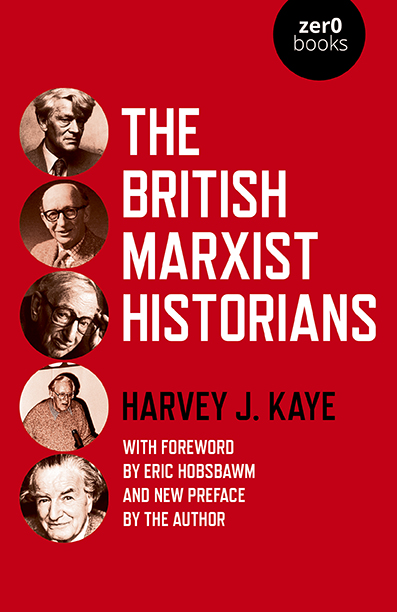
The British Marxist Historians remains the first and most complete study of the founders of one of the most influential contemporary academic traditions in history and social theory. In this classic text, Kaye looks at Maurice Dobb and the debate on the transition to capitalism; Rodney Hilton on feudalism and the English peasantry; Christopher Hill on the English Revolution; Eric Hobsbawm on workers, peasants and world history; and E.P. Thompson on the making of the English working class. Kaye compares their perspective on history with other approaches, such as that of the French Annales school, and concludes with a discussion of the British Marxist historians’ contribution to the formation of a democratic historical consciousness. The British Marxist Historians is an indispensable book for anyone interested in the intellectual history of the late twentieth century.
What we eat, who we are, and the relationship between the two.
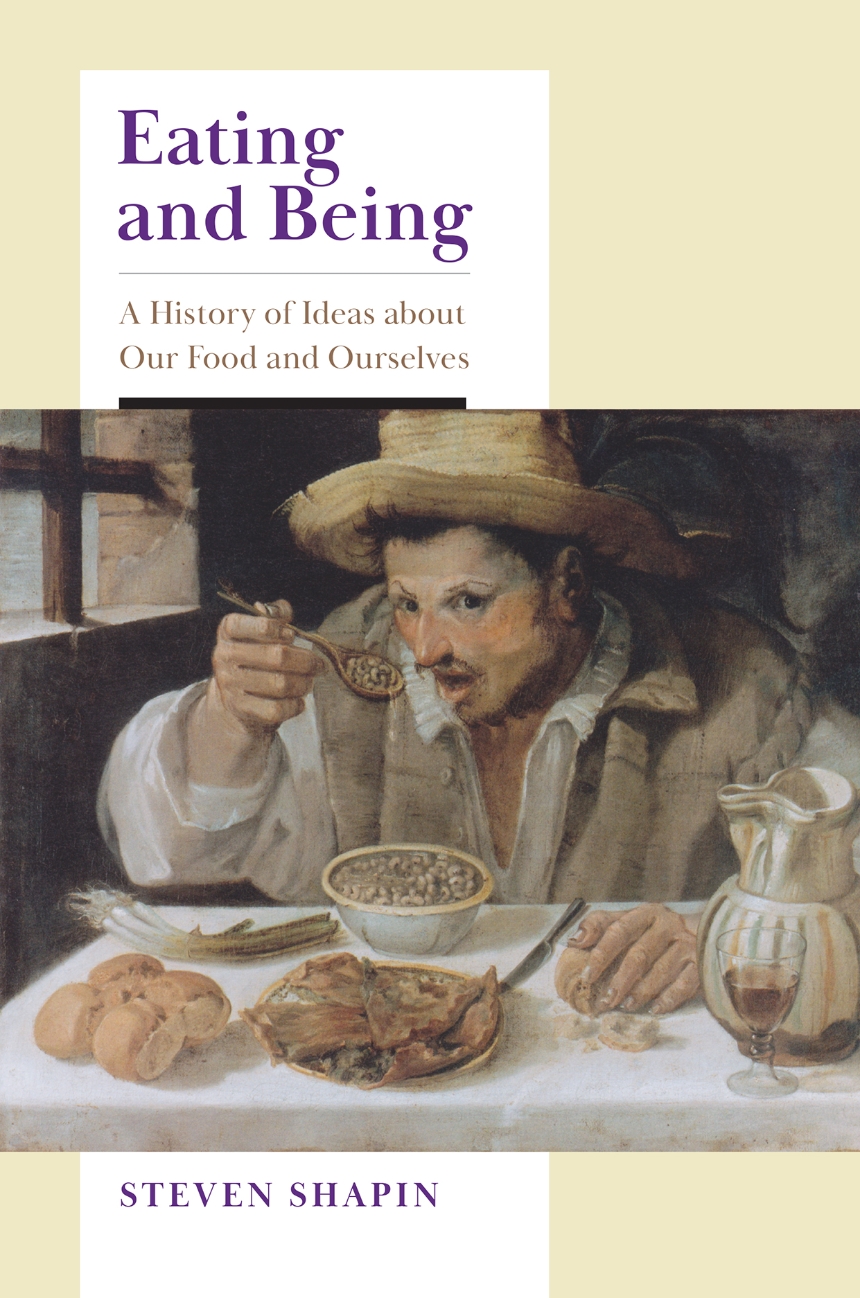
Eating and Being is a history of Western thinking about food, eating, knowledge, and ourselves. In modern thought, eating is about what is good for you, not about what is good. Eating is about health, not about virtue. Yet this has not always been the case. For a great span of the past—from antiquity through about the middle of the eighteenth century—one of the most pervasive branches of medicine was known as dietetics, prescribing not only what people should eat but also how they should order many aspects of their lives, including sleep, exercise, and emotional management. Dietetics did not distinguish between the medical and the moral, nor did it acknowledge the difference between what was good for you and what was good. Dietetics counseled moderation in all things, where moderation was counted as a virtue as well as the way to health. But during the nineteenth century, nutrition science began to replace the language of traditional dietetics with the vocabulary of proteins, fats, carbohydrates, and calories, and the medical and the moral went their separate ways. Steven Shapin shows how much depended upon that shift, and he also explores the extent to which the sensibilities of dietetics have been lost.
Throughout this rich history, he evokes what it felt like to eat during another historical period and invites us to reflect on what it means to feel about food as we now do. Shapin shows how the change from dietetics to nutrition science fundamentally altered how we think about our food and its powers, our bodies, and our minds.